
14 min 31 sec
Available in: English
Oxygen: The Molecule That Made the World
By Nick Lane
Explains why oxygen is both the gas that made complex life possible and a slow poison inside every cell, and how that double role shaped evolution, giant animals, antioxidants and aging.
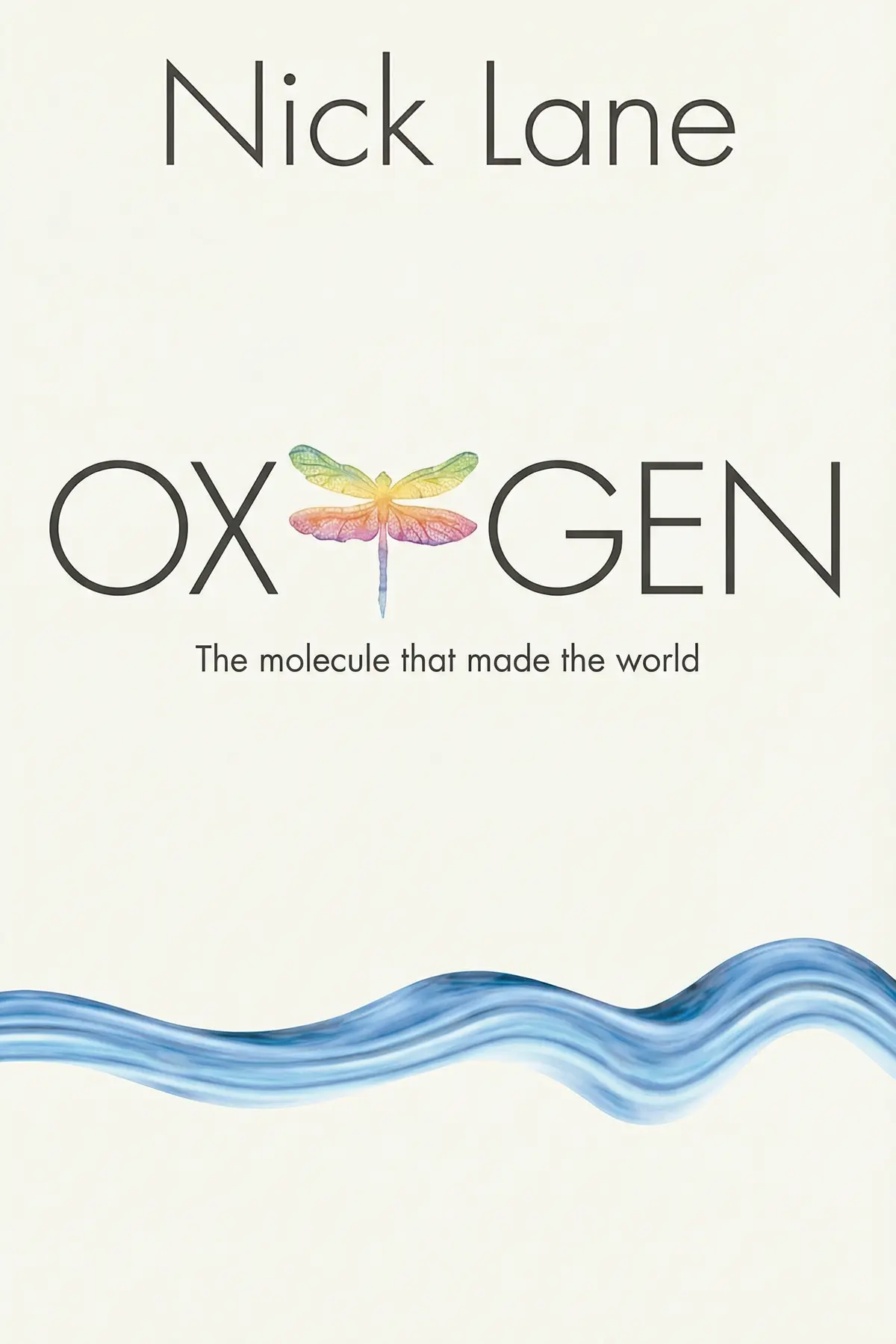
Table of Content
1. Introduction
1 min 00 sec
Most of us think of oxygen as the good part of the air, the gas we cannot live without for more than a few minutes. In Oxygen, biochemist Nick Lane argues that it is also a poison, and that every breath does, very slowly, the same basic damage as radiation.
That double nature runs through the whole book. Oxygen kept Earth’s oceans from draining away. It may have pushed single cells to join together and let dragonflies grow wings half a meter wide. It still limits how long animals live. Life had to defend itself against the gas it depends on, and those defenses shaped evolution.
Follow Lane’s argument and some ordinary things start to look different: a vitamin pill, the dead outer layer of your skin, a bat that outlives a mouse by many years. By the end, you can explain to anyone why the air that keeps you alive is also slowly wearing you down.
2. Discover how a toxic gas saved Earth's oceans
1 min 42 sec
The young Earth was slowly losing its water to space, and the gas that stopped the loss was lethal to the first living things. Here is how one molecule could be both rescuer and killer.
3. Crowding together may have built complex life
1 min 53 sec
Trapped single cells with nowhere to escape a toxic gas fall back on a surprising plan. That plan, and a frozen planet that thawed, may explain one of biology’s oldest puzzles.
4. Buried carbon reveals the air of giant insects
1 min 50 sec
English coal miners once dug up a dragonfly far too large to fly today. Working out why it could fly then meant measuring the air of a world gone for 300 million years.
5. Every breath works like slow radiation
1 min 56 sec
Marie Curie died from the force she helped discover. Lane argues that your lungs carry out a gentler version of the same chemistry all day, and that life’s answer to it came first.
6. More vitamin C is not automatically better
1 min 45 sec
Fruit is good for you, and most people can say why. The real chemistry is less tidy, and life’s other defenses against oxygen include one you are wearing right now.
7. Tell programmed aging from accumulated damage
1 min 40 sec
One nineteenth-century scientist thought yogurt could carry us to age 200. Modern explanations of aging split into two camps, and oxygen sits at the center of the argument between them.
8. Lifespan follows the toxins each breath makes
1 min 33 sec
A horse and a squirrel live very different lives yet share one surprising total. Then bats break the rule, and their exception points to what really sets the length of a life.
9. Conclusion
1 min 12 sec
Lane’s history of oxygen is the history of a bargain. The gas that kept the oceans from escaping into space is the same gas that strips electrons from our molecules every second. It may have pressed lonely cells into bodies, and it lifted half-meter dragonflies into the Carboniferous sky. Life never escaped that bargain. It learned to live with it: catalase before photosynthesis, dead skin over living tissue, cells that clump together, and tight control of vitamin C in the blood.
Seen this way, a few everyday things look different. Treat antioxidant claims with the same caution your body shows, since even vitamin C can cause harm at high doses. When someone talks about a fixed allowance of heartbeats, think of the bat that lives many years longer than a mouse burning energy at the same rate, and of the toxins that make the difference. And when you take a deep breath, you know what you are getting: energy for the next few minutes, and a very small share of the slow wear that eventually ends every life.
The air that made the world is still doing both of its jobs in every breath you take.
About this book
What is this book about?
We take oxygen for granted. It makes up about a fifth of the air, and without it we would die within minutes. Biochemist Nick Lane argues that this familiar gas has a darker side: it damages living molecules, and every breath causes a very slow version of the harm radiation does. Lane follows that double role through the history of life. Oxygen kept the early Earth from losing its water. It may have pushed single cells to band together and helped set off the Cambrian explosion. It may have let dragonflies with half-meter wingspans fly through Carboniferous air that held up to 35 percent oxygen. Living things survived it by building defenses: the antioxidant catalase, cells hiding inside other cells, and shields of dead cells like our own skin. Readers come away with a clear picture of why vitamin C can be risky at high doses, what the two main theories of aging say, and why a bat can live 20 years when a mouse with the same metabolic rate rarely lives past three.
Book Information
Who it's for
Intrigued by life's history
Curious readers who want to understand how one gas shaped the whole history of life.
Biology and chemistry students
Students of biology or chemistry looking for a big-picture story behind photosynthesis, antioxidants and evolution.
Into antioxidants and longevity
People who take antioxidant supplements or follow aging research and want the science behind the claims.
About the Author
Nick Lane
Nick Lane, born in 1967, is a British biochemist and writer who holds a professorship in evolutionary biochemistry at University College London. He studied biochemistry at Imperial College London, and his research asks how energy production in cells relates to the origin of life and the evolution of cells. Oxygen was published in 2002. Power, Sex, Suicide followed in 2005, and Life Ascending won the Royal Society's science book prize for 2010. In 2016 he received the Royal Society Michael Faraday Prize for communicating science.
Ratings & Reviews
Ratings at a glance

What people think
Listeners describe this scientific work as captivating and excellently composed, noting the thorough research evident throughout. The text offers an extensive look at the impact of oxygen on our planet's environment, bridging multiple scientific disciplines and proving especially useful for audiences with a technical background. They enjoy the compelling storytelling and insightful material, with one listener praising the smooth transition from geology to biology to chemistry. Furthermore, listeners appreciate the book's medical perspectives, including one who specifically mentioned the analysis of oxidative stress in disease and aging.
Top reviews
Rodrigo
Nick Lane has a gift for making the invisible visible. This isn't just a book about a gas; it's an epic biography of the molecule that forced life to grow up. Lane transitions seamlessly from the geochemical origins of our planet to the complex machinery of our own cells. To be fair, the biochemistry is dense. You might find yourself re-reading paragraphs about the Krebs cycle or free radicals just to keep your head above water. However, the payoff is immense. Seeing how oxygen acted as both a catalyst for evolution and a ticking clock for our own aging process changed my perspective on biology. It’s a demanding read that treats the reader with intellectual respect. Truly a masterpiece of scientific synthesis.
Show moreMia
Finally got around to this classic of popular science and it did not disappoint. The way Lane connects the “Great Oxidation Event” from billions of years ago to the way our bodies manage energy today is nothing short of masterful. It is fact-dense and meticulously researched, covering everything from the ozone layer to the Hayflick limit. I loved the rugby-metaphor for chlorophyll; it finally made the movement of electrons during photosynthesis click for me! While some of the genetics info feels slightly dated given it was originally written in 2002, the core thesis holds up beautifully. It's a foundational text for anyone interested in why complex life exists at all and how it eventually fails.
Show moreChiw
Wow, this book totally reframed how I look at the world around me. Most people think of oxygen as just something we breathe, but Lane shows it’s the engine of every major transition in Earth's history. I picked up the 2021 updated version and the depth of research is just mind-blowing. The book covers so much ground: mass extinctions, the rise of complex ecosystems, and the very nature of mortality. Not gonna lie, I had to Google a few terms every couple of pages, but that’s part of the fun of reading a book that doesn't talk down to you. It’s a provocative, brilliant piece of writing that manages to make biochemistry feel as exciting as a thriller.
Show moreLeah
Not many authors can weave together paleontology and gerontology without losing the thread, but Lane pulls it off. Oxygen is presented as the ultimate double-edged sword, driving both the evolution of life and its eventual decay. The level of detail regarding free radicals and antioxidant myths was particularly eye-opening for me. It’s a meticulously researched volume that feels like a labor of love. While the dense biochemistry might be off-putting for some, the insights into aging and metabolic throughput are worth the effort. It’s a thought-provoking deep dive that makes you realize just how lucky—and precarious—our existence really is. Truly a stellar piece of science writing that stands the test of time.
Show moreKru
Ever wonder why we're told to eat antioxidants like they're a magic shield? Lane's exploration of oxidative stress is a masterclass in debunking health fads using actual science. He explains how oxygen is both our greatest ally and our most persistent enemy, slowly “rusting” us from the inside through free radical damage. I found the chapters on the evolution of complex body plans to be the most impactful, even if the chemistry was a bit terrifying. The writing is sharp and evocative, though it does get bogged down in the minutiae of electron transfer chains. It's a brilliant synthesis of medicine and evolutionary history that demands your full attention, providing insights you won't find in standard textbooks.
Show moreArjun
As someone with a background in the life sciences, I found this to be one of the more rigorous “pop” books out there. Lane doesn't shy away from the gritty details of bioenergetics. Truth is, if you don't know your ATP from your ADP, you might struggle with the middle sections. The book effectively bridges the gap between disparate fields like geology and gerontology, which is a rare feat. I particularly appreciated the nuanced discussion on LUCA and how oxygen constrained the size of early animals. It’s not a light summer read, and Lane’s iconoclastic style can be polarizing, but it’s incredibly rewarding for those willing to put in the mental gym time.
Show moreNutnicha
The central paradox of oxygen—that it sustains us while simultaneously burning us from the inside out—is explored with incredible nuance here. I was fascinated by the idea that oxygen is essentially a toxin that we learned to harness. Lane’s prose is elegant, even when he’s diving deep into the architecture of mitochondria and the vulnerabilities of human tissues. The section on how oxygen levels influenced the size of prehistoric insects was a particular highlight for me. My only real gripe is the pacing; the book starts strong, gets very bogged down in chemistry in the middle, and then picks up again towards the end. It’s an essential read for science nerds, but perhaps too heavy for a casual enthusiast.
Show moreTen
Picked this up on a whim and was surprised by how much ground Lane covers. It’s really two books in one: a deep history of the planet and a medical exploration of human health. The transition from the “rusting” of the early Earth to the development of diabetes and Alzheimer’s in humans is surprisingly logical under Lane's guidance. I did find some of the stuff about “junk DNA” a bit off-base compared to more recent epigenetics findings, but that’s expected for a book that started in the early 2000s. To be fair, Lane admits when he’s speculating, which I appreciate. It’s a thick, meaty read that rewards those who stick with it through the tougher chemical chapters.
Show moreRohan
Look, there is no denying the author's brilliance, but the level of conjecture here is staggering. Lane frequently argues from “intriguing” rather than “compelling” evidence, which makes it hard to know where the consensus ends and his own theories begin. For a general reader, this lack of a clear boundary can be confusing and misleading. He challenges the standard textbook narratives—which I usually love—but sometimes he reinstates the very intuitions he just spent ten pages disparaging. The content on free radicals and their link to chronic disease is fascinating, but it should be taken with a grain of salt. It’s a polarizing book that is as frustrating as it is enlightening.
Show moreGift
Frankly, this was a slog despite the fascinating premise. Lane is clearly an expert, but he has a disconcerting tendency to veer into highly speculative territory without providing enough conventional context for a layperson. I found the sections on “junk DNA” particularly shaky, and some of the medical claims regarding Alzheimer's felt like they were overreaching based on thin evidence. The book is marketed to a general audience, yet you almost need a degree in biochemistry to follow the more intricate arguments about redox potential. If you enjoy the process of scientific inquiry and don't mind a lot of unproven theories, you might like this. Personally, I found it too disheartening to finish because of the technical humps.
Show moreQuestions about this book
What is the main idea of Oxygen by Nick Lane?
Lane argues that oxygen is both essential and toxic. It kept the early Earth from losing its water, may have pushed cells to become multicellular and allowed giant insects to fly. It also damages living molecules through oxidation. Life survived by building defenses such as antioxidants, and Lane links the leftover damage to aging and to how long different animals live.
Why does Nick Lane compare breathing to radiation?
Radiation breaks water into hydrogen and oxygen and creates highly toxic intermediate molecules along the way, such as the hydroxyl radical. When our cells turn oxygen into water during breathing, the same intermediates appear. Lane therefore describes breathing as a very slow form of oxygen poisoning that is the same in its basic effect as radiation damage.
Is vitamin C always good for you according to Oxygen?
Not without limits. Vitamin C is essential, and too little causes scurvy. But in the presence of oxygen and iron it can act as a pro-oxidant and speed up oxidation. Lane notes there is little evidence this happens much in people, yet the body tightly controls vitamin C in the blood, and he cites a reported fatal case linked to a year of high doses.
Why were insects so large in the Carboniferous period?
Lane links them to oxygen. Researchers Jon Harrison and John Lighton found that dragonflies fly more easily in air rich in oxygen. Geochemists Robert Berner and Donald Canfield estimated, from the amount of buried organic carbon, that Carboniferous air held up to 35 percent oxygen. That richer air could have let half-meter dragonflies and meter-long scorpions thrive.
What does Oxygen say about aging and lifespan?
Lane favors the view that aging is wear and tear caused by a lifetime of oxygen poisoning, while granting that the truth may lie between that view and genetic programming. Across animals, lifespan tracks lifetime oxygen use, but bats outlive mice with the same metabolic rate. Lane’s explanation is that bats produce fewer toxins as they breathe.
Readers also enjoyed


A Life Decoded: My Genome: My Life
J. Craig Venter

A Planet of Viruses
Carl Zimmer

A Short History of Nearly Everything
Bill Bryson

A Thousand Brains: A New Theory of Intelligence
Jeff Hawkins




Alien Earths: The New Science of Planet Hunting in the Cosmos
Lisa Kaltenegger

AUDIO SUMMARY AVAILABLE
Listen to Oxygen in 15 minutes
Get the key ideas from Oxygen by Nick Lane, plus 5,000+ more nonfiction titles.
- 5,000+ titles
- Listen as much as you want
- 7-day free trial
- Cancel anytime









