

11 min 48 sec
Available in: English
Oversubscribed: How to Get People Lining Up to Do Business with You
Shows how a business can escape crowded markets by owning a niche, making its offer feel limited and personal, and building a list of customers who wait eagerly for each new release.
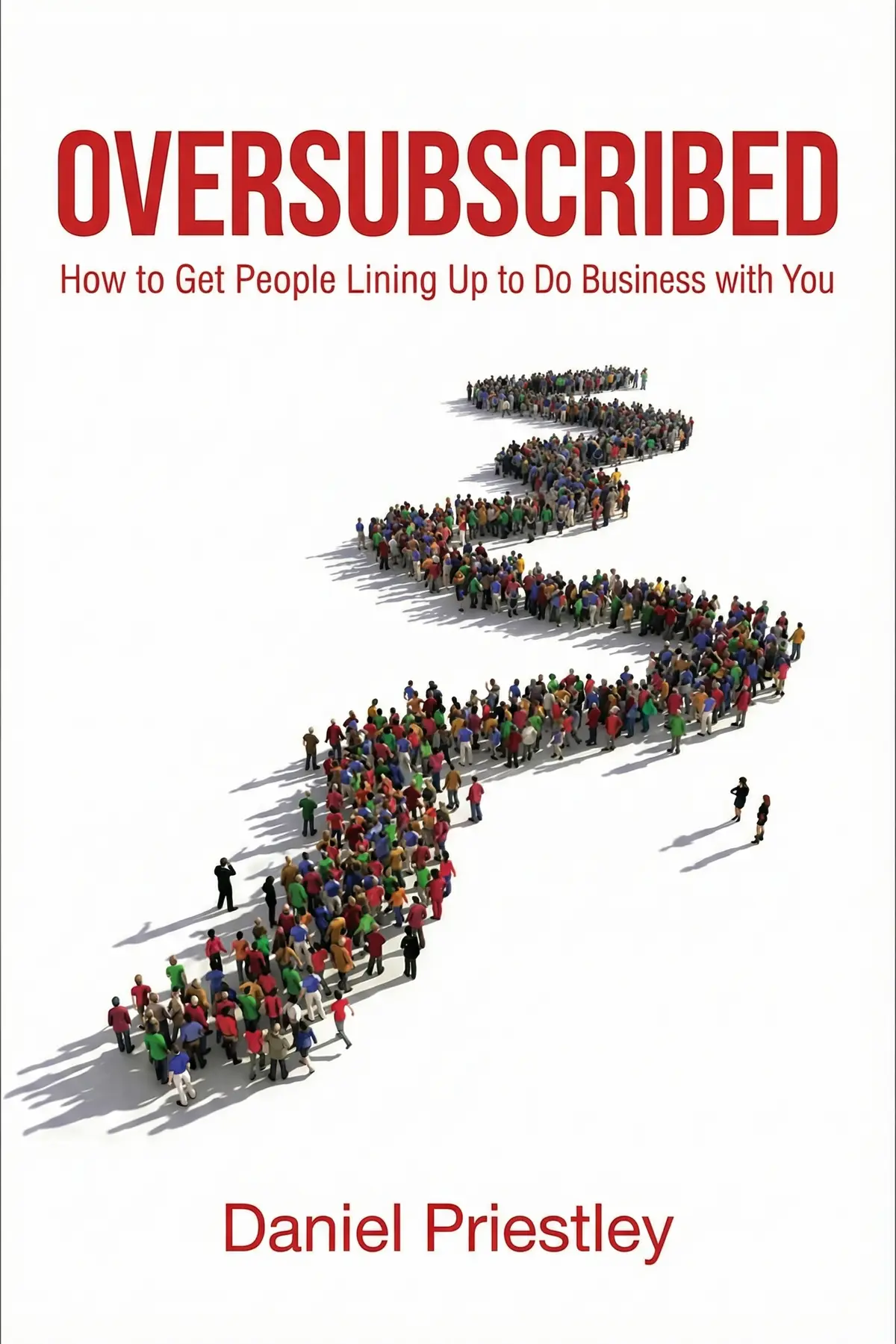
Table of Content
1. Introduction
57 sec
When a market is crowded, the instinct is to shout louder than everyone else, and most small businesses lose that contest. In Oversubscribed, entrepreneur Daniel Priestley argues for the opposite move: build a business where more people want what you sell than you can serve, so buyers line up instead of being chased. He turns the schoolbook rule around. Supply and demand becomes demand and supply, and a shortage becomes a sign of strength.
His case runs through sold-out phone launches, a Paris luxury counter that serves one person at a time and a music festival that clears its early tickets in minutes. The thread is simple. Own a small corner of the market, make buying feel special, let customers do the selling, and keep them waiting for what comes next. By the end, there is a working plan for turning a quiet business into one with a waiting list.
2. Make demand outrun supply in a corner you own
1 min 43 sec
A queue outside a store can look like poor planning. Priestley sees it as the best thing that can happen to a business, and a group of 1980s surgeons shows how quickly that advantage can disappear.
3. Stand apart by being newer, easier or cheaper
1 min 45 sec
Some products face no rivals at all, while others beat famous store chains without inventing anything. Priestley names the routes to that kind of edge, and the old tool that keeps customers from wandering once competitors arrive.
4. A calm line beats a loud pitch
1 min 30 sec
A street vendor shouts bargains all day and sells little. A Paris store barely advertises and has a queue every day. The difference says a lot about how people decide what they want.
5. Turn happy customers into your sales team
1 min 35 sec
A camera ad can promise brilliant photos, but buyers have stopped listening to promises like that. Priestley explains whose voice they trust instead, and how a small music blog could grow into a record label.
6. Build a waiting list before you launch
1 min 33 sec
Hundreds of thousands of people chase a far smaller number of tickets every year, and they signed up to do it. Priestley shows how advance notice creates that rush and what it tells a business in return.
7. Write updates that people actually open
1 min 37 sec
A newsletter full of jokes seems like an easy way to stay friendly with customers. Priestley thinks it usually backfires, and a simple rule borrowed from a store workshop shows where the balance should sit.
8. Conclusion
1 min 08 sec
Priestley’s book adds up to a change of posture. Instead of chasing buyers through a crowded market, you arrange things so that they come to you, and sometimes have to wait. Scarcity, in his view, is something to design. It works best when the offer stands out in some way, whether newer, easier or cheaper than what else is on the shelf.
The practical steps are modest. Give people a list to join before your next launch, and watch which option they ask about most. Send them material that helps them decide, mostly teaching with a little fun. After a good experience, ask customers how you improved their lives, and pass those answers on in their own words.
Priestley also offers an exercise for deciding what comes next. Imagine money was no limit and ask what would excite you most about your business, perhaps a large interactive campaign across several social platforms. Then shrink that idea until it fits the budget you really have. If it excites you, there is a fair chance your customers will enjoy it too.
A line outside the door is the one advertisement nobody has to pay for.
About this book
What is this book about?
Most markets are so full of choices that a new product can disappear without a trace. The usual reaction is to spend more on advertising and compete head on with much bigger rivals. Daniel Priestley argues for a different aim: build a business where more people want what you sell than you can supply. He calls that state oversubscribed, and he treats it as healthy rather than as a problem. Priestley shows how to get there and stay there. A business needs a niche of loyal buyers and a clear edge, whether it is newer, easier or cheaper than the alternatives. It makes buying feel exclusive, the way a Paris luxury counter serves one customer at a time. It lets satisfied customers spread the word, signals upcoming releases to people who have signed up, and keeps them engaged with content that teaches more than it jokes. Readers get a practical way to think about demand, from collecting customer stories to opening a sign-up list before a launch, with examples that range from champagne to a sold-out music festival.
Book Information
Who it's for
Founders and business owners
Founders and small business owners tired of competing on price and ad spend with bigger rivals.
Freelancers and consultants
Freelancers and consultants who want clients asking for them instead of the other way around.
Marketers planning a launch
Marketers planning a launch who want a sign-up list and content people actually read.
About the Author
Daniel Priestley
Daniel Priestley is an entrepreneur who has built and sold several businesses. He founded Dent Global, an accelerator that helps entrepreneurs and leaders grow, and cofounded the marketing software platform ScoreApp along with the AI startups BookMagic and AwardsApp. His other books on entrepreneurship include Key Person of Influence and 24 Assets, and he co-authored What's Your Business Worth? and How to Raise Entrepreneurial Kids.
Ratings & Reviews
Ratings at a glance

What people think
Listeners find this work deeply insightful, with one listener noting that it offers excellent guidance on positioning a business for achievement. Furthermore, the content is easy to digest and listeners believe it is well worth the investment. They also value the practical nature of the material, with one listener specifically pointing to effective strategies for growing a subscriber base, and describe the experience as motivating, with one individual sharing how it introduced them to entirely new viewpoints.
Top reviews
Pierre
Ever wonder why some businesses have lines around the block while you’re scrambling for a single lead? Priestley lays out a blueprint for shifting from a "chase" mentality to an "attract" strategy that actually feels sustainable. I particularly loved the breakdown of signaling interest rather than just begging for a sale; it makes the whole process feel much more dignified for both parties. While he mentions high-end brands like Rolex and Apple a bit too frequently for my taste, the underlying logic of creating an ecosystem is sound. It’s a very readable guide that moves beyond fluff into genuine, actionable tactics for any entrepreneur. I finished it feeling significantly more inspired to overhaul my current marketing campaigns.
Show moreLevi
The chapter on the 7-hour rule is arguably one of the most brilliant things I’ve read in a business book this year. It explains why we fail when we try to force a sale too early and how to build that necessary trust through content and connection. Priestley’s philosophy of "giving away ideas and charging for implementation" is exactly what the modern digital market demands. It’s an easy, fast-paced read that doesn't get bogged down in overly academic jargon, which I really appreciated. Some might find his tone a little self-congratulatory, but when the results of these methods are so clear, it’s hard to stay mad at him. This is a must-read if you want to stop competing on price and start competing on value.
Show moreWararat
Wow, Priestley really nailed the psychology of why people want what they can't have. This isn't just another boring manual on SEO or social media; it’s a deep dive into creating a market where you are the only logical choice for your specific tribe. I’ve spent years chasing every lead that came my way, but this book taught me that being "overbooked" is a choice you make through better positioning. The sections on treating existing customers as your best marketers were particularly eye-opening. Not gonna lie, I was skeptical at first because it sounds like typical business guru talk. However, the tactical advice on building a "product-for-prospects" to filter your audience is worth its weight in gold.
Show moreRotjanee
This book changed how I view the entire concept of sales. Instead of seeing it as a battle to convince someone, I now see it as a process of inviting the right people into an exclusive club. The emphasis on "continuity" and having an online profile that shows your journey over years is so relevant for today’s social-media-driven landscape. I loved the breakdown of the five ingredients for becoming oversubscribed, especially the bit about having a "consistent and repetitive message." It reminded me a lot of Donald Miller’s StoryBrand but with a more aggressive focus on the logistics of demand. It's inspiring, actionable, and arguably the most useful business book I've bought in the last five years.
Show moreHang
After hearing several peers rave about Priestley's methods, I decided to see if the reality lived up to the hype. It does. The book offers a refreshing take on why we should lean into the "discomfort" of having too much work to do rather than trying to please everyone. The distinction between a "lifestyle business" and a "performance business" was a crucial takeaway for me as I plan my next three years. It’s highly readable and provides clear steps on how to register interest and move people through a low-risk first step. While it lacks some of the deep case studies I usually prefer, the sheer volume of "lightbulb moments" makes it a five-star recommendation. It's a fantastic compass for anyone feeling lost in the commodity trap.
Show moreSukit
Picked this up after several colleagues recommended it as the ultimate guide to business positioning. The concept of the "Campaign Driven Enterprise" is a total game-changer for those of us tired of the daily grind of one-off sales. Truth is, most business books are 300 pages of fluff, but this one provides a specific map for building a tribe of loyal followers. I appreciated the advice on "naming your terms" and having the courage to say no to the wrong clients to make room for the right ones. My only gripe is that it can get a bit repetitive regarding the title's core premise. However, the insight on "cooking a great steak" while letting customers provide the sizzle is worth the price alone.
Show morePick
As someone who has struggled to scale my service-based business, this book provided a much-needed perspective shift on capacity and demand. It isn't just about marketing; it’s about how you structure your entire commercial ecosystem to handle growth without burning out. The idea of "signaling" your intentions months in advance was a lightbulb moment for me. I’ve already started drafting my next campaign based on the steps outlined in the middle chapters. Admittedly, the caricatures and diagrams are a bit primitive, and the author does repeat his core buzzwords a lot. But if you can look past the slightly "salesy" tone, the actual framework for building a "lifestyle business" is incredibly practical. It’s definitely helped me rethink how I present my brand to the world.
Show moreOoi
Finally got around to reading this, and I’m kicking myself for not picking it up sooner. The writing style is punchy and direct, which made it easy to fly through over a weekend. It focuses heavily on the idea that your value is significantly higher to a small, dedicated group than to a massive, indifferent market. I found the advice on "exposing the problem of too much demand" to be a very clever psychological trick that I'm eager to test. Some of the examples using Nike or Branson feel a bit ubiquitous and overused in this genre, but they do illustrate the points well. Overall, it’s a solid 4-star read that offers a lot of "gold nuggets" for anyone looking to increase their influence and reach.
Show moreHazel
Look, I have mixed feelings about this one because the tone frequently veers into that "get rich quick" territory that makes me cringe. The author spends a lot of time talking about his own success and his first baby boy, which felt a bit irrelevant to my business needs. That said, I can't deny that the core principle of building a "Commercial Ecosystem" with different price tiers is smart. There’s a decent amount of "snake oil" energy here, especially with the use of words like "magical." But if you filter out the fluff about Ferraris and beach holidays, there are actually some useful tips on campaign timing. It’s an okay read if you’re brand new to marketing, but seasoned pros might find it a bit thin on actual data.
Show moreJai
To be fair, I found this remarkably light on substance and quite disappointing given the hype. It often felt like the entire book was designed as a sophisticated lead generator for the author’s own coaching programs rather than a standalone educational tool. He borrows heavily from existing concepts like the Net Promoter Score (NPS) without offering much in the way of original attribution or deep case studies. The frequent name-dropping of billionaires and luxury car brands felt like a cheap attention-seeking technique straight out of an MLM playbook. There are some okay ideas here regarding exclusivity and scarcity, but you could find the same information in a twenty-minute blog post. If you are a freelancer looking for real tactics, I'd suggest looking elsewhere.
Show moreQuestions about this book
What is the main idea of Oversubscribed by Daniel Priestley?
Priestley argues that a business does best when more people want its products than it can supply. Instead of fighting giants in a crowded market, it should own a niche with loyal buyers and a clear edge: something newer, easier or cheaper. It then makes buying feel exclusive, lets happy customers spread the word and keeps subscribers engaged, so demand stays ahead of supply.
What does oversubscribed mean in business?
In Priestley’s use, a business is oversubscribed when demand exceeds supply, so buyers outnumber the products or places available. He sees this as a strong position. Examples in the book include iPhone launches that sell out before release and the Glastonbury Music Festival, where 350,000 subscribers compete for 120,000 early-bird tickets that are gone within minutes.
How can a small business create demand like Oversubscribed describes?
The book suggests several moves. Give customers a special, personal experience, as the one-customer-at-a-time Chanel counter in Paris does. Collect their stories with a questionnaire and share them online. Open a sign-up list for updates before a release, which builds anticipation and shows which products people want. Then keep subscribers engaged with useful content rather than empty jokes.
What is the 80-20 rule for content in Oversubscribed?
Priestley recommends that content be mostly informative, with entertainment as a small share. He compares it to an in-store workshop meant to raise a business’s local profile: a couple of jokes are fine, but humor should take up no more than 20 percent of the time. The goal is a clear brand whose updates readers know what to expect from.
Who should read Oversubscribed?
It suits entrepreneurs, small business owners and independent professionals who feel lost in a crowded market and want customers seeking them out. It is especially useful for anyone preparing a launch, building an email list or trying to turn satisfied customers into a source of new business through reviews and testimonials.
Readers also enjoyed



7 Powers: The Foundations of Business Strategy
Hamilton Helmer





Alibaba: The House That Jack Ma Built
Duncan Clark

AUDIO SUMMARY AVAILABLE
Listen to Oversubscribed in 15 minutes
Get the key ideas from Oversubscribed by Daniel Priestley, plus 5,000+ more nonfiction titles.
- 5,000+ titles
- Listen as much as you want
- 7-day free trial
- Cancel anytime









