

14 min 53 sec
Available in: English
On Being and Becoming: An Existentialist Approach to Life
Shows how existentialist thinkers from Nietzsche to Beauvoir and Heidegger turned the anxiety of having only one life into a practice of freedom, and how to live authentically toward yourself, other people and nature.
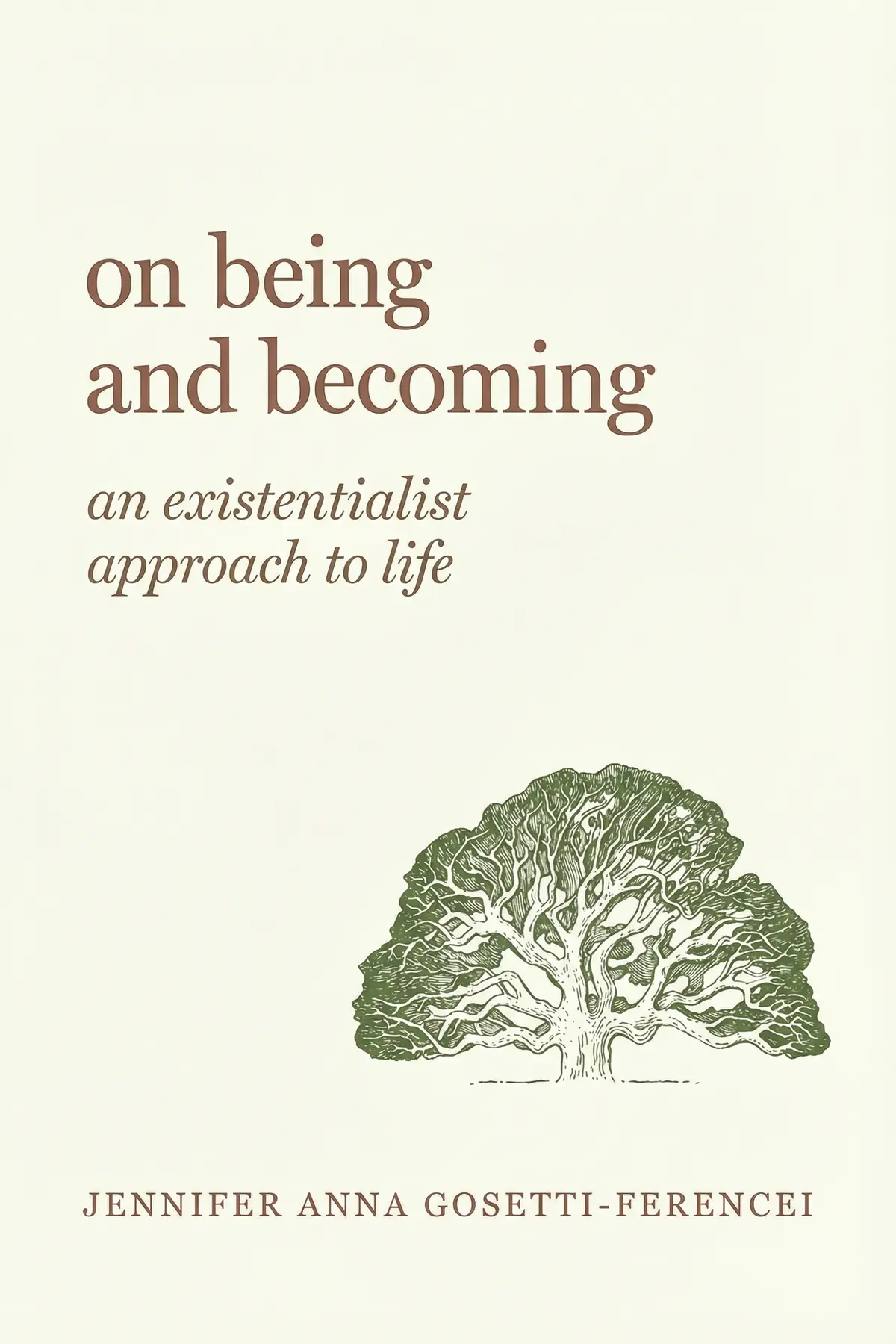
Table of Content
1. Introduction
1 min 03 sec
If you worry that today’s choices might waste the only life you get, existentialism treats that worry as the place where real thinking starts. In On Being and Becoming, Johns Hopkins philosopher Jennifer Anna Gosetti-Ferencei shows how the movement reversed an idea as old as Plato: humans have no fixed nature, only a constant process of change, which makes us free and responsible for who we become.
From that reversal comes her picture of an authentic life, faced honestly in three directions: toward yourself, toward other people and toward the natural world. Each direction has a trap. We hide in habit and the crowd, we turn people into objects, and we treat the earth as a warehouse. What follows shows how to spot each trap in an ordinary day, from a packed train to a post office counter, and ends with a test Nietzsche devised for deciding what in your life to change.
2. Answer the big questions from where you stand
1 min 51 sec
Picture existentialism and you probably see Paris cafés and cigarette smoke. The movement actually began earlier and reached wider, and its shared starting point puts a demanding responsibility back in your own hands.
3. Stop treating your identity as a finished thing
1 min 51 sec
For two and a half millennia, philosophers trusted what never changes and distrusted everything that moves. The existentialists noticed that this view leaves out the very people doing the thinking, and they turned it upside down.
4. Dread can push you toward a fuller life
1 min 49 sec
A sudden wave of despair about your childhood dreams feels like something to escape. Existentialists, unlike the Stoics, suggest a different response, and Heidegger ties it to the one fact almost everyone avoids thinking about.
5. Break the habits that make your choices for you
1 min 51 sec
Applause can spread through an audience before anyone has decided to clap. Nietzsche saw his whole era behaving that way, and the existentialists argue that routine is where we hide from a freedom we would rather not face.
6. See the person behind the post office counter
1 min 52 sec
Descartes once wondered whether the people passing his window were machines in hats and coats. Sartre turned that odd doubt into a way of seeing how ordinary encounters, and one very common emotion, can shrink a person.
7. Your moods shape the world you see
1 min 44 sec
Camus described moments when the world goes silent and strange. A warm spring morning and a single apple suggest that the border between you and your surroundings is much harder to locate than it seems.
8. A poet's ear can repair our bond with nature
1 min 47 sec
Leveled mountains and oceans full of plastic look like problems for engineers rather than philosophers. Heidegger traced them to a habit of mind, and he found an unexpected remedy in the way people listen to verse.
9. Conclusion
1 min 05 sec
What the book finally offers is a single stance applied three times. The existentialists name three basic kinds of being: the self, other people and the world. Each can be met as a fixed object or as something alive with possibility, and authenticity means choosing the second, again and again.
Toward yourself, that means refusing to fuse with any one image of who you are and staying awake to the fact that you choose. Toward others, it means granting them the freedom you would insist on for yourself, from the people you love to the clerk stamping your letters. Toward nature, it means recovering some of the wonder and mystery it once stirred in us, instead of seeing a supply depot.
Nietzsche left a tool for checking where you stand, which he called the eternal return. Imagine learning that you must live your life again exactly as it has been, over and over, forever. Before agreeing, notice what you would change. The parts you would rewrite are where your freedom is waiting, and the parts you would gladly repeat are already yours.
About this book
What is this book about?
Most of us know we only get one life, and that knowledge can become a low hum of anxiety about whether today's choices are the wrong ones. Existentialism, Jennifer Anna Gosetti-Ferencei argues, begins exactly there. It pulls philosophy away from abstract theory and back to the individual who has to decide how to live. She traces the movement past its famous Paris image to Nietzsche and Kierkegaard in the nineteenth century, to the phenomenologists Husserl and Heidegger, and to the novels of Dostoevsky and Kafka. The idea uniting them is a reversal of Plato: humans have no fixed being, only becoming, so they are free and responsible for who they turn into. From that idea she draws an authentic way of living in three directions. Toward yourself, it means facing dread and breaking with the crowd. Toward others, it means following Beauvoir and Sartre in refusing to treat people as objects. Toward nature, it means adopting Heidegger's poetic stance instead of seeing the earth as raw material. Readers get a clear map of existentialism and a set of tests to try on their own lives.
Book Information
Who it's for
Professionals running on habit
Professionals who sense their days running on habit and want a framework for choosing differently.
Facing decisions or despair
People facing a big decision or a bout of despair about unmet dreams who want to use that discomfort instead of numbing it.
Curious about existentialism
Curious readers who want a clear, practical way into Sartre, Beauvoir, Heidegger and Nietzsche.
About the Author
Jennifer Anna Gosetti-Ferencei
Jennifer Anna Gosetti-Ferencei is Professor of Philosophy at Johns Hopkins University, where she also holds the Kurrelmeyer Chair in German, and she has taught at Oxford, Birmingham and Fordham. She earned a DPhil at Oxford, a PhD in Philosophy at Villanova and an MFA in Poetry at Columbia. Her research spans existentialism, phenomenology, the philosophy of literature and aesthetics. Her other books include The Life of Imagination, and her poetry collection After the Palace Burns won The Paris Review Prize.
Ratings & Reviews
Ratings at a glance

What people think
Listeners find that while perspectives differ on whether this work is a pragmatic handbook or a historical critique, most agree it provides an engaging and accessible overview of existentialist philosophy. They appreciate how the author contrasts various thinkers like Nietzsche, Sartre, and Beauvoir to examine concepts of freedom and authenticity. Furthermore, listeners value the way philosophical ideas are applied to contemporary life; one listener specifically notes that the analysis of identity in the "I selfie, therefore I am" chapter is very relevant. Additionally, they mention that the text effectively grounds abstract theories in daily challenges, such as navigating mass culture and making difficult personal decisions.
Top reviews
Tan
Finally got around to reading a philosophy book that actually makes me feel something about my own life choices. The highlight for me was the exploration of Nietzsche’s 'eternal return' as a practical thought experiment for testing authenticity. It’s a haunting question: would you live this exact life over and over again forever? That kind of framing makes the abstract concept of freedom feel heavy and real. I loved how the author included literary figures like Dostoevsky alongside the heavy hitters like Sartre. It makes the movement feel like a living conversation rather than a dead academic subject. Look, it’s not always an easy read, but the payoff for sticking with the denser chapters on the self and the other is immense. Truly inspiring stuff for anyone in a growth mindset.
Show moreRung
Wow, Gosetti-Ferencei has managed to synthesize a massive range of thinkers without losing the core human message of what it means to live well. This isn't just a history of a movement; it’s a call to action to stop treating the world as a resource and start seeing it as a space of possibility. The way she links the eternal return to our modern obsession with identity is masterfully done. I felt truly free to explore my own beliefs while reading, as the text never dictates one 'right' way to be. Instead, it offers a map of the landscape and lets you choose your own path. It’s a beautiful, challenging, and ultimately rewarding book that I’ll be coming back to for years. A must-read for any modern seeker.
Show moreRotjanee
This book manages a tricky balancing act by bridging the gap between rigorous historical analysis and practical application. Gosetti-Ferencei doesn't just list what Nietzsche or Sartre said; she asks what their ideas mean for us when we're staring at our phones or feeling lost in a crowd. The chapter 'I selfie, therefore I am' was a particular standout for me because it applies the concept of the 'look' to our modern digital performances. Personally, I found the writing to be accessible, though there were moments where the academic terminology felt a bit thick. If you want to understand how existentialism can actually shape your daily choices rather than just staying as an abstract theory, this is a great place to start. It reorients the big questions toward the subjective experience of living here and now.
Show moreWatcharin
As someone who usually finds existentialism a bit too bleak, I was surprised by how much wonder is packed into these pages. The author’s focus on relating authentically to the natural world—not just as a resource to be exploited, but as a source of mystery—really resonated with my own environmental concerns. Frankly, the book is at its best when it moves away from the Parisian cafés and into the realm of how we treat the people right in front of us. The warning against 'objectifying' others, like the post office clerk example, serves as a sharp reminder to see the freedom in everyone we meet. It’s a solid 4-star read that encourages you to take responsibility for the person you are becoming every single day.
Show morePia
The chapter on identity in the digital age—'I selfie, therefore I am'—is worth the price of admission alone. In a world where we are constantly performing for an audience, Gosetti-Ferencei uses Sartre’s theories to show how we often turn ourselves into objects for others to consume. It’s a wake-up call. I appreciated how the book emphasizes that freedom isn’t just about making choices, but about recognizing the freedom of those around us to avoid the trap of shaming. The prose is elegant and the structure is logical, moving from the individual to the collective and then to the world at large. Some sections on the history of the movement felt a bit repetitive if you’ve read Sarah Bakewell, but the modern connections here are much stronger.
Show morePracha
Ever wonder why the crowd on a morning commute feels so draining to your soul? This book dives deep into that feeling of anonymity and mass culture through the lens of thinkers like Simmel and Kierkegaard. It’s fascinating to see how the fear of becoming a 'non-playable character' in your own life has such deep philosophical roots. I found the discussion on 'authenticity' to be a refreshing change from the way that word is usually thrown around on Instagram. Here, it’s about a radical commitment to your own freedom and the mystery of the world. Gotta say, it changed the way I look at my daily routine. It’s a bit long in some places, but the insights into how we objectify one another are genuinely eye-opening.
Show moreCharles
Is this a self-help manual or a dense history of philosophy? To be fair, it feels like it’s trying to be both and sometimes gets caught in the middle. While the author does a great job outlining the differences between thinkers like Kierkegaard and Beauvoir, the language occasionally slips into abstruse territory that might alienate a casual reader. I found the sections on 'being in the crowd' incredibly relatable, especially the discussion on maintaining individuality within mass culture. However, the book sometimes spends too much time on historical nuances instead of pushing forward into modern solutions. It’s an interesting read for those with a little philosophy background, but it might be a bit frustrating if you're looking for a quick guide to living authentically. Not a bad book, just a bit uneven.
Show moreSuphan
Truth is, the book oscillates between flashes of brilliance and periods of unnecessary density. I was particularly moved by the chapter on seeking advice, which retells the story of Sartre’s student during the war. It perfectly illustrates the terrifying reality that our choices create our values, not the other way around. However, I often found myself skimming through the more Heideggerian sections because the language became so abstruse it lost its connection to real life. It’s a worthwhile read for the patient, but be prepared to do some mental heavy lifting. The author clearly knows her stuff, and her passion for the subject is obvious. I just wish the editing had leaned a bit more toward the popular side of philosophy to keep the momentum going.
Show morePenelope
Picked this up looking for a light introduction to existentialism, but it definitely requires some prior knowledge to fully appreciate. While it isn't as dry as a textbook, it doesn't quite qualify as 'Existentialism for Dummies' either. The author does a solid job comparing different philosophers, highlighting where Sartre and Beauvoir disagreed, which helped me see the movement as a spectrum rather than a single rulebook. I particularly enjoyed the mentions of Kafka and Dostoevsky; seeing how these ideas manifest in literature made the abstract theories much easier to digest. Personally, I would have liked more actionable advice, as the book spends a lot of time in the 19th and 20th centuries. Still, it's a thought-provoking synthesis for anyone interested in the big questions.
Show morePreeda
Not what I expected based on the subtitle 'An Existentialist Approach to Life.' I was hoping for a more direct application of these ideas to modern struggles, but instead, it felt like a deep dive into Heidegger and other difficult thinkers. The truth is, the academic jargon made it hard for me to stay engaged for long periods. I kept waiting for the 'how-to' part, but it often got buried under pages of historical context and technical distinctions between 'being' and 'becoming.' While the chapter on social media was a bright spot, the rest felt like it was written for graduate students rather than someone looking for life guidance. If you aren't already familiar with Husserl or Kierkegaard, you might find yourself lost in the weeds pretty quickly.
Show moreQuestions about this book
What is the main idea of On Being and Becoming?
Gosetti-Ferencei shows that existentialism rests on reversing Plato. Instead of a fixed nature, humans are always changing, so they are free and responsible for who they become. From that idea she draws a way of living authentically in three directions: toward yourself, by owning your choices; toward other people, by never treating them as objects; and toward nature, by refusing to see it as a mere resource.
What does being versus becoming mean in existentialism?
Being refers to what stays permanent; becoming refers to what keeps changing. Plato treated eternal forms like justice and beauty as true reality and dismissed change as illusion. The existentialists pointed to the constantly renewing body, the restless stream of consciousness and an ever-revised sense of self, and concluded that becoming is the truth about humans. That is why they suggest we are really human becomings, free to change who we are.
Why do existentialists embrace suffering instead of avoiding it?
Unlike Stoicism, which treats suffering as unnecessary and uses self-control to master it, existentialism sees dread, anxiety and despair as part of being human. These feelings are steps toward a more affirming life, not something to wallow in. Heidegger argued that facing your own death squarely can create urgency to change your life and take risks now.
How can I apply existentialism in daily life?
The book suggests several practices. Regularly consider other ways you could act and experiment with breaking your routine. Avoid shaming people and try to see others, even a post office clerk, as free individuals. Approach nature as you would a poem, enjoying it rather than measuring its use. And try Nietzsche’s eternal return: ask what you would change if you had to relive your life exactly as it is, forever.
Readers also enjoyed

A Guide to the Good Life: The Ancient Art of Stoic Joy
William B. Irvine

A Little History of Philosophy
Nigel Warburton

A Theory of Justice
John Rawls

Anarchism: A Very Short Introduction
Colin Ward
AUDIO SUMMARY AVAILABLE
Listen to On Being and Becoming in 15 minutes
Get the key ideas from On Being and Becoming by Jennifer Anna Gosetti-Ferencei, plus 5,000+ more nonfiction titles.
- 5,000+ titles
- Listen as much as you want
- 7-day free trial
- Cancel anytime









