

A Bigger Prize: How We Can Do Better Than the Competition
Margaret Heffernan
 English
Former Green Beret Scott Mann shows how distraction slides into distrust, and how calm, listener-centered stories, purposeful vulnerability and small lasting acts can rebuild trust in teams, families and communities.
1 min 04 sec
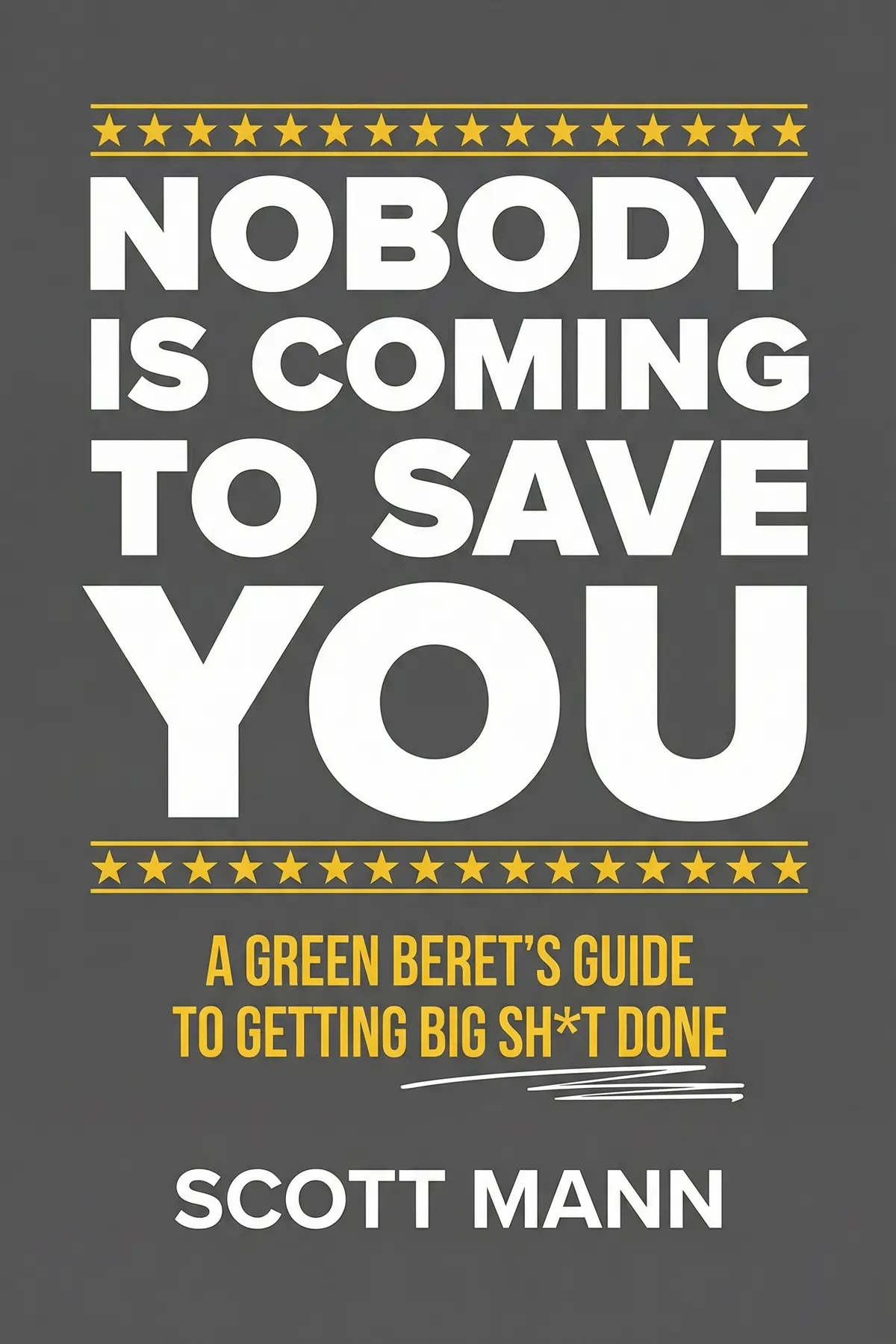
If your days feel scattered, your team seems half-present and your conversations stay guarded, Scott Mann has a name for it: the churn. In Nobody Is Coming to Save You, the former Green Beret argues that the churn runs on four forces, distraction, disengagement, disconnection and distrust, and that each one feeds the next. One example he recalls is an Afghan village squeezed between Taliban coercion and the transactional dealings of foreign forces.
His throughline is blunt. No outside force will repair this, and trust returns only through deliberate human acts that a person chooses to make.
Those acts can be learned. Mann shows how to cool a heated room, how to tell a story that moves someone to act, how to share a painful experience so it builds trust instead of pity, and how to leave something behind that outlasts you. His tools come from war zones, a rehab center and a father planting trees he would never see grow.
1 min 59 sec
A shorter attention span sounds like a private nuisance. Mann traces how it travels outward, through work and friendship, until neighbors start seeing each other as opponents, and he names the level where the damage can be reversed.
1 min 52 sec
Smart people say foolish things once a meeting turns tense, and better arguments rarely help. Mann explains what takes over in those moments and the small moves a leader can make before anyone even speaks.
1 min 59 sec
A rundown building, a veteran paralyzed during military service and a corporate executive who heard their story. What moved him to give $250,000 was a story of resilience and hope, and the reason says a lot about why stories can spark action.
1 min 44 sec
Most leaders guard their old wounds, believing any crack will cost them authority. Mann had not spoken of his fallen comrades since their funerals, until a storytelling coach pushed him to say their names aloud and face his survivor’s guilt.
1 min 45 sec
A man with late-stage cancer spent his remaining strength on trees he knew he would never see mature. His choice holds a practical answer for anyone who feels their anchors slipping and their attention scattered.
1 min 04 sec
Mann’s title sounds harsh, but his message carries hope. The churn, in his account, is a chain running from distraction to distrust, and every link in it can be broken by something a person does on purpose. A calmer voice in a tense room breaks one link. A story told for the listener breaks another, and so does a scar shared with care. The same soldier who watched trust drain out of an Afghan village now argues that it comes back one deliberate act at a time.
The book points to a few concrete starts. Before your next difficult conversation, slow your breathing and turn your sharpest criticism into a question. When you need support for an idea, lead with a story your audience can see themselves in, the way the Camargos’ story reached a Toyota executive. And guard a few unplugged hours in which to think about what you want to leave behind.
Mann’s father planted chestnuts for a forest he would never walk through. Trust grows on the same schedule.
Many people feel scattered, half-present at work and guarded with others, without knowing why. Scott Mann, who spent more than two decades in special operations, calls this state the churn. In his view it is a chain reaction: distraction leads to disengagement, disengagement to disconnection, and disconnection to distrust. He recalls an Afghan village caught between Taliban coercion and the transactional ways of foreign forces, where people were stuck in this pattern. Mann's answer is that rescue will not come from outside. Every group, he argues, runs on a surface of transactions and a deeper layer of status, belonging and shared stories, and trust can only be rebuilt on that deeper layer. He offers a set of human tools for it: managing emotional temperature in tense moments, telling stories centered on the listener, practicing what he calls scar generosity, and leaving tracks through small, steady acts. The examples come from his own life and from people he admires: a rehab center for spinal cord injuries that won a $250,000 gift through its founders' story, the names of fallen comrades he finally spoke aloud, and his father planting chestnut trees he knew he would never see grow.
Team leads and managers facing disengaged staff, tense meetings or low trust.
Professionals who need to win support for an idea and want to tell stories that move people.
Anyone worn down by constant notifications who wants focus and a sense of purpose back.
Scott Mann served in the US Army as a Green Beret and spent more than two decades in special operations, with deployments to Iraq, Afghanistan, Colombia, Panama, Peru and Ecuador. After retiring, he founded The Heroes Journey, a nonprofit that helps warriors, veterans and their families return home from service, and he has served as CEO of Rooftop Leadership. His other books include Operation Pineapple Express.
Listeners find this book highly engaging and influential, with one noting it is an essential read for leaders in the real world. They also value the author's straightforward take on leadership and his talent for building strong relationships. Additionally, listeners appreciate the functional guidance provided, with one individual characterizing it as "gritty and salty knowledge." Finally, they praise the author’s sincerity, as one listener highlights his unique gift as a true empathetic listener.
Wow. This isn't just another military memoir; it's a blueprint for anyone trying to navigate the chaos of modern life. Scott Mann writes with a level of candor and gravity that you rarely see, especially when discussing his own 'generosity of scars.' The way he weaves the high-stakes tension of the Afghan withdrawal with personal lessons on hospitality and interpersonal connectivity is masterful. I found myself highlighting dozens of passages about how our attention spans are being eroded by the 'churn' of technology. Mann is a true empathetic listener, and that comes through in his writing. He makes you feel like you're sitting across from him at a campfire, sharing the kind of hard-earned wisdom that only comes from the darkest places. This book genuinely changed how I view my responsibility to my neighbors. A must-read for real leaders.
Show morePicked this up on a recommendation for the 'salty knowledge' promised, and I wasn't disappointed by the grit. Scott Mann has a gift for taking the complex lessons of unconventional warfare and applying them to the 'churn' of everyday life in a way that feels natural. The story of Gaby Camarjo and the resilience of the human spirit had me literally crying in my chair. He doesn't just talk about building bridges; he shows you the blueprints of how he did it during the most chaotic moments of the Afghan withdrawal. It’s rare to find an author who can balance such intense action with deep, empathetic reflection on mental health. This book is a loud wake-up call that we are responsible for our own rescue. If you're looking for a leader who walks the walk, Mann is your guy. This is essential reading for anyone feeling lost in today's world.
Show moreEvery leader in America needs to read this book right now. Mann’s no-nonsense approach to building trust in a world that has lost it is exactly the medicine we need. He takes the lessons from his time as a Green Beret and translates them into practical steps for civilian life without sounding condescending or 'primitive.' The way he describes the 'churn' of our technology-dependent society resonated deeply with me. It’s a fast read because the pace is steady, but I found myself stopping constantly to take notes on his references to historical figures. Personally, I think the 'Stay in Step' story alone is worth the price of the book. Mann is a model American who isn't afraid to show his cracks, and that's what makes this so impactful. Get a copy for yourself and another for a friend who is struggling to find their purpose. Truly inspiring work.
Show moreReal-world leadership isn't about corporate buzzwords, and Mann hits that nail right on the head. He brings a gritty, no-nonsense approach to the table that is refreshingly authentic compared to the polished, fake gurus we usually see. The stories about Operation Pineapple Express and the evacuation from Afghanistan are harrowing and serve as a powerful backdrop for his lessons on trust. I especially appreciated how he doesn't shy away from his own failures or the dark moments that led him to the brink of suicide. Not gonna lie, some of the chapters feel a bit shorter on substance than I would like, but the emotional core is solid. It's a call to action for anyone who is tired of waiting for a savior and wants to start building bridges in their own community. Definitely worth a spot on your shelf.
Show moreFinally got around to reading this, and the raw vulnerability Mann shows regarding his near-suicide is incredibly moving. He avoids the 'tough guy' trope and instead focuses on the intentionality needed to survive the transition from the battlefield to the home front. The book offers a very practical, gritty perspective on leadership that focuses on human connection rather than strategy. In my experience, most books in this category are too academic, but Mann’s 'salty knowledge' feels earned in the mud. I did think some of the sections on storytelling were a bit meta and could have been tightened up, as the book itself occasionally struggles to stay on track. Despite the discohesion, the message of self-reliance and building local trust is exactly what our polarized society needs right now. It’s an honest, emotional, and ultimately hopeful read.
Show moreLook, Scott Mann is clearly a hero and his work with veterans is beyond reproach, but the book’s structure is a bit of a mess. It fluctuates between heart-pounding narrative and very short, punchy sentences that feel like they belong on a motivational poster. However, if you can get past the stylistic choices, there is a lot of substance here. His focus on 'generosity of scars' and using our past traumas to help others is a powerful concept that I haven't seen explored this way before. To be fair, the book is much more effective when he's telling stories than when he's giving direct advice. The sections on Operation Pineapple Express are the highlight and provide a visceral example of what happens when you stop waiting for permission and start saving people. It’s a solid 4-star read for the authenticity alone.
Show moreAfter hearing Scott Mann on a podcast, I expected more unique takeaways from his Green Beret background. The book is titled like a self-help manual, but it functions much more as a fragmented memoir about his struggle to transition back to civilian life after years of combat. To be fair, his accounts of the 'churn' of modern society and the heavy weight of trauma are poignant and real. However, the structure is quite discohesive and jumps around in a way that makes it hard to stay engaged. I think this book would hit much harder for active-duty military or veterans who can fill in the gaps with their own experiences. For a general reader, the 'salty knowledge' promised feels a bit diluted by the repetitive writing style. It’s an okay read, just not the life-changing leadership guide I was hoping for.
Show moreThe chapter on his father was incredibly moving and provided some of the most grounded moments in the whole book. Mann is clearly a man of great character, and his work with the 'Stay in Step' program is inspiring beyond words. That said, the book’s flow is quite erratic. One moment you're reading a gripping account of a mission, and the next you're hit with 20 pages of what feels like repetitive motivational speaking. Frankly, the advice on building trust and storytelling feels a bit recycled if you’ve already read a lot in the leadership genre. It’s a bit of a mixed bag because the man's life is fascinating, but the delivery is a little thin in places. I'd recommend it more as a memoir of a veteran's healing process than a traditional self-help book. It’s good, but you have to work through some fluff to get to the gems.
Show moreDoes anyone else feel like books today lack actual substance? Mann avoids that trap by being a true empathetic listener through his writing, but the book still feels like it’s missing a final edit. I appreciated the discussion around the drop in human attention spans—it’s a terrifying statistic. But ironically, the repetitive nature of the chapters made it hard for me to maintain my own attention. I think Mann is an incredible storyteller, as evidenced by his TED talk and his play 'Last Out,' but those skills didn't quite translate perfectly to the written page here. The book is at its best when it’s personal and raw. When it tries to be a 'get your sh*t done' manual, it feels a bit generic. It’s a decent read for the historical context of the 2021 withdrawal, but it’s not quite the masterpiece the blurb suggests.
Show moreI wanted to like this more, but it felt like a 20-page essay stretched into a full-length book. While Scott Mann's service is undeniably heroic, the prose here is incredibly repetitive, often circling back to the same short sentences that offer very little new information. There are sections where he discusses the importance of storytelling, yet the book itself fails to build a cohesive bridge to the reader. It felt more like he was writing this as a personal catharsis rather than a guide for others. Truth be told, the advice provided is mostly vague platitudes we've all heard in every other 'get your life together' book. I found myself skimming through the 15-page stretches of fluff just to find the three lines of actual narrative. If you aren't already a die-hard fan of his military work, this might feel like a waste of time and money.
Show moreScott Mann argues that modern life traps people in the churn, a chain of distraction, disengagement, disconnection and distrust. No outside force will fix it. Trust returns through deliberate human acts that work on the deeper level of belonging and shared stories: managing emotional temperature, telling stories built around the listener, sharing scars with purpose and leaving tracks through small, consistent actions.
Mann names distraction, disengagement, disconnection and distrust. Constant notifications scatter attention, and he cites research putting the average adult attention span at 47 seconds. Without focus, purpose fades, as in quiet quitting. Without shared purpose, people withdraw from one another. Finally, assumptions fill the gaps, others start to look like opponents, and polls show trust in institutions and fellow citizens declining.
Scar generosity is Mann’s term for sharing the wounds that shaped you in a structured way that builds trust in others. It is not unloading trauma or seeking sympathy. The leader chooses a scar relevant to the audience and frames it so they see their own struggles in it. Mann practiced this himself when he finally spoke the names of fallen comrades aloud.
Mann starts with self-regulation, recommending breathwork and mindfulness to calm the body, since a composed leader sets a tone others tend to follow. Then he suggests designing the conversation: pausing before you speak, reframing criticisms as questions and making the physical space more welcoming. He adds that calm does not require suppressing feelings; you notice them, name them and choose your response.
It suits leaders and managers dealing with disengaged teams or low-trust situations, professionals who need to persuade others, and anyone who feels scattered by constant digital noise. Its tools are personal and concrete, from a digital detox and regular walks to telling a listener-centered story, as the founders of the Stay In Step rehab center did to win a $250,000 gift.
Margaret Heffernan





Joseph A. Maciariello




AUDIO SUMMARY AVAILABLE
Get the key ideas from Nobody Is Coming to Save You by Scott Mann, plus 5,000+ more nonfiction titles.









