

14 min 32 sec
Available in: English
Move!: The New Science of Body Movement and How it Can Set Your Mind Free
Shows why a mostly seated life dulls thinking and mood, and how walking, strength work, posture, dance, stretching and slow breathing each change the mind in their own way.
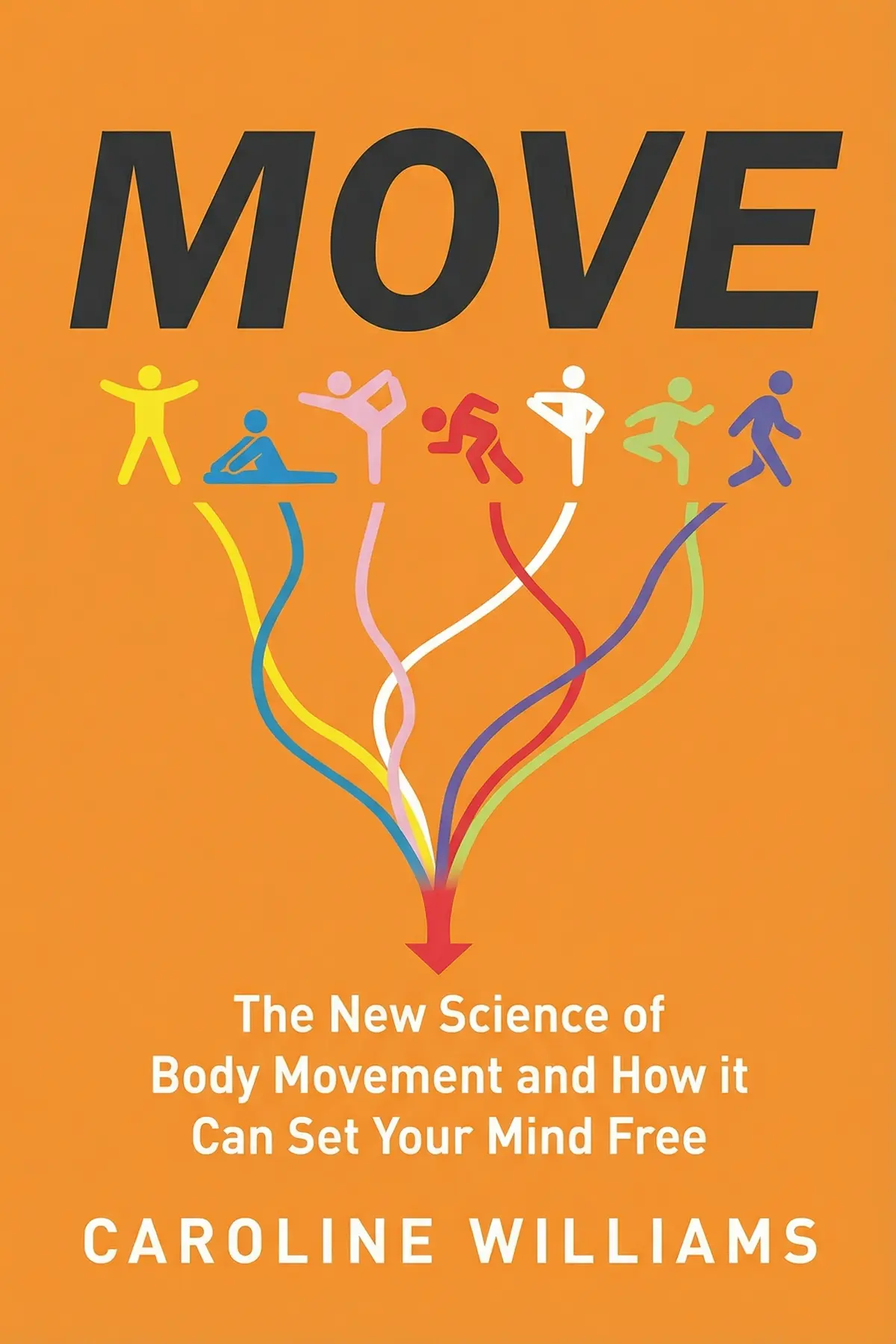
Table of Content
1. Introduction
1 min 03 sec
If your best thinking happens away from your desk, there is a reason, and it goes back to the first brains on Earth. In Move!, science journalist Caroline Williams argues that brains evolved to steer bodies toward food and away from danger, and that thought, memory and emotion came later to serve that job. Sit still most of the day, and the mind loses its main source of news.
Williams began the book after noticing that long walks untangled her ideas and yoga left her calm. To find out why, she interviewed Nobel prize-winning scientists, yoga gurus and practitioners of many kinds of movement. Her answer is that each kind of movement sends its own signals from body to brain. Walking, lifting, sitting tall, dancing, stretching and slow breathing each change thinking and feeling in a different way. Learn which does what, and your body becomes a set of controls for focus, mood and confidence.
2. Sitting still slows your thinking, so keep moving
1 min 49 sec
A small sea creature gives up its brain the moment it stops swimming. Its strange life explains what a mostly seated day may be doing to your own mind, and to a child’s.
3. Walk at the pace that feeds your brain
1 min 43 sec
Darwin had a favorite loop of countryside where his biggest idea took shape. There turns out to be a precise rhythm of steps that sends the most blood to the brain, and a direction that changes what you think about.
4. Strength that turns into calm confidence
1 min 53 sec
Young men today grip far more weakly than their fathers did, and children have lost a fifth of their strength. The surprising part is what lifting can do for anxiety even when the muscles never get bigger.
5. Sit up and change your mood from inside
1 min 45 sec
Your body is constantly talking to your brain, and much of what you call your mood is its report. A strange link between your core muscles and your stress hormone shows how to change the message.
6. Dance with others to feel closer
1 min 31 sec
Babies who are bounced to a beat behave differently toward adults afterward. The tempo involved is oddly specific, and the style of dance you choose seems to steer which kind of thinking improves.
7. Stretch and breathe your way to calmer nerves
1 min 37 sec
Stretching sounds like the dullest part of any workout, yet Harvard researchers found it reaching into the immune system. For one in five people, though, more flexibility may be exactly the wrong goal.
8. Many small moves beat one hard workout
1 min 57 sec
In five corners of the world, people reach 100 at ten times the usual rate, and almost none of them go to a gym. What they do instead fits easily into an office day.
9. Conclusion
1 min 14 sec
The image Williams leaves behind is the sea squirt on its rock, dissolving a brain it no longer needs. Most of us are far from that, but a life of 70 percent stillness leans the same way, and her evidence, from pressure sensors in the feet to teenage girls growing confident under a barbell, shows the mind dimming when the body stops sending news.
The hopeful part is that the news can be changed on purpose. What your body does alters the chemical and electrical setting your brain works in, and Williams finds that freeing. A brisk walk at about 120 steps a minute is a tool for a stuck problem. Lifting weights, or your own body weight, is a tool for worry and self-doubt, whether or not the muscles grow. Sitting tall, laughing hard and moving in rhythm with others change the background music of a day.
So treat the next long stretch at your desk as something to interrupt. Stand, stretch your arms and legs, and walk somewhere, even briefly. Look for one class where people move together. The brain was built for a body in motion, and it still works best when it gets one.
About this book
What is this book about?
Most adults now spend around 70 percent of their lives sitting or lying still. Science journalist Caroline Williams argues that this harms the mind as much as the body, and that one hour at the gym cannot make up for a day spent sitting. Her starting point is evolutionary. Brains exist to guide movement toward reward and away from danger, and thinking, memory and emotion grew up to serve that task. So the body is not a passive vehicle. Through senses such as proprioception and interoception, it keeps reporting to the brain, and those reports shape mood, confidence and sense of self. From there Williams goes through the kinds of movement one by one. Walking at a steady pace raises blood flow to the brain and frees creative thought. Strength training eases anxiety and depression even when muscles do not grow. Upright posture buffers stress, rhythm bonds people, stretching dampens inflammation and slow breathing calms. Readers learn which movement does what, and why small, frequent movement through the day matters more than occasional intense workouts.
Book Information
Who it's for
Curious desk workers
Desk workers who think more clearly on a walk and want to know why.
Wanting body-based coping tools
People dealing with anxiety, low mood or self-doubt who want body-based tools alongside other help.
Wanting simple movement ideas
Teachers, parents and managers looking for simple ways to get people moving through the day.
About the Author
Caroline Williams
Caroline Williams is a science journalist and editor based in Surrey, UK, with more than 20 years of writing for New Scientist, The Guardian, The Boston Globe, BBC Future and BBC Earth. She consults for New Scientist, once produced and reported for BBC Radio, and co-hosted the New Scientist podcast from 2006 to 2010. She edited the New Scientist Instant Expert Guide to the Brain and wrote Override, published in the USA as My Plastic Brain. She studied biological sciences at Exeter University and science communication at Imperial College London.
Ratings & Reviews
Ratings at a glance

What people think
Listeners find the quality of information in the work to be excellent, with one listener highlighting how it is backed up by solid research. The book also earns positive feedback for its high readability.
Top reviews
Ivan
Williams has crafted an exceptionally readable guide that bridges the gap between complex evolutionary biology and our daily physical habits. The research feels incredibly solid, particularly when she dives into how our brains evolved in tandem with our ancestors' hunter-gatherer lifestyles. I was fascinated by the idea that movement isn't just about fitness, but about maintaining the very structure of our cognitive functions. To be fair, some of the advice is simple, like nose-breathing or basic stretching, yet the way it's framed within the context of 'natural movement' makes it feel fresh and urgent. It’s not just another workout book; it’s an exploration of what it means to be a biological machine. Truly, this is the first time I’ve understood the deep connection between my ligaments and my mental alertness. Highly recommended for anyone who feels stuck in a sedentary loop.
Show moreJib
As a self-proclaimed desk warrior who spends ten hours a day staring at a screen, this book was exactly the wake-up call I needed. Williams points out a staggering truth: working out for an hour then sitting the rest of the day might not be enough to counter the mental fog of a sedentary life. The chapter on muscle building and its relation to cognitive resilience was a standout for me. Frankly, I’ve never thought of my muscles as 'chemical factories' that produce mood-boosting substances. The prose is punchy and the advice is entirely actionable, focusing on simple things like using your own body weight and finding natural ways to engage your core. It’s a compelling argument for a lifestyle overhaul that doesn't require a CrossFit membership. Pick this up if you want to feel better daily.
Show moreRatthapong
After hearing the audiobook edition, I’m convinced that more people need to hear Caroline Williams’ message. The narrator was exceptionally clear and confident, making the scientific data feel like a friendly conversation rather than a lecture. Personally, I’ve always struggled with traditional exercise routines, but this book’s focus on 'natural movement'—the kind of interval activity our ancestors did—felt much more sustainable. The specific sections on nose-breathing and using your own body weight to build strength are incredibly actionable and easy to implement. I especially appreciated how the author didn't just tell us to 'move more,' but explained the exact biological mechanisms behind why our ligaments need to be engaged for mental health. It’s a rare book that manages to be both intellectually stimulating and practically useful. I’ve already recommended it to several friends.
Show moreIsabelle
Wow, I didn't expect a book about movement to change the way I think about my daily breathing. Williams explores the mental benefits of physical activity with such precision that it’s hard not to feel inspired to move immediately. I’ve been practicing the 6 breaths per minute technique she mentions, and the impact on my daily anxiety has been profound. The book offers a beautiful reframe of our biology, suggesting that we aren't just 'using' our bodies, but that we *are* our bodies. This perspective is vital in a culture that treats the head as separate from the rest of the self. Even the chapters on rest were eye-opening, showing that true rest is a dynamic process. It’s a fantastic, research-backed guide to living with more ease and more energy. Thanks to the publisher for the ARC—this is a must-read.
Show moreHenry
Ever wonder why you feel so much sharper after a quick walk around the block? Move! breaks down the science behind that feeling with a style that is both analytical and accessible. The author, a seasoned journalist, manages to synthesize a massive amount of scientific literature without making it feel like a textbook. I particularly appreciated the focus on 'interval activity' throughout the day rather than just a single hour at the gym. While it’s true that much of the core advice—move more, breathe better—isn't revolutionary, the specific details about 3 and 6 breath per minute patterns were a revelation. My only minor gripe is that the book leans heavily on a neurotypical perspective, occasionally missing the mark on how mental illness can be influenced by more than just physical inactivity. Still, it's a very helpful resource.
Show moreWaree
Finally got around to reading this and I was pleasantly surprised by the depth of the 'rest' and 'breath' chapters. Most movement books ignore these components, but Williams treats them as essential pillars of a healthy mind. The way she explains the synchronization of breath and movement is far more detailed than what you usually find in generic health articles. Not gonna lie, I was skeptical about the 'natural movement' sections at first, but the anecdotal evidence combined with clinical studies won me over. The writing style is confident and clear, making it easy to digest even the heavier scientific concepts. I do agree with other reviewers that it feels a bit silent on the reality of chronic illness or limited mobility, which is a gap. Regardless, it’s a smart, well-organized accounting of why we need to get off the couch.
Show moreNarong
This book makes a compelling case for the total integration of mind and body, a concept that Western medicine often ignores. Williams grabs hold of the idea that our brains are essentially 'movement organs' and runs with it. I found the section on aerobic exercise particularly interesting, as it focused on creativity and focus rather than just heart health. It's a refreshing change of pace from the usual weight-loss-centric fitness books. While some points might feel obvious to those who stay current with health trends, the way the information is brought together in one place is very convenient for the non-specialist. The tone is encouraging and the author provides a guide that feels genuinely helpful for restarting a routine. A solid four stars for the quality of information and the readability of the prose.
Show moreNing
The science here is undoubtedly solid, yet I couldn't help but feel a bit alienated by the way neurodivergence was framed. Williams does an incredible job of synthesizing complex studies into digestible advice, especially regarding how our brains evolved alongside our movement patterns. However, describing neurodivergent traits as 'disordered' felt a bit sniffy and outdated for a modern science book. Truth is, the chapters on the 3 and 6 breaths per minute were fascinating and provided actionable tools that I’ve already started using. I just wish there had been more consideration for sociological factors or a more inclusive look at people with different physical abilities. It’s a great resource for the 'typical' person looking to optimize their focus, but it misses some nuances that would have made it a five-star read for me.
Show moreWillow
To be fair, the writing is excellent and the author’s background as a science journalist shines through every page. However, I felt like the book spent a lot of time proving things that most of us already know. Does walking improve your mood? Yes. Does breathing deeply help you relax? Obviously. While the scientific evidence she brings to the table is rigorous, it occasionally feels like it's over-explaining the basic. I did enjoy the discussion on how our brains evolved in relation to hunter-gatherer movements, but I found myself skimming the parts about aerobic exercise. It's a good introductory guide for someone who is just starting to think about the mind-body connection, but for seasoned athletes or health junkies, it might feel a bit like a refresher course rather than a breakthrough.
Show moreVipawan
Look, I really wanted to love this, but it felt like reading a series of pop-culture headlines about things we already instinctively know. Yes, walking is good for you; yes, being active helps your brain. It’s giving 'shocker: berries and salmon are healthy' energy throughout most of the chapters. While Williams is a seasoned science journalist and her writing is crisp, the actual substance didn't offer the deep dive I was craving. If you’ve never read a health book in your life, you might find this revolutionary, but for anyone else, it’s a bit repetitive. I found the lack of discussion regarding different body types particularly frustrating. It assumes a level of mobility that isn't universal, which made certain sections feel slightly exclusionary. Not a bad read, just very basic and a bit redundant for the price.
Show moreQuestions about this book
What is the main idea of Move! by Caroline Williams?
Williams argues that brains evolved to guide movement, so the body is constantly sending signals that shape thinking and emotion. A mostly seated life, around 70 percent of adult life on her figures, weakens the mind as well as the body. Different movements act on the mind in different ways: walking aids creative thought, strength eases anxiety, posture buffers stress, rhythm bonds people, and stretching and slow breathing calm the body.
Is going to the gym enough according to Move!?
No. Williams argues that one hour of hard exercise cannot cancel out a day of sitting. Drawing on Katy Bowman, she compares bursts of exercise to taking vitamins alongside a poor diet. Her rule of thumb is to get up every 20 to 30 minutes for a stretch, a short walk, a walking meeting or a song to dance to, which the book calls movement snacks.
How does strength training help mental health in Move!?
An analysis of nearly fifty studies found weight training reduced anxiety and depression even when muscles did not grow. In a 1988 study by Jean Barrett Holloway, teenage girls who gained 40 percent in strength also gained confidence and skill at resolving conflicts. Williams proposes that stronger muscles and bones send upgraded signals that tell the brain it can stand down anxiety.
What walking pace does Move! recommend for the brain?
The book reports that about 120 steps per minute, roughly in time with the heartbeat, gives the best blood flow to the brain. Pressure sensors in the feet work with the heart to raise that flow by 20 to 25 percent, and bearing weight adds more. A comfortable pace also quiets the planning part of the brain, which lets thoughts wander creatively, as Darwin found on his thinking path.
Who should read Move!?
It suits office workers who feel foggy after long days of sitting, people looking for body-based ways to manage anxiety or low mood, and teachers or managers who want to build movement into a group’s day. It explains the science in plain terms and ends with small, practical habits, from hourly stretches to group dance classes and school schemes like the Daily Mile.
Featured in
Readers also enjoyed

A Life Decoded: My Genome: My Life
J. Craig Venter

A Planet of Viruses
Carl Zimmer

A Short History of Nearly Everything
Bill Bryson

A Thousand Brains: A New Theory of Intelligence
Jeff Hawkins




Alien Earths: The New Science of Planet Hunting in the Cosmos
Lisa Kaltenegger

AUDIO SUMMARY AVAILABLE
Listen to Move! in 15 minutes
Get the key ideas from Move! by Caroline Williams, plus 5,000+ more nonfiction titles.
- 5,000+ titles
- Listen as much as you want
- 7-day free trial
- Cancel anytime









