
Discourse on Method
René Descartes
 English
 ไทย
Descartes shows how doubting everything the senses report leaves one certainty, that you think and therefore exist, and how reasoning from that point rebuilds belief in God, a ranked world of ideas and a mind separate from the body.
1 min 04 sec
Most of us trust what we see and hear without a second thought, and we can quote one famous philosophical line without knowing what it proves. In Meditations on First Philosophy, René Descartes, the mathematician who joined geometry and algebra, begins by taking that trust away. Our senses, he argues, mislead us so often that nothing they report can count as certain.
From that wreckage he rebuilds. Doubt everything, and one fact survives: you are thinking. On that single point Descartes raises a ranking of ideas, an argument for God and a case that the mind is separate from the body. The throughline is easy to state. Certainty comes from reasoning, and careful reasoning can rebuild a world that doubt seemed to destroy.
Follow the steps and the line I think, therefore I am stops being a slogan. It becomes an argument you can walk a friend through, one link at a time, along with a habit of asking what your own beliefs actually rest on.
2 min 02 sec
Every night, almost everyone is fooled completely and never notices until morning. Descartes takes that ordinary experience and pushes it toward a far more unsettling possibility about the whole world you think you know.
1 min 51 sec
A deceiver could fake every sight and sound you have ever known. Yet there is one thing it cannot fake, and a lump of melting wax shows exactly where that certainty comes from.
1 min 46 sec
Your eyes insist the sun is small, while a page of mathematics insists it is enormous. Descartes sorts every idea you have into levels, and the order may surprise anyone who trusts experience first.
1 min 40 sec
Descartes treats the ability to think as the most real thing about you. Then he asks where it came from, and a simple rule about fire and warmth carries him to his boldest conclusion.
1 min 45 sec
Descartes began by doubting he even had a body. When he finally lets it back in, he gives it a lower place than the mind, and that ranking leads him somewhere far beyond physics.
1 min 06 sec
Descartes begins by throwing away nearly everything a person usually trusts, and he ends with more than he started with: a self he cannot doubt, a ranking of ideas, a God and a mind that may outlive its body. His method matters as much as his conclusions. He never asks the senses to settle a question. Each step rests on the one before, and the whole structure hangs from a single fact, that whoever doubts must be thinking.
You may not accept his proof of God or his division of mind from body. The reasoning is still worth following, and some of it travels well. When something feels obviously true, remember the dreamer who is sure the dream is real, and ask what your belief actually rests on. When you need firm ground, look for the conclusion you reached by thinking it through, the way the mind knew that the melted wax was still wax.
To the eye, the sun looks smaller than a tree. Descartes wrote his Meditations to show why we know better.
Almost everyone can quote I think, therefore I am, yet few can say what the line proves or why Descartes needed it. Meditations on First Philosophy is where the argument lives. It starts from an uncomfortable claim: our senses mislead us so often, in dreams and perhaps under the control of some deceiving power, that nothing they report can count as certain. Descartes then searches for a belief that survives total doubt and finds it in the act of thinking itself. From that fixed point he builds outward. He ranks ideas by how much reality they carry, from pure concepts like a triangle down to invented creatures like the satyr. He argues that our inborn ability to think must come from a higher thinking being, God. And he concludes that the mind and the body exist on different levels, so the soul could outlast the body. Listeners get the full chain of reasoning in plain language, with the examples Descartes himself uses: the melting wax, the sun that looks smaller than a tree, the fire that warms a room. By the end, the famous line becomes an argument you can follow and explain.
Students meeting philosophy for the first time who want the reasoning behind I think, therefore I am.
Curious professionals who want a clear, step by step account of how Descartes moves from doubt to God and the soul.
Anyone who likes testing how much of what they believe rests only on their senses.
René Descartes was born on 31 March 1596 in La Haye, Touraine, in France, and died on 11 February 1650. A key figure in the Scientific Revolution, he joined geometry and algebra into analytic geometry, and the Cartesian coordinate system is named after him. In philosophy he shaped the study of knowledge, of reality and of the mind. His most famous line is I think, therefore I am.
René Descartes
Listeners find Descartes' philosophical treatise compelling, with one listener highlighting it as an excellent first choice for grasping logic. Additionally, the text arrives in perfect condition and is composed well, with listeners valuing the reasonable price. However, the ease of reading draws varied responses; some consider it quite fascinating while others describe it as tiresome. Furthermore, the caliber of the logic and the print size also attract a mix of reviews.
After hearing so much about the father of modern philosophy, I finally dove into the Meditations, and it certainly lived up to the hype for me. Descartes’ methodology of radical doubt is genuinely thrilling. He strips away every sensation until only the thinking thing remains. While some argue his transition to proving the existence of God feels forced, the initial intellectual exercise is a masterclass in foundational logic. It is a slim volume that demands a lot of your cognitive energy, but the payoff is a profound shift in how you perceive reality. I found myself pausing after every few paragraphs just to sit with the weight of his skepticism. In truth, it is not a light beach read, but it is essential for anyone who wants to understand the roots of Western thought. My copy arrived in great condition, and the price makes it an easy addition to any library.
Show moreWhat is reality, and how can I even be sure that I am writing this review right now? This book completely wrecked my sense of certainty. It led me down a dark rabbit hole of existential questions that I still cannot answer today. Actually, Descartes managed to make me question the validity of my own senses and the entire world around me with just a few short meditations. It is a wild ride to go from 'I think, therefore I am' to wondering if a malicious demon is tricking my perception. The way he builds his argument is ingenious, even if the later parts about the soul feel a bit dated to a modern reader. I recommend this to anyone who wants to challenge their own dogmatic slumbers and dive into the deep end of metaphysics. Just be prepared to feel like your brain has been through a blender by the final page.
Show moreEver wonder if you are actually a fraud living in a dream world controlled by a deceptive spirit? Descartes faces these phantoms head-on with a level of dignity and rigor that is truly inspiring to read. While I approached this as an atheist, I was fascinated by the ingenious way he constructs his world from nothing but his own thoughts. This specific volume is great, but the actual reading is very complex and hard to get into if you are not prepared for a challenge. Once you get past the dense writing style, you find a thinker who was brave enough to release the ghosts of modern being. I highly recommend this to everyone who wants to see how a single thinking thing changed the world forever by simply sitting alone and doubting the existence of everything he once knew.
Show moreAs someone who identifies as an atheist, I found this to be a surprisingly engaging dive into the mechanics of 17th-century logic. Descartes starts with a fascinating premise by discarding everything he knows to find a singular truth, which is a journey any fan of debate would enjoy. I love how he identifies as a thinking thing, yet I could not help but notice the argument falls apart once he tries to bridge the gap toward the divine. The shift from cold, hard skepticism to the unmoved mover felt like a leap of faith rather than a logical step. Despite these fallacies, the book is a great first read for those interested in the philosophy of mind. It is short, punchy in places, and the translation I got was actually quite readable compared to other classics. It definitely makes you question your own suppositions about the world.
Show moreThe 'thinking thing' is back at it again, and 400 years later, Descartes’ voice still feels remarkably present and daring to me. I love the way he admits his own ignorance right at the beginning, setting a tone of humility that is often missing from modern academic writing. His methodology of demolishing his own opinions to find a firm foundation is something every thinker should try at least once. Look, I was impressed by how he handles the distinction between the soul and the body, even if neuroscience has since complicated his findings. It is an interesting read that bridges the gap between medieval thought and the enlightenment, providing a thrill for anyone who loves a good debate. The book is written nicely, though you might need a dictionary nearby for some of the more archaic phrasing. Overall, it is a classic for a reason.
Show moreFinally got around to reading this classic, and I have to say the physical quality of the book from the publisher was quite excellent. For such a low price, the binding is strong and it looks great on the shelf, though the print size is a bit on the small side. The price is a major plus here. Content-wise, the first few meditations are a brilliant display of logic that really makes you examine your own suppositions. I found the transition from doubting everything to proving his own identity to be the highlight of the entire work. While the argument for dualism has its critics, it is still an important foundation for the philosophy of mind that deserves to be studied. Truth be told, it is a bit of a challenge to get through the denser middle sections, but it is a rewarding experience overall.
Show morePicked this up for a philosophy class and it is basically exactly what you would expect from a standard Hackett edition. The price was very reasonable for a student budget, and the book itself is sturdy enough to survive being tossed in a backpack every day. However, the content is a bit of a mixed bag. It is fairly interesting at the start when he is doubting the senses, but it becomes quite tedious as it goes on. I struggled with the dense arguments regarding the separation of the mind and body, which feel very disconnected from modern science. Personally, the translation is decent, but the font is small and the margins are tight, making it hard to take notes. It is a solid 3-star read—essential for the curriculum, but not something I would ever revisit for fun or leisure.
Show moreIn my experience, the Meditations is one of those books that is much better discussed in a classroom than read alone in a room. The logic is influential, but the prose is a slog. I appreciated the first two meditations where he establishes his own existence, but the quality of the argument drops significantly after that point. Not gonna lie, I found myself skimming the sections on the existence of God because they felt like a desperate attempt to stay in the Church's good graces rather than a cold, logical deduction. The physical book was fine, arrived in perfect condition, and the price was right. It is an okay introduction to logic, but there are definitely more modern texts that cover the same ground with much more clarity and less fluff.
Show moreThis book is a prime example of why people find philosophy incredibly frustrating and inaccessible to the modern reader. I picked this up hoping for a clear logical progression. Instead, I was met with dense, run-on sentences that seemed to circle back on themselves constantly in a way that felt entirely unnecessary. Frankly, the writing style is so verbose and tedious that it is hard to stay focused on the actual argument being made. By the time Descartes reaches his conclusions about the soul and body, the logic feels paper-thin and reliant on outdated medieval assumptions. It is an important historical text, sure, but the actual experience of reading it felt like intellectual masochism for me. The tiny print size in my edition did not help either.
Show moreLook, I understand the historical importance of Descartes, but this book is just riddled with logical fallacies that are hard for me to ignore. The argument for God's existence is particularly weak and feels like it employs the very same assumptions he claimed to discard in the first meditation. Gotta say, I found the whole unmoved mover concept to be a self-defeating argument when you look at it through the lens of modern physics. It feels less like a rigorous philosophical inquiry and more like a man trying to justify his preconceived notions using fancy language. Unless you are an intellectual masochist who enjoys dense, circular prose that never seems to reach a satisfying conclusion, I would suggest finding a good summary instead of reading the original text. It is just not very accessible.
Show moreDescartes argues that the senses can deceive us, through dreams or even an imagined evil deceiver, so nothing they report is certain. One fact survives that doubt: we are thinking, and so we exist. From that point he reasons his way to a ranking of ideas, a proof that God exists and the claim that the mind is separate from the body and could outlive it.
It means that the act of thinking proves the existence of the thinker. Even if every sight and sound were faked, being fooled still requires someone doing the thinking. Even the thought I do not exist must be thought by someone. Descartes uses this as the single certainty that survives total doubt, and he builds the rest of his argument on it.
Descartes describes a piece of beeswax that smells, feels and looks like wax. Held near a fire, it melts, yet we still recognize it as beeswax. Since the senses cannot be trusted, it is through thinking that the mind recognizes it. The example shows thinking at work, and thinking proves we exist.
He argues that we have the ability to think from the moment we exist, so we cannot be its source. He adds a rule: nothing can give a quality to something else unless it has that quality to a greater degree, as only something warm, like a fire, can warm a room. So our ability to think must come from a supreme thinking being, God.
Use his ranking as a test. When you hold a belief, ask whether you reasoned it out, observed it with your senses, or assembled it from other ideas. Descartes places reasoned ideas highest and sense impressions lower, pointing out that the sun looks smaller than a tree to the eye. Checking what a belief rests on helps you see which ones you can truly defend.

John Rawls



William B. Irvine

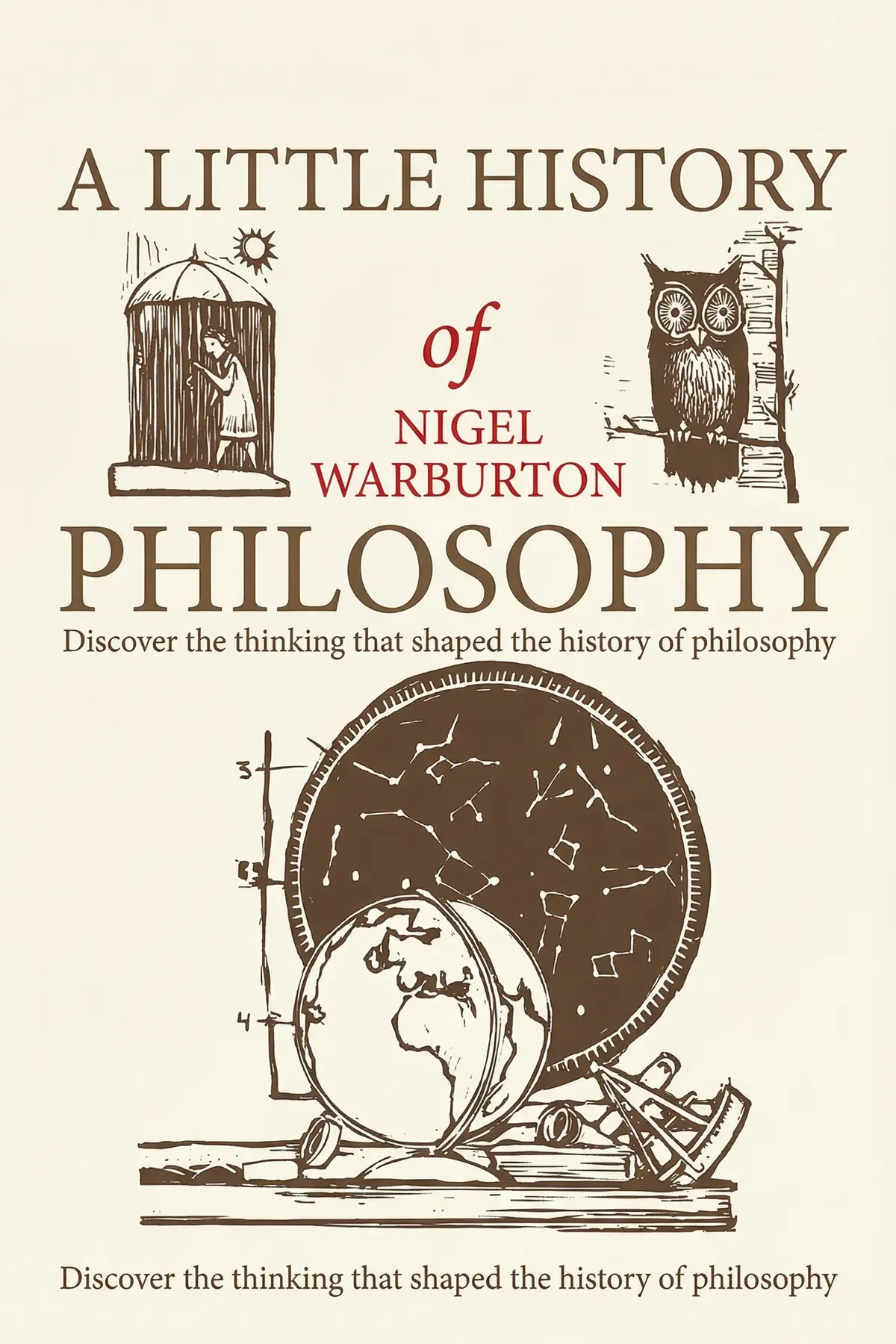
Nigel Warburton
Colin Ward
AUDIO SUMMARY AVAILABLE
Get the key ideas from Meditations on First Philosophy by René Descartes, plus 5,000+ more nonfiction titles.









