

14 min 01 sec
Available in: English
Mastering Leadership: An Integrated Framework for Breakthrough Performance and Extraordinary Business Results
Shows why an organization's performance depends on how its leaders grow from the inside, and how to move from fearful, play-it-safe management to leading from your own purpose and in service of everyone else.
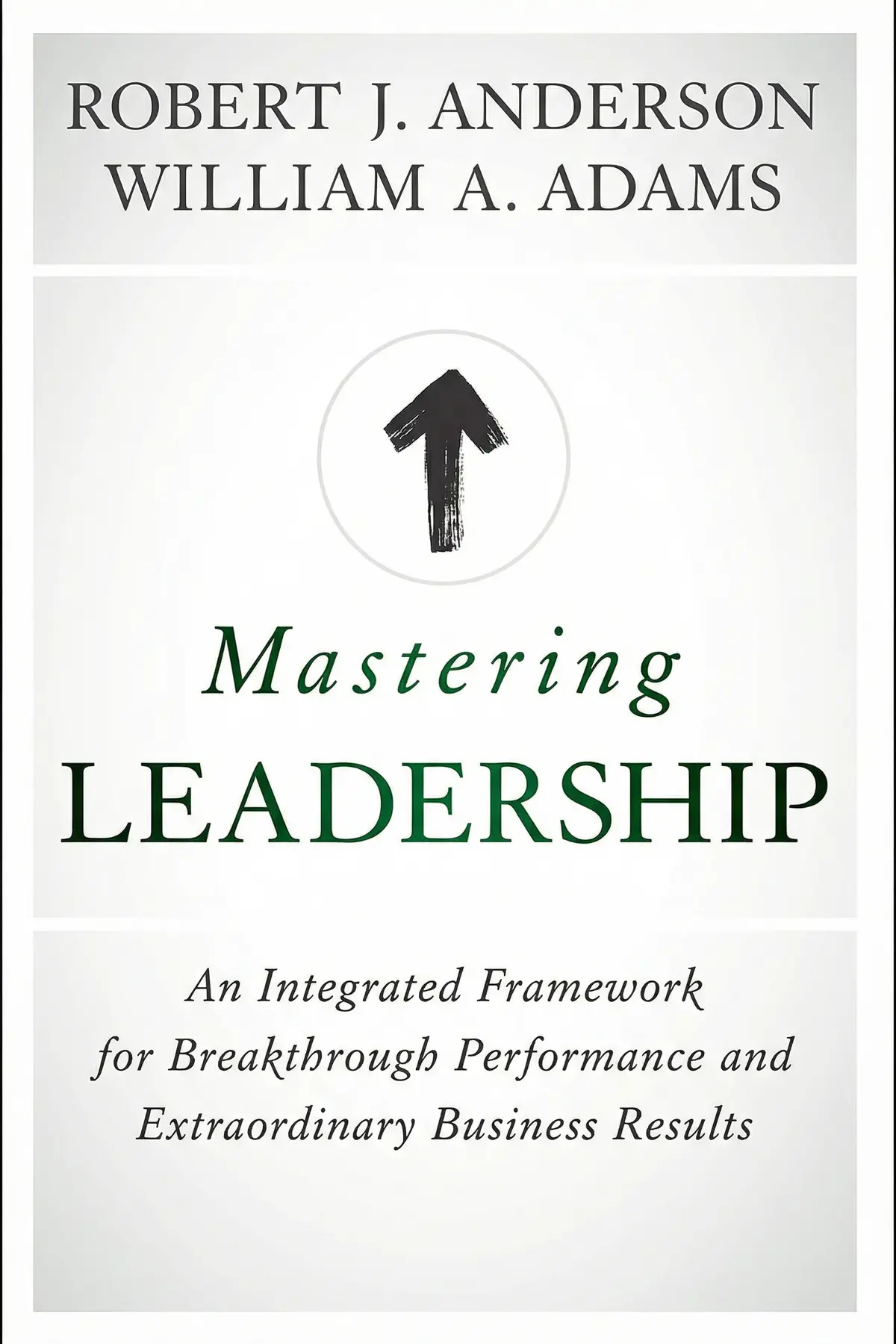
Table of Content
1. Introduction
1 min 01 sec
Most managers who watch results slip look first at the product, the process or the people, and rarely at themselves. In Mastering Leadership, Robert J. Anderson and William A. Adams argue that the self is where the fix starts. Comparing businesses, they found that the top tenth of American companies had leaders far more effective than average, while the bottom tenth had leaders far less effective.
Their throughline is a path in three stages. Most leaders run on fear and play safe, a style the authors call reactive. Better leaders act from a purpose that is truly their own. The rare best ones combine caution with vision and lead in service of the whole organization.
Follow that path and you gain a way to spot fear inside your own decisions, two questions that surface what you actually want, and a reason to say in the meeting what you would normally save for the hallway afterward.
2. Meet the expectations nobody wrote down for you
1 min 56 sec
A manager can hit every target in her job description and still be seen as failing her team. The reason lies in a set of promises people believe their leader has made, often without the leader knowing.
3. Your whole management layer sets your results
2 min 03 sec
Almost every leader agrees leadership drives performance, yet few treat their own growth as a priority. The authors show where that contradiction does the most damage, and it is rarely at the very top.
4. Stop playing not to lose at work
2 min 04 sec
Taking on responsibility is usually what we call growing up. The authors argue that the same kind of maturity can slowly drain a person’s ability to lead, and they name the feeling that drives it.
5. Get through the identity crisis that real growth brings
1 min 59 sec
One leader in a development session suddenly realized he had no idea who he was. An ancient myth told across many cultures explains why that moment of panic may be the best sign of progress.
6. Bring the bathroom conversation into the boardroom
1 min 50 sec
People often say what they really think only after a meeting ends, in the one room nobody takes minutes. The authors see that habit as both the problem and the model for a better way to lead.
7. Serve the whole organization without fear
1 min 56 sec
Creative leaders call cautious colleagues immature, and cautious ones call creative leaders dreamers. A small group of leaders refuses to pick a side, and the authors explain what lets them work with everyone.
8. Conclusion
1 min 12 sec
Mastering Leadership traces an arc that begins with a manager agreeing with the boss to stay safe and ends with someone redesigning systems for the good of everyone. Its claim is that an organization changes only as fast as the people at its center change. Anderson and Adams warn that conversations within the extended leadership team are often weak, with groups dumbing down together and marked by poor listening and self-interest, and that team shapes how the whole business performs.
The way forward starts small. Ask yourself the authors’ two questions, about who you would be if it felt safe and what you would do if nobody could fire you, and write down your own must, as one of the authors did after hearing himself speak beside his car. Take the honest comment you would normally save for the bathroom and say it in the meeting. When you lead others, ask what they need as well as what you want, and give your gut a vote when the data runs out.
The village in Campbell’s myth was saved by a hero who came back changed. An organization waits for the same return.
About this book
What is this book about?
When results slip, it is tempting to blame the product, the process or the people. Robert J. Anderson and William A. Adams argue that leaders who want a different organization must start by changing themselves. They also argue that the quality of the whole management layer, and of its conversations, decides how a business performs. Their model follows leaders through three stages. Reactive leaders choose safety, agree with whoever holds power and let fear of disapproval steer their decisions. Creative leaders find their own purpose, live through the identity crisis that comes with it, and bring the honest talk usually saved for the bathroom into the boardroom. Integral leaders, about 5 percent of the total by the authors' estimate, blend caution with vision and lead in service of the entire organization. Readers get a clear picture of the unwritten promises their teams expect them to keep, two questions for finding what they really want, and a way to work with colleagues of every leadership style without dismissing either side.
Book Information
Who it's for
Managers who object later
Managers who agree in meetings and disagree in the hallway afterward.
Senior leaders and HR
Senior leaders and HR teams responsible for developing a large group of managers.
Professionals torn on careers
Ambitious professionals torn between a safe career path and work that feels like their own.
About the Author
Robert J. Anderson
Robert J. Anderson founded and chairs The Leadership Circle and the Full Circle Group, and created the Leadership Circle Profile, an assessment organizations around the world use. He has worked with CEOs and leadership teams and serves as adjunct faculty at Notre Dame's Mendoza College of Business. William A. Adams has spent about 35 years helping leaders with complex business challenges, for clients from Fortune 500 corporations to start-ups. He has started, sold and merged several businesses and wrote The Whole Systems Approach and The Quest for Quality.
Ratings & Reviews
Ratings at a glance

What people think
Listeners value the framework for leadership growth, particularly how it merges effectiveness with consciousness. The quality of research also earns high marks; listeners note it draws from multiple study formats and serves as an excellent resource for persistent learning. Furthermore, listeners enjoy the book's flow, with one listener describing it as engaging for both the heart and mind. However, opinions on its financial worth are divided, with some considering it a great investment while others feel it is a waste of money.
Top reviews
Landon
Finally, a leadership book that actually feels grounded in rigorous research rather than just anecdotal fluff. Anderson and Adams have constructed a comprehensive model that bridges the gap between inner consciousness and outward effectiveness. I found the distinction between reactive and creative leadership styles particularly enlightening, as it gave me a vocabulary for patterns I’ve seen in my own career. Look, it’s a heavy read and definitely doesn't shy away from being a bit academic at times, but the depth is worth the effort. It’s rare to find a manual that addresses the ego's development so directly. To be fair, the authors do lean hard into their own 'Leadership Circle' product, but the insights stand on their own merit. This is built on various types of research and serves as an excellent source for continuous study.
Show moreSavannah
Mastering Leadership isn't your typical airport bookstore management guide. This is a deep dive into the soul of the leader. I’ve read dozens of these books, but this is the first one that successfully links consciousness with tangible business results. The authors argue that the inner game runs the outer game, and their research validates this in a way that is both liberating and inspiring. Truth is, it’s a bit of a marathon to get through the 15+ pages of notes I took, but I feel like a different person after finishing it. The way they map out the journey from reactive to creative mindsets is nothing short of brilliant. Absolutely essential for anyone serious about growth and understanding the underlying principles of consciousness in the workplace.
Show moreSelin
Wow. This is hands down the best book on leadership I’ve ever encountered. The integration of psychology, business theory, and consciousness is masterfully done. What sets this apart is the sheer volume of research backing up their claims. It’s not just theory; it’s a proven model for effectiveness. I found the portraits of individual leaders and their journeys to be incredibly moving and relatable. The book challenged my core competencies and forced me to look at my leadership through a completely different lens. It’s lucid, well-paced, and genuinely life-changing if you’re willing to do the work. I’ll be re-reading this one for years to come. It truly is a breakthrough in the field.
Show moreSam
The integration of consciousness and organizational effectiveness presented here is a masterstroke. I picked this up hoping for some tips on team management, but I ended up with a total overhaul of my self-awareness. The authors' ability to blend metaphysical concepts with hard business data is impressive. Gotta say, I was skeptical of the 'oneness' talk at first, but in the context of high-performing teams, it actually makes sense. The book is compelling for both the heart and the mind, providing a clear roadmap for anyone looking to move beyond basic management into true mastery. It’s a large text, but the pacing keeps you engaged throughout. Highly recommended for executive-level study and those who appreciate research quality.
Show moreHemp
The Leadership Circle assessment mentioned throughout the book is where the real value lies. If you aren't planning on taking the test or using their specific tools, the book might feel like one long advertisement. However, the theoretical framework regarding stages of ego development is fascinating. It helped me realize how many of my 'strengths' were actually reactive limiting drivers. The case studies are well-selected and provide a clear picture of how these principles apply to real-world executive challenges. I will say, the pacing is a bit uneven—some chapters fly by while others feel bogged down in diagrams. Still, it’s a compelling look at how personal growth dictates leadership capacity. It is a dense 80-200 page summary of years of coaching, distilled into a very usable format.
Show morePornpimon
After hearing several colleagues rave about the 'Universal Model of Leadership,' I decided to give this a shot. It is certainly comprehensive. The authors do a great job of synthesizing various leadership theories into one cohesive map. I especially liked the section on how our internal assumptions create 'redundancy' in our decision-making structures—though I know some engineering purists take issue with their terminology. The book is well-organized and serves as an excellent source for continuous study. My only real complaint is that it can feel a bit repetitive. They hammer home the 'creative vs reactive' point so many times that I found myself skimming by the middle of the book. Solid 4-star material that justifies its length through quality of research.
Show moreSaovapa
This text is quite dense, so don't expect a quick weekend read. I’m currently in a yearlong seminar where we use this as our primary text, and it’s been transformative for our cohort. The authors provide a very clear mirror for your own leadership shortcomings, specifically those pesky reactive drivers that hold us back. Not gonna lie, some of the diagrams are a bit overwhelming at first glance. You really have to sit with them to understand the 'tension resolutions' they discuss. It’s a very analytical approach to what is often considered a 'soft' skill. While the sales-y tone can be annoying, the underlying research is too good to ignore. Definitely worth the price of admission for the depth of insights into organizational effectiveness alone.
Show moreIff
There’s some decent stuff here, but you really have to dig through a mountain of 'sales pitch' energy to find it. They use words like 'breakthrough' and 'groundbreaking' so often it starts to feel like a late-night infomercial. My biggest gripe? The way they redefine engineering terms like 'redundancy' to fit their narrative; it’s just confusing and unnecessary. That said, once you strip away the 'mystical mumbo-jumbo' about Unity at the end, the core concepts regarding organizational effectiveness are solid. If you can handle the superfluous storytelling and the occasional Christian references, there’s a framework here that might actually help your team. It’s just not the revolutionary bible they claim it is. Personally, I found it a bit overpriced for what is essentially an advertisement for their assessment tool.
Show moreAdam
Ever wonder why some leaders just seem to 'get it' while others struggle despite having all the right credentials? This book attempts to answer that, and for the most part, it succeeds. The authors focus on the evolution of leadership consciousness, which is a refreshing change of pace from standard 'how-to' manuals. However, the writing style is a bit verbose. To be fair, they could have cut about 50 pages of storytelling and still made their point effectively. Also, the prompts at the end of the chapters felt a little cheesy to me. 'How long has it been since your world was rocked?'—it feels a bit melodramatic. Good insights on people's reactive limiting drivers, but it needs a better editor to trim the fat and get to the nuts and bolts.
Show moreOtt
As a veteran manager who prefers logic and direct strategy, the final sections of this book left me cold. The authors start with great research-backed insights into leadership competencies but eventually veer into what I can only call 'metaphysical twaddle.' This concept of 'Unity' where a leader loses their individuality sounds good on paper but lacks practical application in a corporate setting. Frankly, it felt like they ran out of data and filled the gap with philosophical fluff. I appreciated the earlier chapters on creative enabling drivers, but the 'car salesman' tone throughout made me skeptical. If you want hard-hitting management advice, look elsewhere; this is more about spiritual self-exploration than it is about actually running a company efficiently. Total waste of money for my needs.
Show moreQuestions about this book
What is the main idea of Mastering Leadership?
Robert J. Anderson and William A. Adams argue that an organization’s performance depends on how effective its leaders are, and that effectiveness grows from the inside. They describe three stages: reactive leaders driven by fear and the need for safety, creative leaders driven by their own purpose, and integral leaders who combine both and lead in service of the whole organization. Leaders who want different results must start by changing themselves.
What is the difference between reactive and creative leadership?
Reactive leaders play not to lose. Afraid of disapproval and of damaging their careers, they keep quiet and agree with the most senior person in the room. Creative leaders look inward for a purpose that is truly theirs, and that purpose gives them the courage to speak up and think independently. The authors argue reactive leadership cannot last in markets constantly disrupted by new technology.
What is the extended leadership team?
It is everyone in an organization who holds a managerial position, which in large companies can mean hundreds of people. The authors argue this group influences overall performance more than any other, even more than a single strong CEO. Its success depends on honest conversations held in trust, which are often missing because, as Peter Senge observed, groups tend to perform below the level of their average member.
How can I apply Mastering Leadership at work?
Begin with the authors’ two questions: whom would you become if being that person carried no risk, and how would you act if dismissal were impossible? Write down your must, the things you feel you have to do. In meetings, say what you would usually only say in the bathroom afterward. When deciding, use data and reason, but also trust your intuition when a system is too complex for logic alone.
Featured in
Readers also enjoyed




A Year with Peter Drucker: 52 Weeks of Coaching for Leadership Effectiveness
Joseph A. Maciariello



Acting with Power: Why We Are More Powerful Than We Believe
Deborah Gruenfeld

All In: How Great Leaders Build Unstoppable Teams
Mike Michalowicz

AUDIO SUMMARY AVAILABLE
Listen to Mastering Leadership in 15 minutes
Get the key ideas from Mastering Leadership by Robert J. Anderson, plus 5,000+ more nonfiction titles.
- 5,000+ titles
- Listen as much as you want
- 7-day free trial
- Cancel anytime









