

13 min 13 sec
Available in: English
Light: A Radiant History from Creation to the Quantum Age
By Bruce Watson
Follows humanity's long fascination with light, from creation myths and sacred symbols to Renaissance painting, laboratory prisms and Einstein's quanta, and shows how each age's view of light reshaped its faith, art and science.
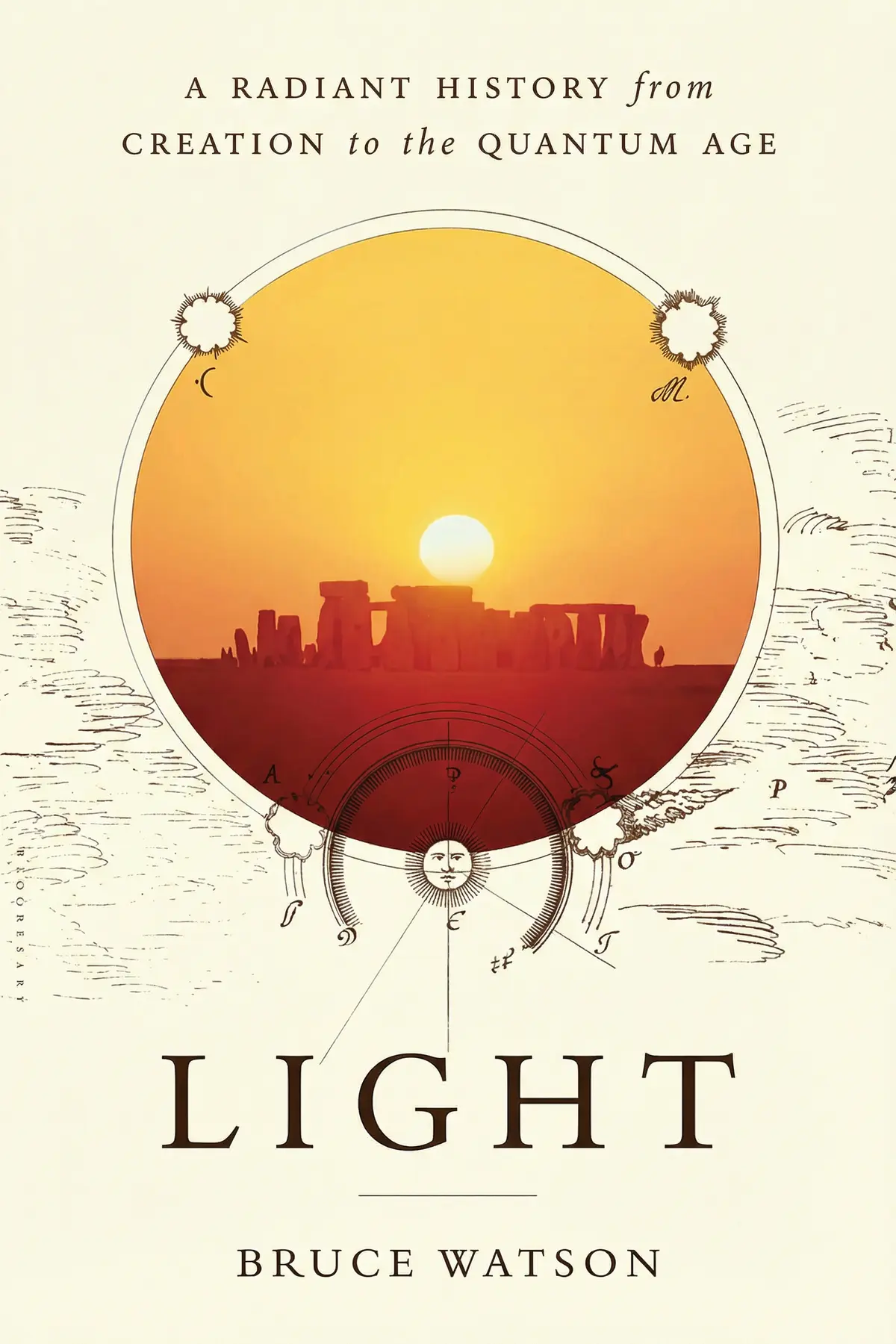
Table of Content
1. Introduction
1 min 02 sec
If light is just something you switch on, you are missing one of the longest arguments people have ever had. Humans worshipped light for thousands of years before anyone could say what it was, and the answer, when it came, pushed Albert Einstein to rethink time itself. In Light, writer Bruce Watson follows that argument from creation myths and scripture through Renaissance canvases and laboratory prisms to the quantum age.
His thread is easy to hold. Every era took the same mystery and made something new from it: first gods, then holy symbols, then paintings and music, and finally a physics so strange that it changed our sense of time. By the end, the glow of an ordinary lamp becomes a story you can tell, from a Congolese god who vomited up the sun to two narrow slits that tipped a long scientific dispute, and a clear picture of how wonder, faith, art and science keep feeding one another.
2. See why the first stories began with light
1 min 30 sec
Peoples in Finland and the Congo, along with the Zuni Native Americans, each told of the world’s beginning. Their stories involve an egg, an underworld and a sick god, and they all reach for the same thing.
3. Learn what Greek mirrors revealed about light's rules
1 min 26 sec
Ancient Greek thinkers could not agree on whether sight starts in the eye or in the world. Their experiments with mirrors revealed basic rules of reflection, and left one enormous question untouched.
4. Learn how mystery made light a symbol of the holy
1 min 34 sec
A word for lighthouse names a feature of mosques around the world, and medieval churches treated ordinary mirrors as sacred objects. The reason connects three religions to one unsolved puzzle.
5. Understand the first laws scientists found in light
1 min 33 sec
A candle across a room, a bouncing tennis ball and a glass prism each taught early scientists something exact about light. Yet a rival idea from Italy hinted that they were missing something basic.
6. Artists turned new knowledge of light into feeling
1 min 32 sec
Renaissance masters, a much-loved composer and a German poet all drew inspiration from light. One of them claimed that each color carries its own emotion.
7. Watch two narrow slits reveal light's wave nature
1 min 45 sec
An English scientist found evidence for one side of a stubborn question with little more than a beam of light and a pair of openings. His test has been ranked above every other experiment in modern physics.
8. See how light led Einstein to rethink time
1 min 37 sec
One physicist announced that his field had almost nothing left to discover. Within a few years, a puzzle about light hitting metal opened the way to a new idea of what time is.
9. Conclusion
1 min 14 sec
Watson’s history shows that light has never stayed one thing for long. It was a sun spilling from a broken egg, a sign of God in a mosque tower, a riddle in a Greek mirror, a mood in Goethe’s colors and finally the clue that told Einstein time can change. Each era looked at the same glow and found what it was ready to find, and every answer opened a new question.
What stands out is how long the mystery lasted. Rembrandt and da Vinci painted light with great skill long before anyone could say what it was made of, and even Young’s clean result was later complicated by Einstein’s packets of energy.
That gap is worth carrying into daily life. When something seems too obvious to question, ask where it actually comes from, as Empedocles did with light, and notice how much you have simply assumed. And the next time sunlight pours through a tall window, remember that it was once a god, then an argument, then an equation.
Today light waits behind a switch on the wall. It took worshippers, painters and physicists centuries to learn what arrives when you press it.
About this book
What is this book about?
Light is now something we switch on without a thought, yet for centuries no one knew what it really was. Bruce Watson tells the story of how humans tried to make sense of it, and how each attempt left its mark on the culture that made it. He begins with creation stories from Finland, the Congo, the Zuni people and the Book of Genesis, then follows Greek thinkers testing light in mirrors. Because no one could say what light was, Judaism, Islam and Christianity made it a sign of the holy, and Renaissance painters made it the heart of their realism. The scientific revolution then gave light laws, from Kepler's candle to Newton's prisms, and those laws in turn inspired composers and poets. The last stretch is a scientific detective story. Thomas Young's two-slit experiment pointed to waves, Maxwell showed light is electromagnetic, and Einstein proposed that light comes in packets of energy. His reasoning about light's constant speed led him to a startling conclusion about time. Readers get a single thread that ties together myth, religion, art and modern physics.
Book Information
Who it's for
Professionals curious across fields
Curious professionals who want one clear story linking religion, art and physics.
History or science students
Students of history or science looking for the human background to optics, waves and quanta.
Art and music fans
Art and music lovers wondering how ideas about light shaped painting, poetry and composition.
About the Author
Bruce Watson
Bruce Watson is a writer of narrative history whose Light was published by Bloomsbury in 2016 and nominated for an L.A. Times Book Prize in science. He has also written books on Freedom Summer, the Sacco and Vanzetti case and the 1912 Bread and Roses textile strike, plus short biographies of Jon Stewart and Stephen Colbert. He has written more than three dozen feature articles for Smithsonian, with work also in the Washington Post and the Wall Street Journal, and he writes The Attic, an online magazine of true stories about America.
Ratings & Reviews
Ratings at a glance

What people think
Listeners find the book accessible and straightforward, featuring thoroughly researched material that spans hundreds of years of thought regarding light. They admire the elegant writing style, with one listener observing that it reads like a thriller written by a poet. The work earns praise for its comprehensive scope, with one review characterizing the experience as a fascinating journey through the history of light. Listeners appreciate the book’s exploration of religion and mysticism, and one listener mentions it provides a foundational grasp of light for those without a scientific background.
Top reviews
Omar
Watson's prose is genuinely arresting, reading more like a lyrical thriller than a standard nonfiction text. He weaves together the mysticism of Stonehenge with the cold precision of Maxwell’s equations in a way that feels seamless. To be fair, some chapters linger a bit too long on the philosophical metaphors, but the historical scope is undeniably impressive. I found myself particularly drawn to the sections detailing how our ancestors perceived the divine in a simple sunrise. It’s an encyclopedic journey that somehow manages to remain accessible to those of us without a physics degree. This is a truly illuminating read that reminds us why light is the ultimate protagonist of the human story.
Show morePlernpiriya
Picked this up on a whim and was immediately struck by the sheer scale of Bruce Watson’s research. It is rare to find a book that treats stained glass windows and quantum mechanics with the same level of reverence and curiosity. In my experience, most science books tend to ignore the emotional impact of discovery, but Watson keeps the human element front and center. The chapter on how photography captured light through chemical reactions was a personal highlight that I won't soon forget. Even though some of the math-heavy sections went over my head, the overall narrative kept me hooked. This is a must-read for anyone who enjoys history with a side of physics and art.
Show moreTen
The way this book bridges the gap between the lab and the cathedral is nothing short of masterful. Watson’s writing is fluid and poetic, making the history of the telescope feel as dramatic as any work of fiction. Not everything landed perfectly—the discussion on light as a metaphor for love felt a bit repetitive after a while—but the core message remains strong. I loved learning about the shift from animal fat candles to incandescent bulbs and how that changed our social structures. It’s a broad, sweeping history that manages to feel intimate because of Watson’s focus on individual thinkers and artists. This is the kind of book you want to read slowly by the glow of a good lamp.
Show moreSirirat
Finally got around to this after hearing it described as a 'masterclass' in cultural history, and it mostly lived up to the hype. The book explores everything from Renaissance painters to the invention of the lightbulb with incredible detail and a poet's touch. Personally, I think the transition from soot-heavy tallow candles to the clean glow of LEDs was the most fascinating part of the narrative. The author has a real talent for making complex optics feel like a grand adventure through time. My only real gripe is that the middle sections felt slightly repetitive when discussing religious symbolism. Still, it is a solid achievement in science writing that I would recommend to any curious reader.
Show moreOm
This feels like it was written for a high-end television special, with each chapter unfolding like a beautifully narrated episode. Watson does a fantastic job of tracing our relationship with the sun, from ancient rituals to the modern-day internet. Not gonna lie, I was surprised by how much I enjoyed the bits about Haydn’s music and its sonic representation of light. The book successfully argues that light isn't just a physical constant, but a cultural force that has shaped our religions and our architecture. Some of the transitions between centuries are a bit abrupt, which can be jarring if you aren't paying close attention. Regardless, it’s a thought-provoking piece of work for any history buff.
Show moreSom
As someone who usually finds science history a bit tedious, I was pleasantly surprised by how much I enjoyed Watson's storytelling. He treats the discovery of the speed of light like a detective story, keeping the reader engaged through every twist and turn. Gotta say, the link between the Renaissance and our understanding of optics was handled with a lot of nuance and skill. It isn't a perfect book—the lack of focus on solar energy and modern technology felt like a missed opportunity—but it's still very good. The writing style is what really carries it, as it feels both scholarly and incredibly warm. I would definitely recommend this to anyone looking for a fresh perspective on the natural world.
Show moreFort
Look, I really wanted to love this given the subject matter, but it felt remarkably dry in several places. The writing is certainly elegant, but the pacing often slows to a crawl when the focus shifts heavily toward metaphorical interpretations. While the science of Einstein and Maxwell is touched upon, the book seems much more interested in how light felt to people than how it actually works. I appreciate the effort to bridge the humanities and the sciences, but for me, the balance was just a little off. It is a decent overview for a general audience, though it might not satisfy someone looking for a deep technical dive into the physics of photons.
Show moreGun
Truth is, I was expecting a bit more hard science and a bit less philosophy when I started this. The book is heavily weighted toward how light is perceived through art and religion, which is fine, but it left me wanting more physics. To be fair, Watson explains the Maxwell Equations quite well for a layman, but those moments are few and far between. The prose is beautiful, almost too beautiful at times, occasionally obscuring the actual facts of the history he’s presenting. It’s a pleasant read for a rainy afternoon, but it didn't quite hit the 'phenomenal' mark for me. Good, but perhaps a little too focused on the metaphorical side of things for my personal taste.
Show moreAnchalee
Ever wonder how we went from worshiping the sun to perfecting the LED? Watson takes us on that journey with a level of detail that is occasionally exhausting. From the winter solstice at Stonehenge to the quantum revolution, this book covers an immense amount of ground, but it often feels like it's trying to do too much. Personally, I found the exploration of how light influenced architectural glory in cathedrals interesting, yet the narrative gets bogged down in mysticism too frequently. It is an ambitious project that only partially succeeds in reconciling the ancient wonder of light with our modern understanding. A decent read, but not quite the 'phenomenal' experience I was promised by the cover blurb.
Show moreRin
Why would a book about light ignore the most fundamental biological process on Earth? I was stunned that Watson managed to write hundreds of pages without giving photosynthesis or the biological evolution of the eye more than a passing glance. Frankly, neglecting how life itself incorporates light feels like a massive oversight that undermines the 'comprehensive' nature of the work. The sections on art history and the development of artificial lighting are well-researched, but they can't fill the void left by the missing science. It felt like reading a biography of a chef that focuses only on the kitchen tools rather than the food. It’s a beautifully written book, but ultimately a frustratingly incomplete one.
Show moreQuestions about this book
What is Light by Bruce Watson about?
Watson tells the history of how people have understood light, from creation myths in Finland, the Congo and Genesis to Einstein’s quanta. He shows light moving from object of worship to sacred symbol, to the focus of Renaissance painting, to a subject of laboratory laws. The story ends with physicists discovering that light behaves as both particle and wave, and with Einstein using its constant speed to conclude that time itself can change.
Why does Light say religions treated light as holy?
Because for most of history nobody knew what light actually was. That mystery made it a natural symbol of the divine. The Old Testament shows God speaking from a burning bush, the Qur’an devotes a whole sura to light, and the word minaret comes from an Arabic word for place of light. In the Middle Ages, Thomas Aquinas pictured a blazing paradise, so gold, jewels and mirrors were seen as holy.
What was Young's experiment and why does it matter?
In 1802, Thomas Young shone light through two slits side by side. If light were a wave, the two streams should interfere, growing brighter where wave peaks lined up and darker where a peak met a low point. Young saw exactly that pattern, which supported the wave theory of light. Watson notes it has been called the most influential experiment in modern physics.
How did light lead Einstein to say time is relative?
Einstein started from the fact that light always travels at the same speed. Watson compares it to an airport walkway: your speed normally adds to the walkway’s, but light’s speed never changes that way. Since light can cross different distances in the same time while its speed stays fixed, Einstein concluded that time itself must be able to change. Earlier, in 1905, he also described light as packets of energy called quanta.
Readers also enjoyed
1491: New Revelations of the Americas Before Columbus
Charles C. Mann

Age of Anger: A History of the Present
Pankaj Mishra

A Life Decoded: My Genome: My Life
J. Craig Venter
1929: Inside the Greatest Crash in Wall Street History--and How It
Andrew Ross Sorkin
Agent Sonya: The Spy Next Door
Ben Macintyre
A Planet of Viruses
Carl Zimmer

A Biography of Loneliness: The History of an Emotion
Fay Bound Alberti
Alexander Hamilton
Ron Chernow

A Short History of Nearly Everything
Bill Bryson
AUDIO SUMMARY AVAILABLE
Listen to Light in 15 minutes
Get the key ideas from Light by Bruce Watson, plus 5,000+ more nonfiction titles.
- 5,000+ titles
- Listen as much as you want
- 7-day free trial
- Cancel anytime









