

14 min 12 sec
Available in: English
Life Worth Living: A Guide to What Matters Most
A guide to replacing the wealth-and-leisure picture of the good life with one you have tested. It draws on philosophers and religions, then gives tools such as a sponsor and a nightly review.
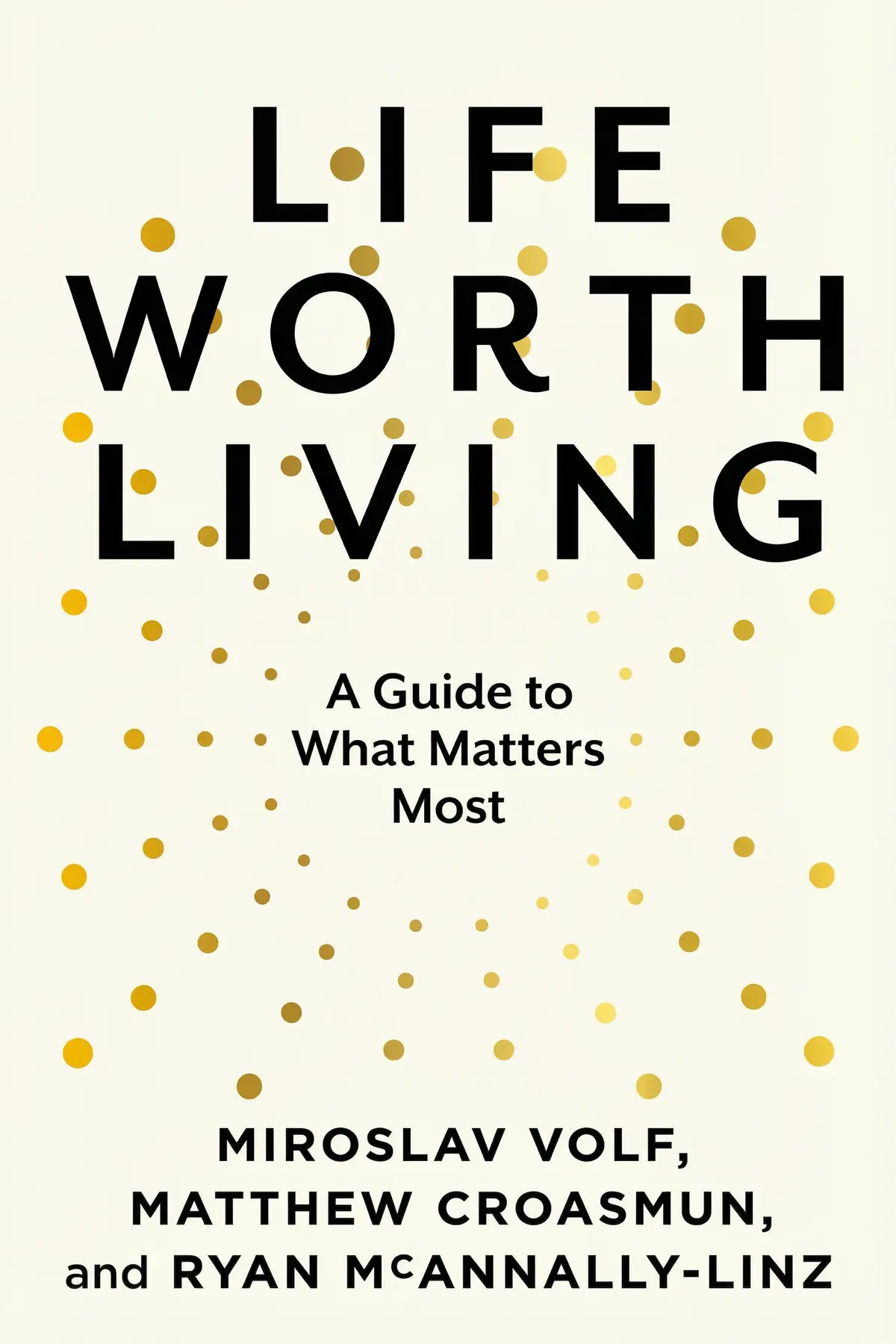
Table of Content
1. Introduction
1 min 12 sec
Many people chase a picture of the good life that looks like an advertisement: yachts, champagne, designer clothes and endless leisure. In Life Worth Living, Yale scholars Miroslav Volf, Matthew Croasmun and Ryan McAnnally-Linz suggest that this picture answers the wrong question. Asking what you want tends to lead toward comfort. Asking what is worth wanting leads somewhere better, and that harder question is at the heart of what the authors call the Question.
The Question is really a family of questions. What matters most? What should we hope for? Who do we answer to? The authors do not offer one correct answer. They set out what philosophers and faiths have said, from Jeremy Bentham to the Buddha, from Oscar Wilde in a prison cell to a soldier who became a saint, and invite you to build your own answer from the best parts. Then they insist on the step most people skip, which is actually living it. Their argument leaves you with three tools: a test for your desires, a map of your responsibilities and a nightly practice for staying on course.
2. Learn the one question that sorts your desires
1 min 40 sec
Reaching a goal and feeling oddly empty afterward is common. The authors trace that emptiness to a small choice of words, and they describe a dive that only works if you come back up.
3. Map who you answer to in three parts
1 min 48 sec
An old fire-safety slogan hides a surprisingly sharp tool for moral thinking. Each part of it points to a different kind of responsibility, and most people only ever consider one.
4. See what pleasure alone cannot give a good life
2 min 04 sec
One philosopher ranked a parlor game equal with a Beethoven symphony. A famous playwright, sitting in a prison cell, reached a very different verdict about pleasure and about the feeling he had spent years avoiding.
5. Two paths to freedom from endless craving
2 min 00 sec
The Buddha once lived on a single grain of rice a day, and then changed his mind. Three other faiths found release by a road that looks like the opposite of freedom.
6. Draw your circle of care wider
2 min 04 sec
Some of the most admired visions of the good life were written for a narrow slice of humanity. An author’s critique and an argument about death show what happens when that circle grows.
7. Turn your vision into daily practice that lasts
2 min 02 sec
Knowing your values rarely changes a life by itself. A recovery program built around one supportive person, and a daily prayer from a former sixteenth-century gambler, show what does.
8. Conclusion
1 min 22 sec
Life Worth Living ends a long way from the yacht where it began. The good life it describes is a meaningful one, where you flourish by pursuing values you have actually tested and perhaps help build a world where others can flourish too. No single school owns that life. Bentham’s concern for other people’s pleasure, Wilde’s respect for sorrow, the Buddha’s release from craving, the believer’s relief in obedience and Kimmerer’s care for water and trees can all belong in one recipe, as long as the ingredients work together.
The book is demanding because it holds you to both halves of the dive. Asking the Question honestly is hard. Coming back up and living the answer is harder, and the authors never pretend anyone does it alone.
So start with the wording. The next time you set a goal, ask whether it is worth wanting and whose forest it will touch. Find one person who shares your vision and can stand by you in the difficult weeks, the way a sponsor does. Then end each day with gratitude, an honest review and a plan to repair what went wrong.
Ignatius changed his life in a single moment, but he kept it changed one evening at a time.
About this book
What is this book about?
Ask people to picture the good life and many will describe yachts, fine restaurants, designer clothes and endless sunny days. Three Yale scholars, Miroslav Volf, Matthew Croasmun and Ryan McAnnally-Linz, argue that this picture answers the wrong question. The useful question is what is worth wanting. They call it the Question, and it brings others with it: what matters most, what we should hope for and who we answer to. The authors do not hand down one correct answer. They set the great traditions side by side: Jeremy Bentham's pleasure principle, Oscar Wilde's prison reflections on sorrow, the Buddha's middle way, obedience in Judaism, Christianity and Islam, Robin Wall Kimmerer's Indigenous-inspired care for the land, and competing views of death. Readers are invited to combine the parts that fit, like ingredients in a recipe. Then the book turns to the step most people skip, which is living the vision. It points to small communities like Alcoholics Anonymous and its sponsors, to the strength of shared ritual, and to the examen, a five-part daily review created by Ignatius of Loyola.
Book Information
Who it's for
Professionals questioning their success
Professionals who have reached their goals and still wonder what all the effort is for.
Weighing a major change
People weighing a career or life change who want to test their values before acting.
Exploring philosophy and religion
Readers curious how philosophy and the world's religions answer the question of how to live.
About the Author
Miroslav Volf
Miroslav Volf is Henry B. Wright Professor of Theology at Yale Divinity School and directs the Yale Center for Faith and Culture. His book Exclusion and Embrace won the Grawemeyer Award in Religion. Matthew Croasmun, an associate research scholar at the same center, directed its Life Worth Living Program and lectures in divinity and humanities at Yale. Ryan McAnnally-Linz is a systematic theologian with a Yale PhD and a former associate director of the center. His work brings together theology, ethics and cultural criticism.
Ratings & Reviews
Ratings at a glance
What people think
Listeners describe the work as stimulating, and one notes that it functions as an excellent primer on moral and ethical topics. The prose also earns praise, with one listener highlighting that the text was authored by three Christian theologians. Furthermore, listeners believe the book offers a solid return on investment. On the other hand, opinions on clarity are varied, as one listener found it difficult to read.
Top reviews
Thanit
Wow, this was exactly the existential kick in the teeth I needed this year. The authors do an incredible job of taking 'The Question' and breaking it down into manageable, yet deeply challenging, pieces. I loved how they wove together voices as diverse as Robin Wall Kimmerer, C.S. Lewis, and the Dalai Lama. It’s rare to find a book that feels both academically rigorous and deeply personal at the same time. The discussion on how our understanding of death gives agency to our life really stuck with me. If you’re willing to do the work, this book will change how you view your daily responsibilities.
Show moreFang
After listening to the audio version narrated with such care, I feel compelled to start a discussion group for my friends. The way the authors explain complex ideas like utilitarianism and the 'middle way' of Buddhism is so accessible. I especially appreciated the stories and examples that illustrated how these ancient ideas apply to modern life. It’s a great book for college-aged people, though I think even high schoolers could get a lot out of the sections on community. This is one of those rare books that actually provides a roadmap for flourishing. It is truly an invaluable guide for anyone seeking a more meaningful existence.
Show moreSupaporn
This book doesn't just ask what you want, it asks what is actually worth wanting in the long run. The concept of 'The Forest' of responsibility really resonated with me, especially the idea that we are accountable to more than just ourselves. I found the contrast between the 'will to power' and utilitarian ethics to be a brilliant way to spark internal debate. Even though the authors are theologians, the book feels inclusive and deeply rooted in our shared humanity. It’s the kind of text you want to keep on your bedside table to revisit whenever life feels aimless. Truly a masterclass in moral philosophy for the modern age.
Show moreThida
Ever wonder what actually makes a life worth living? This book uses a fascinating deep-sea dive metaphor to help you move past reflexive actions into true self-reflection. I particularly loved the 'Smokey the Bear' analogy for responsibility—it’s such a clever way to frame our duties to ourselves and the higher power. Personally, I found the chapters on pleasure and pain to be the most provocative, especially the contrast between Oscar Wilde and the Buddha. Some parts are a bit slow, but the overall journey is worth the effort. It really forces you to ask what is worth wanting instead of just what you want.
Show moreAurora
Finally got around to reading this after hearing about the famous Yale course it’s based on. The writing is incredibly thought-provoking, especially how it balances perspectives from three Christian theologians while remaining fair to non-Christian traditions. Frankly, I expected it to be a bit more evangelistic, but it stays remarkably ecumenical and open-minded throughout. It’s a great introduction to moral imagination for anyone who feels stuck in the daily grind. My only minor complaint is that the middle sections on various philosophies can feel a little rushed. Still, it’s a wonderful resource for anyone looking to build a life around what matters most.
Show moreRapee
The section on the Ignatius examen was the highlight of the whole experience for me. This book doesn't just leave you with abstract theories; it provides actual tools like daily prayers and reflection rituals to put ideas into action. I’ve been looking for a way to integrate more mindfulness into my routine, and the five-part review process is very helpful. Not gonna lie, some of the philosophical summaries are a bit simplified, especially when they tackle heavyweights like Nietzsche. However, as a guide for living rather than just a history of thought, it succeeds brilliantly. It would be a fantastic choice for a church book group.
Show moreSue
Picked this up because I’ve spent my whole career in STEM and realized I hadn't touched a philosophy book since college. The truth is, this serves as a decent, high-level survey of how different religions and schools of thought approach 'The Question.' I appreciated the inclusion of figures like Maimonides and Bentham alongside more modern voices. However, the survey style means you never really dive deep into any one tradition. It’s a good starting point for moral discourse, even if it feels a bit repetitive by the end. Not exactly life-changing, but it certainly stirs the imagination for a little while.
Show moreMalee
While the writing style is certainly clear and the authors are obviously brilliant, I think I’m just the wrong age for this. Look, this book essentially walks you through a popular Yale course aimed at twenty-somethings trying to find their path. As a seventy-year-old, I’ve already made most of the big decisions this book asks us to contemplate. The sections on responsibility and 'The Forest' are interesting, but they feel more like a refresher than a revelation. It is good value for money if you need a structured way to think about ethics, but older readers might find it a bit elementary.
Show moreRatchanee
As a student who had to read this for a class, I found the core message incredibly repetitive and basic. The central premise seems to be that what you do in your day makes up your life, which feels like a 'duh' moment. Truth is, the book tries to give a broad overview of so many different philosophies that it ends up watering all of them down. Most of my classmates admitted they didn’t actually finish the readings and just copied off worksheets. It might be good for sparking a classroom discussion, but as a standalone read, it’s uninspiring and doesn’t offer anything new. Blegh.
Show moreBook
I really wanted to like this, but I simply could not get through it. Honestly, it feels way too much like a dry classroom textbook rather than a guide for the general reader. I made it about halfway through the chapter on the Stoics and just felt completely lost in the jargon. Phrases like 'Agency' and 'The Way' are tossed around without enough grounding for someone reading this solo. To be fair, the authors are clearly experts, but the prose is just too dense and boring for a casual Sunday afternoon. I tried for about 75 pages and gave up because it felt like a chore rather than an inspiration.
Show moreQuestions about this book
What is the main idea of Life Worth Living?
Volf, Croasmun and McAnnally-Linz argue that the good life is not a life of wealth and leisure. It is a meaningful life you choose deliberately by asking what is worth wanting, a set of questions they call the Question. They compare answers from utilitarianism, Buddhism, Judaism, Christianity, Islam and other sources, invite readers to combine the parts that fit, and stress that the vision then has to be lived.
What is the Question in Life Worth Living?
The Question is a cluster of linked questions about how to live. Which things matter the most? How would a flourishing life appear? What should we hope for? Who do we answer to? The authors open with the shift from asking what you want to asking what is worth wanting, and compare it to a deep dive that must end with a return to everyday action.
What does Smokey the Bear have to do with responsibility?
The authors use the slogan Only you can prevent forest fires to name three kinds of responsibility. You are the agent who acts. The forest is the reach of your responsibility: family, community, the wider world and possibly non-human life. Smokey is the authority who sets rules and judges, a role many faiths give to God. They suggest weighing all three before making important choices.
How can I apply Life Worth Living in daily life?
Test your goals by asking whether they are worth wanting, then check whether your actions match. Find support, even one person, as Alcoholics Anonymous sponsors do. Use ritual, meditation or prayer. The authors highlight the examen of Ignatius of Loyola, a five-step evening review: gratitude, review of the day, sorrow, forgiveness and a request for grace for tomorrow.
Is Life Worth Living a religious book?
Its authors are Yale theologians and it draws heavily on Judaism, Christianity, Islam and Buddhism, but they do not push one answer. They also discuss Jeremy Bentham’s utilitarianism, Oscar Wilde, Robin Wall Kimmerer, Martha Nussbaum and others, and they invite readers to treat the traditions as ingredients for their own vision of the good life.
Readers also enjoyed

Abundance: The Inner Path to Wealth
Deepak Chopra
Aflame: Learning from Silence
Pico Iyer

Alcoholics Anonymous
Alcoholics Anonymous World Services


A Guide to the Good Life: The Ancient Art of Stoic Joy
William B. Irvine



A Force for Good: The Dalai Lama's Vision for Our World
Daniel Goleman
A Little History of Philosophy
Nigel Warburton
AUDIO SUMMARY AVAILABLE
Listen to Life Worth Living in 15 minutes
Get the key ideas from Life Worth Living by Miroslav Volf, plus 5,000+ more nonfiction titles.
- 5,000+ titles
- Listen as much as you want
- 7-day free trial
- Cancel anytime









