

16 min 53 sec
Available in: English
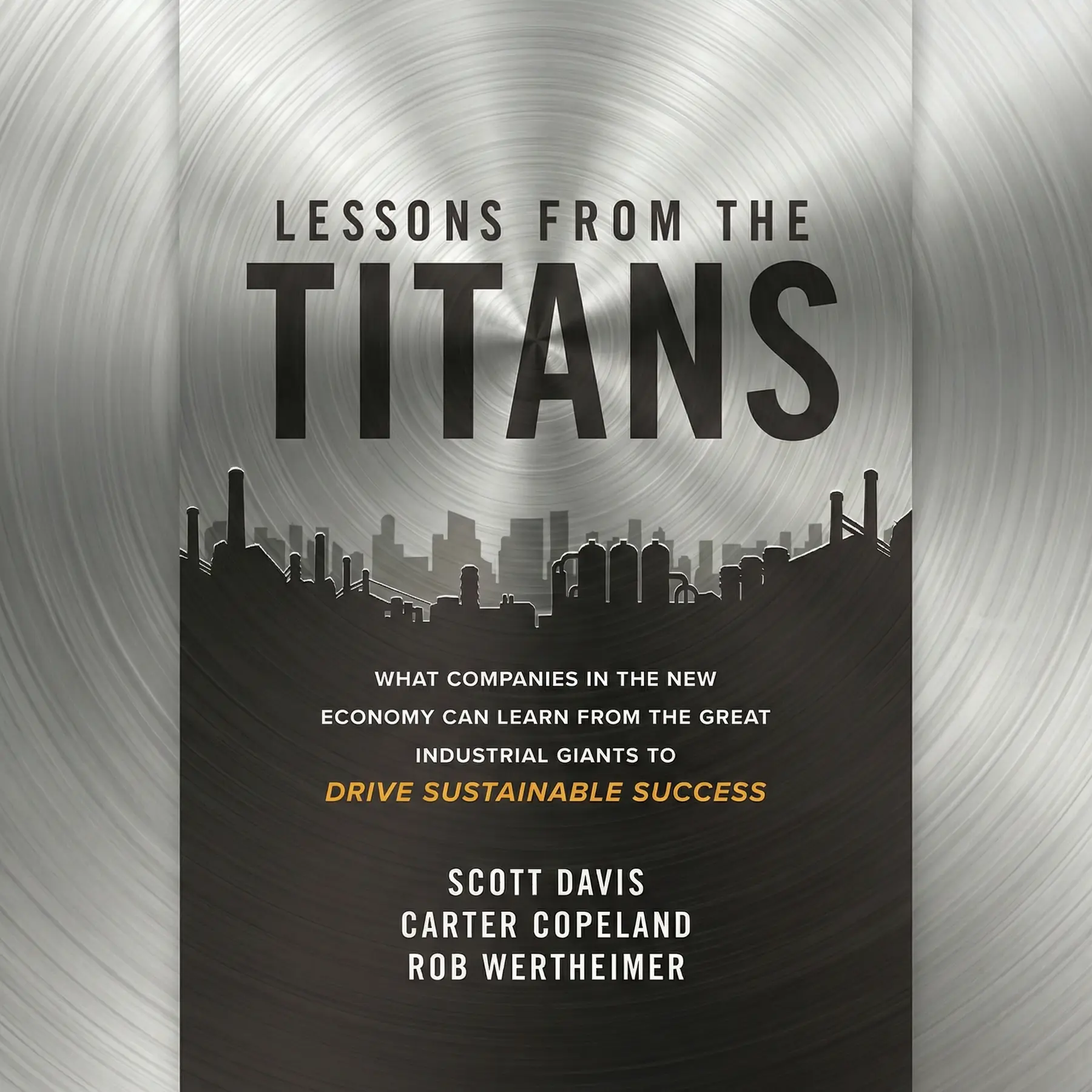
Lessons from the Titans: What Companies in the New Economy Can Learn from the Great Industrial Giants to Drive Sustainable Success
Shows why great companies usually decline from arrogant management, not outside disruption, and which habits (honest numbers, cost discipline, smart incentives and steady improvement) kept GE, Boeing, Honeywell and United Rentals rising or falling.

Table of Content
1. Introduction
1 min 10 sec
Most leaders worry about the startup that might disrupt them, but the bigger danger usually sits inside their own building. In Lessons from the Titans, Wall Street analysts Scott Davis, Carter Copeland and Rob Wertheimer argue that great companies fail more often from arrogant management than from new rivals. Collapses that look sudden have usually been building for years.
Their evidence comes from industrial giants they have covered closely: General Electric, Boeing, Honeywell and the equipment renter United Rentals. One argument runs through every case. Companies last when leaders stay humble, keep costs and risks in check, run disciplined systems and invest cash only where it earns a real return. They fade when success breeds pride and bad news stops reaching the top.
Along the way, GE gets a television network for free, Boeing loses more than $50 billion on one airplane, and nobody wants to run Honeywell. Each story leaves a habit you can test on your own team or business this month.
2. Turn one odd deal into decades of growth
1 min 56 sec
Wall Street could not understand why GE would pay billions for an electronics company it did not need. The real plan was hidden inside the deal, and it paid for two of GE’s biggest bets.
3. Steady profits can hide a shaky business
2 min 02 sec
For years GE looked like a company that never had a bad quarter. The smoothness itself was the warning, and the arm of the company producing it carried more risk than almost anyone realized.
4. Make it safe to bring you bad news
1 min 56 sec
In his first year covering GE, an analyst got a daily phone call warning him that the company could wreck his career. What that pressure did to the stock, and to the company, is a warning for anyone who leads people.
5. Test your savings before you trust them
2 min 13 sec
Boeing’s own figures said building parts in-house was 30 percent cheaper. The authors doubt it, and what followed shows how a cost plan that looks clever in a spreadsheet can fail badly in the real world.
6. Put people and money where growth lives
2 min 10 sec
Honeywell’s new boss got the job because nobody else would take it. Instead of the usual layoffs, he hired more people, and within fifteen years the company’s profit margin had nearly doubled.
7. Reward teamwork and the whole company improves
2 min 09 sec
Branch managers at one rental company kept buying machines they did not need, and nobody had told them to. The cause was hiding in their paychecks, and fixing it started a turnaround.
8. Lift the middle 80 percent of your team
1 min 58 sec
Most leaders pour their attention into a few star performers. The authors run the numbers and find that a modest gain from ordinary employees beats a huge leap from the stars by a wide margin.
9. Conclusion
1 min 19 sec
None of the giants in these stories was brought down by an outsider. GE went from one of the largest companies on Earth to the edge of insolvency because pride, smoothed accounting and fear of criticism let problems grow out of sight. Boeing finally made the Dreamliner pay, then a defect in the 737 MAX cost many lives. Honeywell and United Rentals, both fighting to survive, became two of the steadiest companies around by doing unglamorous work well.
What the authors describe is a discipline that rarely looks heroic. It lives in knowing your true costs, counting defects per million, paying managers for the district’s results and hiring where the growth actually is.
You can begin this week. Ask the colleague who disagrees with you most to explain why, and make sure they are glad they did. When a set of numbers never moves, look closer instead of relaxing. Before the next big purchase or acquisition, write down the return you expect and check it a year later. And give more of your attention to the middle of your team than to its stars.
Decline takes years to build, and so does recovery. Both start with whether you are willing to hear one honest number.
About this book
What is this book about?
When a famous company collapses, people usually blame a clever startup. Three veteran industrial analysts, Scott Davis, Carter Copeland and Rob Wertheimer, think that blame usually lands in the wrong place. In their view the more common cause is an arrogant management culture, and a fall that looks sudden has usually been years in the making. To prove it, they study industrial giants they know well. General Electric under Jack Welch and Jeffrey Immelt rose to a peak whose value, in 2020 dollars, edged past the biggest tech companies of 2020, then nearly failed. Boeing lost more than $50 billion on the 787 Dreamliner, then saw the 737 MAX crash twice. Honeywell and United Rentals, both close to collapse, were rebuilt by leaders who cut waste, rethought incentives and improved a little every day. From these cases the authors pull a set of rules that apply just as much to young technology companies: manage costs and risk, grow cash flow, invest only in deals that truly pay, keep the culture humble and lift the performance of ordinary employees instead of betting everything on stars.
Book Information
Who it's for
Founders and executives
Founders and executives who want to build a company that lasts beyond its first big win.
Managers making key decisions
Managers deciding how to reward people, cut costs or judge an acquisition.
Investors and analysts
Investors and analysts who want to spot a company's decline before the share price shows it.
About the Author
Scott Davis
Scott Davis, Carter Copeland and Rob Wertheimer lead Melius Research. Davis is its chairman and CEO, with about 25 years in industrials research, including 16 at Morgan Stanley and 6 at Barclays, and Institutional Investor has ranked him the top multi-industry analyst six times. Copeland, Melius's president, covers aerospace and defense and was named the number one analyst in that sector by Institutional Investor's Alpha magazine. Wertheimer, a founding partner, directs research and covers machinery after two decades in equity research.
Ratings & Reviews
Ratings at a glance
What people think
Listeners find the book provides useful lessons that can be applied across various industries, with one review highlighting its strong emphasis on process discipline. Furthermore, the text is thoroughly researched and enjoyable to read, with one listener characterizing the work as "wildly entertaining narratives." Listeners also appreciate the authors' writing style, with one noting it is written by articulate former sell-side analysts, and they value the investment insights, as one review mentions its relevance for both public and private markets investors.
Top reviews
Yothaka
Rarely do you find a book written by sell-side analysts that actually captures the soul of the industrial sector. The authors provide a masterclass in how culture and process discipline drive long-term value. I found the investment frameworks particularly sharp, especially the focus on metrics like inventory turns and incremental margins. Most business books are fluff, but this offers a rigorous look at how Danaher and Honeywell actually operate. The breakdown of the Danaher Business System (DBS) is the best I've seen in print. If you want to understand why some conglomerates thrive while others like GE crumble, this is your roadmap. It’s a deep dive that rewards careful reading.
Show moreSoontorn
What surprised me most was how the authors turned dry industrial data into wildly entertaining narratives. You wouldn't think a chapter on Stanley Black & Decker would be a page-turner, but the focus on 'skunk works' projects was fascinating. The book excels at explaining the 'why' behind corporate evolution. I loved the emphasis on humility as a leadership trait. In an era of celebrity CEOs, hearing about managers who focus on 'first pass' rates and safety is a breath of fresh air. This is an essential toolkit for both public and private market investors. Truly a solid read that I'll be referencing for years.
Show moreHassan
Finally got around to finishing this and the chapter on Transdigm alone is worth the price of admission. The authors explain the aerospace aftermarket and regulatory moats with incredible clarity. It’s rare to find such a blunt assessment of how pricing power and niche monopolies actually work. I’ve been an investor since the late 70s, and I still learned a lot about the nuances of Lean manufacturing. The book strikes a perfect balance between being an educational resource and an entertaining read. The concluding chapter ties all the 'lessons learned' together perfectly. This is high-level analysis that stays accessible throughout. Highly recommended for any serious portfolio manager.
Show moreSavannah
Industrial stocks aren't usually known for being the subject of page-turners, but Davis and his co-authors pulled it off. This book is a fascinating look at the 'titans' that build the world around us. Not gonna lie, I expected something much drier. Instead, I got a series of insightful stories about grit, failure, and the relentless pursuit of efficiency. The breakdown of Caterpillar’s inability to forecast cycles was particularly enlightening. It’s a great reminder that even the biggest players can stumble if they lose their lean edge. The authors' style is engaging and authoritative. It's a must-read for anyone who wants to understand the backbone of the economy.
Show moreSupachai
Look, if you're an investor, you need this on your shelf. The authors use their sell-side experience to point out the red flags that most people miss until it's too late. The GE sections are infuriating but necessary, showing how analysts were coerced into ignoring negative data for years. It’s a cautionary tale about the dangers of executive celebrity and wasteful spending. Beyond the drama, the book offers a clear investment framework based on humility and continuous improvement. It’s well-researched and avoids the fluff usually found in business biographies. You get real metrics, real history, and real lessons. This is easily one of the best business books I've picked up in a decade.
Show moreMadison
As an operator in the industrial space, I found these historical case studies incredibly grounded. The authors don't just celebrate success; they dissect the failure of GE with refreshing honesty. It connects the dots between leadership decisions and the resulting financial dynamics in a way that feels authentic to the shop floor. I do think some of the stories are well-worn in investing circles, leading to a bit of repetition in the middle chapters. However, the lessons on 'lean' and capital allocation are essential for anyone trying to fix a cost base. It’s not just for Wall Street guys. It’s for anyone trying to build a disciplined organization.
Show morePierre
Picked this up after seeing a recommendation on Twitter and it mostly lived up to the hype. The writing style is articulate, clearly coming from people who have spent decades grilling management teams. To be fair, if you’re looking for high-frequency data tables, you might find it a bit ‘squishy’ in parts. But the qualitative insights on Boeing and United Technologies are gold. I particularly appreciated the warning signs for investors, like CEOs pursuing mega-mergers in their twilight years. It’s a bit of an old-school investing perspective, but the logic is sound. It’s a refreshing deviation from the tech-heavy narratives dominating the market today.
Show moreRyan
The chapter on Danaher is essentially a manual for how to run a disciplined business. I appreciated how the authors highlighted that most companies talking about culture don't actually have one. It’s a sobering look at the industrial landscape. My only gripe is that it feels a bit repetitive if you read it cover-to-cover in one sitting. Some of the case studies start to blend together after a while. Still, the focus on R&D investment and capex-to-depreciation ratios provides a great framework for screening stocks. It’s a solid, practical book for anyone who values process over personality. It helped me connect many dots regarding my own employer’s leadership.
Show morePhimwan
Ever wonder how these massive blue-chip companies actually function behind the scenes? This book provides the answer through ten detailed case studies. I work for one of the included companies, and the insights into our corporate history were spot on. The authors describe the 'defense before offense' mindset of Honeywell and it perfectly explains our internal incentives. While the narrative can feel a bit dismissive of modern tech companies at times, the long-term perspective is valuable. It’s a sobering reminder that turnarounds take time—usually five years or more. It’s not perfect, but it’s a very useful tool for understanding industrial dynamics. I wish I’d read this during my orientation.
Show moreUbolrat
Frankly, I was disappointed given the glowing reviews I’d seen elsewhere. This felt like a typical business book where the analysis could have been so much deeper. These are public companies with decades of freely available data, yet the authors stayed at the surface level far too often. I wanted more on how strategy specifically translated into return on capital and FCF growth. Instead, we got a lot of high-level talk about culture and leadership. The GE chapter was okay, but I’ve read much better post-mortems on Immelt’s tenure. It felt like average sell-side commentary stretched into a book. It’s a great idea that just didn’t hit the mark for me.
Show moreQuestions about this book
What is the main idea of Lessons from the Titans?
Scott Davis, Carter Copeland and Rob Wertheimer argue that big companies usually decline because of an arrogant management culture, not because of disruptive startups, and that such falls build for years. Using General Electric, Boeing, Honeywell and United Rentals as cases, they show that lasting success comes from managing costs and risks, growing cash flow, investing capital wisely and keeping a humble culture of continuous improvement.
Why did General Electric decline according to Lessons from the Titans?
The authors point to GE Capital and the culture around it. The lending arm grew to 55 percent of earnings by 2007, and GE could shift gains between businesses to make profits look steady. Criticism was discouraged, even toward outside analysts. The 2008 crisis hit GE hard, its share price fell to $6 in 2009, and later deals such as the $17 billion Alstom Power purchase hurt its recovery.
How did Dave Cote turn Honeywell around?
Cote hired a finance chief who cleaned up the accounting and settled most asbestos lawsuits. He cut costs while hiring in growth areas like business jets and environmental products, made products where they were sold, and gave factories clear measures through the Honeywell Operating System. Research went mainly to fast-growing products. The profit margin rose from 11 percent in 2002 to about 20 percent in 2017.
How can managers apply Lessons from the Titans?
Check what your pay system really rewards, as United Rentals did when it tied 70 percent of manager pay to district results. Treat suspiciously smooth numbers as a warning sign. Invest only in deals with a tangible return. And focus on the middle 80 percent of employees: the authors calculate that a 10 percent gain there has three times the impact of stars improving by 50 percent.
Who should read Lessons from the Titans?
It suits founders, executives and team leads who want to understand why strong companies weaken and how others recover, along with investors trying to read the warning signs early. Leaders of newer technology companies may find it especially useful, since the authors argue that firms like Uber and WeWork face the same basic problems of profitability and risk management as the old industrial giants.
Readers also enjoyed

A Bigger Prize: How We Can Do Better Than the Competition
Margaret Heffernan





A Year with Peter Drucker: 52 Weeks of Coaching for Leadership Effectiveness
Joseph A. Maciariello



Acting with Power: Why We Are More Powerful Than We Believe
Deborah Gruenfeld
AUDIO SUMMARY AVAILABLE
Listen to Lessons from the Titans in 15 minutes
Get the key ideas from Lessons from the Titans by Scott Davis, plus 5,000+ more nonfiction titles.
- 5,000+ titles
- Listen as much as you want
- 7-day free trial
- Cancel anytime









