

14 min 50 sec
Available in: English
Leisure: The Basis of Culture
By Josef Pieper
Pieper shows why rest that only recharges you for work is not real leisure. True leisure is receptive stillness, rooted in celebration and worship, and it is the ground every culture grows from.
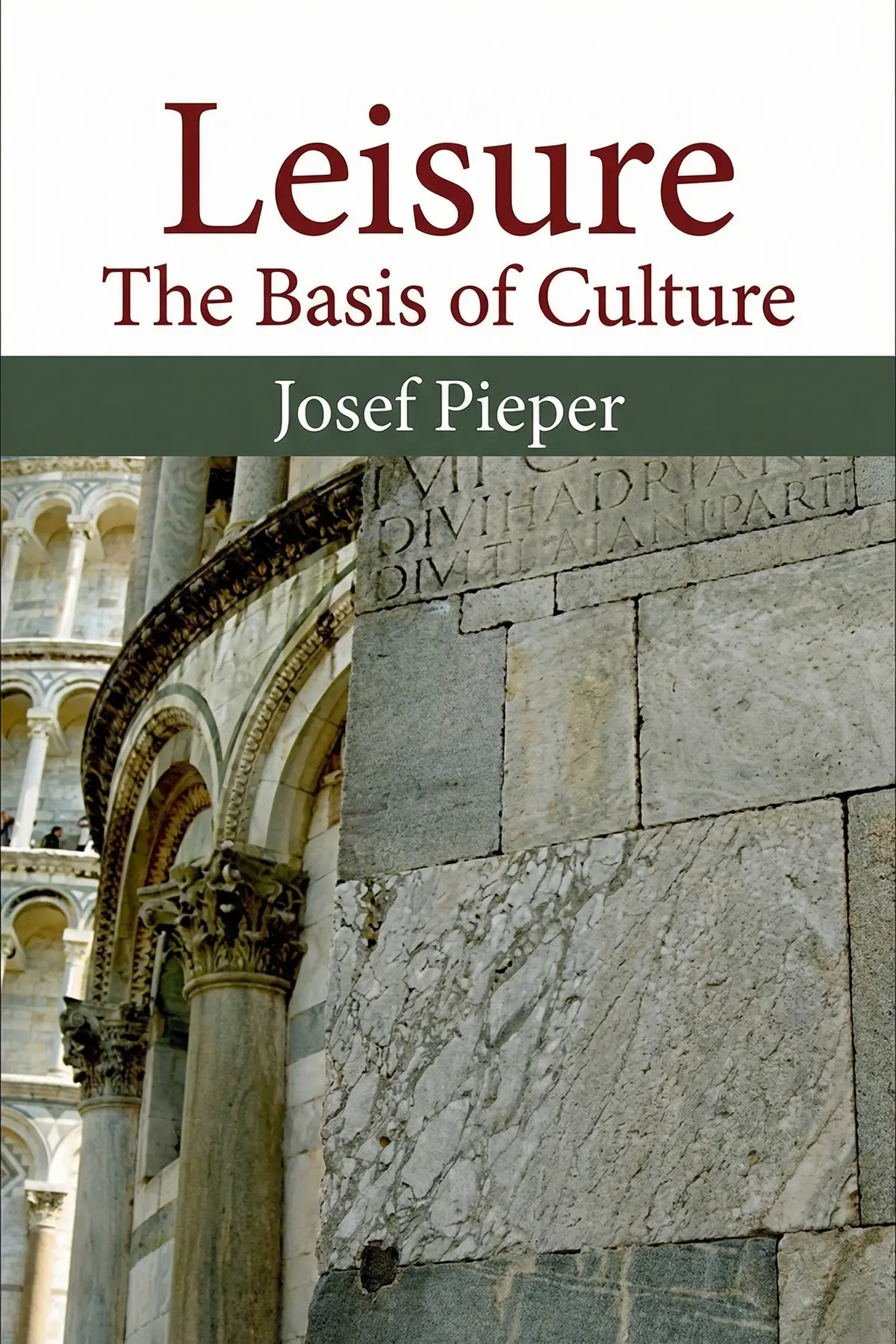
Table of Content
1. Introduction
1 min 06 sec
If your evenings and weekends exist mostly to recharge you for Monday, Josef Pieper would say you have lost something the ancient world took for granted. In Leisure: The Basis of Culture, the German philosopher points out that the Greek word for leisure, skole, gave us the word school. The place of learning was named after free time, and work was described only as its absence.
Pieper wrote the essay in 1947, in a Germany rebuilding after war, and its original title means Leisure and Worship. That title holds his throughline. Leisure is a receptive stillness of the soul that grows from celebration and worship, and when it is cut from that root, both our rest and our culture shrink into tools for more production. He does not attack work. He asks whether a human life can be used up by it entirely.
Follow his argument and you will be able to tell real rest from recovery, see why good ideas arrive when you stop pushing, and understand why a culture that cannot celebrate cannot last.
2. Put work back in service of leisure
1 min 55 sec
The ancient Greeks had no positive word for a job, only a word that meant the absence of something else. What they put at the center of life says a lot about what we have pushed to the edges.
3. See more by straining less
2 min 14 sec
Counting the thorns on a rose and seeing its beauty are both ways of knowing it. Modern thought kept only one of them, and Pieper argues the loss has made us harder in a way few people notice.
4. Stop distrusting what comes easily
1 min 56 sec
Most of us assume the hard-won skill is worth more than the easy one. A medieval argument about loving your neighbor suggests that instinct may be backwards, and that it shuts us off from our best moments.
5. Tell real rest from busy recovery
2 min 09 sec
A weekend of serious golf and home projects can feel like time off. Pieper’s definition of leisure says otherwise, and it links the workaholic and the idler in a way neither would enjoy hearing.
6. Break free from work, however well you are paid
1 min 58 sec
Pieper uses an old political word in a way that includes the comfortable office worker. His definition of who is trapped by work, and his three ways out, reach well beyond economics.
7. Find the festival that makes leisure possible
2 min 16 sec
The book’s original title pairs leisure with a word most readers skip past. Pieper’s boldest claim is that without it, rest turns hollow, work turns endless and culture loses the thing that feeds it.
8. Conclusion
1 min 16 sec
Pieper’s short book, first published in English in 1952 with an introduction by T. S. Eliot, makes a large claim. Our schools, the philosophy we admire, even our weekends, all depend on a capacity we have trained ourselves out of: the ability to stop, receive and affirm. A society of total work can produce enormous wealth and still find its rest hollow, its thinking strained and its festivals empty, because it has cut leisure from the root that fed it.
What he asks of a reader is modest in form and demanding in spirit. Guard some time that serves nothing, and resist filling it with play work. When an insight arrives without effort, accept it instead of discounting it because it cost you nothing. Treat boredom and compulsive busyness as two faces of the same restlessness. And find something to celebrate, an occasion whose whole point is to say that the world is good.
Pieper warned that unless hectic amusement gives way to silence, insight and non-activity, we risk destroying our culture and ourselves. The Greeks named their schools after leisure. His book leaves us asking whether we still remember why.
About this book
What is this book about?
Many professionals treat evenings, weekends and holidays as recovery time, a way to be fit for work again. Josef Pieper argues that this reverses an order he takes from Aristotle and the ancient Greeks. The Greeks named their places of learning after leisure and described work only as its absence. Modern life, he says, has fallen into total work, where even thinking counts as labor and anything gained without strain looks suspect. Writing in 1947, Pieper draws on Aristotle and Thomas Aquinas to rebuild the idea. Knowing needs both busy reasoning and simple, receptive seeing. The best insights and virtues often come as gifts. Restlessness and idleness share a single root. People can be chained to work whether they are poor or well paid. At the bottom of it all, leisure grows from festival, and festival grows from worship. Readers get a sharper way to tell real rest from busy recovery, a reason to trust insights that come without effort, and a serious account of why a culture that forgets how to celebrate puts itself at risk.
Book Information
Who it's for
Knowledge workers rethinking rest
Knowledge workers whose weekends feel like recovery shifts and who want a deeper idea of rest.
Professionals questioning their busyness
Burned-out professionals who suspect their busyness has become a habit they cannot switch off.
Curious about Pieper's claim
Readers of philosophy and faith curious why Pieper calls leisure the basis of culture.
About the Author
Josef Pieper
Josef Pieper was born in Elte, in the German Empire, in 1904 and died in 1997. He studied Plato and Thomas Aquinas closely and taught philosophical anthropology at the University of Münster. He is counted among the thinkers who revived interest in Aquinas in the early and middle twentieth century. His other notable works include The Four Cardinal Virtues and Guide to Thomas Aquinas.
Ratings & Reviews
Ratings at a glance
What people think
Listeners find this philosophical work quite insightful, with one listener noting that it offers a lucid depiction of contemporary society. They also value the heartening message, with one listener mentioning feeling inspired after every chapter, and believe it is truly worth the effort. Furthermore, the text receives praise for its take on rest, with one review highlighting how it reverses our standard concept of leisure. However, reactions to the readability are mixed, as one listener found the book difficult to parse.
Top reviews
Pracha
This slim volume packs an intellectual punch that most modern self-help books couldn't dream of landing. Pieper effectively flips our current understanding of leisure on its head, arguing that it isn't just 'time off' from a grueling job but the very foundation of human culture. Truth is, I felt inspired at the end of each chapter because he validates the 'useless' pursuit of philosophy as something essential to our nature. He writes with a post-war German gravity that makes his critique of 'total labor' feel incredibly urgent even today. It is an uplifting experience to realize that our worth isn't tied to productivity or some frantic hustle. If you want a clear description of why modern society feels so hollow, this is the definitive text. It requires focus, but the intellectual reward is immense.
Show moreLuckana
Rarely does a book change your fundamental perception of a single word, but 'Leisure' does exactly that. Pieper explains that leisure is a receptive attitude of mind and a contemplative beholding of reality, rather than just hitting the beach or snowboarding. Not gonna lie, his argument that eliminating religion cuts the heart out of culture was a bold pill to swallow, but he defends it with such grace. The way he connects leisure to divine worship and celebration is beautiful and provides a much-needed corrective to our secular, work-obsessed era. I found the sections on 'wonder' to be particularly moving and deeply insightful. This isn't just an academic exercise; it’s a manual for reclaiming your soul from the machinery of the workaday world. Every page offers a new reason to stop and think.
Show moreArnav
Each chapter left me feeling strangely quieted and deeply inspired to reclaim my own humanity from the gears of the modern world. Pieper’s central thesis—that leisure is the basis of culture because it allows us to contemplate Things As They Are—is a revelation. I’ve read plenty of books on mindfulness, but none have the philosophical depth or the cultural bite of this monograph. He successfully argues that when we view everything through the lens of utility, we lose the capacity for joy and festive celebration. The truth is, we are more than just social functionaries or workers; we are beings meant for wonder. This book is an excellent example of critical thinking that challenges both sides of the economic spectrum. It is well worth the effort for anyone feeling the weight of endless drudgery.
Show moreUbolrat
While the first essay on leisure gets all the glory, the second monograph on 'The Philosophical Act' is equally essential for understanding Pieper’s vision. He describes philosophizing as stepping beyond the workaday world to engage with the totality of existence, which is a breath of fresh air. Frankly, the way he links the ability to wonder with the capacity for true leisure is brilliant. He shows that we can only be bored if we have lost the spiritual power to be leisurely in the first place. This book flipped my understanding of 'free time' entirely. It’s not about doing nothing; it’s about being open to everything. For a book written decades ago, its critique of the 'worker' mentality feels like it was written about our current social media-driven hustle culture. It’s absolutely essential reading.
Show moreYuki
After hearing so much about Pieper’s critique of 'total labor,' I finally dove into this 1947 classic. The book is actually two distinct monographs, and while the first is more famous, both offer a profound rebuke of our obsession with being 'useful.' Look, the prose is definitely dense in that traditional German philosophical style, which makes the readability a bit of a mixed bag for a casual reader. However, his insights into how we’ve replaced true contemplation with mindless entertainment are stinging. I particularly appreciated his discussion on 'acedia' or spiritual sloth, which he links to our inability to simply be still. While I found some of his theological assertions a bit leap-of-faith heavy, the core message is salubrious. It’s a challenging read that demands you slow down, which is ironically exactly what the book advocates for.
Show moreFang
Is it possible that our obsession with productivity is actually a form of spiritual despair? Pieper argues exactly this, suggesting that 'total labor' is a grim prospect that leads to inner impoverishment and a loss of wonder. Personally, I found his definition of leisure as an 'effortless' act of celebration to be the most compelling part of the book. It’s a radical idea to suggest that the best things in life are those we don't 'work' for but simply receive. The historical context of post-war Germany adds a layer of poignancy to his rejection of mindless slavery to the state or the market. While the writing style is occasionally dry, the underlying sentiment is incredibly uplifting. It makes you realize that being 'useless' in the eyes of the world is often a prerequisite for being truly human.
Show morePan
Pieper’s argument that leisure is not simply 'vacation time' feels like a much-needed slap in the face for our current society. We often mock others for their work ethic, yet Pieper suggests this obsession is merely an expression of our own moral and spiritual poverty. I found his analysis of how we've turned even our 'hobbies' into forms of work to be incredibly accurate. My only real gripe is that he avoids the economic realities that make leisure impossible for so many people today. He speaks of it as a spiritual capacity, which is true, but ignores the 'human foundations' like a living wage that Aristotle noted were necessary. Still, the book provides a clear and necessary description of the sickness affecting our modern souls. It's a profound, if occasionally elitist, look at what it means to live well.
Show morePim
If you feel like you're drowning in a sea of emails and 'deliverables,' stop what you are doing and read this immediately. Pieper reminds us that the best parts of being human—art, philosophy, and love—cannot be justified by their 'usefulness' to society. I was particularly struck by his point that leisure is a form of silence that is a prerequisite for apprehending reality. It’s an insightful look at how we’ve traded our spiritual development for economic efficiency. To be fair, some of the Hegelian 'spirit' talk got a bit dense for me, but the overall message is clear and incredibly salubrious. It’s a book that demands a slow pace, ironically forcing you to practice the very leisure it describes. A truly definitive rebuke of the productivity trap that defines our lives.
Show moreSupachai
To be fair, the concepts here are groundbreaking, but the prose is a dense thicket that requires several passes to hack through. I struggled with how Pieper presents massive theological assertions as if they were self-evident truths without providing the rigorous grounding you'd find in someone like C.S. Lewis. He stands firmly in the tradition of German Idealism, which makes his discussion of 'spirit' feel a bit airy and intuitive at times. I agree that our society is obsessed with productivity to a fault, yet I found his rejection of the 'useful' to be slightly hyperbolic. It's an important conservative critique of the Cold War era, but it lacks a certain practical bridge to modern life. If you aren't already well-versed in philosophy, you might find this more frustrating than inspiring.
Show moreKamol
Gotta say, I have mixed feelings about this one despite its high reputation among conservative intellectuals. On one hand, Pieper offers a biting and necessary critique of the 'total labor' state that resonates deeply in our age of burnout. On the other hand, the readability is quite challenging, and his arguments often feel like they are floating in a vacuum of high-altitude abstraction. He laments the decline of leisure and worship but then suggests these things cannot be humanly manufactured, which leaves the reader in a bit of a stalemate. It’s a brilliant analysis of the symptoms of our cultural decline, but the 'cure' remains somewhat elusive and tethered to a specific religious worldview. I appreciate the insights, but I left the book feeling more intellectually stimulated than practically helped. It’s worth reading, but keep your dictionary close.
Show moreQuestions about this book
What is the main idea of Leisure: The Basis of Culture?
Josef Pieper argues that leisure is an inner stillness and receptiveness. It is neither idleness nor a break that recharges us for work. Following Aristotle, he holds that we work in order to have leisure. Modern total work has reversed that order. Leisure, he says, grows from celebration and festival, which grow from worship, and culture depends on that root. Without it, rest becomes mere recovery and culture weakens.
What does Pieper mean by total work?
Total work is Pieper’s name for a world where work defines human existence. It binds people to production and then calls that the meaning of life. In such a world even thinking becomes intellectual work, weekends exist to restore our capacity for labor, and anything gained without effort looks suspect. Pieper does not reject work itself. He questions whether life can be used up by it entirely.
What is the difference between ratio and intellectus?
These are the two ways of knowing that ancient and medieval thinkers recognized. Ratio is discursive reasoning: analyzing, comparing and deducing step by step. Intellectus is receptive contemplation, a simple looking at what is there. Pieper argues that human knowing needs both, but modern thought, shaped by thinkers like Kant, values only ratio and treats all knowledge as the product of labor.
How can I apply Pieper's ideas about leisure?
Start by asking what your free time is for. If it only prepares you for more work, it is not leisure in Pieper’s sense. Protect some time that serves no purpose, and avoid filling it with intense play such as serious hobbies done like a job. Accept insights that arrive without strain. Make room for celebration that affirms the world is good, which Pieper ties to worship.
Is Leisure: The Basis of Culture a religious book?
Yes, at its center. The German title of the main essay means Leisure and Worship. Pieper argues that true festival draws its life from divine worship, and that culture cannot be renewed by willpower or by studying antiquity, because antiquity itself was built on worship. He has the Christian cultus in mind. His analysis of total work and restlessness can still speak to readers who do not share his faith.
Readers also enjoyed

A Guide to the Good Life: The Ancient Art of Stoic Joy
William B. Irvine

A Little History of Philosophy
Nigel Warburton

A Theory of Justice
John Rawls


Anarchism: A Very Short Introduction
Colin Ward
AUDIO SUMMARY AVAILABLE
Listen to Leisure in 15 minutes
Get the key ideas from Leisure by Josef Pieper, plus 5,000+ more nonfiction titles.
- 5,000+ titles
- Listen as much as you want
- 7-day free trial
- Cancel anytime









