

12 min 37 sec
Available in: English
Lead Yourself First: Inspiring Leadership Through Solitude
Shows how regular, protected time alone helps leaders sharpen decisions, find original ideas, stay calm under pressure and keep their values. The examples run from Eisenhower and Grant to today's executives.
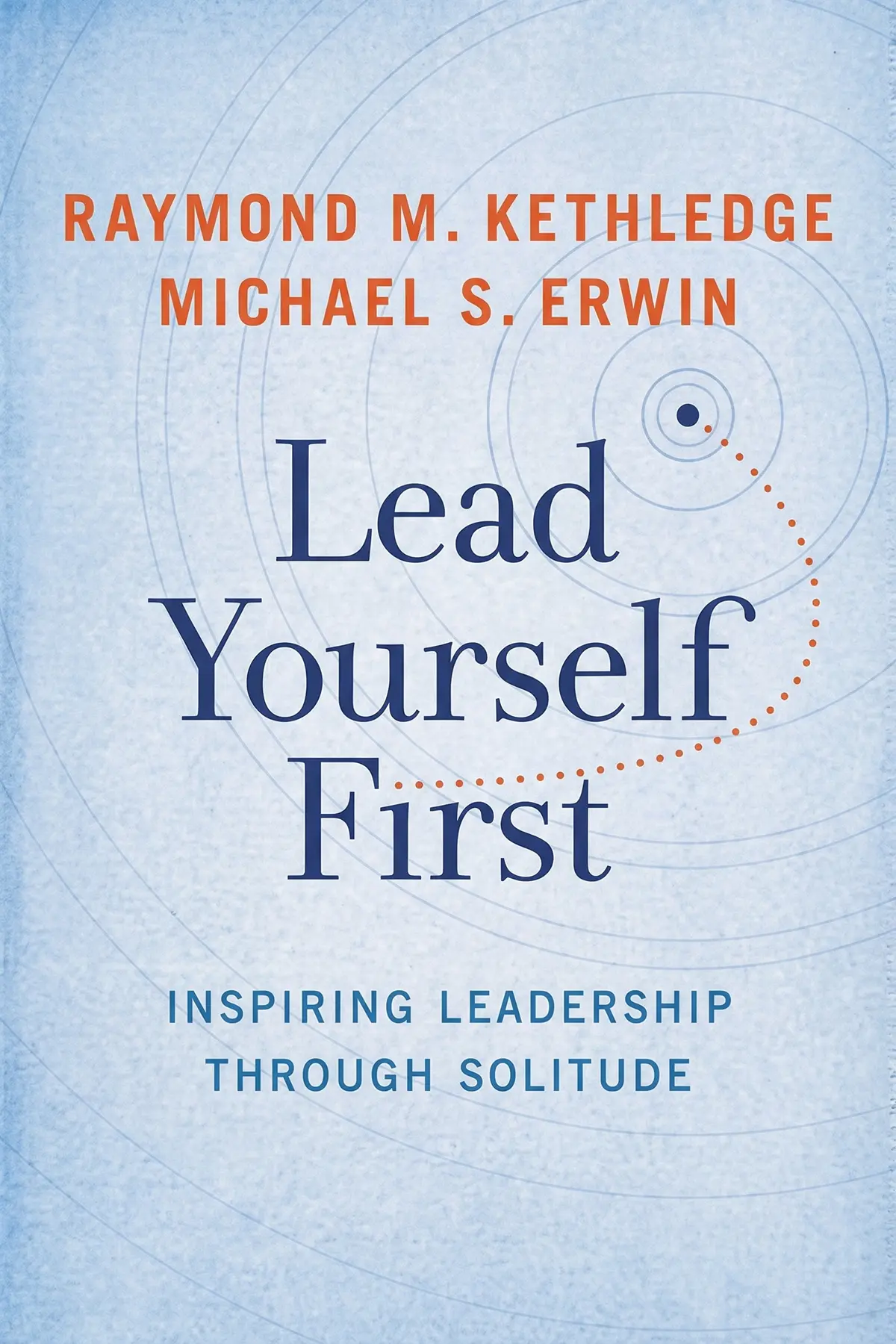
Table of Content
1. Introduction
1 min 05 sec
Most leaders spend their days answering whatever is loudest, and their best thinking never gets a turn. In Lead Yourself First, appeals court judge Raymond Kethledge and Michael Erwin argue that the fix is surprisingly modest: regular, protected time alone with your own mind. A general found it in a helicopter over the desert. The CEO of Medtronic found it in twenty silent minutes before anyone else arrived at work.
The authors’ claim is that solitude is not a retreat from leading but the place where leading gets prepared. Used on purpose, time alone does four jobs. It sharpens analysis, frees creative thinking, steadies emotions and builds the conviction to resist pressure. The book follows each job through people who lived it, from Eisenhower before D-Day to a civil rights pioneer whose mother’s home was dynamited. By the end you will have a short, concrete routine for each of those four jobs, and good reasons to defend your quiet hour when the calendar tries to take it.
2. Protect one quiet window before the day begins
1 min 56 sec
A general did his best strategic thinking in a noisy helicopter, and a CEO did his in an empty office. What those two very different places shared is easier to recreate than most busy people think.
3. Break big decisions into facts, gaps and deciding factors
2 min 06 sec
While planning D-Day, the man in charge sat alone and wrote notes to himself. His simple format cut thousands of worries down to a handful, and it works on far smaller problems.
4. Give new ideas a place to surface
2 min 04 sec
A young researcher without a science degree broke the main rule of her field and changed what we know about chimpanzees. Her breakthrough came from a kind of solitude that works very differently from careful analysis.
5. Stay calm in public by feeling it in private
2 min 02 sec
With his army breaking apart around him, one general sat on a log and whittled wood. He was not unmoved. He simply knew where and when to let the day’s weight land, and that balance shaped his leadership through the war’s worst fighting.
6. Build the conviction to stand against the crowd
2 min 11 sec
Crosses burned on his lawn and his mother’s house was blown up, yet one man kept dismantling unjust laws. His daily habit, and a three-day pause taken by a researcher, show where that kind of nerve comes from.
7. Conclusion
1 min 13 sec
What Kethledge and Erwin finally describe is a leader with two working modes. One acts, decides and speaks in front of others. The other sits alone and prepares the first. Most busy people starve the second mode and then wonder why the first feels so reactive. Eisenhower’s weather notes, Goodall’s choice to sit in the open, Grant’s time alone in his tent and Johnson’s hour in chambers all came from the same source: a stretch of time when nobody else was talking.
The book’s practices are modest enough to begin this week. Claim fifteen minutes at the start of each day, phone silent, and keep them as firmly as any appointment. Before your next major decision, write down what you know, what you do not and the few factors that will decide the outcome, then sketch the best, worst and likely cases. Find one place outside home and work where your mind wanders, and go there with a notebook. And write your own ethical anchors from real decisions you have faced, so they are ready before the pressure arrives.
None of this needs a retreat or a special room. Mattis found it in a helicopter. The quiet you need is probably already somewhere in your day, waiting to be defended.
About this book
What is this book about?
Many leaders spend the whole day answering whatever is loudest: notifications, overflowing inboxes, back-to-back meetings. The deeper questions that shape where a team or organization is going rarely get their attention. Raymond Kethledge and Michael Erwin argue that the missing ingredient is solitude, meaning regular, deliberate time alone with your own thoughts. The authors break that solitude into four uses. It sharpens analysis, as Eisenhower showed when he wrote himself memos before D-Day. It frees creative thinking, as Jane Goodall's quiet hours with chimpanzees did. It steadies emotions, the way it did for Ulysses S. Grant on a collapsing battlefield. It builds moral courage, as it did for a civil rights pioneer whose mother's home was dynamited. Modern leaders, including Medtronic's Bill George and researcher Brené Brown, show the same habits at work today. Readers get concrete routines for each use: a fifteen-minute daily quiet window, decision maps and three-scenario writing, third places for creative work, small emotional reset points and written ethical anchors.
Book Information
Who it's for
Busy managers and executives
Managers and executives whose calendars leave no time to think beyond the next urgent task.
Founders weighing hard calls
Founders facing big, uncertain decisions who want a method for weighing them alone.
First-time team leads
New team leads who want to stay calm under pressure and hold to their values when it costs them.
About the Author
Raymond M. Kethledge
Raymond M. Kethledge, born in 1966, was appointed to the US Court of Appeals for the Sixth Circuit by President George W. Bush in 2008 and became its chief judge in October 2026. He was on Donald Trump's 2016 shortlist of possible Supreme Court nominees. Michael S. Erwin co-wrote Lead Yourself First with him. Bloomsbury published it in 2017. Their book looks at how quiet, reflective time alone connects to leading well.
Ratings & Reviews
Ratings at a glance

What people think
Listeners consider this work essential reading for those in leadership roles, highlighting its accessible style and the way its deep insights prompt self-reflection. The text incorporates compelling accounts and historical background; in fact, one listener specifically mentions how narrative techniques are used effectively to illustrate the core arguments. Listeners value the high-quality prose, ethical significance, and the focus on how solitude serves as a vital component of leading others.
Top reviews
Pranee
Finally got around to reading this after seeing it on a leadership list, and it really hits home in our hyper-connected world. Kethledge and Erwin argue convincingly that solitude isn't just about being alone, but about finding the space to think for yourself amidst the noise of social media and endless emails. I loved the section on Doug Conant's morning routine—thinking about family, work, and faith before starting the day is a practice I've already tried to adopt. The writing is polished and the historical anecdotes, especially regarding Eisenhower, provide a weight that most modern self-help books lack. It’s a deep dive into how clarity and conviction are forged in quiet moments. Highly recommended for anyone feeling burnt out by the constant stream of inputs.
Show moreTum
Wow. This book completely changed how I view my morning commute and my 'quiet time' at the office. Kethledge and Erwin provide a compelling framework for why we need to disconnect from our devices to connect with our own values and principles. I was fascinated by the way they analyzed Abraham Lincoln's use of solitude to find the strength to navigate the Civil War. It’s not just about 'me time'; it’s about the hard work of thinking through complex problems without the distraction of other people's opinions. If you feel like you're constantly reacting to crises rather than leading with purpose, buy this book and actually do the work.
Show moreRiley
After hearing about the authors' different backgrounds—one a judge, the other a veteran—I was curious to see how they would blend their perspectives. The result is a beautifully written, thought-provoking exploration of the inner life of a leader. They argue that to lead others, you must first lead yourself, and that requires the clarity that only comes from solitude. I found the section on T.E. Lawrence particularly haunting and insightful regarding the relationship between isolation and creativity. This isn't just another corporate manual; it's a call to reclaim our minds from the constant buzz of modern life. It’s definitely a book I’ll be revisiting and highlighting for years to come.
Show moreKamol
As a professional who struggles to unplug, this was a much-needed reminder that silence is a tool, not a luxury. The authors break down the benefits of solitude into four categories: clarity, creativity, emotional balance, and moral courage, which makes the concepts easy to digest. I particularly enjoyed the stories about Jane Goodall and Martin Luther King Jr., as they provided a refreshing break from the heavy focus on generals and presidents. To be fair, some of the military anecdotes feel like they were pulled straight from a West Point reading list, which might not resonate with everyone. However, the overall message about leading from the inside out is powerful and timely.
Show moreKomsan
Truth is, I think most of us know we should spend less time on our phones, but this book explains why it's detrimental to our leadership capacity. The distinction between 'inputs' and 'reflection' was a lightbulb moment for me. I appreciated the practical tips near the end, like putting 'time to think' on the calendar and setting expectations for availability. Some of the civil war history was a bit dense and felt like padding to reach a certain page count, but the core message remains vital. It’s a solid 4-star read that encourages you to step back and examine your own 'first principles' before trying to guide others. Definitely worth the time if you can filter out the fluff.
Show moreBenjamin
Picked this up because of the Jim Collins foreword and I wasn't disappointed by the depth of the research. The authors do a fantastic job of showing how solitude helped leaders like Churchill and Eisenhower maintain emotional balance during high-stakes conflicts. It’s interesting to see how these men intentionally created space for their own thoughts when the world was literally falling apart around them. My only criticism is that it feels a bit like a 'boys' club' at times, with a very heavy tilt toward military and government figures. Still, the lessons on finding your moral compass through quiet contemplation are invaluable in our current 'always-on' culture.
Show moreCaleb
Not what I expected given the hype, though the central premise that solitude leads to better leadership is undoubtedly sound. My main gripe is that the execution feels like a 'most fluff in a book' competition entry, with way too many pages dedicated to granular military history that doesn't always bridge the gap to modern corporate life. Do we really need twenty pages on D-Day to understand that reflection is good for decision-making? Some of the stories felt a bit dry, and I found myself skimming the detailed battle descriptions to get to the actual advice. While it’s a noble effort to encourage introspection, the book could have been half as long and twice as effective for a general audience.
Show moreTee
Ever wonder if great leaders are great because of solitude, or if the authors are just cherry-picking winners? This book feels like 'chicken soup for the leader's soul,' full of inspiring stories but lacking any real scientific rigor or data to back up its claims. Look, I agree that solitude is great for reflection, but the narrative structure is essentially: 'Here is a famous person who spent time alone, therefore they succeeded.' It ignores the possibility that mediocre leaders also spend time alone, or that some great leaders might be constantly collaborative. It’s a pleasant read with some decent historical trivia, but it functions more as a collection of biographies than a data-driven leadership manual.
Show moreAnchalee
This book is essentially a long-form argument for a single point: put your phone away and think. While the sentiment is crucial, the authors take the scenic route to get there, filling hundreds of pages with historical anecdotes that vary wildly in quality. Frankly, I didn't need to know every detail of how Eisenhower handled Patton's outbursts to understand the value of emotional distance. It's a well-written book, but it suffers from the classic business-book trap of being an excellent 50-page essay stretched into a full volume. If you enjoy history, you’ll like it; if you want quick, actionable leadership tips, you might find it frustratingly slow and repetitive.
Show moreSarawut
The chapter on Aung San Suu Kyi was a major red flag for me, especially since her actions regarding the Rohingya were well-documented by the time this was published. Beyond that ethical oversight, the authors display a somewhat narrow, colonialist mindset throughout, consistently using the name 'Rangoon' instead of Yangon. It’s hard to take advice on 'moral courage' from writers who seem so disconnected from the lived experiences of anyone outside a very specific, white-male, military-centric bubble. I agree that solitude is important, but this collection of stories felt repetitive and lacked the diverse perspectives necessary to make it a truly universal leadership guide for the 21st century.
Show moreQuestions about this book
What is the main idea of Lead Yourself First?
Raymond Kethledge and Michael Erwin argue that good leadership depends on regular, deliberate time alone. They see solitude doing four jobs: sharpening analysis, freeing creative thinking, steadying emotions and building moral courage. Their examples include Eisenhower writing memos before D-Day, Jane Goodall watching chimpanzees, Ulysses S. Grant during a collapsing battle and civil rights pioneer Frank M. Johnson Jr. holding firm against threats.
How much time alone do leaders need according to Lead Yourself First?
The authors suggest starting small, with about fifteen minutes before the day begins, notifications off, letting your thoughts settle. Bill George, as CEO of Medtronic, used twenty quiet minutes before anyone else arrived. For creative challenges, Joey Reiman recommends deep incubation: four to sixteen weeks of regular quiet sessions on one problem. The authors stress consistency over exact timing.
How did Eisenhower use solitude to plan D-Day?
Alone in his quarters aboard the command ship, Eisenhower wrote memos to himself in a fixed pattern: confirmed facts, open uncertainties and the few factors that would decide success. This showed him that weather was decisive, and that he needed clear skies, bright moonlight, calm seas and low tide. Narrowing the problem that way let him focus on a handful of conditions instead of endless detail.
How can I apply Lead Yourself First at work?
Protect a short daily quiet window. For big decisions, map options two steps out and write best, worst and likely scenarios. Find a third place outside home and work for creative thinking. Build small emotional reset points, such as a walk before a hard email. Write ethical anchors drawn from real decisions, and when a call is tough, weigh the fast solution against the option that pleases the crowd and the one based on values.
Readers also enjoyed



A Year with Peter Drucker: 52 Weeks of Coaching for Leadership Effectiveness
Joseph A. Maciariello



Acting with Power: Why We Are More Powerful Than We Believe
Deborah Gruenfeld

All In: How Great Leaders Build Unstoppable Teams
Mike Michalowicz


AUDIO SUMMARY AVAILABLE
Listen to Lead Yourself First in 15 minutes
Get the key ideas from Lead Yourself First by Raymond M. Kethledge, plus 5,000+ more nonfiction titles.
- 5,000+ titles
- Listen as much as you want
- 7-day free trial
- Cancel anytime









