

14 min 46 sec
Available in: English
Language, Truth, and Logic
A guide to Ayer's verification test for meaning. It shows how to sort sentences into definitions, checkable facts and expressions of feeling, and where critics like Popper, Quine and Wittgenstein found the test's limits.
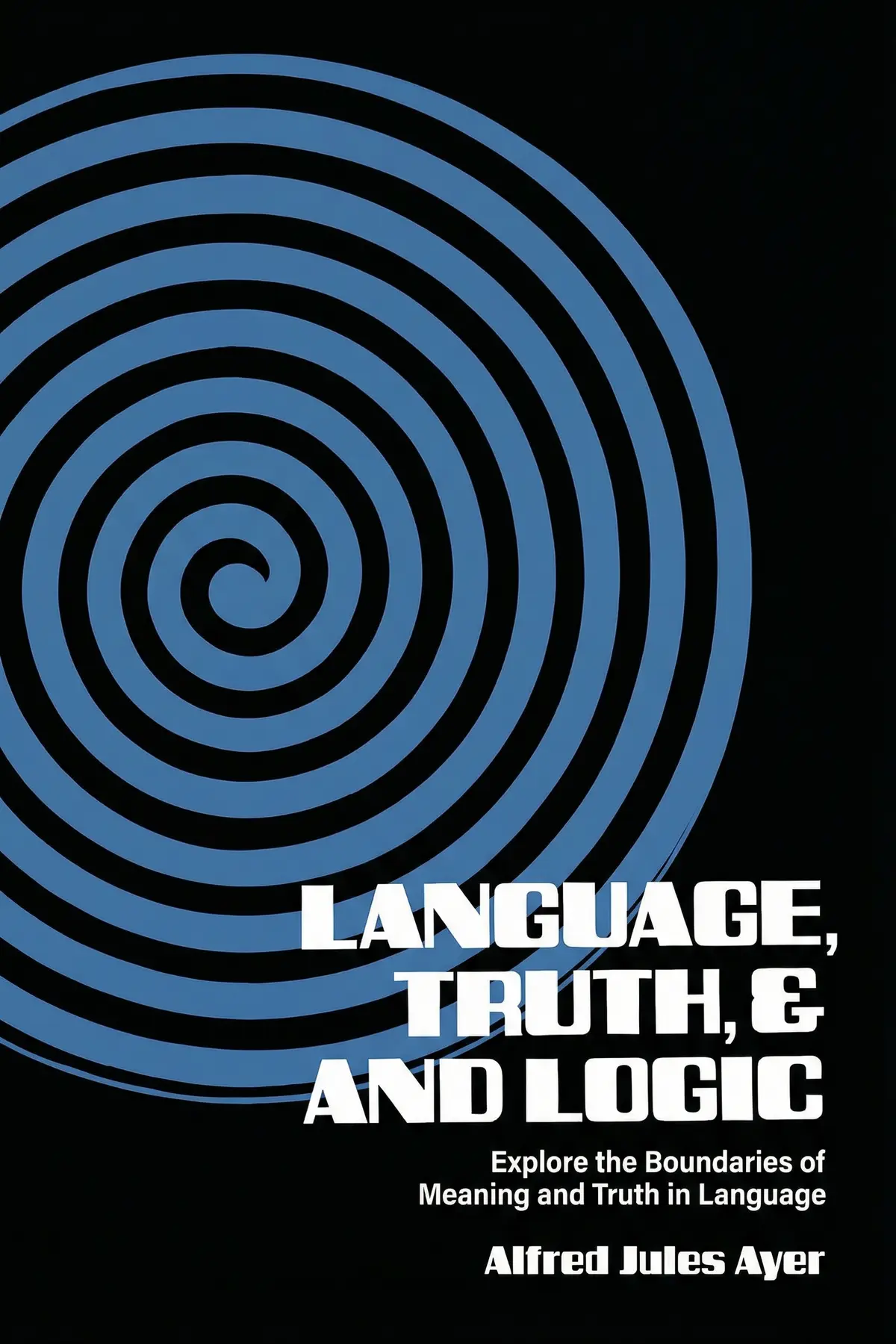
Table of Content
1. Introduction
1 min 02 sec
Most of us hear dozens of confident claims a day and have no quick way to tell which ones say anything at all. In Language, Truth, and Logic, published in 1936, the British philosopher A. J. Ayer offered a blunt test. A statement means something only if it is true by definition or could be checked by experience. By that test, talk of a world beyond this one says nothing, and so do declarations that violence is wrong, at least as claims of fact.
Ayer worked out this view after time spent among the Vienna Circle, and it made his name. Critics later battered his test, but it still gives anyone a sharp habit of mind: work out what a sentence is actually doing before deciding whether to believe it. Along the way come a method for sorting sentences, a sliding scale of evidence, and the arguments from Popper, Quine and Wittgenstein that showed where the test breaks.
2. Ask what observation could settle a claim
2 min 04 sec
Some arguments can run forever because nobody could ever lose them. A group of scientists turned philosophers in Vienna decided that was a warning sign, and a young Englishman carried their alarm home.
3. Tell a definition from a fact about the world
2 min 02 sec
Two sentences can sound equally certain while resting on completely different ground. Ayer’s sorting method shows why one needs a look out of the window and the other never will, and it exposes a third kind that says nothing.
4. Hear the feeling inside a moral claim
2 min 06 sec
A famous self-sacrifice from science fiction looks like the purest logic on screen. Ayer’s framework reads it very differently, and that reading changes how you might answer the next person who calls a decision simply wrong.
5. A sliding scale for how sure you can be
2 min 13 sec
Even a sunny sky outside your window might not be what it seems. Ayer had to loosen his own rule to keep history and science on the table, and the way he did it offers a sharper way to present evidence.
6. Test ideas by trying to prove them wrong
1 min 58 sec
Ten results that agree with you can feel like proof. A philosopher of science and a mathematician argued that this comfort is misleading, and one of them had made his case before Ayer’s book even appeared.
7. Words shift meaning, so check how they're used
2 min 07 sec
The thinker whose early work inspired the positivists later turned against his own foundations. His second thoughts, along with a stubborn defense of ethics, explain why so many arguments are really about words.
8. Conclusion
1 min 14 sec
Ayer set out to sweep philosophy clean, and in one sense he failed. Popper showed that confirmation is always provisional, Gödel that logic can never close every question, and Wittgenstein that meaning moves with use. Ethicists refused to let morality be filed next to a preference for sweatpants. Yet the test at the heart of Language, Truth, and Logic keeps its edge, because it forces a question most claims would rather avoid: what, exactly, would show this to be so?
That question is worth carrying with you. When a sentence sounds deep but nothing could ever check it, treat it as poetry or feeling and respond on those terms. When a moral claim is on the table, hear the value and answer the value, without pretending a measurement will settle it. When a factual claim is made, grade it by how it could be checked, and then look hardest for the single case that would break it, as Popper urged.
As Gödel’s work suggested, the conversation Ayer helped start will probably never be finished. That is not a defeat. It is the reason the question still works, every time someone tells you something with total confidence.
About this book
What is this book about?
Some claims can be settled by looking. Others are true by definition. And some, like "time is an illusion" or "violence is wrong", cannot be checked at all. A. J. Ayer wrote Language, Truth, and Logic after spending time with the Vienna Circle, and in it he argues that only the first two kinds count as knowledge. Everything else is either meaningless or a way of expressing feeling. Ayer sorts statements into analytic, synthetic, tautological, meaningless and emotional types, and he adds a scale of strong and weak verification so that history, forecasts and scientific hypotheses still have a place. The book pushed theology, metaphysics and moral claims out of philosophy, and it drew both loud praise and fierce attack. Readers get the test itself and the arguments against it. Karl Popper put falsification ahead of proof. Kurt Gödel showed the limits of logic, Willard Quine questioned whether analytic and synthetic statements really differ, Ludwig Wittgenstein argued that meaning shifts with use, and Philippa Foot defended ethics. What remains is a practical habit for any argument: work out whether a sentence states a fact, a definition or a value, and then decide how to answer it.
Book Information
Who it's for
New to analytic philosophy
Students meeting analytic philosophy who want logical positivism explained clearly, with its critics included.
Paid to argue
Professionals who argue for a living and want a quick test for empty or slippery claims.
Curious how fields diverged
Curious readers wondering why science, ethics and language came to be treated so differently.
About the Author
Alfred Jules Ayer
Alfred Jules Ayer (1910 to 1989) studied at Oxford. In the winter of 1932 to 1933 he spent time with members of the Vienna Circle, including Moritz Schlick. He lectured at Christ Church, Oxford, and Language, Truth, and Logic, published in 1936, made his name. He later held a professorship at University College London and then became Wykeham Professor of Logic at Oxford. He was knighted in 1970 and led the British Humanist Association from 1965 to 1970.
Ratings & Reviews
Ratings at a glance
What people think
Listeners find the writing accessible and articulate, with one observer noting that it is a quick read for philosophy students. Furthermore, they value the intellectual substance, with one person describing it as a standard introduction to Logical Positivism. The book is also commended for its logical methodology, and one listener mentions its exemplary presentation of Anglo-American style philosophy.
Top reviews
Pisit
Ayer manages to condense a massive paradigm shift into a remarkably slim volume that feels both dangerous and refreshing. This book serves as the quintessential manifesto for Logical Positivism, presenting the Vienna Circle's doctrines with a sharp, Anglo-American clarity that is rarely seen in dense philosophical texts. Frankly, his 'elimination of metaphysics' acts like a conceptual flamethrower, burning away centuries of what he considers linguistic confusion and nonsense. While some might find his dismissal of ethics and theology as mere 'emotive grunts' to be overly reductive, the sheer boldness of his prose is infectious. He takes the complex ideas of Wittgenstein and Russell and makes them accessible to anyone willing to follow a rigorous logical path. It is a quick read for any philosophy student, yet it leaves you questioning the very foundations of how we use language to describe reality. Even if you disagree with his verification principle, you cannot deny the impact of his godlike style.
Show moreTun
Wow, talk about a philosophical flamethrower! Ayer doesn't just critique previous philosophers; he essentially tells them they’ve been speaking gibberish for two thousand years. I love the notion that something isn't necessarily false, but just plain meaningless if it can't be verified. It’s an aggressive, exciting approach to truth that clears the air of so much metaphysical smoke. The chapter on the 'elimination of metaphysics' is easily one of the most provocative things I’ve ever read in an academic context. He writes with a godlike confidence that makes you want to agree with him, even when your intuition is screaming that there must be more to ethics than just 'emotive squeaks.' If you want to understand the roots of modern analytical thought, this is the place to start. It’s concise, logical, and unapologetically brutal toward anything it deems irrational.
Show morePan
Ever wonder what happens when you apply the strict rules of science to every single thought you have? This book is the answer, and it is absolutely fascinating in its cold, clinical approach to the human experience. Ayer argues that the task of the philosopher is not to speculate about the universe, but to act as a scientist of language. He strips away the 'mythical mumbo-jumbo' of the past and leaves us with a lean, mean system of logic and observation. I especially loved the section on how we verify the existence of other people through hypothesized sense-experiences. It sounds abstract, but he makes it feel like the only rational way to view the world. This is a must-read for anyone who values clear thinking over poetic obfuscation. It’s a short book that packs a massive intellectual punch, and it changed the way I look at every sentence I speak.
Show moreNang
Picked this up for a seminar and was surprised by how readable the prose actually felt compared to the usual continental slog. Ayer has this way of making radical ideas seem like common sense, especially when he’s dismantling the 'mumbo-jumbo' of traditional metaphysics. Not gonna lie, seeing him describe ethical judgements as nothing more than expressions of feeling was a bit of a shock to the system. He essentially argues that when we say 'stealing is wrong,' we aren't stating a fact, but rather just saying 'boo' to stealing. It’s a bitchslap to traditional morality that feels incredibly modern and cynical. The book is short, punchy, and provides an exemplary presentation of how to do philosophy with a scalpel rather than a sledgehammer. My only gripe is that he occasionally treats his predecessors with a hauteur that feels a bit unearned given the cracks in his own logic.
Show moreMarco
There’s a certain youthful audacity here that makes the text pulse with energy, even when the logic feels a bit too tidy for the real world. Ayer was only in his mid-twenties when he wrote this, and that 'hauteur of youth' is evident in every dismissive sentence directed at the 'metaphysicians.' He provides a standard introduction to the logic of science that every aspiring philosopher should grapple with at least once. Personally, I found his distinction between analytic and synthetic propositions to be a helpful, if flawed, way to categorize our knowledge. The way he synthesizes the empiricism of Berkeley and Hume with modern symbolic logic is nothing short of brilliant. Even if Quine eventually undercut the foundations of this book, the clarity of Ayer’s vision remains a stern reminder of what philosophy can be when it stops over-complicating itself. It’s a foundational piece of the Anglo-American style that remains relevant for its sheer rhetorical force.
Show moreNim
Finally got around to this classic manifesto, and it’s easy to see why it caused such a stir in the 1930s Oxford scene. Ayer took the complex, often impenetrable ideas of the Vienna Circle and translated them into a punchy, English idiom that anyone could grasp. The way he handles the division between analytic and synthetic propositions is a masterclass in philosophical exposition. Gotta say, I appreciated his honesty later in life when he admitted that nearly all of this was wrong, but the journey through his logic is still immensely valuable. It teaches you how to look for the 'nonsense' in everyday arguments and demands a level of precision that most writers lack. It’s a brief, intense encounter with a mind that wanted to solve everything with a single rule. Even as a failed project, it’s a brilliant failure.
Show moreFah
Is it still worth reading a book whose central thesis was famously debunked by the author himself in his later years? To be fair, Ayer is an incredible stylist who presents the analytic tradition with more vigor than almost any of his contemporaries. The problem is that the verification principle—the idea that a statement is only meaningful if it’s a tautology or empirically verifiable—fails its own test. It isn't a mathematical certainty, nor can we prove it through a laboratory experiment, which leaves the whole system feeling like a house of cards. I found his treatment of the problem of induction particularly hand-wavy, almost as if he decided that if he couldn't solve it, it simply wasn't a real problem. Still, as a historical document, it’s an essential bridge between Hume’s empiricism and modern linguistic analysis. It’s a standard introduction to a movement that failed, but it failed in a fascinating, intellectually stimulating way.
Show moreBrooklyn
After hearing so much about the 'death of logical positivism,' I wanted to go straight to the source to see what the fuss was about. The truth is, Ayer is a fantastic writer, but his system is far too restrictive to be practically useful in our daily lives. He attempts to turn philosophy into a mere appendage of science, tasking the philosopher with nothing more than the clarification of definitions. While this linguistic turn was revolutionary at the time, it feels somewhat limiting today. Why should we stop asking 'why' just because a lab can't provide the answer? His dismissal of theology as literally senseless is a bold move, but it ignores the deep psychological and social functions of religious language. It’s a quick read for philosophy students, and certainly an intellectual milestone, but it feels more like a museum piece than a living philosophy. I respect the effort, but I’m not buying the doctrine.
Show moreDream
As someone who prefers the rigors of science to the vagueness of traditional metaphysics, I expected to love this book more than I did. To be fair, Ayer’s project of linguistic analysis is noble and his writing is exemplary in its clarity. However, the rigid adherence to the verification principle feels like a trap that eventually catches the author himself. If we can only talk about what we can observe or calculate, we lose so much of what makes philosophy worth doing in the first place. I found the sections on the 'logic of science' to be the most rewarding, as they provide a clear framework for how we should define our symbols. But the total dismissal of aesthetics and ethics as non-sciences felt like a massive oversight. It’s a standard introduction to the period, but it lacks the depth of the thinkers it tries to replace.
Show moreSupachai
The arrogance dripping from these pages is almost unbearable, even if you appreciate the historical importance of the Vienna Circle. Ayer seems to believe he has solved every philosophical problem once and for all by simply declaring that anything he doesn't like is 'meaningless.' Look, you can't just wave away the problem of induction or the entirety of ethics by calling them fictitious problems. It feels less like a rigorous inquiry and more like a dogmatic religious tract for people who hate religion. He leans heavily on the work of Russell and Wittgenstein, yet he seems to miss the mystical nuances that made the Tractatus so profound. To him, the world is just a collection of sense-data and tautologies, which leaves no room for the actual human experience of living. It is a well-written book, sure, but the underlying philosophy feels hollow and ultimately self-defeating.
Show moreQuestions about this book
What is the main idea of Language, Truth, and Logic?
A. J. Ayer argues that a statement is meaningful only if it is true by definition, like all bachelors are unmarried men, or could be checked by experience, like it’s raining outside. Sentences about a world beyond this one fail the test and are meaningless. Moral statements express feeling and state no facts. The book pushed theology, metaphysics and ethics out of philosophy and put language at its center.
What is the difference between strong and weak verification in Ayer?
Strong verification covers claims that anyone can confirm directly, such as it is sunny outside, or that are settled by mathematics, such as two plus two equals four. Weak verification allows statements that have not been checked yet but could be in principle, such as historical claims and scientific hypotheses. Ayer needed the weaker form because even direct observation can mislead, through hallucination or a faulty ruler.
What does Ayer say about ethics and moral statements?
For Ayer, sentences like violence is wrong or love thy neighbor make no claim about the world that could be checked, so they express emotion and say nothing true or false. Even Mr. Even Spock’s Star Trek line, in which the few’s needs are outweighed by the needs of the many, counts as emotional. The ethicist Philippa Foot and others replied that being unverifiable does not make morality meaningless.
What were the main criticisms of logical positivism?
Karl Popper argued that science advances by falsifying claims, which makes all verification weak. Kurt Gödel’s incompleteness theorems suggested that no formal system can ever be complete. Willard Quine questioned the line between analytic and synthetic statements. Wittgenstein’s later Philosophical Investigations treated language as a changing game with no fixed truth beneath it. Ethicists defended the meaning of moral claims.
How can I apply Ayer's ideas in everyday life?
Before you accept a claim, work out what kind it is. Is it true by definition, checkable by observation, a forecast, or an expression of value? Ask what evidence would settle it. If nothing could, respond to it as feeling and not as fact. Then add Popper’s correction: look first for the one result that would prove your favorite idea wrong.
Readers also enjoyed

A Guide to the Good Life: The Ancient Art of Stoic Joy
William B. Irvine

A Little History of Philosophy
Nigel Warburton

A Theory of Justice
John Rawls


Anarchism: A Very Short Introduction
Colin Ward
AUDIO SUMMARY AVAILABLE
Listen to Language, Truth, and Logic in 15 minutes
Get the key ideas from Language, Truth, and Logic by Alfred Jules Ayer, plus 5,000+ more nonfiction titles.
- 5,000+ titles
- Listen as much as you want
- 7-day free trial
- Cancel anytime









