
13 min 35 sec
Available in: English
 ไทย
EnglishไทยIt’s Not How Good You Are, It’s How Good You Want to Be: The World’s Best Selling Book
By Paul Arden
Advertising veteran Paul Arden argues that ambition sets your ceiling more than talent does. He pairs that with practical habits: asking for honest criticism, risking mistakes, refusing to accept a no and pitching ideas clients will actually buy.
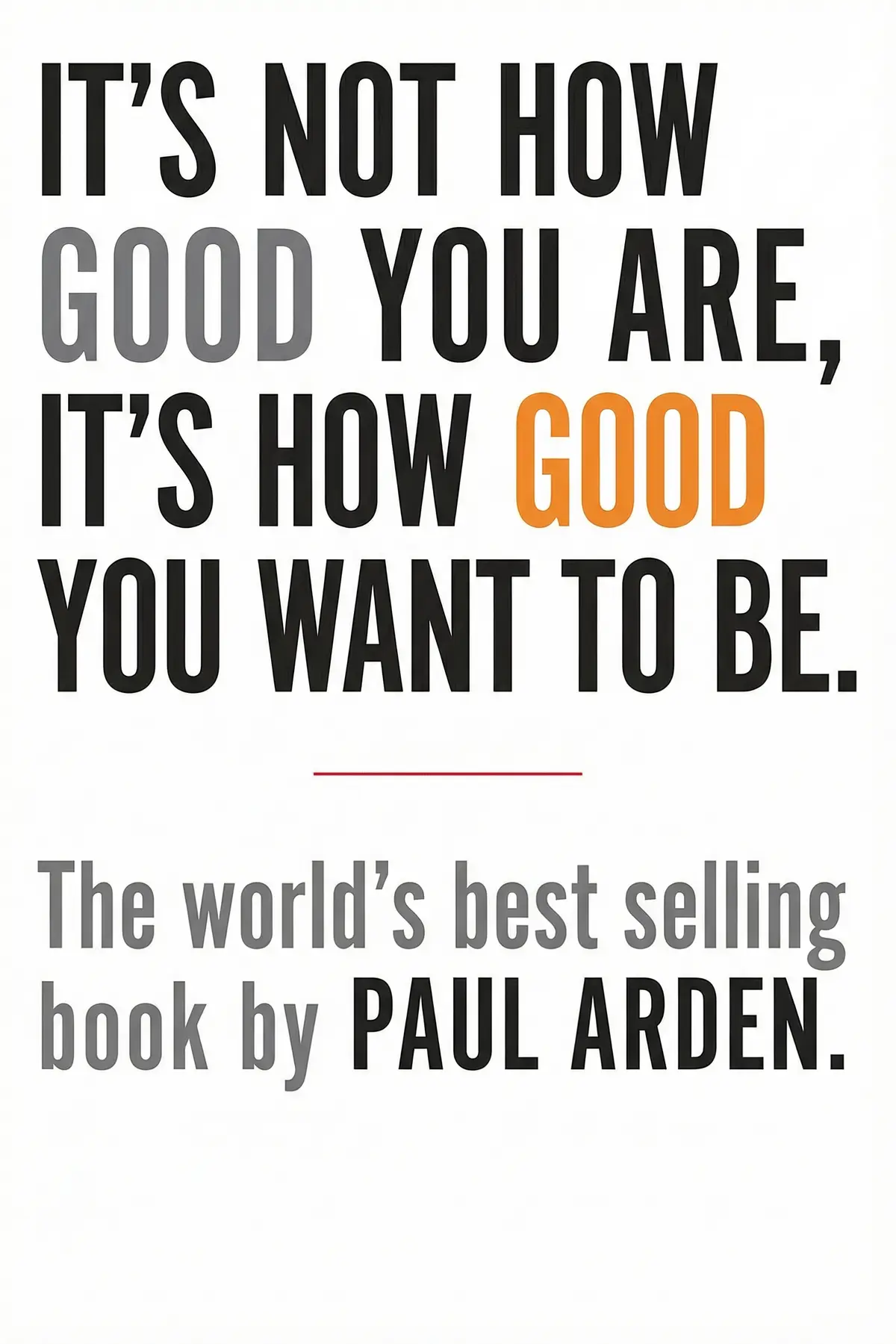
Table of Content
1. Introduction
1 min 01 sec
Talent gets most people to good, and then they stop. In It’s Not How Good You Are, It’s How Good You Want to Be, Paul Arden, who rose to executive creative director at the advertising agency Saatchi & Saatchi, argues that ambition sets the ceiling, not ability. The people who go furthest decide how good they want to be and aim well past what they can do today.
Arden’s short book reads like a working creative’s rulebook, and its argument runs in one line: success follows a deliberate choice about your level, backed by habits most people avoid. Those habits include asking for criticism, giving ideas away, being wrong often, refusing to accept a no and presenting work in a way the client can see and love. His examples run from a teenage Victoria Beckham to an all-night scramble that won Arden a government contract. Each one is a move you can try on your next proposal, presentation or career goal.
2. Aim past what you can do today
1 min 47 sec
The brightest kids at school rarely turn out to be the most successful adults. Arden thinks he knows what separates them, and a future pop star’s strange choice of role model shows it clearly.
3. Get the criticism people would rather not give
1 min 50 sec
Ask a colleague for their opinion and you will probably hear something kind and useless. Arden offers a small change in wording that gets the truth instead, plus a habit with ideas that feels completely backward.
4. Free yourself from the need to be right
1 min 55 sec
Being right feels safe, and Arden thinks that safety is exactly what keeps most people ordinary. A famous inventor, a duck on a pond and a wine with a rude name show another way.
5. Turn a rejection into a second chance
1 min 59 sec
Investors turned down one of the most admired films ever made, and Arden’s own agency was told it had lost a government contract. Both stories turned around overnight, and not by luck.
6. Layouts that win clients before they read
1 min 57 sec
A rough sketch can beat a polished one, and a box of watercolors once added a third to a budget. Arden explains why the look of your work matters as much as the thinking behind it.
7. Pitch the creativity your client will buy
1 min 54 sec
The boldest idea in the room often loses, and Arden thinks he knows why. Clients use the word creative in surprising ways, and one Toyota slogan shows how to win them over anyway.
8. Conclusion
1 min 12 sec
On the surface Arden’s book is advertising advice, but its real case is that ambition is a choice you make on purpose. Talent decides where you start. What you decide to want, and what you will put up with to get it, decides where you finish. Seen from that angle, the overnight second campaign, the watercolor layout and the wine with the ridiculous name share a common thread: someone choosing to stand out and accepting the risk that comes with it.
His closing advice is about memory. People forget words but remember pictures, so whether you are giving a formal presentation or pitching in a casual conversation, describe your idea in images your listener can see. Paint the car crossing the world on one tank instead of reciting its mileage.
Start with the goal. Write down a level of success that feels slightly absurd, the way a teenager once measured herself against a box of detergent. Then find the honest colleague who will tell you what to improve, and build the second campaign nobody asked for yet. Most people stop at good because they never decided to be anything more.
About this book
What is this book about?
Plenty of talented people settle at good. Paul Arden, who spent years leading the creative department at Saatchi & Saatchi, argues that the people who go further are not always more gifted. They decided how good they wanted to be, set goals beyond their current ability and accepted the discomfort that comes with reaching for them. Arden turns that idea into working habits. He wants you to ask questions that pull out real criticism, give your ideas away so new ones keep coming, and stop needing to be right. He also wants you to treat a rejection as an opening, and to understand what the person across the table wants. His examples include a teenage Victoria Beckham measuring herself against a laundry detergent, Orson Welles filming scenes to win over investors, and Arden's own team building a whole campaign overnight after being told they had lost. The second half moves into the craft of pitching: layouts people recognize from a distance, rough drafts that invite clients in, originality found outside your own field, and the kind of creativity clients will actually choose. It is short, direct advice for anyone who has to sell an idea.
Book Information
Who it's for
Early-career professionals feeling stuck
Early-career professionals who feel talented but stuck at good enough.
Designers, marketers, agency staff
Designers, marketers and agency staff who pitch ideas to clients and keep losing to safer work.
Wanting to work boldly
Anyone who avoids feedback or guards their ideas and wants a bolder way to work.
About the Author
Paul Arden
Paul Arden (1940 to 2008) was a creative director at the advertising agency Saatchi & Saatchi, becoming executive creative director in 1987. He worked on accounts including British Airways, Toyota, Fuji and Nivea, and came up with campaigns for Silk Cut and The Independent. After leaving the agency in 1992 he kept working with it as a consultant until 1995. His other books include Whatever You Think, Think The Opposite and God Explained in a Taxi Ride.
Ratings & Reviews
Ratings at a glance
What people think
Listeners consider this book a pleasant, rapid read that offers high motivational impact along with quality insights and guidance. They also enjoy the comedic touch, with one listener pointing out how it provides amusing reminders of advertising days. Additionally, the book functions well as a gift to encourage creativity. However, listeners express mixed feelings concerning the book's total length and its value for money.
Top reviews
Kru
Stop waiting for permission to be great and just read this little powerhouse of a book. Arden understands that talent is secondary to the hunger to improve, which is a message that resonated deeply with my current career goals. The layout is brilliant—minimalist, bold, and designed to make you think about the space between the words. I found myself highlighting almost every other page because the insights on 'failing better' were exactly what I needed to hear. To be fair, it is a very quick read, but the impact lingers long after you've closed the cover. It’s the kind of book you keep in your bag to flip through before a big interview or a difficult presentation.
Show moreTanawan
Imagine a mentor who refuses to sugarcoat anything and speaks only in headlines—that is exactly what this reading experience feels like. I bought five copies to give to my team because it perfectly encapsulates the 'fail fast' mentality we are trying to foster. It’s not just for advertising types; the lessons on imagination and taking risks are applicable to anyone who wants to push past their own comfort zone. Not gonna lie, I was skeptical of the small size at first, but every page delivers a punchy realization that sticks with you. It’s a motivational spark plug that ignores the boring rules of traditional business books. Truly a gem for anyone who values time and impact.
Show moreManop
Wow. This is the ultimate 'no-nonsense' guide for people who hate traditional self-help books but still want to grow. Paul Arden turns the entire idea of a management manual on its head by focusing on the power of being wrong and the necessity of looking silly. The way he references his time at Saatchi & Saatchi gives the advice a grit that you don't get from university professors or career coaches. It’s a visual delight, and while some critics call it a 'trifle,' I think the simplicity is where the genius lies. Frankly, if you can’t find one life-changing idea in these pages, you probably aren't looking hard enough. This is essential reading for every aspiring creative I know.
Show moreAisha
Picked this up during a creative slump and it definitely provided the jolt I needed to get moving again. Paul Arden has a very specific, punchy way of writing that mirrors a high-energy pitch meeting, which keeps the momentum high throughout. I particularly enjoyed the section on doing the opposite of what is expected; it’s a refreshing take in a world obsessed with 'best practices' and safe choices. While some of the tips—like the specific days to pitch—feel a bit like personal superstitions, the core message about ambition over raw talent is empowering. Just be aware that this isn't a deep dive into psychology. It's more of a visual pep talk that you can revisit whenever your ego needs a reality check.
Show moreSamroeng
Looking back at the golden age of London advertising, you can really see where Arden’s 'out of the box' mindset came from. This book is a witty, somewhat arrogant, but ultimately charming collection of thoughts from a man who lived and breathed the creative circus. It provides an amusing reminder of the days when guts mattered more than data, though some of it feels a bit dated in the digital age. I loved the section about sharing credit with others; it’s a surprisingly humble note in an otherwise ego-heavy industry. It isn't a perfect manual, and some might find the brevity annoying, but the spirit of the thing is undeniably infectious. It’s a great spark for anyone feeling stagnant.
Show moreRome
Ever wonder why some people with less skill always seem to end up on top? Arden argues it’s all down to the 'want,' and he makes a compelling case using the visual language of an ad campaign. The tip about drawing with a different pen when you’re stuck sounds silly until you actually try it and feel your brain shift gears. Gotta say, the brevity is actually a strength here because it forces the reader to focus on the core sentiment rather than getting lost in academic fluff. My only gripe is that it can feel a bit dismissive of people who actually value being 'right' or precise in their work. Still, for a creative kick in the pants, you can’t do much better than this.
Show moreRuangrat
Is it worth the price of admission? That depends entirely on how much you value a thirty-minute reading experience that looks great on a desk. The advice about seeking criticism instead of praise is a genuine gem that I’ve started implementing in my own workflow. However, I can't ignore the fact that half the pages are nearly empty or filled with unremarkable stock photos. In my experience, you can find more actionable advice in a single long-form blog post for free. It’s a good-natured attempt at motivation, but calling it the 'world's best-selling book' is a cheeky ad-man lie that leaves a sour taste. It's a solid middle-of-the-road coffee table addition.
Show moreArm
Finally got around to finishing this today, and I have mixed feelings about the 'Phaidon' prestige attached to such a slim volume. The book makes some bold claims and uses striking typography, but the content feels a bit like a collection of posters rather than a cohesive argument. I appreciated the advice to 'seek criticism' because it’s a difficult mindset to adopt but incredibly rewarding. On the flip side, paying full price for something that takes twenty minutes to read feels like a bit of a marketing trick. It’s a charming little object, and the humor is top-notch, yet I found myself wishing there was more 'meat' on the bones. Decent, but maybe borrow it from a friend first.
Show moreFon
After hearing so much hype about this supposed 'biblical' business text, I felt quite let down by the lack of universal application. As someone training for a high-stakes technical field, the suggestion that 'making mistakes is good' feels reckless and poorly translated to any world outside of 1980s Madison Avenue. The book is incredibly aesthetic and fast to get through, yet it lacks the depth needed to truly change a professional's trajectory. Truth be told, I spent more time looking at the layout than I did reflecting on the actual prose. It might work as a fun stocking stuffer for a marketing intern, but it shouldn't be marketed as a serious management manual for the rest of us.
Show moreDivya
This book is a masterclass in advertising smoke and mirrors, which isn't surprising given Paul Arden's background at Saatchi & Saatchi. He tries to convince you that being contrarian is the same as being a genius, but most of the advice boils down to expensive-looking fluff. I found the 'it’s wrong to be right' philosophy to be a dangerous oversimplification for anyone not working in a high-budget creative agency. Frankly, the publisher, Phaidon, seems to be coasting on their reputation for fine art while printing what is essentially a glorified pamphlet. If you want actual substance or a step-by-step guide to success, you are looking in the wrong place. It feels like Arden is still trying to sell me a product that doesn't actually exist once you open the packaging.
Show moreQuestions about this book
What is the main idea of It's Not How Good You Are, It's How Good You Want to Be?
Paul Arden argues that talent alone stalls, and that real success comes from deciding how good you want to be and setting goals beyond your current ability. He backs that ambition with habits: seeking honest criticism, sharing ideas freely, accepting mistakes, refusing to take no for an answer and pitching work in a way clients can see and appreciate.
How does Paul Arden suggest getting honest feedback?
Arden notes that asking a colleague for their opinion usually gets a polite, positive answer that teaches you nothing. Instead, ask what they would improve, or which single problem they would pick in your proposal if they had to choose one. Making these questions routine with trusted colleagues helps you see your weaknesses, which he treats as the first step to getting better.
What does Arden say about failure and being right?
Arden points to Thomas Edison, who said he never failed but found thousands of ideas that did not work. Needing to be right makes you inflexible and unoriginal, Arden argues, while accepting mistakes frees you to take risks, which are often rewarded. To loosen up, he suggests trying the opposite of your instinct, taking a walk for inspiration and embracing silly ideas.
What pitching advice does the book give?
Arden advises opening with layouts that show off the client’s logo and brand, since clients want their brand displayed before they hear bolder ideas. Keep early drafts rough so clients feel part of the process, make layouts recognizable from a distance, use memorable slogans repeated with variations, and find out what creativity means to each client, because the most creative idea does not always win.
Who should read It's Not How Good You Are, It's How Good You Want to Be?
The book suits people early in their careers who want to go beyond good, and anyone who has to sell ideas, especially in advertising, design and marketing. Its advice is short and direct, drawn from Arden’s years at Saatchi & Saatchi, with stories such as his team building a second campaign overnight to win a government contract.
Readers also enjoyed







AUDIO SUMMARY AVAILABLE
Listen to It’s Not How Good You Are, It’s How Good You Want to Be in 15 minutes
Get the key ideas from It’s Not How Good You Are, It’s How Good You Want to Be by Paul Arden, plus 5,000+ more nonfiction titles.
- 5,000+ titles
- Listen as much as you want
- 7-day free trial
- Cancel anytime









