

12 min 57 sec
Available in: English
Invent and Wander: The Collected Writings of Jeff Bezos
By Jeff Bezos
Jeff Bezos's letters and speeches show how to keep a successful organization inventing: put customers ahead of profit targets, plan for the long term so failure is affordable, and match decision speed to what is at stake.
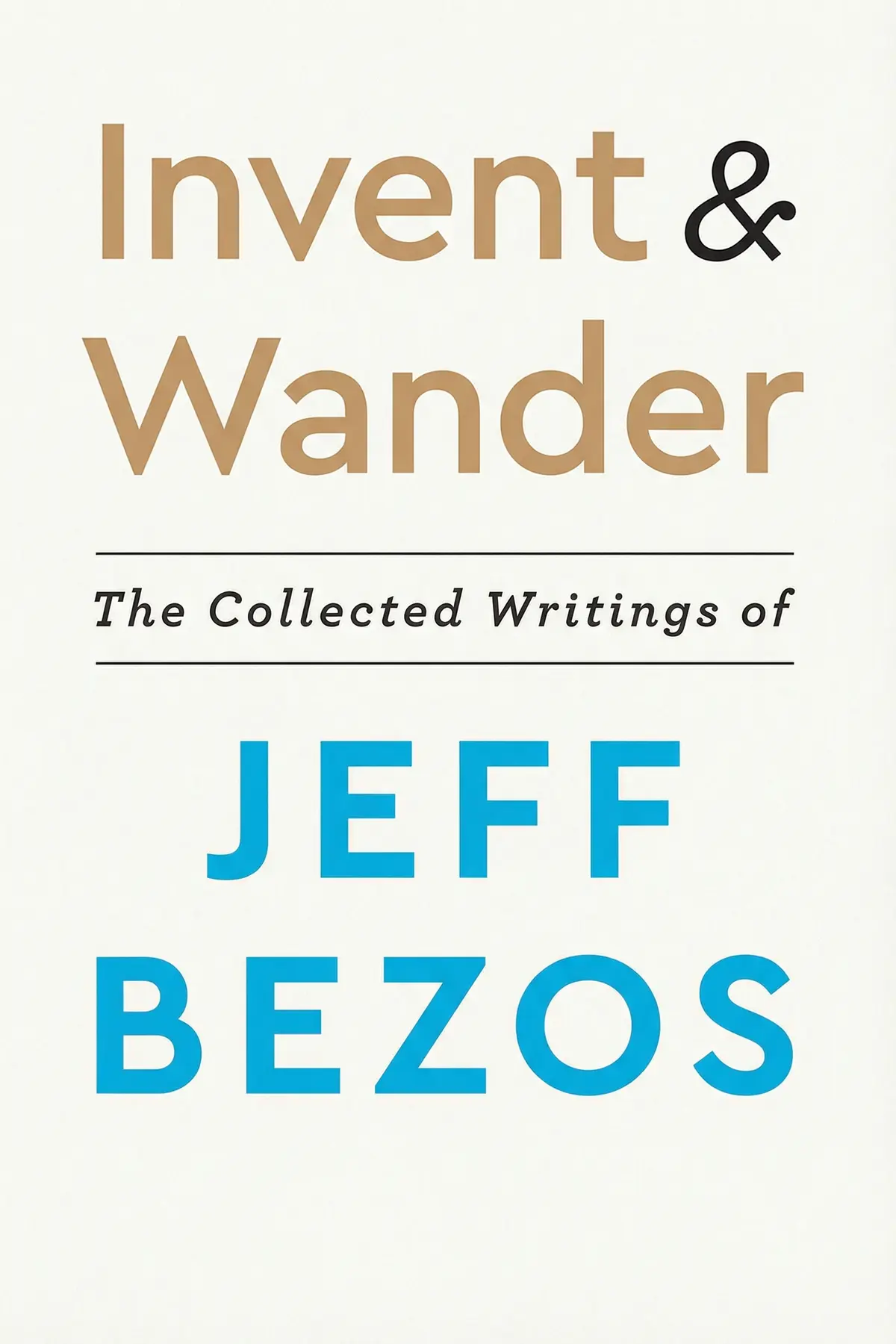
Table of Content
1. Introduction
58 sec
If you lead a team or a business, success pulls you toward protecting what already works. In Invent and Wander, a collection of his letters to shareowners, speeches and interviews, Jeff Bezos argues that this pull must never be allowed to set in, and that the answer is to treat every day like a company’s first. He calls it Day One.
The letters follow Amazon across a quarter-century, from 10 employees to 750,000 and from an online bookstore to a place to find almost anything. Behind that growth sits one argument: a company stays inventive only if it puts customers before profit targets, thinks in years so it can afford to fail, decides fast on choices it can undo, and teaches high standards. Follow it through and you will have a way to sort quick decisions from slow ones, a test for whether your goals serve customers, and a reason to give a failed idea a second try.
2. Keep your team acting like it's the first day
1 min 45 sec
The bigger an organization gets, the more its past wins start to feel like a strategy. Bezos saw that drift as the real threat to a successful company, and he named the habit that resists it.
3. Set goals your customers would actually notice
1 min 43 sec
A company that earns its living from profits once wrote hundreds of goals without naming profit in a single one. The reasoning behind that choice explains a refund nobody requested and a feature that lowered sales.
4. Think in years so failure becomes affordable
1 min 57 sec
Two early attempts to open the site to outside merchants performed poorly. What the company did next turned a pair of flops into a business that now accounts for over 40 percent of its sales, and it began with a willingness to experiment.
5. Decide fast by treating most choices as reversible
1 min 41 sec
Growing companies tend to treat every choice as if a wrong move could sink them. Bezos thinks that too much caution brings slowness, risk aversion and less invention, and he offers a simple way to tell which decisions deserve it.
6. Offerings customers love that keep on growing
1 min 51 sec
Fast, free shipping was a risky bet at the time, and offering on-demand, pay-as-you-go computing was a radical break from traditional IT. Both fit a four-part picture Bezos uses to judge what deserves the company’s bets.
7. Standards your whole team can learn
1 min 50 sec
People often treat high standards as a personality trait you either have or lack. Bezos admits he lacked them in one area when he started, and a handstand coach explains why most people give up too soon.
8. Conclusion
1 min 12 sec
Read one after another, Bezos’s letters keep circling a single fear: that success makes a company careful, and careful companies stop inventing. Everything else follows from refusing that fate. Customer goals outrank profit lines because customers keep raising the bar. Long horizons make room for flops like zShops on the way to a Marketplace. Quick, reversible decisions keep things moving, and taught standards stop speed from turning into sloppiness.
In one of the speeches, Bezos separates cleverness, which he calls a gift, from kindness, which he calls a choice, and warns that gifts can tempt you to neglect choices. His business thinking runs on the same logic. Early success is a gift. Staying in Day One is a choice that has to be made again and again.
You can make it in small ways this week. Mark the decisions in front of you as one-way or two-way doors, and stop agonizing over the second kind. Count how many of your goals a customer would feel. Give one idea that failed a second, better-designed attempt.
The company that grew to 750,000 people still measured itself against its first morning.
About this book
What is this book about?
Success has a side effect. As companies grow, they get careful, slow and attached to what already works. Jeff Bezos spent a quarter-century writing against that drift, and Invent and Wander gathers his annual letters to Amazon's shareowners together with speeches and interviews, following the company from 10 employees to 750,000. His answer is a stance he calls Day One: run a large company with the urgency of a new one. In practice that means goals built around customer experience instead of profit lines, a long horizon that leaves room for failed experiments, a sharp split between decisions you can undo and decisions you cannot, and standards that are taught instead of assumed. The cases are concrete, from the flops that came before Marketplace to Prime, cloud computing and a $2.99 refund nobody asked for. Readers get Bezos's own reasoning in plain language, plus tools they can carry into any team, such as sorting decisions into one-way and two-way doors.
Book Information
Who it's for
Leaders of slowing teams
Founders and managers whose growing teams have started to slow down and avoid risk.
Leads stuck on decisions
Team leads who spend too long on decisions that could easily be reversed.
Business students, Amazon watchers
Business students and Amazon watchers who want Bezos's reasoning in his own plain words.
About the Author
Jeff Bezos
Jeff Bezos was born in Albuquerque in 1964 and grew up in Houston and Miami. After an engineering degree from Princeton in 1986, he worked on Wall Street until early 1994, then founded Amazon in mid-1994 as an online bookstore. It grew into many products and services, including cloud computing. He stepped down as CEO in July 2021 to become executive chairman. He also founded Blue Origin, flying to space on its NS-16 flight in 2021, and bought The Washington Post in 2013.
Ratings & Reviews
Ratings at a glance

What people think
Listeners find the material enlightening and expertly structured, with one person emphasizing how it brings Bezos’s core philosophies and logic into focus. They generally view the book as an inspiring, swift experience, and one listener specifically mentions that it functions as a great roadmap for many aspects of life. Nevertheless, the quality of the narrative receives mixed reviews, and several listeners point out that the content often feels repetitive.
Top reviews
Connor
Ever wonder how one man built a company that basically owns the internet? This collection of writings is a masterclass in long-term thinking and relentless discipline. I was stunned by how consistent Bezos’s message has remained from 1997 all the way to 2020. He doesn’t chase short-term profits; he chases market leadership through customer obsession, and that comes through clearly in every single letter. The section on 'missionaries vs mercenaries' changed how I think about hiring for my own small business. I also loved the detail about replacing PowerPoint with six-page memos—it’s such a simple but profound shift in corporate culture. Some might find the repetition annoying, but I think it reinforces the core principles. It’s inspiring to see a vision executed with such dogged determination over twenty-five years. Highly recommended for any aspiring entrepreneur.
Show moreIsabelle
As a startup founder, I found this to be an invaluable resource that I’ll likely revisit every year. The concept of 'two-way doors' versus 'one-way doors' is a game-changer for decision-making velocity. Bezos explains that most decisions are reversible, so you shouldn't waste time over-analyzing them—save that energy for the truly consequential choices. The book isn't just about Amazon; it also touches on Blue Origin and the future of space travel, which adds a nice layer of 'wander' to the 'invent' part. Truth is, the repetition is actually the point. It shows how deeply these mental models are ingrained in the company's DNA. It’s a quick, punchy read that serves as a great guide for life and leadership. Even the minor anecdotes, like the 'Ouch!' kneepad story, help humanize the man behind the billions. Five stars for the clarity of thought alone.
Show moreTeng
Wow. I didn't think a book of letters could be this engaging. Bezos is a gifted storyteller who knows how to make complex business strategies sound like common sense. The way he explains why EBITDA isn't cash flow is probably the clearest explanation I've ever read. This book really crystallizes the Amazon way of thinking—it’s all about the long-term flywheel. It’s incredibly inspiring to see how a simple focus on the customer can lead to such massive scale. I particularly enjoyed the sections on 'big winners' paying for many failed experiments; it’s a great reminder that failure is a requirement for innovation. Some might call him a megalomaniac, but you can't deny the brilliance of the systems he built. This is a must-read guide for anyone who wants to understand the modern economy. It’s simple, powerful, and deeply insightful.
Show moreHunter
Picked this up thinking it was a standard biography, but it’s actually a curated collection of shareholder letters and speeches. Even though most of this material is technically available for free online, having it all in one place with Walter Isaacson’s framing is incredibly helpful. The focus on 'Day 1' thinking really crystallizes how Bezos managed to keep Amazon feeling like a startup for decades. You can see the evolution of his philosophy from a tiny garage operation to a global behemoth. My only real gripe is that it gets quite repetitive toward the middle because the same anecdotes appear in multiple letters. Still, for anyone interested in high-level strategy and customer obsession, this serves as a solid guide. It’s a quick read that packs a punch if you’re looking to sharpen your business mental models.
Show moreWitthaya
The chapter on the 'Day One Fund' and his philanthropic efforts gave me a much-needed different perspective on Bezos. We often see him as this cold, calculating billionaire, but these writings show a man who is genuinely obsessed with solving complex problems for the long run. The writing style is surprisingly accessible and clear, avoiding the typical jargon you’d expect from a CEO. However, I have to admit that reading twenty years of shareholder letters in one sitting is a bit much. You start to see the same 'D1' references over and over again until they lose their impact. Despite the repetitive nature, the book is incredibly well-written and serves as a blueprint for anyone trying to build something that lasts. It’s more of a reference manual than a narrative, so keep that in mind before buying. Definitely worth the read for the strategic insights.
Show morePloy
After hearing so much about Amazon’s 'toxic' culture, I wanted to read the philosophy straight from the source. What I found was a fascinating look at a leader who values intellectual rigor above almost everything else. The emphasis on 'wandering' and intuition was a pleasant surprise; it’s not all just data and spreadsheets. Bezos makes a compelling case that the biggest discoveries are often non-linear and require a bit of messiness. Frankly, the book is a bit lopsided since the second half feels like a collection of random interview transcripts, but the first half is gold. It’s a quick read that helps you understand the 'why' behind the company's success. I didn't agree with everything, especially the parts that felt like 'internal marketing,' but I respect the consistency. It’s a solid addition to any business library.
Show moreAraya
Look, I know people have strong feelings about Bezos, but this book is a legitimate masterclass in strategic thinking. The way he describes the 'Day 2' decline as a slow, painful death is hauntingly accurate for many large corporations today. It’s a call to action for leaders to stay curious and keep experimenting no matter how big they get. The book is very informative and serves as a quick read for a flight or a weekend. I enjoyed the personal touches, like the stories about his parents and his upbringing, which give some context to his drive. It’s not a perfect book—it's definitely repetitive and avoids the darker sides of his empire—but the business lessons are undeniable. Personally, I found it to be a great guide for staying focused on what actually matters in the long run. Worth it for the mental models alone.
Show morePawinee
To be fair, the introduction by Walter Isaacson is the best part of the entire book. He does a fantastic job of comparing Bezos to other 'creative geniuses' like Steve Jobs, which sets a high bar for the rest of the text. Unfortunately, the rest of the book is basically a copy-paste job of old annual reports. I was hoping for more behind-the-scenes stories or new reflections on the controversies surrounding Amazon’s labor practices. Instead, we get a lot of corporate buzzwords and 'internal marketing' that feels a bit dry after the first fifty pages. Is it informative? Yes. Is it groundbreaking? Not really. If you’ve already followed Amazon’s journey closely, you won’t find much new information here. It’s a decent coffee table book for casual fans, but serious researchers might find it a bit thin on substance.
Show moreEvelyn
Finally got around to reading this and I have mixed feelings. On one hand, the insights into Amazon’s culture are tremendous and very practical for any manager. On the other hand, the book feels like it was thrown together in a weekend. The third part of the book literally repeats stories and quotes that appeared in the first two parts word-for-word. Did no one edit this? It’s frustrating to pay for a book and get the same 'kneepads' anecdote three times. Look, if you’ve never read a Bezos letter, you’ll get a lot out of this. But if you’re a fan who has followed his career, you’ll be bored by the lack of new content. It’s an okay compilation, but it doesn't live up to the hype Isaacson builds in the intro. Useful, but definitely flawed in its execution.
Show moreSook
Not what I expected at all. I feel like the publishers just took a bunch of public documents, slapped a famous name on the cover, and called it a book to make a quick buck. I abandoned it halfway through because it felt like I was reading a corporate brochure rather than a memoir. Bezos clearly has a massive ego, and while he’s undoubtedly successful, the constant self-congratulation gets old fast. There is almost zero mention of the actual human cost of this 'innovation,' like the reported exploitation of warehouse workers. It’s all very high-level and 'visionary,' but lacks any real soul or self-reflection. If you want to learn about Amazon, read 'The Everything Store' instead. This one is just a collection of shareholder letters you can find on Google for free. Save your money and your time.
Show moreQuestions about this book
What is the main idea of Invent and Wander by Jeff Bezos?
The collection argues that a successful company must keep acting like a new one, a stance Bezos calls Day One. That means setting goals around customer experience before profit, thinking long term so experiments and failures are affordable, deciding quickly on reversible choices, and teaching high standards. His letters to shareowners trace how this approach carried Amazon from 10 employees to 750,000.
What are one-way and two-way door decisions?
Bezos calls consequential, nearly irreversible decisions Type 1, or one-way doors, and says they deserve slow, careful thought. Type 2 decisions are two-way doors: if they prove wrong, you can reverse them. He warns that growing companies apply the heavy Type 1 process to most choices, which leads to slowness, risk aversion, fewer experiments and less invention.
How can I apply Invent and Wander at work?
Label the decisions on your agenda as one-way or two-way doors and move fast on the reversible ones. Check how many of your goals a customer would notice, as Amazon did when 360 of its 452 goals for 2010 focused on customer experience. When you disagree but lose the argument, use Bezos’s disagree and commit approach and back the decision anyway.
Is Invent and Wander worth reading?
Kirkus judged that business students will find many usable case studies in it. Another reviewer found little overview or analysis, calling it not much more than a collection of writings, and felt general readers might see it as a long, polished press release. It suits readers who want Bezos’s reasoning directly, in his own plain style, more than an outside account.
Readers also enjoyed




A Year with Peter Drucker: 52 Weeks of Coaching for Leadership Effectiveness
Joseph A. Maciariello



Acting with Power: Why We Are More Powerful Than We Believe
Deborah Gruenfeld

All In: How Great Leaders Build Unstoppable Teams
Mike Michalowicz

AUDIO SUMMARY AVAILABLE
Listen to Invent and Wander in 15 minutes
Get the key ideas from Invent and Wander by Jeff Bezos, plus 5,000+ more nonfiction titles.
- 5,000+ titles
- Listen as much as you want
- 7-day free trial
- Cancel anytime









