

13 min 51 sec
Available in: English
Innumeracy: Mathematical Illiteracy and Its Consequences
Shows how a weak sense of numbers and chance leads smart people into needless fears, false beliefs and bad purchases, and how a few elementary math ideas let you judge risks, coincidences and claims more clearly.
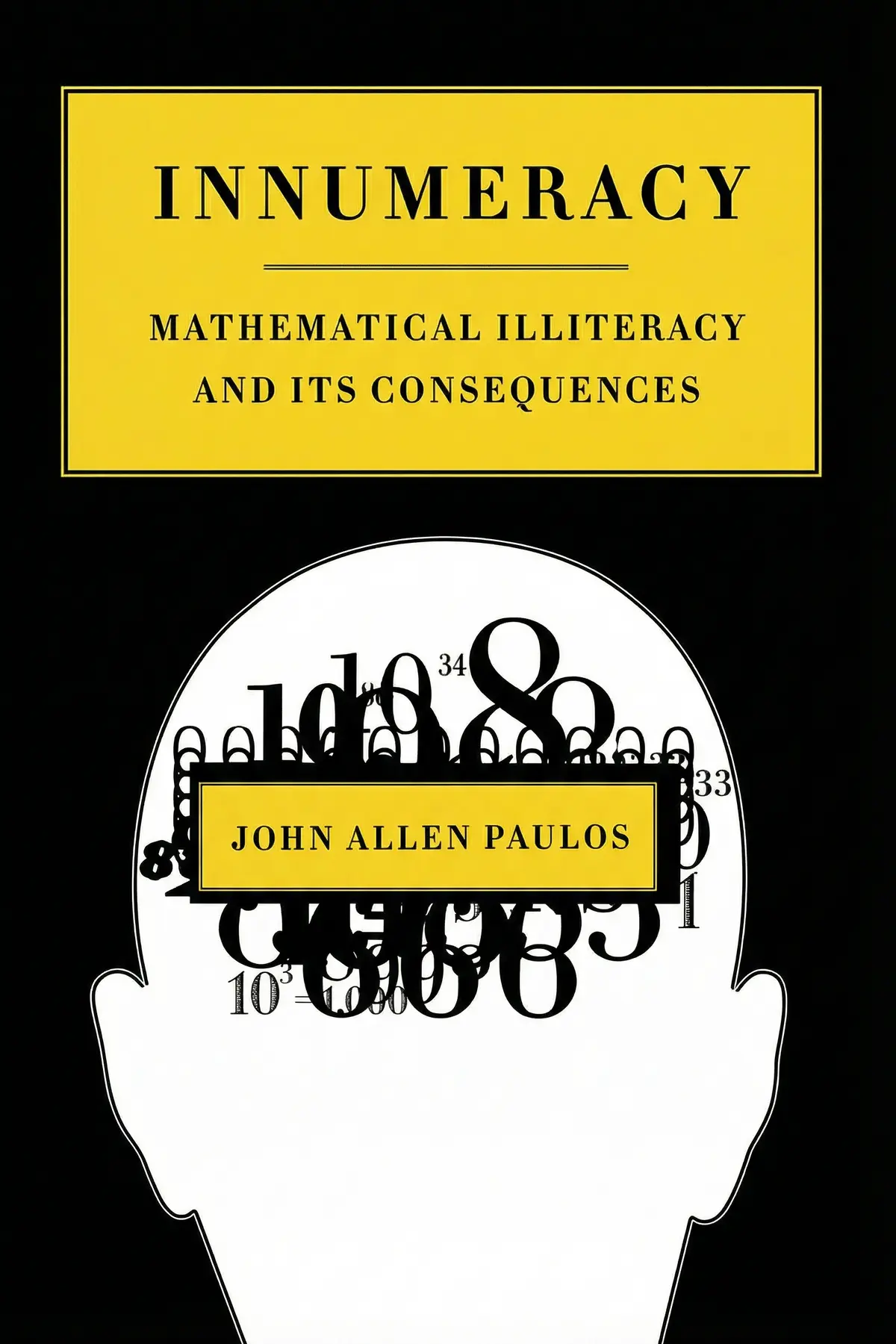
Table of Content
1. Introduction
1 min 07 sec
Plenty of capable adults shrug off numbers as not their thing, and then pay for it in small ways: a scary headline that warps their sense of danger, a coincidence that feels like fate, a sale that is smaller than it looks. In Innumeracy, Temple University mathematician John Allen Paulos argues that this blind spot deserves as much concern as being unable to read. He calls it innumeracy, the lack of basic ideas about number and chance, and its cost is poor judgment in daily life.
His case comes down to one claim: a few elementary ideas, such as sizing a number, multiplying choices and expecting coincidence, protect you from needless fear, from tricksters dressed in math and from bad deals. Along the way there is a purse snatching in Los Angeles settled with probability, a party where birthdays collide, and Sigmund Freud fooled by two ordinary numbers. Each idea ends with a check you can run the next time a figure crosses your desk.
2. Size up a scary headline with two questions
1 min 46 sec
One dramatic news story can shape a person’s fears for years, even when the statistics point the other way. Paulos names the mental slip behind it, and it has nothing to do with intelligence.
3. Count your options with one simple rule
1 min 55 sec
A wardrobe holding just five shirts and three pairs of trousers conceals a figure so enormous that many people flatly refuse to believe it. The rule that produces it applies far beyond getting dressed.
4. Stop reading coincidences as signs
2 min 06 sec
Two suspects matched a robbery witness’s description in striking detail, yet a California court set them free using probability. The reasoning behind that ruling changes how any strange match in your life should feel.
5. See through nonsense dressed up as math
2 min 00 sec
Astrology borrows the laws of gravity, and a friend once convinced Freud that two numbers had magical powers. Both claims sound mathematical, and both fall apart under one simple test anyone can apply.
6. Rebuild number confidence one easy problem at a time
2 min 00 sec
Many bright adults carry a fear of math that began with negative experiences, such as a harsh teacher or the belief that only some people have math minds. Paulos traces where that block comes from and offers a remedy that sounds almost too modest.
7. Weigh your mistakes and check every discount
1 min 51 sec
Two shoppers see the same double markdown, and one walks away believing she got far more off than she did. The same kind of reasoning also explains why people argue past each other on serious questions.
8. Conclusion
1 min 06 sec
What Paulos adds up to is a case that numbers belong to ordinary judgment, for everyone. The alligator story, the 170 million outfits, the Los Angeles couple and the double discount all go wrong in the same place: a feeling about size or chance is allowed to stand in for a count. Each one is fixed by a modest step, and none needs more than school arithmetic.
That makes the habits easy to carry. When a headline frightens you, ask how often the event happens and out of how many. When a coincidence seems to carry a message, remember that 23 guests already give even odds of a shared birthday, and that rare events are bound to turn up somewhere. When someone uses numbers to prove something special, see whether the same trick works with ordinary numbers, as it did with Freud’s 23 and 28. And when a price drops twice, work from the original.
Freud, a man of real brilliance, was taken in by a party trick of arithmetic. What he lacked was a habit anyone can build: stopping to check.
About this book
What is this book about?
Many capable adults say openly that they were never good at math, as if it were a harmless quirk. John Allen Paulos, a mathematics professor at Temple University, disagrees. He calls the lack of basic number sense innumeracy and argues that, unlike illiteracy, people admit to it openly, though it is nothing to boast about because it distorts everyday judgment. Paulos shows the cost through vivid cases. A single alligator attack in the news warps a reader's sense of danger. Five shirts and three pairs of pants produce over 170 million weekly outfit plans, a figure many people refuse to believe. A Los Angeles purse snatching from 1964 was settled in court by probability. Astrology borrows the language of gravity, and even Sigmund Freud fell for a numerical trick about the numbers 23 and 28. Readers get a short set of mental checks: how to size up a scary number, how to expect coincidences instead of reading meaning into them, how to test claims dressed in math, how to ease math anxiety and how to see that two 40 percent discounts add up to 64 percent off.
Book Information
Who it's for
Not a numbers person
Professionals who call themselves not a numbers person and want to stop being misled by statistics.
Hoping to relearn math
Students and adults whose math anxiety began in school and who want a gentler way back.
Tired of being fooled
Curious readers tired of astrology, scary headlines and shop discounts that are smaller than they look.
About the Author
John Allen Paulos
John Allen Paulos teaches mathematics as a professor at Temple University in Philadelphia and holds a doctorate in mathematics from the University of Wisconsin. He has written columns for ABCNews.com, Scientific American and the Guardian, and Innumeracy spent 18 weeks on the New York Times bestseller list. His other books include A Mathematician Reads the Newspaper and A Numerate Life. The American Association for the Advancement of Science and the Joint Policy Board for Mathematics have both honored his work explaining math to the public.
Ratings & Reviews
Ratings at a glance
What people think
Listeners describe this book as educational and stimulating, with one listener highlighting how it clarifies concepts that trick our instincts using numerous practical examples of applied mathematics. Furthermore, the prose is clear and engaging, making the material accessible for those without a technical background. Listeners also feel it is essential reading for students and value its focus on the significance of numerical literacy. Nevertheless, views on the entertainment factor vary, as some find it captivating whereas others consider it dull.
Top reviews
Ubolrat
The safety index mentioned toward the end of the book should be mandatory teaching in every public school curriculum. By using a logarithmic scale to compare the risks of activities like driving versus smoking or getting hit by lightning, Paulos provides a clear framework for understanding probability in our daily lives. This isn't just a book about math; it is a vital tool for navigating a world filled with sensationalized news. I found the writing to be accessible and the examples, like the volume of human blood if poured into Central Park, were both vivid and memorable. While some might find his tone a bit sharp, the truth is that our society is drowning in innumeracy. We need this kind of cold, rational wake-up call to avoid being duped by bad statistics. It's an essential read for anyone who wants to think more clearly.
Show moreSven
Wow, this book does a fantastic job of illustrating how our intuition often fails us when dealing with probability. The 'birthday paradox' example is a classic for a reason, and Paulos explains it with such clarity that even a total novice can understand the mechanics. He takes topics that usually fool our brains and breaks them down into simple, logical steps. I particularly enjoyed the bashing of pseudoscience and phrenology; it’s hilarious to think that corporations used to hire people based on the bumps on their heads. This book is a must-read for anyone who wants to avoid being a 'winner' or 'loser' by pure chance. It’s short, punchy, and packed with insights that remain true decades after it was first published. I highly recommend it for anyone looking to sharpen their critical thinking skills.
Show morePatcharaporn
After hearing about this book for years, I am glad I finally dove in to see his take on our collective inability to handle numbers. The truth is, we live in a world governed by statistics, and being 'innumerate' is just as dangerous as being illiterate. Paulos writes with a passion that is infectious, even when he’s being a bit of a grouch about how lazy students are these days. His idea for a safety scale for risks is pure genius and something I wish the government would actually implement. Some might find the math heavy in parts, but he gives you permission to skip the bits that overwhelm you. It is a very accessible entry point into mathematical thinking. I finished it in two sittings and immediately started recommending it to my friends. It is definitely not a somniferum!
Show moreOlivia
Picking this up was the best decision I've made for my 'mental library' this year. It is a breezy, fun, and deeply informative exploration of why we all need to know at least a little math to survive in a high-tech society. I loved the quirky calculations, like figuring out how fast hair grows in miles per hour—it’s that kind of playful thinking that makes the subject come alive. Paulos is a great writer who manages to make cold numbers feel warm and full of life. He highlights the need for serious reforms in how we teach kids, moving away from boring formulas and toward real fluency. If you've ever felt intimidated by statistics or confused by the news, this book is for you. It’s an empowering read that gives you the tools to judge reality for yourself.
Show moreSomrutai
Ever wonder why you keep hearing about 'miraculous' coincidences on the news? Paulos does a masterful job of debunking the idea that these events are mystical or evidence of ESP. He explains that in a country as large as the United States, even a one-in-a-million event is bound to happen to someone every few days. I loved the section on how we perceive patterns where none exist. The writing is punchy and moves fast, making complex ideas like Bayes' Theorem feel relatively simple. My only real gripe is that the book shows its age; some of the cultural references and examples are definitely stuck in the late 1980s. Still, the core lessons about how we are easily manipulated by percentages remain incredibly relevant today. It’s a solid, informative piece of work that will make you a more skeptical consumer of media.
Show moreNong
As someone who has always struggled with 'math anxiety,' I found the author’s perspective on estimation to be genuinely grounding. Paulos suggests that we should all build a 'mental library' of various powers of ten, which has helped me visualize the difference between a million and a billion in a way I never could before. No more feeling overwhelmed by the massive figures cited in the morning paper! He makes a persuasive case for why math literacy is a civic duty in a high-tech society. While he can be a bit dismissive of educators, his suggestions for shifting math education away from rote memorization and toward 'playful exploration' are spot on. The prose is fluid and full of humor, though his jokes are admittedly a bit nerdy. It’s not a perfect book, but it’s an eye-opening one for the mathematically timid.
Show moreOrawan
Finally got around to this classic, and it is fascinating to see how it basically paved the way for the modern pop-science genre. The author’s discussion on 'regression to the mean' was particularly insightful for me. He explains how we often misattribute the effects of punishment and reward simply because we don't understand that performance naturally fluctuates back toward an average level. It is a brilliant observation that explains so much about human behavior and management. The book is easy to follow, well-written, and provides plenty of real-world examples that apply to everything from gambling to healthcare. I do wish he had spent more time on the 'consequences' mentioned in the subtitle, as the book leans more toward the math itself than the societal impact. Nevertheless, it is a thought-provoking read that will definitely change the way you look at the world.
Show moreMatteo
To be fair, the information within these pages is quite thought-provoking, even if the delivery feels like a disorganized talent show. It is essentially a precursor to the style of Malcolm Gladwell, filled with 'did you know' moments and counter-intuitive facts that challenge our basic instincts. However, it lacks the social relevancy and narrative focus that makes modern pop-math books so engaging. Paulos spends a lot of time on probability and coincidences—like why having the same birthday as a stranger isn't actually rare—but he fails to weave these into a larger argument. The first two chapters are way too long and could have been condensed into a simple introduction. It’s an okay read if you want some fun dinner party facts, but don't expect a structured roadmap for systemic educational reform. It’s a bit too breezy for the weight of its subject matter.
Show moreSuda
Paulos describes himself as a former math prodigy, but his arrogance makes him a terrible ambassador for the subject. Throughout the text, he treats the 'innumerate' public with a level of smug superiority that is frankly exhausting to read. He even admits that he was attracted to mathematics because it allowed him to feel superior to others, and that attitude bleeds into every chapter. To be fair, some of the statistical scenarios are interesting, but the author's constant need to flaunt his intellectual dominance over the 'hoi polloi' ruined the experience for me. The organization is also quite messy, jumping from random facts to personal anecdotes without a clear, cohesive thesis. There are much kinder and more effective books out there for those who want to improve their numerical literacy without being insulted on every other page.
Show moreNing
Look, I am a huge proponent of logic, but the author’s own logical inconsistencies are hard to ignore. On page 94, he correctly warns readers not to attribute combination to causation, yet by page 108, he fumbles his own argument while discussing the link between poor education and innumeracy. He compares people with a 'bad' education to those with 'no' education to make a point that doesn't actually follow the rules he established just a few pages prior. It is deeply frustrating to read a book about the poor state of logic in America that contains such sloppy reasoning. Beyond the logic issues, the book feels very dated and often reads like a collection of trivia rather than a serious investigation. I stopped halfway through and have no desire to finish. It’s more of a talent show than a teaching tool.
Show moreQuestions about this book
What is the main idea of Innumeracy by John Allen Paulos?
Paulos argues that innumeracy, a lack of basic understanding of numbers and probability, is as serious as illiteracy. It leads people to misjudge risks after one vivid news story, to read meaning into ordinary coincidences, to fall for pseudoscience like astrology and to miscalculate everyday deals. A few elementary ideas, such as sizing numbers in context and multiplying choices, correct most of these errors.
What does Innumeracy say about coincidences?
Paulos defines a coincidence as an improbable event that is nonetheless common, so common we should expect it. He separates the chance of some coincidence from the chance of a specific one. With 23 people at a party, there are even odds that two share a birthday, but even odds that two share one chosen date require 253 people. A 1964 Los Angeles court case turned on this reasoning.
Why does Paulos call astrology pseudoscience?
Astrology claims planetary gravity at birth shapes personality, borrowing real physics: gravity grows with mass and weakens with the square of distance. Applied honestly, those laws show the doctor or nurse at your birth pulled on you far more than distant planets. Paulos uses astrology, and Freud’s belief in the special numbers 23 and 28, to show how math-flavored claims exploit people who do not check.
How can I overcome math anxiety, according to Innumeracy?
Paulos traces math anxiety to bad experiences, such as a harsh teacher or the belief that only some people have a mind for math. He notes that even brilliant people like Freud struggled with numbers without being incapable. His remedy is to rebuild confidence by solving many simple problems you already feel comfortable with, then progress slowly to harder ones.
How do two 40 percent discounts work out?
They do not add up to 80 percent. Paulos explains that the second 40 percent applies to the already reduced price, so it removes only another 24 percent of the original. The combined discount is 64 percent. The practical lesson is to apply stacked percentage cuts one after another from the starting price before deciding a deal is as good as it sounds.
Readers also enjoyed

A Life Decoded: My Genome: My Life
J. Craig Venter

A Planet of Viruses
Carl Zimmer

A Short History of Nearly Everything
Bill Bryson

A Thousand Brains: A New Theory of Intelligence
Jeff Hawkins




Alien Earths: The New Science of Planet Hunting in the Cosmos
Lisa Kaltenegger

AUDIO SUMMARY AVAILABLE
Listen to Innumeracy in 15 minutes
Get the key ideas from Innumeracy by John Allen Paulos, plus 5,000+ more nonfiction titles.
- 5,000+ titles
- Listen as much as you want
- 7-day free trial
- Cancel anytime









