

14 min 04 sec
Available in: English
Implementing Six Sigma: Smarter Solutions Using Statistical Methods
Shows managers how to stop reacting to every bad number. Measure processes honestly over time, separate real problems from random noise, and use structured projects and experiments to fix causes at the root.
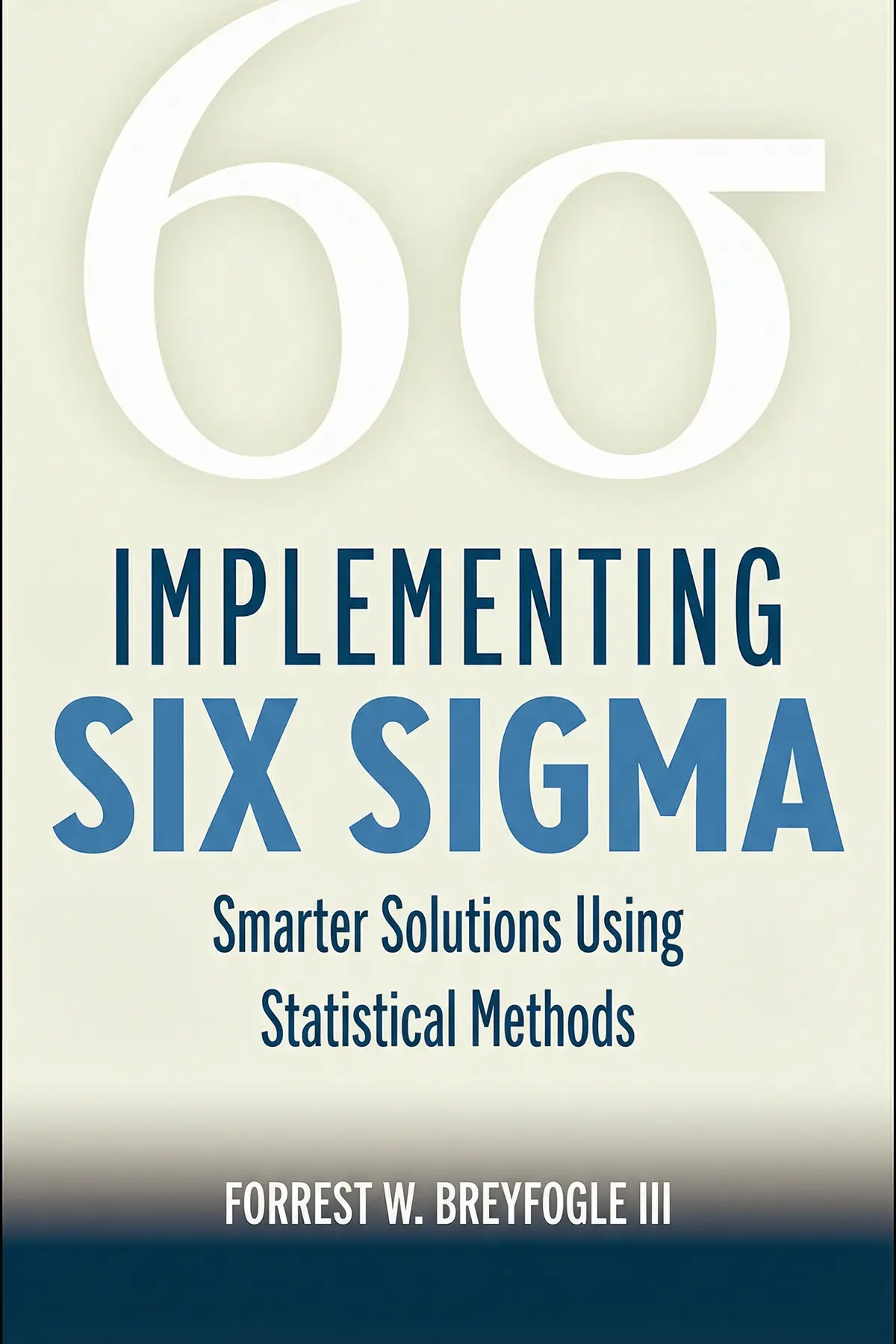
Table of Content
1. Introduction
1 min 08 sec
If your week is spent putting out the same fires again and again, more effort will not stop them; a different way of measuring will. In Implementing Six Sigma, statistician and consultant Forrest W. Breyfogle III argues that most managers react to random noise in their numbers, and that adjustments made in response to noise can make a process worse. His remedy is a joined-up system he calls Integrated Enterprise Excellence, or IEE. It starts with honest, long-term measurement, turns weak spots into focused improvement projects, and tests solutions with structured experiments instead of hunches.
The thread running through the book is easy to state. Lasting improvement comes from treating the organization as one system and letting trustworthy data, and never the crisis of the day, decide what gets fixed. Follow that thread and you get a way to price the waste everyone has stopped noticing, to spot which problems are real, and to find fixes that one-at-a-time tinkering would miss.
2. Put a price on doing nothing different
1 min 48 sec
Most companies count what their defects cost once something breaks. Breyfogle points to a much larger bill hiding underneath, one that nobody budgets for, and shows how naming it turns a complaint into a case for change.
3. Watch your business from two altitudes
1 min 52 sec
Quarterly numbers rise and fall, and every swing seems to demand an explanation. Breyfogle offers a way of looking at the business that calms the overreaction and, at the same time, points straight at the work that matters.
4. Tell a real problem from background noise
2 min 06 sec
Two operators spend a whole shift correcting a machine, and every correction seems to work for a while. A simple chart of the day’s readings reveals what they were really doing, and why a popular inspection rule offers similar false comfort.
5. A five-step route from vague problem to lasting fix
2 min 02 sec
Teams often leap from complaint to solution and wonder why the problem returns. A five-phase roadmap forces a pause in the right places, including one stage where changing anything at all is deliberately forbidden.
6. Test factors together to find hidden wins
2 min 03 sec
An engineer tests two settings carefully, one after the other, and reaches a confident answer. It may be the wrong one. The same flaw could keep a school district from learning when its absence program actually works.
7. Build a company that prevents problems by design
1 min 56 sec
Six Sigma reduces variation and defects, while Lean improves flow by cutting waste, and IEE shows which of the two to apply. Breyfogle shows how one chart settles which to use, and how a single change in a monthly meeting reveals whether a company has truly changed.
8. Conclusion
1 min 09 sec
Breyfogle’s book adds up to an argument about attention. Firefighting feels productive because everyone can see it, while the waste that starts the fires stays below the waterline. His system moves attention to where it pays: long-term numbers at the top, charted processes beneath them, and projects that begin only when the data shows a process falling short.
Several practices follow from the material. Put a yearly price on leaving one troublesome process unchanged, and use that figure to argue for fixing it. Chart that process with spaced-out samples, and resist adjusting it every time a single reading crosses a line, since Joe and Mary’s long shift showed what reacting to noise achieves. When you test a fix, change factors in combination, as the school district could with its call-backs, because the best answer may sit in a pairing nobody tried. And once a fix works, watch the inputs that predict trouble rather than the outputs that report it.
The fires do not stop on their own. They stop when someone stops asking who missed the target and starts asking what the process is doing.
About this book
What is this book about?
Many managers spend their days solving urgent problems, only to see the same kinds of problems return. Forrest W. Breyfogle III argues that the cycle continues because organizations measure themselves badly and then react to the wrong things. Managers chase random swings in their numbers, adjust stable processes, and trust inspection rules that let poor quality through. His answer is a joined-up system he calls Integrated Enterprise Excellence. It tracks broad business results over long periods and charts the processes that drive them. When a process falls short, the data itself justifies an improvement project already tied to strategy. Those projects follow the five-phase DMAIC roadmap and rely on Design of Experiments, which tests several factors at once and finds interactions that one-at-a-time tinkering misses. Readers get a practical way to price the waste they have stopped noticing, to tell a real signal from background noise, and to choose between Lean and Six Sigma tools for a given process. The larger goal is an organization where leaders ask about the state of the system instead of who missed a target.
Book Information
Who it's for
Tired of recurring problems
Operations managers and engineers tired of solving the same production or service problems every week.
Hoping for blame-free reviews
Team leads who want their monthly reviews to discuss processes instead of assigning blame.
Choosing between improvement methods
Founders and analysts deciding whether a slow or unreliable process needs Lean tools or Six Sigma.
About the Author
Forrest W. Breyfogle III
Forrest W. Breyfogle III became interested in statistical techniques after a Design of Experiments workshop at IBM in 1975, and later worked there as a full-time internal statistical consultant. After retiring from IBM in 1992, he founded Smarter Solutions, Inc., which offers Six Sigma training and consulting. The second edition of Implementing Six Sigma won the American Society for Quality's Crosby Medal in 2004. He has written more than a dozen books, served as subject matter expert for APQC's national Six Sigma benchmarking study, and was named Quality Magazine's Quality Professional of the Year for 2011.
Ratings & Reviews
Ratings at a glance
What people think
Listeners consider this volume to be an incredibly detailed and authoritative resource that successfully clarifies the hands-on use of Six Sigma. Furthermore, they appreciate that it provides enough statistical depth for Black Belts, with one listener noting its effectiveness as a primary source for a thesis. Additionally, while some listeners feel the dense material can be a challenge to navigate, they also remark that it offers everything required for a total grasp of the methodology.
Top reviews
Sukit
As a Black Belt candidate, I found Breyfogle’s work to be the definitive guide for actually executing a project. It goes well beyond the high-level theory found in most introductory texts and dives straight into the gritty statistical mechanics. The math is robust and precise, which is exactly what you need when you're defending your metrics to a skeptical management team. I appreciate how it frames the 'how' of the methodology within a larger business framework. While the physical weight of the book is daunting, the knowledge contained inside is essentially priceless for anyone serious about process improvement. It isn't a light read by any stretch, but the rewards for your career are massive if you take the time to study it properly. Definitely a cornerstone text for the industry.
Show moreSven
Finally got around to using this for my master's thesis and it was a total lifesaver for my research. My professor recommended Breyfogle because of his rigorous approach to Lean Six Sigma, and the book definitely lived up to that reputation. It covers every single nuance of the implementation phase that other authors usually gloss over. Not gonna lie, I struggled with some of the more complex formulas early on, but the logical flow of the text eventually made everything click. This is an essential reference for any academic or practitioner looking to back up their work with rock-solid data and proven methodologies. Thank you, sir, for such a brilliant resource! It made my defense much easier.
Show moreNam
Wow, the Smarter Solutions approach outlined in these pages really changes the game for anyone pursuing operational excellence. I’ve been through several LSS training programs, and this is by far the most detailed breakdown of the statistical tools required for success. The book contains everything needed for a comprehensive understanding, even if it takes a while to process the more advanced chapters. I especially liked the inclusion of real-world application examples that bridge the gap between abstract math and actual factory floor results. It is a massive, knowledgeable text that has become the most referenced book in my professional library. Highly recommended for serious students of the craft who want to master the discipline.
Show moreManop
The statistical depth here is truly impressive, though it can feel like a dense forest at times. I've spent weeks digging through the chapters on DMAIC and the sheer amount of technical detail for Black Belts is staggering. Frankly, it is probably the most comprehensive resource on my shelf, yet I wouldn't recommend it to someone just starting their journey. You need a solid foundation before tackling Breyfogle’s advanced insights. Some sections feel a bit repetitive, but the clarity of the practical applications usually makes up for the redundancy. It’s a dense, heavy-duty textbook that demands respect and focus from the reader. If you want the truth behind the numbers, look no further.
Show moreClara
Ever wonder how to actually translate theory into a functional Lean Six Sigma environment without losing your mind? This book attempts to answer that question with a level of detail that is frankly unparalleled in the current market. I’ve found the sections on statistical analysis particularly useful for my current project load. While the text is extremely thorough, the complexity can be a major hurdle for those who aren't naturally inclined toward mathematics. You really have to commit to the material to get the full value out of it. It’s a dense read, but it provides a very clear roadmap for anyone looking to achieve real operational excellence. Hard work, but it definitely pays off.
Show moreSamuel
This book functions more like an encyclopedia of methodology than a quick reference guide, which is both a blessing and a curse. You get a deep dive into the 'how' of Six Sigma that most other books simply cannot match. I particularly appreciated the focus on statistical detail which is vital for anyone aiming for their Black Belt certification. Gotta say, the sheer volume of information can be intimidating at first glance, but the structured approach helps keep you grounded. It is a very difficult read at times, yet the depth of knowledge is worth the effort if you are serious about the subject. You really have to commit to the material to get the full value.
Show moreNarumon
After hearing so much about this 'bible' of Six Sigma, I’m glad the content matches the hype despite its steep learning curve. The author provides sufficient detail in the stats for Black Belts to feel confident in their analysis. It isn't a book you read cover to cover in a weekend, but rather a companion for a long-term project. My only real gripe is the difficulty of the material, which can be discouraging for newcomers. However, the thoroughness of the 'how' makes it an indispensable tool for anyone who needs to get results. It’s a very smart, well-constructed text that deserves its place on your bookshelf. It covers the bases where others fall short.
Show moreWacharapol
Truth is, while the content is exhaustive, the navigation and layout make it a bit of a slog to get through for a daily practitioner. I found myself searching for specific answer guides and needing external resources to fully grasp the heavier statistical concepts presented here. It contains everything you could possibly need for a total understanding of the system, yet the presentation feels slightly dated and overly academic. Personally, I think it works best as a desk reference rather than a teaching tool for a corporate team. It is a massive volume of knowledge that requires a lot of patience to digest. It’s good, but be prepared for some heavy lifting during your study sessions.
Show moreKevin
Look, Breyfogle knows his stuff, but the sheer volume of data points can be completely overwhelming for the average reader. I picked this up hoping for a practical walkthrough, and while it delivers on the technical side, the prose is incredibly dense. It’s a thorough text, almost to a fault. I spent more time trying to decode the formatting than actually learning the implementation steps. In my experience, there are easier ways to learn these concepts, although you might sacrifice some of the statistical precision found in these pages. It’s a decent enough book if you have the time to sit down and study it like a university course. Just don't expect a quick read.
Show morePaiboon
Not what I expected given the high praise from colleagues, as it felt overly academic and dry for a busy practitioner. I was looking for a streamlined guide to implementation, but instead, I found a thousand-page tomb that felt like a chore to navigate. To be fair, the information is all there, but the density makes it incredibly difficult to find quick answers when you are on a tight deadline. It’s definitely a knowledgeable text, but the style is so heavy that it becomes a barrier to learning. If you are writing a thesis, buy it. If you are trying to fix a production line by Friday, look elsewhere for a more accessible manual that isn't so cumbersome.
Show moreQuestions about this book
What is the main idea of Implementing Six Sigma?
Breyfogle argues that organizations stay stuck in daily firefighting because they measure badly and react to random noise. His Integrated Enterprise Excellence system tracks business results over long periods, charts the processes behind them, and launches improvement projects only when the data shows a process falling short. Those projects follow the DMAIC roadmap and use designed experiments, so problems get solved at their root instead of returning.
What is the 30,000-foot-level control chart?
It is Breyfogle’s way of viewing a process from a distance. Samples are taken infrequently, perhaps one a day or a week, so normal differences such as a new operator or a fresh batch of material fall within the chart’s limits. Those limits come from the process’s own variation. A point outside them is a real signal worth investigating, while a stable process that still fails customers needs wider improvement.
Why is testing one factor at a time a mistake?
It misses interactions. In Breyfogle’s example, an engineer changes additive and then temperature separately and concludes that high temperature with low additive works best, never trying both settings high, which might have been far better. Design of Experiments tests combinations in a planned grid, examining seven or more variables in eight to sixteen trials, and reveals how factors work together.
How does the book help decide between Lean and Six Sigma?
Breyfogle uses the 30,000-foot chart as the guide. A process with low variation that runs too slowly has a flow problem, so Lean tools that cut waste such as waiting and surplus inventory fit best. A process that is fast but inconsistent has a variation problem, which calls for the DMAIC roadmap and designed experiments to find and fix the root causes.
Readers also enjoyed



A Year with Peter Drucker: 52 Weeks of Coaching for Leadership Effectiveness
Joseph A. Maciariello



Acting with Power: Why We Are More Powerful Than We Believe
Deborah Gruenfeld

All In: How Great Leaders Build Unstoppable Teams
Mike Michalowicz


AUDIO SUMMARY AVAILABLE
Listen to Implementing Six Sigma in 15 minutes
Get the key ideas from Implementing Six Sigma by Forrest W. Breyfogle III, plus 5,000+ more nonfiction titles.
- 5,000+ titles
- Listen as much as you want
- 7-day free trial
- Cancel anytime









