

A Planet of Viruses
Carl Zimmer
 English
Shows why science advances by asking good questions about what we do not know. It also explains how to turn your own gaps in knowledge, failed tests and huge problems into questions you can work on.
58 sec
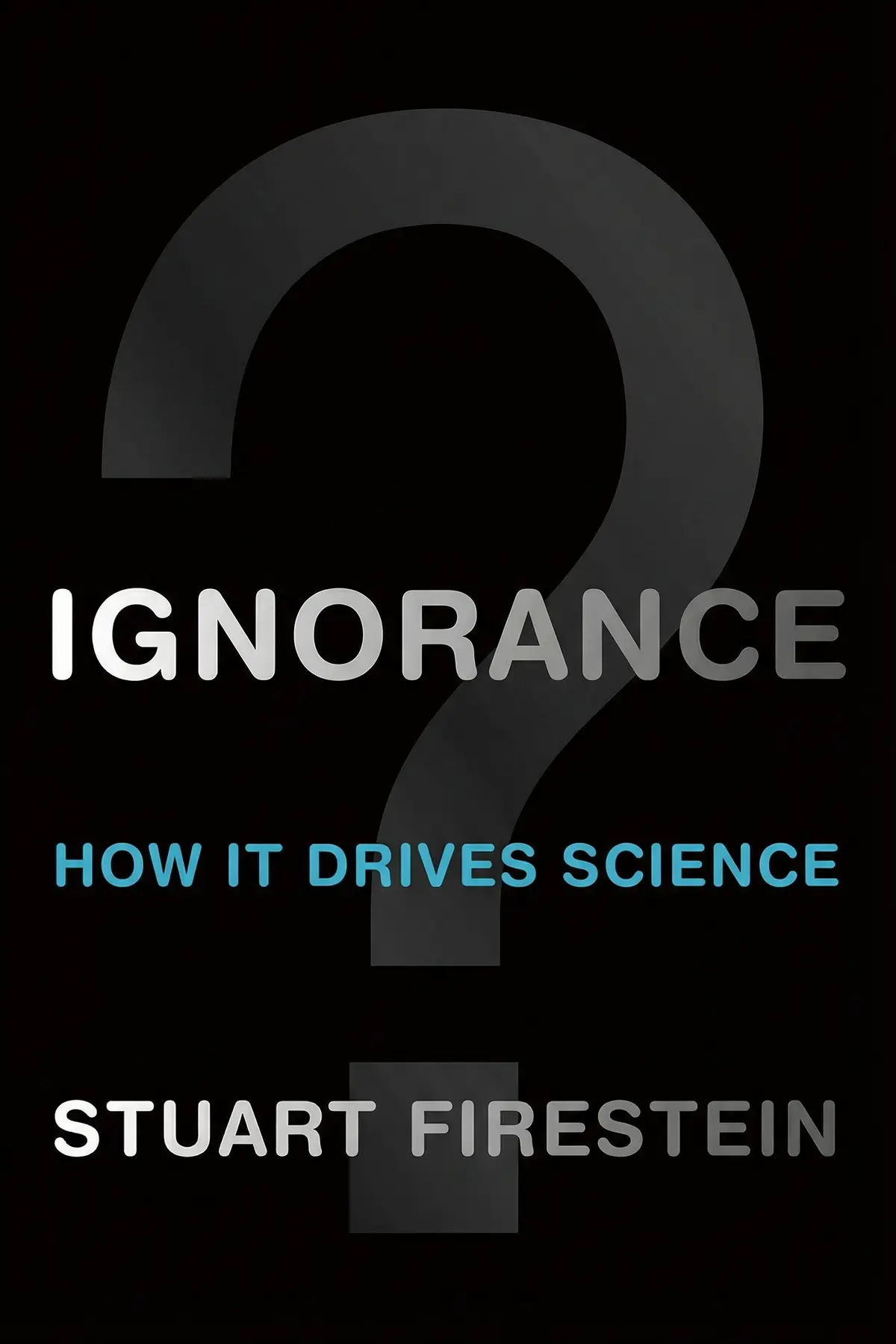
Most of us learned at school that knowing the answer makes you smart, and that not knowing is something to hide. In Ignorance, Columbia neuroscientist Stuart Firestein turns that around: science, he argues, runs far more on what researchers do not know than on the facts they have already gathered. A clear map of your own ignorance, and the right question aimed at it, is where discovery begins.
That idea connects every story Firestein tells, from a horse that seemed to do sums to a dolphin that punished its trainer, and from a split at the heart of physics to the puzzle of how memory fits inside a brain. It also speaks to ordinary work, where answers are a click away and good questions are rare. By the end, you will be able to tell useful ignorance from the stubborn kind, shrink a huge question into a workable one, and see why being proved wrong can be the best news of your week.
1 min 40 sec
A fact sounds like the final word on a question. Firestein points to a hidden human hand behind every one of them, and to a kind of light nobody suspected existed, to show why that word is never final.
1 min 39 sec
A great physicist told his students that an experiment which proves you right is the less interesting outcome. His reasoning changes how a failed test, a broken plan or a rejected idea should feel.
1 min 37 sec
Bold claims about the next decade almost always age badly. One mathematician, offering predictions in 1900 about the century to come, found a way to keep them relevant right up to today.
1 min 45 sec
The human brain is too complicated to study head on, and so are most real problems. A dull piece of paperwork and a few laboratory mice show how scientists make the impossible manageable.
1 min 38 sec
A horse that stamped out sums fooled crowds, and a dolphin once turned the tables on its trainer. Between them sits a question scientists knew little about, whether animals can think, and a lesson about trusting impressive results.
1 min 57 sec
Physics runs on two sets of laws that refuse to fit together, and the brain stores more memories than it seems to have room for. Both puzzles became starting points, and one result says something about your own forgetting.
1 min 39 sec
Galileo made a choice about language that opened science to ordinary readers. Today’s research has drifted back behind a wall, and one question asked in nearly every lecture hall shows what education is getting wrong.
1 min 06 sec
Firestein’s book is, in the end, a defense of the blank spaces on the map. Facts matter, but they are made by people with limited senses and strong hopes, and they never close the story. What moves science is a clear view of what is still unknown, turned into a question precise enough to work on. A horse that could not count opened research into animal minds. A brain with too few synapses revealed that forgetting is part of learning. A split at the center of physics gave rise to string theory.
The same habits travel well beyond the lab. When a result goes against you, take Fermi’s view and look for what it revealed before you rush to repair it. When a problem feels too large, keep shrinking it, the way brain researchers turn to mice, until you reach something you could begin tomorrow. And when you have to look ahead, write your forecast as an open question, as Hilbert did.
Answers now cost a click. Knowing exactly where your knowledge ends is the rarer skill, and that edge is where the interesting work begins.
Most of us were taught that being smart means having the answer. Stuart Firestein, a neuroscientist at Columbia University, argues that science works the other way around. Research starts with ignorance, the honest absence of knowledge, and progress depends on how well scientists turn that ignorance into questions. Firestein shows why scientific facts are always provisional, why long-range predictions usually fail, and why the physicist Enrico Fermi counted a failed experiment as a discovery. He follows ignorance at work through a horse that seemed to count, a dolphin that put its trainer on time-out, chimpanzees in front of a mirror, the gap between quantum and classical physics, and a memory puzzle that showed forgetting is part of learning. Readers get a clear way to separate useful ignorance from the willful kind, a method for breaking giant questions into small ones, and a case for teaching students to ask questions in an age when almost any fact is one click away.
Professionals and students who feel they must always have the answer and want a better way to handle not knowing.
Teachers, trainers and team leads who want people to ask sharper questions.
Curious readers who want to see how real scientific discovery happens.
Stuart Firestein is a professor of neuroscience at Columbia University, where his laboratory studies the sense of smell. He has published more than 100 scientific papers and has received awards for his teaching. Ignorance grew out of a class he started at Columbia, in which working scientists told students what they do not yet know. He gave a TED talk on the subject in 2013 and has also written Failure, a book about the place of failure in science.
Listeners find this work highly captivating and skillfully authored, offering excellent perspectives on the way scientific research is conducted. Furthermore, they value its intellectually stimulating quality; one listener points out its ability to foster critical thinking skills, while another observes how the ideas progress smoothly from chapter to chapter. Listeners also appreciate the way information is presented, with one review highlighting how it conveys the actual experience of dealing with ignorance, while another notes how it turns the tables on the idea of ignorance.
Firestein completely flips the script on how we perceive scientific discovery in this engaging work. Instead of seeing science as a cold accumulation of data, he presents it as a messy, human, and deeply exciting hunt for better questions. I was particularly struck by the discussion on how successful facts can be 'worrisome' because they stop people from asking new things. The writing is witty and accessible, moving at a brisk pace that never feels bogged down by jargon. It’s incredibly refreshing to see an author celebrate what we don't know rather than just listing what we do. This book encourages critical thinking skills by teaching readers to look beyond the textbook answers. Truly, it’s a wonderful reminder that the most interesting part of any experiment is usually the part that didn't work. Highly recommended for anyone who thinks science is just about memorization.
Show moreFinally got around to reading this after seeing it on a 'Science' journal reading list. It’s a punchy, short book that doesn’t overstay its welcome. Firestein’s use of the Faraday quote—comparing a new discovery to a newborn baby—is absolutely brilliant and sticks with you long after you close the cover. He argues that science isn't a mountain of facts, but an expanding horizon of what we don't understand. Personally, I found the chapter on the history of the brain cell count to be a staggering example of how 'facts' can be wrong for decades. While the writing occasionally feels like a transcribed lecture, the energy of the ideas carries it through. This should be required reading for every undergrad before they step into a lab. It gives you the courage to be wrong, which is the most important tool a researcher can have.
Show moreWow, I am still chewing on the idea that facts are just the jumping-off point for the truly interesting work. Firestein does a masterful job of conveying the experience of dealing with ignorance as a productive force. The reference to C.S. Peirce and the idea of 'communal gaps' in knowledge added a depth that I wasn't expecting from such a short volume. It turns the tables on the idea of ignorance being a negative trait. Instead, it’s the very fuel that keeps the scientific engine running. The writing is clear, funny, and deeply insightful, making complex philosophical points feel like common sense. I loved the emphasis on how scientists really communicate when the cameras aren't rolling. It makes the world of research feel much more accessible and human. This is easily one of the most thought-provoking books I’ve read this year.
Show moreEver wonder why textbooks are so boring while real research feels like an addiction? Stuart Firestein suggests it’s because we focus on the wrong end of the telescope, obsessing over established facts rather than the delicious mystery of the unknown. His metaphor of the black cat in a dark room—where there might not even be a cat—is a hauntingly perfect description of the scientific frontier. I loved the way he reframes ignorance not as a lack of intelligence, but as a communal gap in knowledge that demands exploration. To be fair, some sections feel a bit repetitive, and he hammers the central point home perhaps a few too many times. However, the insight into how scientists actually talk over a beer versus how they write in journals is worth the price of admission. It’s a quick read that will fundamentally change how you view your own uncertainty.
Show moreAs someone who spent years in a lab, I found this perspective incredibly refreshing and authentic. Firestein captures that specific feeling of 'managing ignorance' that defines the daily life of a working scientist. We spend our time at the edge of the map, and this book does a great job of explaining that to the layperson without being condescending. The story about the miscounted brain cells was a particular highlight for me. It shows how easily we can be led astray by 'impregnable' facts that turn out to be completely wrong. My only complaint is that the case histories felt a bit disconnected from the philosophical punch of the introduction. They are interesting on their own, but the transitions could have been smoother. Regardless, the book is a great insight into how science is conducted in the real world.
Show moreThe core argument here—that science is driven by what we don't know rather than what we do—is handled with surprising wit. I’ve always been bothered by how science is taught as a finished story, so seeing someone prioritize 'knowledgeable ignorance' was fantastic. Firestein’s prose is conversational and moves quickly, though it occasionally feels like you’re sitting in the back of a slightly disorganized classroom. He avoids the typical arrogance found in pop science, opting instead for a humble look at the limitations of human perception. The section on how we might be conceptually blind to certain dimensions was particularly mind-bending and well-written. I think students would benefit immensely from this perspective before they get burnt out on rote learning. It’s a small book that manages to turn a massive concept on its head. A few more diagrams or illustrations might have helped, but the writing is strong enough to carry it.
Show moreLook, this is a tiny book, but it packs a significant punch regarding how we educate students. Firestein argues that we should be teaching 'how the data frames the unknown' rather than just asking kids to memorize lists of discoveries. The way he reframes the conflict between Galileo and the Church was particularly fascinating and offered a perspective I hadn't encountered before. The book is thoroughly engaging and well-written, even if it feels a little disorganized in the latter half. I found the ideas flowed nicely from chapter to chapter in the beginning, but the case studies felt a bit like a detour. Still, the underlying message about embracing doubt is something we desperately need more of in today's world. It’s a great piece for anyone looking to sharpen their critical thinking skills. It makes you realize that being ignorant isn't a failure—it's an opportunity.
Show moreTo be fair, the premise is absolutely brilliant, yet the execution left me feeling a bit adrift. The first few chapters are electric, exploring the 'Negative Capability' and why certainty is the enemy of discovery. However, the narrative eventually starts to feel like a collection of lecture notes that haven't been fully polished for a general audience. The prose is a bit messy in places, with some paragraphs feeling like misshapen lumps that circle back on themselves. I enjoyed the case histories in theory, but some were far more engaging than others. It’s a short book, which is a blessing, because the central thesis is essentially exhausted by the midpoint. It is certainly thought-provoking, but it feels more like a long essay that was stretched into a book. If you are looking for a deep dive, this might feel a little thin.
Show morePicked this up because the concept of 'knowledgeable ignorance' sounded like the perfect antidote to current social media certainty. There are some gems in here, especially the parts about the 'negative capability' and the danger of being too sure about an experiment's outcome. However, the book didn't quite live up to the hype for me. The rambling style went around in circles at times, and I found myself checking how many pages were left in the case history sections. To be fair, Firestein is a great storyteller, but the transitions between anecdotes and theory are a bit jarring. It’s a good book that could have been a great one with a more rigorous editor to trim the repetitive bits. I’d recommend it for the first fifty pages alone, but don’t expect a life-changing epiphany in the second half. It's a solid, interesting perspective, but ultimately feels a bit unfinished.
Show moreNot what I expected from a book with such a provocative title and high praise. While the initial few chapters hit hard, the middle section felt like a collection of lecture notes that hadn't been properly adapted for a book. There were several moments where the prose drifted into a kind of academic monotony that made it difficult to stay engaged. The 'case histories' were a great idea in theory, but they didn't always bridge the gap between abstract philosophy and concrete application. Frankly, I think the author’s classroom seminar probably offered a more vibrant experience than these misshapen lumps of paragraphs. It’s a short read, which is a mercy, but I was hoping for much more cohesion. It feels like a brilliant 20-page essay padded out to 100 pages just to justify a hardcover price. I'd skip this and look for a summary online instead.
Show moreFirestein argues that science is driven less by the facts we have than by what we do not yet know. Research starts with ignorance, meaning a genuine absence of knowledge, and progress depends on turning that ignorance into good questions. Facts are always provisional because they are made by imperfect people with limited senses, so no discovery should be treated as the end of the road.
Firestein separates willful stupidity, which means deliberately ignoring facts or logic to protect a belief, from a simple absence of facts or understanding, whether in one person or across a whole field. The first kind blocks learning. The second is valuable, because asking questions about it is what drives scientific research forward and opens up new areas of study.
Fermi told his students that an experiment confirming a hypothesis is only a measurement, while one that fails to confirm it is a discovery. A wrong result exposes a gap in knowledge you did not know about, and that gap produces new questions. Firestein uses the idea to show why being proved wrong is a productive outcome in science.
Treat findings as provisional and ask what would change them. When a plan fails, note what the failure revealed before fixing it. Break a huge problem into smaller questions, the way scientists study mice to understand the brain. Phrase long-range forecasts as open questions, as the mathematician Hilbert did in 1900. If you lead people, share unsolved problems and reward sharp questions.
It suits students and professionals who feel pressure to always know the answer, teachers and managers who want to encourage better questions, and anyone curious about how science really works. Its examples range from a horse that seemed to count and a dolphin that put its trainer on time-out to string theory and research on memory.
Carl Zimmer

Bill Bryson

Jeff Hawkins




Lisa Kaltenegger


AUDIO SUMMARY AVAILABLE
Get the key ideas from Ignorance by Stuart Firestein, plus 5,000+ more nonfiction titles.









