
15 min 47 sec
Available in: English
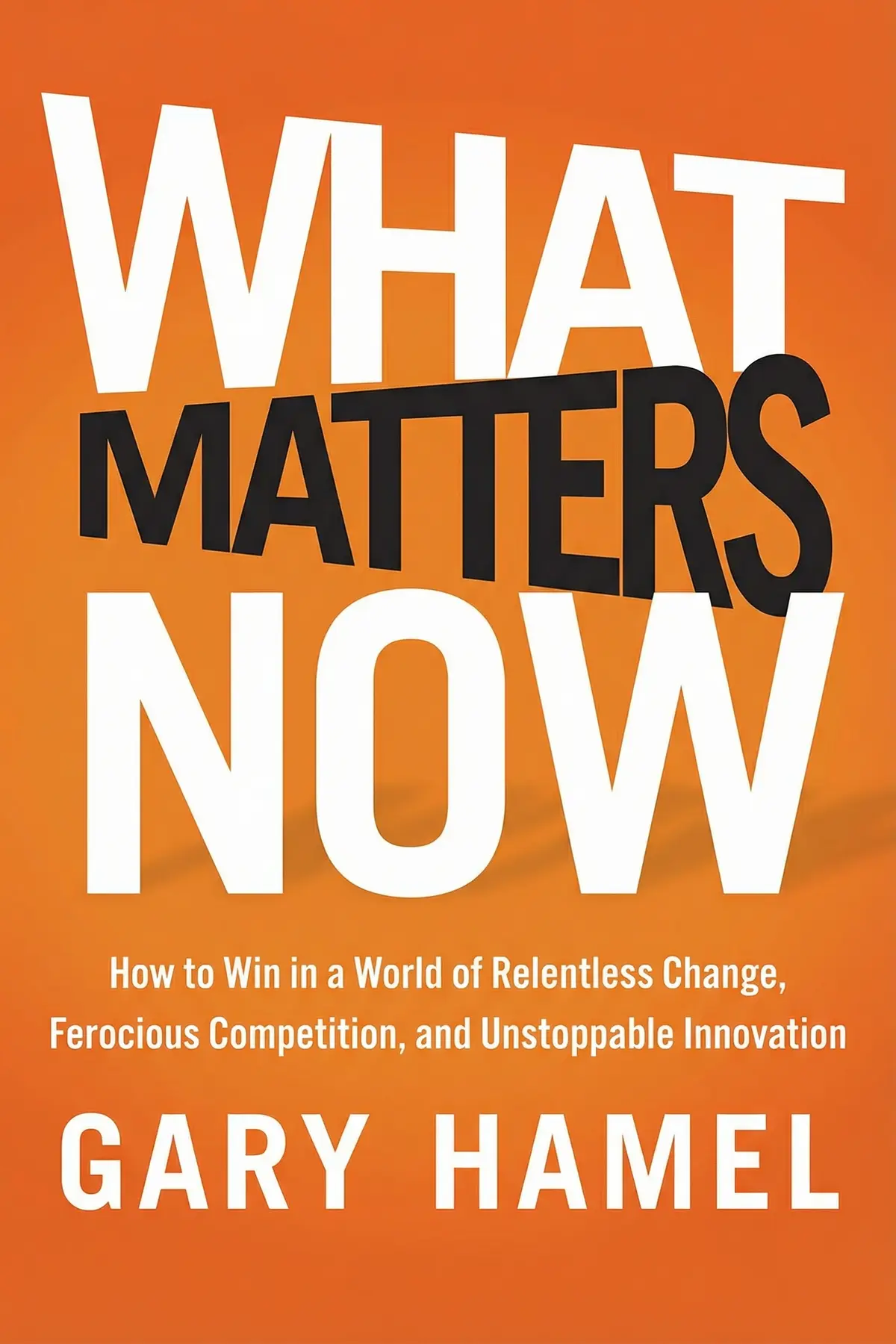
Humanocracy: Creating Organizations As Amazing As the People Inside Them
Shows why bureaucracy keeps growing and wasting people's talent, and how organizations can keep order while handing real power, context and rewards to the people doing the work, starting with small experiments.
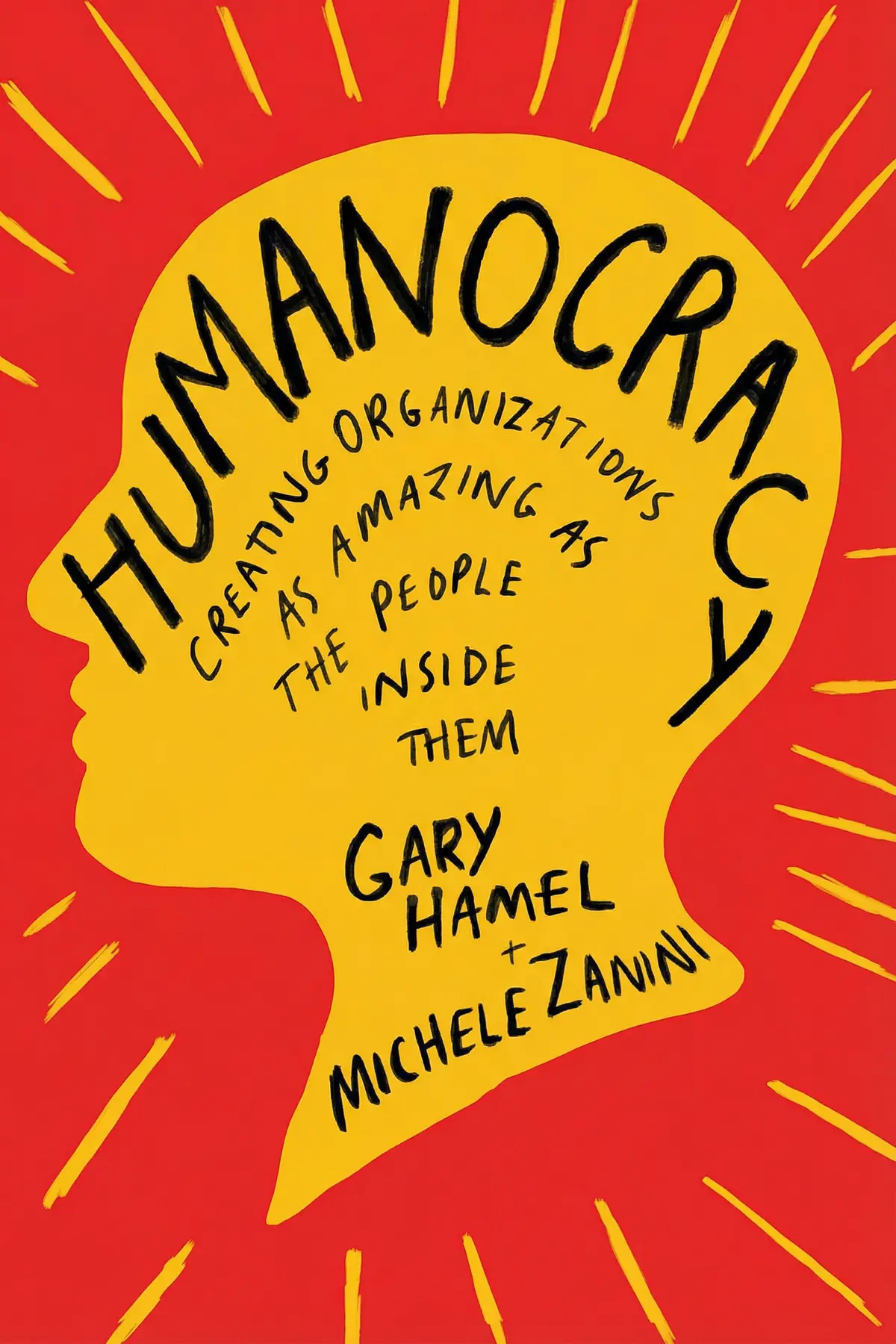
Table of Content
1. Introduction
1 min 02 sec
If your best ideas shrink as they climb through layers of approval, the problem may lie in the model your organization runs on rather than the people in it. In Humanocracy, Gary Hamel and Michele Zanini trace that frustration to bureaucracy, a system born about 150 years ago, when most workers could not read and hierarchy was the only way to move information. Hamel says only 15 percent of employees are truly engaged, so most organizations waste more human ability than they use.
The authors argue that a company can keep the control, consistency and coordination bureaucracy offers while shedding its costs, once it sets out to get the most from every person. Their evidence includes a steelmaker with almost no managers, an appliance maker split into thousands of tiny firms and a Dutch nursing network run by two line managers. The book then lays out seven principles and a way to start changing things from wherever you sit.
2. See the hidden tax your organization charges
1 min 36 sec
A famous management thinker once predicted that companies would soon need far fewer bosses. The opposite happened, and the reason shows up in how your own week is spent, often in ways nobody ever bills a customer for.
3. See why bureaucracy survives every crisis
1 min 43 sec
During the pandemic, healthcare providers formed lateral learning networks to share research and advance protocols. Yet Hamel warns that once a crisis fades, bureaucracy tends to reassert itself. The authors explain what pulls organizations back, and who benefits when it happens.
4. An organization that serves the people in it
1 min 45 sec
The everyday words companies use for their staff reveal a hidden assumption about who serves whom. Hamel compares it to a troubled marriage, and the comparison explains more about low engagement than any survey.
5. Run a giant company with almost no managers
1 min 39 sec
Its rivals carry four or five times as many managers, yet an American steelmaker keeps leading its industry. Its approach rests on careful hiring, cross-training and heavy investment in people, building a high-trust network where teams can grow and share what they know.
6. Turn every employee into an entrepreneur
1 min 40 sec
At one appliance giant, a team can remove a leader who underperforms. At a Dutch care provider, thousands of nurses organize themselves. Both raise an awkward question about what managers are really for.
7. Copy the beliefs behind the pioneers
1 min 46 sec
Borrowing one clever practice from a famous company feels like progress, yet it usually fails. A soccer jersey, a recovery group and an airline show what actually has to change underneath.
8. Reward proven impact over confident self-promotion
1 min 39 sec
Almost every executive believes they belong among the best performers, and the numbers make that impossible. The gap between self-image and reality decides who rises in most companies, and the authors propose a fix.
9. Start the change with your own habits
1 min 37 sec
Big transformation programs announced from the top tend to stall. The authors propose a humbler starting point, one that begins with an uncomfortable look at how you yourself behave at work.
10. Conclusion
1 min 20 sec
Humanocracy keeps returning to a question most organizations never ask themselves: who is serving whom? For a century and a half, people have served the structure, and the structure has kept growing through booms, reforms and crises, protected by those who can afford not to learn. Hamel and Zanini wager that the order can be reversed without chaos. A steelmaker where only 2 percent of staff are managers, an appliance maker of 4,000 small firms and a nursing network of 15,000 people with two line managers are their evidence that it already has been.
Nobody needs to wait for a visionary chief executive. Begin by spotting the bureaucrat in your own habits, the sign-off you insist on or the information you keep to yourself. Give the people closest to customers the context and the stake to act like owners. When an idea from a pioneer tempts you, find the principle beneath it before you copy anything, and judge colleagues by the impact their peers can confirm.
Each of these experiments is small. Repeated, they turn a company from a machine that uses people into a tool people use to make their lives larger, an organization finally worthy of the people who work in it.
About this book
What is this book about?
Most large organizations run on a model designed about 150 years ago, when workers could not read and information moved slowly. Gary Hamel and Michele Zanini argue that this model, bureaucracy, now acts as a tax on human effort. Managers and administrators have multiplied, engagement is low, and every crisis that loosens the rules is followed by a return to the old order, because those who hold power resist giving it up. The authors make the case that there is a better way, and that it already works at scale. Nucor runs a leading steel business with only 2 percent of its staff in management. Haier has split itself into thousands of microenterprises that answer to users. Buurtzorg coordinates some 15,000 nurses and helpers with two line managers. Readers get more than inspiring cases. The book sets out seven principles behind these companies, from ownership and markets to meritocracy and community, and warns against copying practices without the beliefs beneath them. It closes with a practical route: start with your own bureaucratic habits, run small experiments, and let change grow from the bottom up.
Book Information
Who it's for
Managers tired of bureaucracy
Team leads and middle managers tired of approvals, reports and politics slowing good work.
Leaders of growing companies
Founders and executives watching their growing company slide into layers and red tape.
Staff wanting more say
Employees who want to argue for more ownership and a real voice in decisions.
About the Author
Gary Hamel
Gary Hamel is an American management consultant, founder of the Chicago consulting firm Strategos, and has been on the faculty of London Business School, where his research has examined how multinationals develop strategy. Michele Zanini was an Associate Partner at McKinsey and Company and spent five years as a RAND Corporation analyst studying how decentralized networks use information age technology. Together they cofounded the Management Lab, which builds tools for management innovation. Hamel's books have been translated into more than twenty-five languages.
Ratings & Reviews
Ratings at a glance
What people think
Listeners describe this work as expertly written and suggest it is a vital resource for corporate leaders. They value the concepts explored, with one listener noting the inclusion of many actionable strategies, while another draws attention to the detailed case studies. The book earns praise for its people-first philosophy and organizational framework, with one review particularly highlighting how it aids in stripping away impediments to output. Listeners find the material motivating, with one remarking on how it prompts readers to step up and take charge.
Top reviews
Elan
After hearing Hamel speak on a podcast, I knew I had to grab this. It is a powerful battle cry against the 'psychotic' nature of modern corporations that treat people like soulless assets. The authors argue that humans are naturally resilient while organizations are brittle, and they prove it through fascinating deep dives into companies like Haier and Nucor. I loved the concept of the 'burecotomy'—the idea that we must aggressively cut out the layers that stifle creativity. While some might find the manufacturing examples a bit specific, the underlying principles of ownership and meritocracy are universal. It is easily the most inspiring management book I have read in years. If you are tired of being infantilized by HR policies and rigid hierarchies, this is the roadmap you have been waiting for.
Show moreClara
Wow, I did not expect a business book to make me feel this seen as a human being. We have spent decades squeezing the emotion and color out of our jobs for the sake of 'efficiency,' and this book finally calls it what it is: a tragedy. The authors highlight how we've allowed 'entitled' leaders to make decisions they aren't equipped for simply because of their title. I found the 7 principles—especially Openness and Experimentation—to be a perfect framework for the future. The writing is sharp and energetic, even if some of the data points are a bit dense. This isn't just a book for CEOs; it is for anyone who believes that work should be a vehicle for bettering our lives. It is a significant, heroic call to action that I will be recommending to my entire leadership team.
Show moreYam
As someone who has spent years drowning in 'suffocating rules,' reading this felt like coming up for air. The authors nail the description of how the typical organization 'infantilizes' its best people. I loved the specific details about how Haier manages its ecosystem of thousands of micro-enterprises. It proves that you can be both big and fast if you are willing to trust your people. The truth is, we can't afford the 'pernicious side effects' of the old model anymore. Hamel and Zanini provide a compelling argument that the organization should be an instrument for human growth, not the other way around. It's an essential read for anyone who wants to build something that actually survives the next decade of disruption. Highly recommended!
Show moreDimitri
The chapter on meritocracy alone is worth the price of admission here. Hamel and Zanini successfully argue that we must replace the 'authoritarian power structures' of the past with a model that maximizes contribution rather than control. I've read many books on innovation, but few address the structural barriers to productivity as clearly as this one does. They highlight that the greatest threat to any company is the 'unwillingness of senior leaders to write off their own depreciating intellectual capital.' It’s a biting, brilliant critique of why big companies fail. The examples are concrete, the flow is logical, and the call to be 'fully human' at work is genuinely inspiring. Even if you can only implement one of the seven principles, your organization will be better for it.
Show moreTantipat
Ever wonder why your morning meetings feel like a slow descent into madness? Hamel and Zanini have the answer, and they don't hold back in their critique of the 'industrial age' management model. The book provides numerous practical solutions for distributed responsibility, which I found refreshing compared to the usual vague leadership advice. I particularly enjoyed the section on the 'Power of Markets' and how internal services should have to compete for business. However, as a tech worker, I found the heavy focus on the steel industry and AC companies a bit clunky and dated for a modern software environment. Still, the core message about prioritizing expertise over rank is essential. It took me a while to get through the denser chapters, but the insights on organizational resiliency made it worth the effort.
Show morePooja
Look, we all know bureaucracy is a nightmare, but this is the first time I have seen a genuine roadmap to dismantle it. The BMI survey at the end of the chapters is brilliant because it forces you to confront the 'toxic politicking' in your own backyard. Personally, I think the authors' focus on meritocracy was a bit confused at times, but their examples of 'micro-enterprises' were eye-opening. The book is well-written and serves as a wake-up call to mega-companies that are currently dying under their own weight. My only gripe is that it could have been about 50% shorter. By the time you get to the final section, you've heard the same 'human-centric' story several different ways. Despite the repetition, the core ideas are too important to ignore in today's hyper-competitive market.
Show moreTariq
Picked this up because I was tired of the same old 'management guru' fluff, and I was pleasantly surprised by the depth of the 7 principles. The authors provide a very clear step-by-step instruction manual for 'hacking' your way out of the bureaucratic prison. I found the chapter on 'The Power of Ownership' particularly moving, as it connects financial incentives with actual human dignity. My only hesitation is that the writing can be a bit 'rah-rah' at times, which might turn off more analytical readers who want hard data over anecdotes. But honestly, the message is so vital that the occasional over-enthusiasm is easy to forgive. It is a bold, prudent, and necessary look at how we work. Make sure to check out the online BMI survey—it is a total reality check.
Show moreTong
To be fair, the first hundred pages felt like a manifesto I have heard many times before. While Hamel makes excellent points about how bureaucracy 'defends the status quo,' the book often reads like a series of cherry-picked case studies. He focuses on the 'vanguard' companies but never really addresses the messy failures of trying to implement these ideas in legacy environments. Truth is, the middle section became a bit of a slog with endless lists of attributes that lacked a cogent narrative. I appreciated the chapter on the Bureaucratic Mass Index, which is a great tool for self-assessment, but the overall tone felt a bit too 'rah-rah' for my taste. It is a decent read for the theory, but I struggled to see how a mid-level manager could actually trigger a transformation without total executive buy-in.
Show moreIvan
Finally got around to finishing this on the recommendation of Adam Grant, but I am left feeling a bit conflicted. On one hand, the critique of how power is the 'ability to afford not to learn' is one of the most profound things I have read in a management book. On the other hand, the authors make broad generalizations about human nature that don't always ring true. Not everyone wants to be an entrepreneur at work; some people just want a stable 9-to-5 with clear rules. The lack of scientific rigor in the case studies bothered me—they only show you the successes and never the 'Humanocracy' experiments that went off the rails. It is an interesting philosophical exercise, but it lacks the investigative depth needed to be a truly definitive guide for large-scale organizational change.
Show morePensuda
Frankly, this book feels like it was written in a vacuum where every employee is a self-motivated entrepreneur and theft doesn't exist. It is far too utopian. In many global environments, the rigid oversight and 'tedious processes' the authors hate are actually there to prevent massive inventory loss and corruption. You simply cannot give everyone 'free reign' in a culture that isn't already perfectly aligned. The authors seem allergic to the idea that some people actually prefer clear tasks and structure over constant 'strategy hacking.' While the success stories of Morning Star are interesting, they feel like anomalies rather than a scalable model for a 50,000-person legacy firm. It's a nice thought, but the lack of comparative rigor regarding the risks of decentralization makes it feel more like a sales pitch than a serious manual.
Show moreQuestions about this book
What is the main idea of Humanocracy?
Gary Hamel and Michele Zanini argue that bureaucracy acts as a tax on human effort and wastes more talent than it uses, with Hamel noting only 15 percent of employees are truly engaged. They show that companies such as Nucor, Haier and Buurtzorg keep order while giving people real power, and they urge organizations to aim at maximizing contribution instead of compliance.
What are the seven principles of humanocracy?
The book names seven principles: ownership, markets, meritocracy, community, openness, experimentation and paradox. The authors argue that industrial-age principles like standardization and specialization solved the problem of compliance, while adaptive organizations need these new ones. They warn that copying a single practice without its principle rarely works, comparing it to wearing Cristiano Ronaldo’s jersey to become a soccer legend.
How do Nucor and Haier work without heavy bureaucracy?
Only 2 percent of Nucor’s employees are managers, compared with 8 to 10 percent at peers, and it relies on selective hiring, cross-training and heavy investment in people. Haier has split into more than 4,000 microenterprises that set their own revenue and profit goals, answer to users, share profits with staff and can remove leaders who perform poorly.
How can I apply Humanocracy at work?
The authors advise starting with yourself: Zanini tells leaders to ask where they behave like bureaucrats. Hamel says change comes through a series of experiments guided by consistent principles. Give frontline people business training, a financial upside and context about customers and competitors, and judge performance by impact that peers can confirm instead of self-confidence.
Who should read Humanocracy?
It suits managers, team leads and executives who feel their organization has become slow and political, and founders who want to keep a growing company flexible. It also helps employees who want evidence for more ownership and a bigger voice, since it pairs data on the cost of bureaucracy with concrete cases and a step-by-step path to change.
Readers also enjoyed





A Year with Peter Drucker: 52 Weeks of Coaching for Leadership Effectiveness
Joseph A. Maciariello





Acting with Power: Why We Are More Powerful Than We Believe
Deborah Gruenfeld
AUDIO SUMMARY AVAILABLE
Listen to Humanocracy in 15 minutes
Get the key ideas from Humanocracy by Gary Hamel, plus 5,000+ more nonfiction titles.
- 5,000+ titles
- Listen as much as you want
- 7-day free trial
- Cancel anytime









