

13 min 56 sec
Available in: English
How the Future Works: Leading Flexible Teams To Do The Best Work of Their Lives
A step-by-step method for making flexible work permanent and fair: set guiding principles, protect remote careers, let teams agree their own hours, coach managers, and measure people by results instead of desk time.
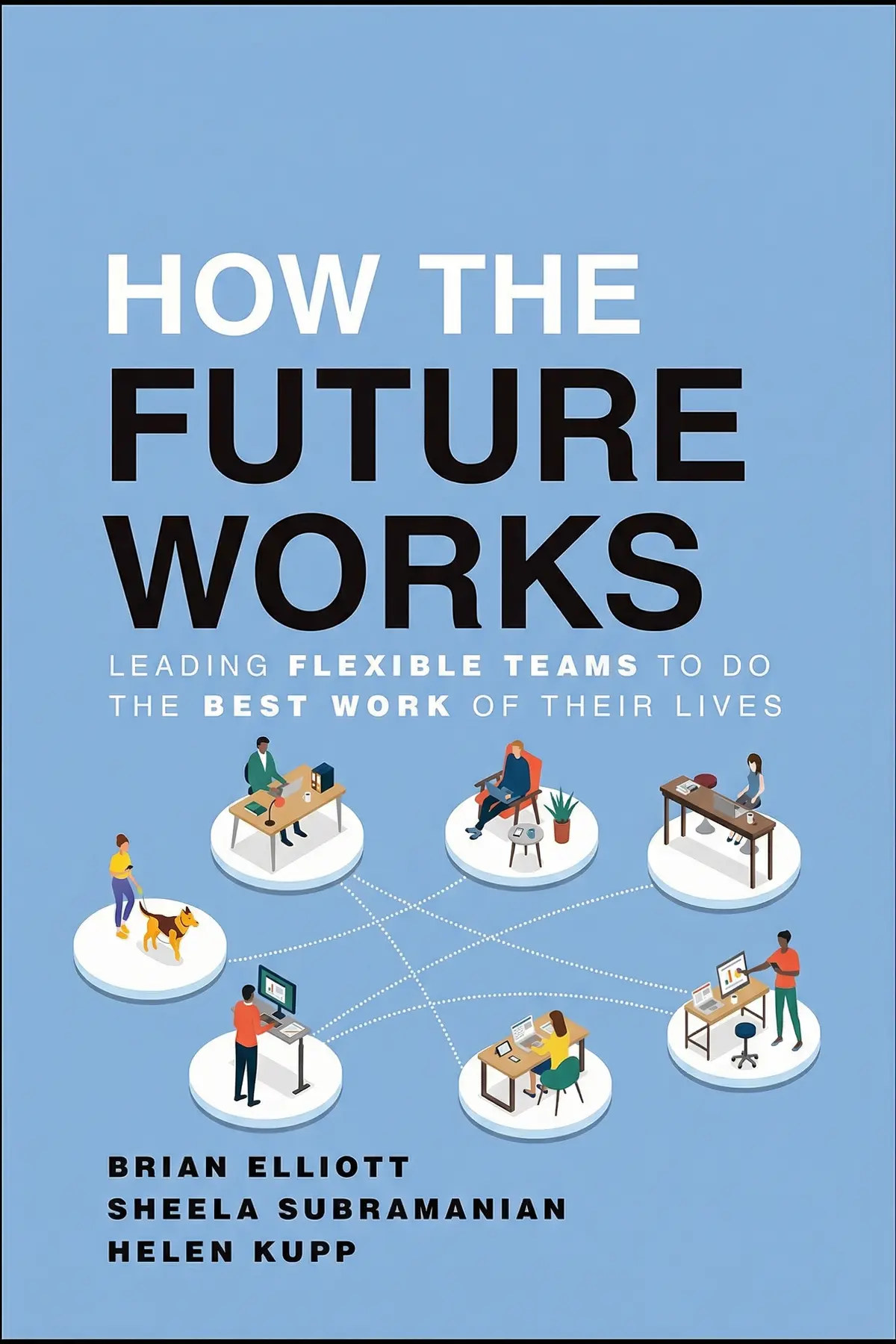
Table of Content
1. Introduction
1 min 03 sec
Many leaders feel stuck between ordering people back to their desks and letting flexible work drift with no plan. The pandemic already answered part of the question: when offices emptied, productivity improved. In How the Future Works, Brian Elliott, Sheela Subramanian and Helen Kupp, founders of the workplace think tank Future Forum, argue that the task now is design. Flexibility, in their view, does not mean total freedom or zero accountability. It means a deliberate balance between personal autonomy and shared company guidelines, built so people can meet the needs of both their work and their life.
Their case runs through everything that follows: flexible work succeeds when leaders stop issuing one rule for everyone and instead set principles, protect fairness, let teams agree on their own rhythms and judge people by results. Each step is something a leader or manager can begin this week, from changing how a video meeting is joined to rewriting what a good month looks like.
2. Build your flexible policy on a clear purpose
1 min 45 sec
Apple announced a sensible-sounding hybrid schedule in 2021, and valued employees walked out almost at once. The mistake was not the number of days, and it is one many leadership teams are still making today.
3. Keep remote staff from becoming second-class colleagues
1 min 40 sec
A single video call can tell a remote employee more about their real standing than any policy document. A Stanford finding shows what that hidden message can cost a career, and one simple meeting rule changes it.
4. Let each team write its own working agreement
1 min 35 sec
Sales and engineering, introverts and extroverts, parents and marathon runners all need different days. A company-wide schedule cannot serve them all, yet total freedom breaks teamwork. The authors describe a middle path that teams build themselves.
5. Keep people connected without an office
1 min 51 sec
Many executives assume that scattered teams drift apart and stop having ideas. Research gathered during the pandemic points somewhere unexpected, and it changes what the office itself might be for.
6. Turn your managers into coaches people trust
1 min 36 sec
The manager who watches the clock and walks the floor has nothing left to watch. The authors describe the role that replaces it, and the support most companies forget to give the people stepping into it.
7. Measure results that matter instead of hours logged
1 min 45 sec
A sales team can hit every weekly target and still win no new clients. The way most companies track effort can damage the very results they want, and the fix starts with a document most leaders already publish.
8. Test new ways of working with a small group first
1 min 35 sec
Roll out a new tool to everyone and one failure can hand skeptics the argument they were waiting for. Slack found a way to catch problems early and show the whole company it meant business.
9. Conclusion
1 min 06 sec
Underneath all seven steps sits one change of mind. The old office assumed that people are much the same and that being present proves effort. The authors replace both assumptions. People differ by role, personality and life outside work, and those differences, as they see it, are a chance to design work that respects them and brings colleagues closer, instead of a problem to manage away.
The Apple episode shows the cost of ignoring that. A fixed schedule from the top cost the company talented people, while the Royal Bank of Canada’s open principle about being together left room for each team to find its own rhythm.
If you lead people, start by checking whether your meetings and promotions still reward whoever sits closest to the senior team, and change the rule that allows it, even if that means everyone joins the call from their own screen. Then agree with your team on a few hours a day of shared time, and judge the rest by what gets delivered.
Flexibility that works is designed on purpose, and the best designers are usually the teams who will live with the result.
About this book
What is this book about?
When offices emptied during the pandemic, many organizations found that productivity improved. Now leaders face a harder question: how to turn that emergency arrangement into a lasting way of working without losing fairness, connection or accountability. Brian Elliott, Sheela Subramanian and Helen Kupp, the founders of the workplace think tank Future Forum, argue that one schedule decreed from the top will fail. Apple's three-day office rule in 2021 drove talented people out the door. Their alternative is a sequence of seven moves: agree on why you want flexibility and turn that into a few principles, set guardrails so remote staff are not passed over, let each team write its own agreement with shared core hours, build connection through digital spaces, test changes with a diverse task force, retrain managers as coaches, and measure outcomes instead of activity. The book draws on Future Forum's research and on practices at Slack, Atlassian and the Royal Bank of Canada. Readers get a practical plan for designing work around people's different needs while keeping teams aligned and results visible.
Book Information
Who it's for
Executives and HR leaders
Executives and HR leaders deciding how hybrid or remote work should run for good.
Leading spread-out teams
Team leads whose people are spread across homes, offices and different working hours.
Managers moving to coaching
Managers moving from watching activity to coaching for results, and wondering how to start.
About the Author
Brian Elliott
Brian Elliott, Sheela Subramanian and Helen Kupp founded Future Forum, a think tank that helps leaders redesign work for people and organizations. Elliott has spent about thirty years leading teams, as a startup CEO, at Google and as a Senior VP at Slack, and now runs the advisory firm Work Forward. Subramanian, a former Slack Vice President, has twenty years of building global teams, and her workplace equity work has been cited by the Wall Street Journal and the New York Times. Kupp led major cross-team initiatives at Slack and wrote many of Future Forum's playbooks.
Ratings & Reviews
Ratings at a glance

What people think
Listeners find that although some readers consider the material somewhat redundant, the guide provides an immensely beneficial seven-step framework for managing shifts to hybrid work. They value the emphasis on fostering trust and leading with empathy, as one listener points out that the text delivers the "why" paired with the "how and what" of team empowerment. Furthermore, the presence of actual case studies from organizations such as Slack and Apple aids in demonstrating how flexible work principles function in real life. In addition, they highlight the final toolkit as an incredibly practical tool for anyone prepared to put these strategies into action right away.
Top reviews
Suthee
Finally got around to finishing this, and it is a blueprint for the modern era of employment. The authors do an incredible job of explaining the 'why' behind the shift to flexible work before diving into the 'how' and 'what' of actual execution. I especially appreciated the deep dive into the Apple case study regarding their top-down return-to-office mandate; it serves as a stark warning for any executive stuck in 2019. The shift from being a 'gatekeeper' manager to an empathetic coach is the most vital takeaway for me. While some might find the concepts intuitive, seeing them structured into a seven-step framework makes them actionable rather than just aspirational. This isn't just theory; it’s a manual for survival in a digital-first world where talent holds the cards. If you want to build a culture rooted in trust rather than surveillance, start here.
Show moreValentina
This book provides a much-needed wake-up call for founders who are still obsessed with 'office hours' and physical presence. I felt a huge wave of relief reading about the move toward asynchronous work and the importance of digital-first communication. The authors don't just advocate for total freedom; they talk about striking a balance between autonomy and company guidelines. This isn't about letting people slack off; it's about optimizing individual performance by respecting personal lives. The stories from leaders who made life-changing transitions gave me the confidence to suggest a four-day work week pilot at my own startup. The results so far? Mixed, but the potential for growth is massive. This is the first book I’ve read that treats flexible work as a strategic advantage rather than a temporary inconvenience. Truly inspiring and a must-read for any modern executive.
Show moreMilk
As a team lead struggling to keep my department aligned, this book was exactly the resource I needed this quarter. The concept of 'guardrails'—setting behavioral expectations without being overly prescriptive—is genius. It helped us move away from a one-size-fits-all approach that was clearly frustrating my best performers. I’ll admit, the middle chapters can feel a bit repetitive, as the authors drive home the same points about autonomy and digital connection multiple times. However, the toolkit provided at the end is worth the price of admission alone. It’s an exceedingly useful resource that we’ve already started using to draft our own Team-level Agreements. It’s practical, grounded in real-world data from the Future Forum, and provides a clear path forward for those of us navigating the messy middle of hybrid work.
Show moreSirichai
Why do some companies thrive in a hybrid model while others see a massive talent drain? This book answers that question by focusing on the human element of the workplace. I was particularly struck by the section on 'core collaboration hours.' It’s such a simple way to protect employee focus time while still ensuring that team synergy doesn't evaporate. The authors argue that proximity isn't the only way to build connection, and their data-backed approach to digital headquarters is very convincing. My only real gripe is that the writing style is a bit dry and corporate at times, which makes it feel like a chore to read in longer sittings. Still, the emphasis on empathetic leadership and the transition to outcome-based metrics is exactly what the business world needs right now. It's a solid four-star guide for any forward-thinking manager.
Show moreAom
Picked this up during our company's transition to a permanent hybrid model and it served as a great anchor for our leadership team. The focus on building trust is critical. For too long, management has been about watching the clock, and this book successfully argues that measuring outcomes is the only way forward. I loved the idea of the 'Team-level Agreement'—it gives teams the agency to decide what works for them instead of following a mandate from a CEO who doesn't understand their day-to-day. My only criticism is that some of the advice feels a bit idealized, as if every employee is an introverted software engineer who loves Slack. Real-world implementation is often messier than the seven steps suggest. Regardless, it’s a high-quality framework that provides the necessary vocabulary for these difficult conversations. Highly recommended for HR professionals.
Show moreGai
Look, if you're an executive who is still worried about whether your employees are watching cat memes instead of working, you need to read this immediately. The truth is, the world has changed, and 'How the Future Works' explains why you can't go back to the old ways without losing your best people. The focus on 'digital-first' isn't about abandoning the office; it's about making sure the office doesn't become a place where people just sit on Zoom calls all day. The authors do a great job of explaining how to level the playing field for remote workers so they don't become second-class citizens. Some of it is a bit repetitive, sure, but the core message is vital. Trust your people, give them the tools they need, and measure the results, not the hours. It’s a sensible, well-researched guide for the modern leader.
Show moreEthan
The core ideas presented by Elliott, Subramanian, and Kupp are undeniably solid, but the book feels like it could have been a long-form article or a short brochure. By the third chapter, you start to notice that the same fundamental principles regarding flexible work are being rephrased and recycled. It’s a lot of fluff surrounding a very good seven-step framework. To be fair, the examples from Slack and the Royal Bank of Canada are insightful, and they provide a necessary look at how large-scale organizations can pivot. But if you’ve already been working remotely or in a hybrid setup for a few years, you won't find many 'lightbulb' moments here. It’s a great primer for traditionalists who are scared of losing control, but for the rest of us, it’s mostly stuff we’ve already implemented by necessity. Good, but definitely repetitive.
Show moreLeah
I found the case studies in this book to be its strongest asset, particularly the insights into how Slack operates internally. It’s fascinating to see how they’ve turned their own product into a digital HQ that fosters genuine connection. However, the actual writing can be quite monotonous. Each chapter follows the same predictable pattern, and the 'seven-step framework' feels a bit forced at times. Is it helpful? Yes. Is it revolutionary? Not really. If you are a middle manager without the power to change company-wide policy, you might find this read a bit frustrating because it requires top-down buy-in to really work. It’s a decent resource to have on your shelf, especially for the toolkit section, but don't expect to be blown away by any radical new theories. It’s a solid, middle-of-the-road business guide for the post-pandemic era.
Show moreVera
To be fair, the authors clearly know their stuff and the research consortium data they cite is top-notch. But man, does this book drag in the middle. I felt like I was reading the same three paragraphs about 'empowerment' and 'transparency' over and over again. It’s well-intentioned, but it lacks the punchy, concise delivery that makes for a great business read. I did appreciate the practical advice on upskilling managers to become coaches rather than gatekeepers, as that’s a huge pain point in my current organization. But I can't help feeling that this could have been a 50-page PDF and been just as effective. Use the table of contents to find what you need and then jump straight to the toolkit at the back. That's where the real value lies. It's a three-star book with a five-star appendix.
Show moreHarper
Frankly, this was a disappointment for anyone who has been paying attention to workplace culture over the last four years. If you work in People Ops or Communications, you likely won't learn anything new from these pages. It’s a compilation of well-known basic principles that have been discussed ad nauseam on LinkedIn and in every business podcast since 2020. The authors spend way too much time convincing the reader that flexible work is good—something I already believed when I bought the book. I wanted more technical depth on the 'how' and less of the repetitive 'why.' While the toolkit at the end is somewhat helpful, it doesn't justify the slog through the rest of the text. It feels like this was written for CEOs who have been living under a rock. If you're already in a flexible environment, skip it and just find a summary online.
Show moreQuestions about this book
What is the main idea of How the Future Works?
Brian Elliott, Sheela Subramanian and Helen Kupp argue that flexible work succeeds by design, not by decree. Instead of one schedule for everyone, leaders should agree on why they want flexibility, turn that into a few principles, set guardrails for fair treatment, let teams write their own agreements, support managers as coaches and measure people by outcomes. They contrast this with Apple’s 2021 three-day office rule, which led talented staff to resign.
What is a Team-level Agreement in How the Future Works?
A Team-level Agreement, or TLA, is a framework each team writes to put company principles into practice. It sets out behavioral expectations instead of rigid rules, giving both flexibility and structure. Its central feature is core collaboration hours: three to four hours each workday when everyone is online and available. People arrange the rest of the day themselves, which the authors say also protects against burnout from always being reachable.
How do you keep remote workers from being overlooked for promotion?
The authors cite a 2014 finding by Stanford’s Nicholas Bloom that home-based workers were half as likely to be promoted despite equal or better performance. Their answer is guardrails: listen to remote staff, then fix what disadvantages them, for example by having everyone join video calls from their own screen. Leaders must model the rules too. Atlassian limits its executives to one office day a week.
How should managers measure performance in a flexible team?
By outcomes instead of activity. The authors show how a target of 40 sales calls a week can push people to rush calls without winning new clients. Managers should name the outcomes that matter, including employee experience, turn them into deliverables such as finished client projects or protected focus time, and set clear timeframes, with progress shared in digital systems everyone can see.
Who should read How the Future Works?
It suits executives and HR leaders shaping a permanent hybrid or remote policy, and team leads managing people across locations and hours. The book is practical: it covers writing principles, setting fair meeting rules, agreeing on core hours, building digital community spaces, testing changes through a task force like Slack’s and retraining managers as empathetic coaches.
Readers also enjoyed




A Year with Peter Drucker: 52 Weeks of Coaching for Leadership Effectiveness
Joseph A. Maciariello





Acting with Power: Why We Are More Powerful Than We Believe
Deborah Gruenfeld
AUDIO SUMMARY AVAILABLE
Listen to How the Future Works in 15 minutes
Get the key ideas from How the Future Works by Brian Elliott, plus 5,000+ more nonfiction titles.
- 5,000+ titles
- Listen as much as you want
- 7-day free trial
- Cancel anytime









