
15 min 32 sec
Available in: English
 ไทย
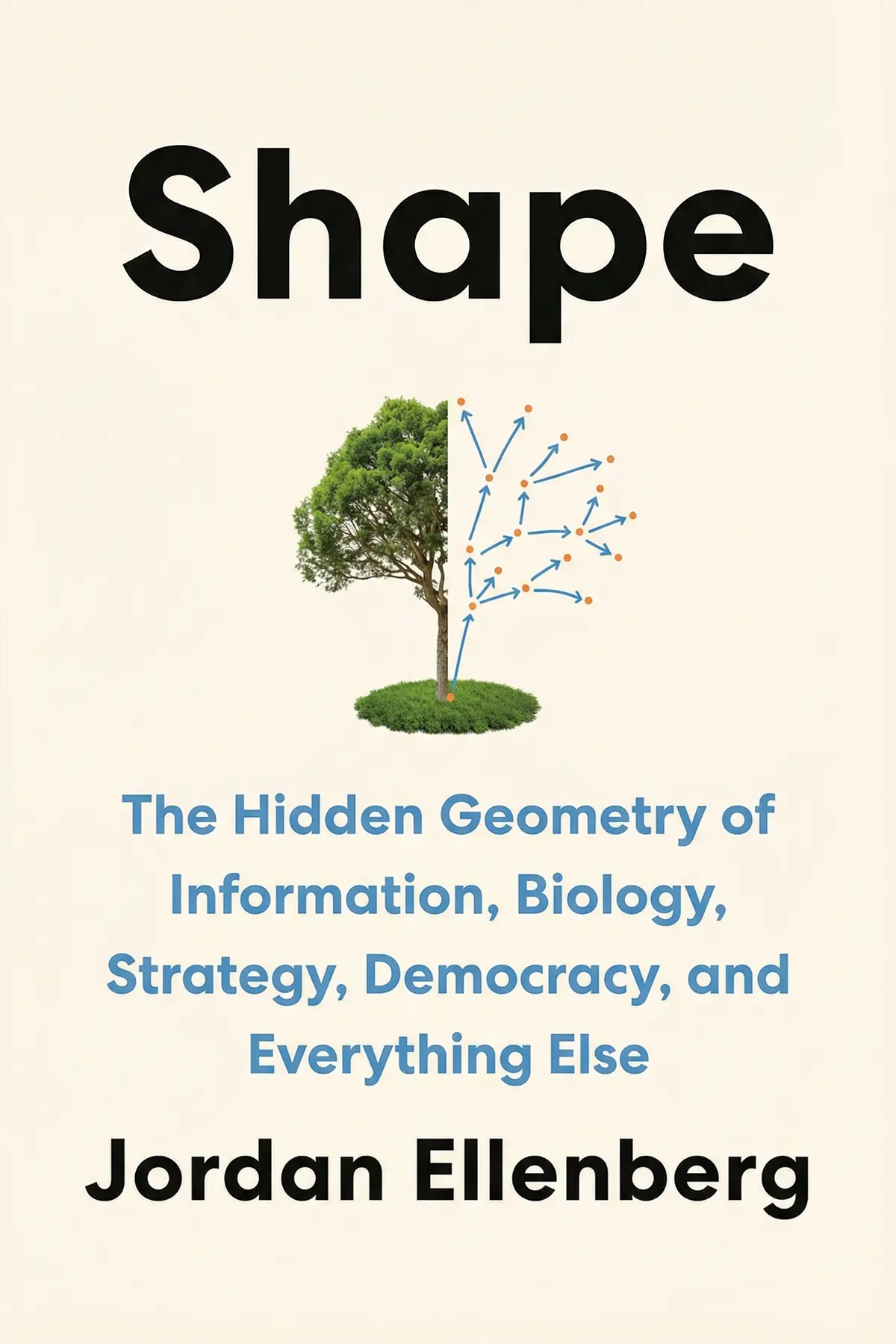
EnglishไทยHow Not to Be Wrong: The Power of Mathematical Thinking
Shows how simple mathematical ideas, from survivorship bias to expected value and regression to the mean, help you spot misleading statistics, shaky research, risky bets and polls that claim more than they measure.
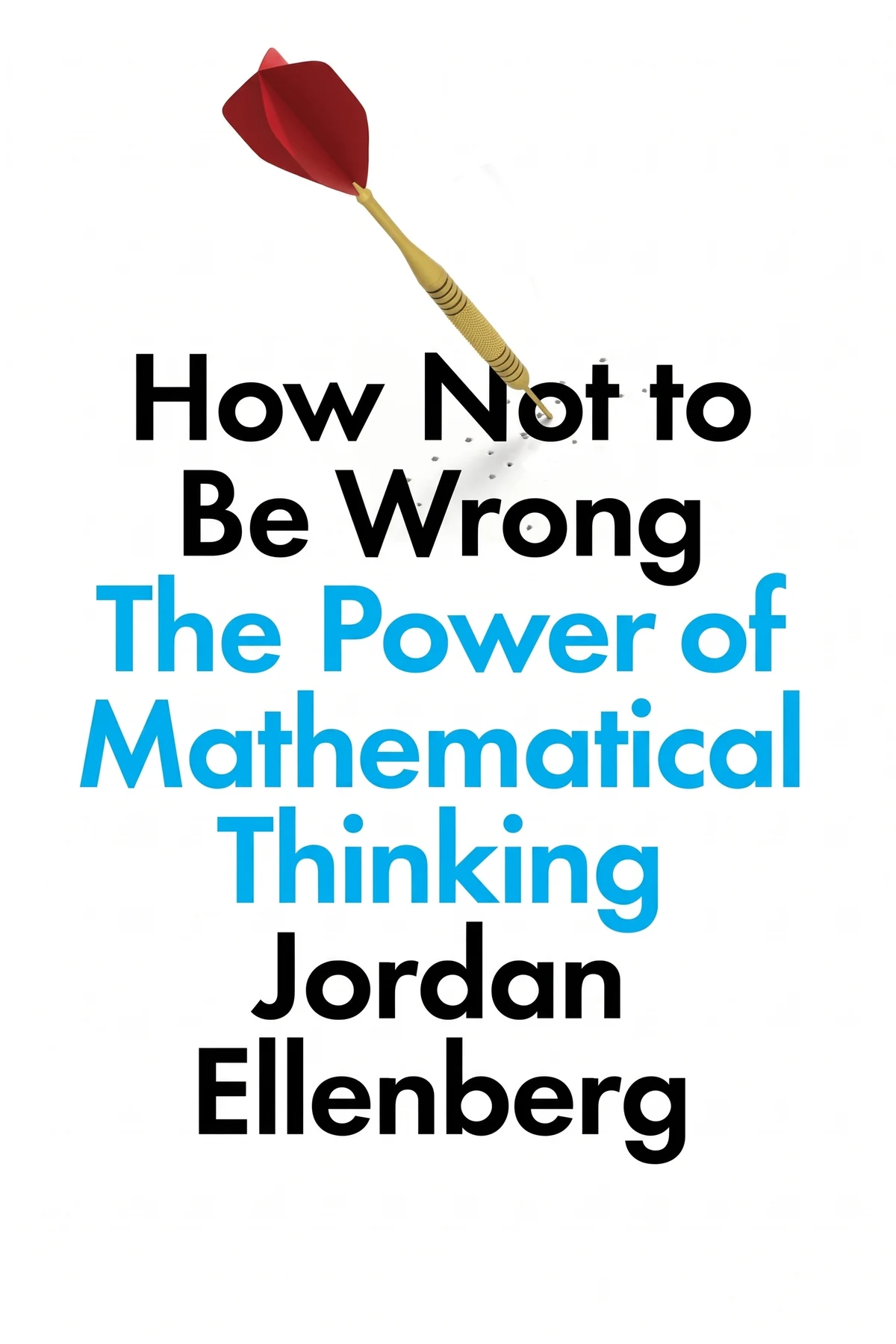
Table of Content
1. Introduction
55 sec
Most of us take the numbers in headlines, studies and polls at face value, because checking them seems to need math we left behind at school. In How Not to Be Wrong, mathematician Jordan Ellenberg argues that the tools for catching bad numbers are mostly common sense, made precise. His opening case comes from World War II, where the right place to add armor was exactly where returning planes showed the fewest bullet holes.
Ellenberg’s claim is that a few mathematical habits protect anyone from being fooled: by missing evidence, by straight lines stretched too far, by lucky results, by averages that hide risk and by polls that pretend the public speaks with one voice. None of it needs formulas. Once these ideas settle in, a news graph, a medical study or a lottery ticket starts to show its hidden math, and you can say plainly where it goes wrong.
2. Spot the evidence that never made it back
1 min 32 sec
Military advisors studied damaged bombers and reached a sensible-sounding plan to protect them. A young mathematician looked at the same planes and saw something nobody else did, a mistake that still hides inside many success stories.
3. Make hard problems easy with straight lines
1 min 37 sec
An ant on a giant circle believes it is walking in a straight line. That illusion turns out to be one of mathematics’ most useful tricks, and it sits behind many of the statistics in the news.
4. Catch a trend line before it misleads you
1 min 35 sec
A respected journal once predicted that every American would be overweight or obese by a certain year. The forecast came from a simple, common method, and pushing it a little further shows exactly what went wrong.
5. Tell a real effect from a lucky accident
1 min 42 sec
A scientist scanned the brain of a dead fish and found it reading human emotions. The joke exposes a serious weakness in research, along with the standard test scientists use to guard against it.
6. Spot the flaws behind many published research findings
1 min 49 sec
One researcher argued that most published scientific findings are false. His reasons involve thousands of genes, a stack of jelly bean experiments and the honest beliefs of scientists themselves.
7. Expect the next result to be more ordinary
1 min 46 sec
Second novels disappoint, children of very tall parents come out shorter, and a 1976 study credited bran with fixing digestion. One mathematical pattern links all three, and it regularly fools researchers.
8. Price a bet by its average and its risk
1 min 41 sec
A lottery ticket has a precise average worth, and it is less than its price. Yet even a bet with a fair-looking average can be a terrible choice, as one choice between $50,000 and a coin flip shows.
9. Read polls that claim a majority with a critical eye
1 min 52 sec
Polls show a public that wants spending cut and raised at the same time, and a law opposed by people who want more of it. Counting a crowd turns out to be much harder than it looks.
10. Conclusion
1 min 03 sec
The bullet holes, the dead fish and the Florida ballots teach the same thing: the number in front of you is rarely the whole story. Ellenberg’s book argues that mathematical thinking is mostly the habit of asking what a number leaves out. Survivors hide the failures. A straight line hides the curve. A significant result can hide the many tests that found nothing. An average hides the risk, and a majority hides the second choice.
None of this needs a calculator. When a chart projects a trend decades ahead, ask how far the line runs past its data. When a study reports a striking effect, wonder how many other results never reached print, and whether the first measurement was just extreme. When a poll says the public has spoken, look at how the choices were split.
Ellenberg’s own advice is plain: skip the lottery ticket. Then treat the next confident number you hear the way the young mathematician treated those planes, by looking hard at the holes that are missing.
About this book
What is this book about?
Numbers arrive all day in news graphs, medical studies, investment pitches and polls, and most people either trust them or ignore them. Jordan Ellenberg, a mathematician, argues that neither is necessary. Mathematics, in his telling, is common sense made exact: a disciplined way of reasoning so that you are not fooled. He builds the case through memorable examples. Damaged American planes in World War II reveal survivorship bias. A dead fish in a brain scanner shows how chance produces convincing results. A 2008 forecast that every American would be overweight or obese by 2048 exposes the danger of stretching a straight line. A 1976 bran study, a disappointing second novel and the 2000 Florida vote show how regression to the mean and badly counted majorities mislead even experts. Along the way, readers learn the ideas behind significance tests, expected value and linear regression without formulas. The payoff is practical: knowing why most lottery tickets lose money, why a good average can hide a dangerous risk, and which questions to ask before believing a striking study or a poll that claims to speak for the public.
Book Information
Who it's for
Wary of misleading data
Professionals who read reports, studies and dashboards and want to know when the numbers mislead.
Left math behind
Students and graduates who left math behind and want to see what it is actually good for.
Weighing risks and odds
Anyone weighing investments, insurance or bets who wants to judge the risk as well as the average.
About the Author
Jordan Ellenberg
Jordan Ellenberg is a mathematician on the faculty of the University of Wisconsin-Madison, where his research focuses on number theory and arithmetic geometry. He holds a doctorate in mathematics from Harvard and a master of fine arts in creative writing from Johns Hopkins. He wrote the Slate column Do the Math, and his articles have appeared in the New York Times, the Washington Post, the Wall Street Journal and the Boston Globe. His other books include Shape and a novel, Grasshopper King.
Ratings & Reviews
Ratings at a glance
What people think
Listeners consider this work essential reading, featuring clearly explained mathematical ideas that provide an excellent introduction to logical reasoning. Furthermore, the writing is sophisticated and engaging, offering an accessible experience for those with a fundamental background. They also value the information quality; one listener specifically mentioned how the hand-drawn charts and diagrams make the content approachable, while the statistical sections are praised for their rational delivery.
Top reviews
Nikolai
Wald’s plane example is worth the price of admission alone for showing how to think about what isn't there. Ellenberg uses the story of the Statistical Research Group during World War II to illustrate survivorship bias in a way that is utterly gripping. He has this rare gift for making high-level abstract concepts feel relevant to the average person's daily life. To be fair, you need a basic grasp of numbers to get the most out of it, but the prose is elegant and conversational. I particularly loved the hand-drawn charts which made the statistics content feel approachable and grounded. It isn't just a book about math; it is a fundamental manual for logical thinking. Every chapter challenged my assumptions about how the world actually works.
Show moreCarter
Ever wonder why common sense often fails us in the face of raw data? Ellenberg explores this beautifully by teaching us 'how to try to be right' even when our information is imperfect. The chapter on 'Are you there, God? It's me, Bayesian Inference' was a highlight for me, blending theology with probability in a way that was both profound and hilarious. I found the explanation of how Target predicts pregnancies based on shopping habits to be both fascinating and a little terrifying. This book isn't just for math nerds; it's for anyone who wants to navigate a world filled with misleading headlines and junk science. It’s easily the best-written book on applied statistics I have ever encountered in my professional life.
Show moreNoah
Hand-drawn charts and approachable diagrams make the statistics content feel much less intimidating than a standard college course. I absolutely loved the xkcd cartoon reference about green jelly beans and acne; it perfectly illustrated the pitfalls of statistical significance. Ellenberg has a way of turning what could be a dry subject into a vibrant exploration of human error and triumph. The truth is that math is often taught as a sterile procedure, but here it is presented as a creative, living process. I was particularly impressed by the sections on error-correcting codes and their relation to geometry. This is required reading for anyone who wants to stop being fooled by big data and start thinking for themselves.
Show moreSomporn
Mathematics is often taught as a series of boring procedures, but Ellenberg treats it like a piece of music with its own rhythm and logic. This book is a wonderful introduction to the power of mathematical thinking in everyday life. I found the prose to be elegant, entertaining, and incredibly insightful. Whether he's discussing the probability of a car's license plate or the strategies for winning a state lottery, his passion is infectious. It really helps you understand that being 'wrong' is often a result of using the wrong mental model for the problem at hand. Personally, I think this should be mandatory reading in every high school. It makes the world feel much more comprehensible and less like a series of random, chaotic events.
Show morePornpimon
Jordan Ellenberg has this uncanny ability to make you laugh while explaining complex geometry or the nuances of Bayesian inference. I’m not usually one for pop-math, but his inclusion of pop culture references, like the Mean Girls limit quote, kept me engaged throughout. The lottery examples were particularly fascinating, showing how math can turn a game of chance into a predictable investment strategy. However, the book does jump around quite a bit between topics, which can feel a little disjointed at times. Some sections on the Torah or the existence of God felt a bit like tangents compared to the more rigorous data analysis. Still, it’s an entertaining read that makes you feel significantly smarter by the time you reach the final page.
Show moreTawee
As an English major who usually breaks into a cold sweat at the sight of an equation, I found this surprisingly readable. The author manages to be humorous and self-deprecating, which helps lower the intimidation factor of the actual math involved. Frankly, I did have to skim some of the more technical figures and actual equations because my brain just doesn't work that way. But the stories—like the one about the cleanest man in school wearing a new t-shirt every day—made the logic click for me. It’s a bit of a chore in the middle sections where things get heavy, but the overall message is worth the effort. It helps you see the hidden structures of reality without needing a PhD to follow along.
Show moreDaranee
Finally got around to reading this after seeing it recommended on several science blogs. The core strength of the book is how Ellenberg dismantles linear thinking, especially regarding taxation and economics. He explains that while we like simple lines, the world usually functions on complex curves. My only real gripe is that the book tries to appeal to both casual readers and hardcore mathematicians simultaneously, which doesn't always work. Sometimes it’s too simple, and other times it dives into esoteric proofs that feel out of place in a popular science book. Regardless, the statistics content is presented with such logical clarity that I’ve already started recommending it to my colleagues. It’s a great addition to any library.
Show moreOm
Disappointing is a strong word, but I truly expected more practical advice from a book titled this way. While Ellenberg clearly knows his stuff, the writing often feels like wading through a dense textbook. I appreciated the sections on the lottery and the mathematical exploits of MIT students, yet other parts were incredibly turgid. Truth is, there are long stretches where the author proves a point with grueling detail without drawing a clear conclusion. It's frustrating because the core ideas are brilliant, but the execution feels like a series of disconnected lectures. If you want a quick guide on how to make better decisions, this might not be it. You have to be willing to do the work to find the gems hidden in the academic filler.
Show moreMaksim
The lottery examples were fascinating, but the book feels like it lacks a cohesive direction at several points. One moment we are talking about fighter planes in the 1940s, and the next we are deep in a discussion about the existence of God or the nuances of Florida's voting system. To be fair, Ellenberg is a great writer, but he needs a stronger editor to keep him on track. I found the pacing to be quite uneven, with some chapters flying by and others feeling like a total slog through a textbook. I liked the bit about Nate Silver and election predictions, but it felt a little dated. It’s a decent read, but there are better books on this subject that stay focused on the main topic.
Show moreGabriel
Look, I came here for the math, not a lecture on American politics or the author's personal opinions on historical figures. The mathematical segments were actually quite good, but they were constantly interrupted by unnecessary snark about Republicans or long-winded sections about Al Gore and Florida. It felt like someone was trying to shove their political views down my throat under the guise of teaching statistics. Why are we talking about Bashar Assad’s rigged elections or Stalin when the book is supposed to be about mathematical thinking? If you aren’t interested in the author's political stance, you'll find yourself skimming half the book. It’s a shame because the actual math is solid, but the bias is just too distracting to ignore.
Show moreQuestions about this book
What is the main idea of How Not to Be Wrong?
Jordan Ellenberg argues that mathematics is common sense made precise, a way of reasoning that keeps you from being wrong. He shows it at work in survivorship bias, trend lines, significance tests, regression to the mean, expected value and polls, with cases ranging from World War II bombers to the 2000 Florida vote, so readers can judge the numbers they meet every day.
What is survivorship bias in How Not to Be Wrong?
Survivorship bias is judging a process only by what made it through. Ellenberg’s example is American planes in World War II, which came back with more bullet holes in the fuselage than in the engines. Advisors wanted more armor on the fuselage, but a young mathematician saw that planes hit in the engine were the ones that never returned, so the engines needed the armor.
Why does Ellenberg say many research findings are wrong?
He backs John Ioannidis’s 2005 argument. When thousands of things are tested, such as 100,000 genes, the usual 95 percent standard lets about 5,000 pass by chance. Studies that find nothing often go unpublished, as in the example of 20 labs testing green jelly beans for acne. And results just below the cutoff sometimes get nudged over it by researchers who believe in their hypotheses.
How can I apply How Not to Be Wrong in everyday life?
Ask where the failures went when you hear success stories. Check how far a trend line is stretched past its data. Treat a single striking study with caution and ask whether an extreme first result will simply drift back toward average. For any bet or investment, compare the average outcome with the worst case you could afford. For polls, ask how the choices were grouped.
Is a lottery ticket worth buying according to Ellenberg?
No. Using expected value, Ellenberg shows that in a lottery with $1 tickets, 10 million tickets sold and a single $6 million prize, each ticket is worth 60 cents on average, so you lose about 40 cents per play. Playing once can be fun, but over many plays most lotteries take more money than they return.
Featured in
Readers also enjoyed


A Life Decoded: My Genome: My Life
J. Craig Venter

A Planet of Viruses
Carl Zimmer

A Short History of Nearly Everything
Bill Bryson

A Thousand Brains: A New Theory of Intelligence
Jeff Hawkins




Alien Earths: The New Science of Planet Hunting in the Cosmos
Lisa Kaltenegger

AUDIO SUMMARY AVAILABLE
Listen to How Not to Be Wrong in 15 minutes
Get the key ideas from How Not to Be Wrong by Jordan Ellenberg, plus 5,000+ more nonfiction titles.
- 5,000+ titles
- Listen as much as you want
- 7-day free trial
- Cancel anytime









