

15 min 07 sec
Available in: English
How Language Works: How Babies Babble, Words Change Meaning, and Languages Live or Die
Explains what makes human language unique, how babies go from babble to subtle intonation, why words keep changing, and why most people and countries live with several languages, some of which are now dying.
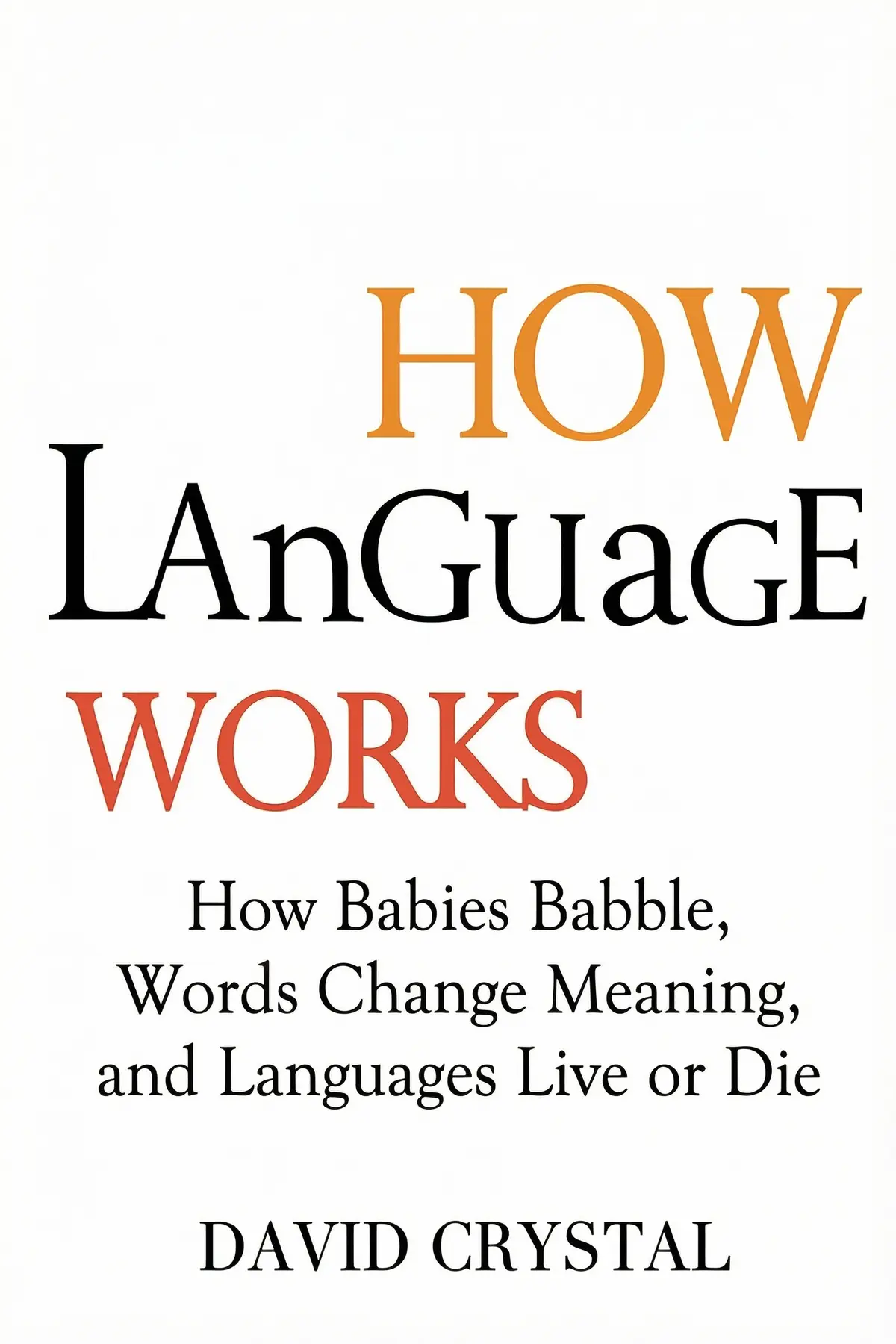
Table of Content
1. Introduction
1 min 03 sec
If you have ever winced at someone’s grammar or decided you are just not a language person, linguist David Crystal offers a better way to hear the talk around you. In How Language Works, he argues that speech came first, writing came later, and constant change is how a language stays alive. Even a baby’s babble, he shows, is a small set of sounds rehearsed for later speech.
His case is that language is a living system humans are built for, one to understand and protect rather than police. Crystal follows it from its basic machinery to its fate in the world. We pick up its rules in infancy, keep refining them into adolescence, then carry them across borders where words mix, split and sometimes vanish. Follow him and you can explain why words shift, why most people live with more than one language, why learning another depends on attitude more than talent, and what it takes to rescue a language before its last speaker is gone.
2. See what sets human language apart from animal calls
1 min 49 sec
A dog can bark all day and never say anything new. Humans produce fresh sentences every hour. Two dry-sounding ideas from linguistics explain the gap, and why no rulebook can ever catch up.
3. Give everyday speech the respect writing took from it
1 min 49 sec
For centuries, scholars treated the way people actually talk as a sloppy copy of the page. Crystal shows how that belief changed the way whole populations spoke, and what our own bodies say about which form came first.
4. Hear a baby's babble as serious practice
1 min 56 sec
Most adults treat baby noises as cute and meaningless. Research says otherwise, and it also explains why a teenager can miss something in a sports broadcast that any adult picks up instantly.
5. Stop treating language change as decay
1 min 50 sec
Every office has someone who corrects grammar as if civilization depended on it. Crystal argues they have it backward, and he names the forces that keep pushing words and accents in new directions.
6. Trace a language's birthplace through its missing words
1 min 47 sec
A word a language never had can be as revealing as one it did. Linguists use exactly that kind of absence to argue about where the ancestor of English was first spoken, thousands of years ago.
7. Learn another language without waiting for talent
1 min 49 sec
Perfect fluency in two languages is far rarer than most people assume, and so is the inborn gift many learners think they lack. Crystal names what actually decides who succeeds.
8. Learn what brings a dying language back to life
1 min 51 sec
Half the world’s languages may disappear within this century, usually through slow shame rather than sudden disaster. One program in New Zealand shows that the slide can be reversed, and at what cost.
9. Conclusion
1 min 13 sec
Crystal leaves a different picture of something you use every waking hour. Language is not a fixed code guarded by rule keepers but a living system the body was shaped to produce. It generates sentences no one has said before, is learned in babble and refined into the teenage years, and is pushed into new shapes by invention, admiration and distance. Many languages side by side are the normal state of things, yet that variety can fade over time once pressure and shame push a minority language back into the home, or out of use entirely.
That changes how you might listen and act. Hear a dropped g or an unfamiliar new word as language doing its job, and judge people less by how closely their speech matches the page. Treat a new language as a matter of motivation, relevant material and daily exposure, and stop waiting for a gift you were told you lack. And where a language near you is fading, remember that its future rests on whether its speakers still pass it to their children.
Crystal’s balance is the one to keep: guard languages for those who come next, and leave them room to keep changing alongside us.
About this book
What is this book about?
Most of us talk all day without thinking about how it works, and many of us carry habits from grammar class: writing is the proper form, new words are a decline, some people just have no talent for languages. Linguist David Crystal takes each of those beliefs apart. He starts with what language is in the strict sense: an organized system that can produce endless new sentences and builds meaning out of meaningless sounds. He explains why speech is primary and writing a later invention, how babies practice sounds long before they speak, and why intonation takes until the teenage years to master. He then shows why languages never stop changing, how historical linguists trace families such as Indo-European back thousands of years, and why multilingualism is the normal human state. The book ends on an urgent theme. About half of the world's roughly 6,000 languages have fewer than 100 speakers, and Crystal shows how communities such as the Maori in New Zealand have brought a language back. Readers come away able to explain how language works, and with a calmer, more curious way to hear the speech around them.
Book Information
Who it's for
Professionals who mind grammar
Curious professionals who correct grammar or feel uneasy about new words and want to understand how language really works.
Unsure adult language learners
Adults learning a second language who doubt they have the talent for it.
Educators, parents and students
Parents, teachers and students interested in how children learn to speak and why languages disappear.
About the Author
David Crystal
David Crystal was born in Lisburn, Northern Ireland, in 1941 and grew up partly in Holyhead, North Wales. He studied English at University College London, lectured in linguistics at Bangor and Reading, and later became an honorary professor of linguistics at Bangor. His research covers intonation and stylistics, he has applied linguistics in clinical, educational and religious settings, and he has advised Shakespeare productions on original pronunciation. He received an OBE in 1995 and became a Fellow of the British Academy in 2000.
Ratings & Reviews
Ratings at a glance

What people think
Listeners find the material engaging and straightforward, with one individual noting it is a work that invites multiple readings. Furthermore, the content spans every aspect of language, and one listener notes it's highly recommended for students of language and social sciences.
Top reviews
Tang
Ever wonder why humans are the only ones who can babble in such complex ways, or how a simple word can change its meaning over a century? David Crystal delivers an absolutely fascinating journey through the mechanics of speech and the way our brains process communication. I particularly loved the "eyebrow flash" observation; now I catch myself looking for it in every social interaction I have! The short, self-contained chapters make it incredibly easy to digest even the more technical bits about vocal organs and phonetics. It is the kind of book you can pick up for five minutes or an hour and always walk away with a new fact. While it lacks a grand, singular theory, it offers something much better: a vivid, comprehensive map of the human experience through language.
Show moreBook
Finally got around to reading this after it sat on my shelf for months, and I am honestly impressed by how much ground Crystal covers. From the way our mouth parts physically produce sound to the evolution of writing systems, nothing is left out of this survey. I was especially moved by the sections on language death and the way electronic media is currently reshaping how we interact. Truthfully, the book is incredibly accessible and avoids the heavy-handedness you often find in pop-science literature today. It reminded me that studying language is really just a way of studying what it means to be human. Even though some of the chapters felt a little too short, they served their purpose as a mental map. Highly recommended for anyone in the social sciences or just those who love a good non-fiction deep dive.
Show moreAhmed
The chapter on the "eyebrow flash" alone made this book worth the purchase price for me. I have always been fascinated by non-verbal communication, and Crystal weaves it into the broader study of language with such ease and wit. This isn't a book about a "Grand Thesis" like Stephen Pinker might write, but rather an affectionate summary of a lifetime of learning. It is a meaty resource for students of language, yet it remains light enough for a casual reader to enjoy before bed. I appreciated the inclusion of diverse topics like finger-spelling and the history of hieroglyphs, which many other introductory texts tend to ignore. To be fair, some chapters are so brief they feel more like teasers for other books, but that just encourages more reading. It is an essential addition to any linguaphile’s library.
Show moreKofi
After hearing so much praise for David Crystal, I found the fragmented structure of "How Language Works" to be mostly successful, if a bit light. Each chapter is only a few pages long, which means you never really get beyond a surface-level understanding of any single topic. For example, the discussion on how vocabulary grows was anecdotal and charming, but it lacked the analytical weight I was hoping for. It feels like the book is trying to do many things at once by covering sign language, grammar, and history in one go. Gotta say, the prose is lovely and Crystal is clearly a master of his craft, but the lack of diagrams for the language families was a minor oversight. It is a pleasant read for a rainy afternoon, even if it doesn't offer a groundbreaking theory.
Show moreYulia
Wow. This is easily one of the most readable books on linguistics I have ever encountered in my life. The beauty of this work lies in its "dip-in" nature; you don't have to read it chronologically to get value out of it. I jumped straight to the chapters on how babies learn to babble and then skipped ahead to electronic media, and it felt perfectly natural. Crystal has this way of making complex ideas about syntax and morphology feel like a casual conversation at a pub. Some sections are meatier than others, but the variety keeps your brain stimulated throughout the entire 500-page journey. My only real gripe is that I wanted more on the "why" instead of just the "how" of language development. Still, it is a brilliant orientation to the field that I will likely revisit.
Show moreUdom
To be fair, I went into this expecting a dense academic slog, but Crystal’s approach is far more inviting and encyclopedic. He doesn't try to sell you on a specific school of thought or a "Big Idea" like Universal Grammar. Instead, he presents a buffet of linguistic facts that range from the movement of air particles to the way we use metaphors. This breadth is both the book's greatest strength and its most significant weakness, as you never stay on one topic long enough to feel like an expert. It is a bit like browsing an old-school encyclopedia where you are constantly distracted by the next interesting figure or anecdote. I found the sections on how children acquire grammar particularly insightful and well-written. It is a great book to keep on your coffee table for whenever you have a spare ten minutes.
Show moreEli
David Crystal has managed to distill the entire field of linguistics into a single, highly approachable volume. The book functions like a globe; it gives you the big picture of the world without the granular detail of a street map. This makes it an ideal text for anyone starting their journey into "All Things Language" or for those who want a reliable reference guide. The short chapters cover everything from how our vocal organs function to the way dialects co-exist and eventually die out. While I would have preferred more visual aids to illustrate the inter-relationships of language families, the prose itself is engaging enough to carry the weight. It is a solid four-star read that respects the reader's intelligence while keeping the tone light and accessible. Definitely a must-read for fans of popular science.
Show moreJames
Picked this up because I wanted a break from the dense, theoretical jargon of Noam Chomsky, and Crystal definitely provided that relief. There isn't one "Big Idea" here, which I actually found a bit frustrating after a while because the book lacks a central gravity. Truth is, language is too vast for one single thesis to cover everything, but the "Big Picture" approach feels more like browsing an encyclopedia than reading a unified book. The 73 chapters stand well on their own, but they are so brief that you never really get into the weeds of Egyptian hieroglyphs or modern electronic media. Some might find the lack of a connecting thread refreshing, but for me, it felt slightly disjointed. It is a decent starting point, but don't expect a deep dive into the science.
Show moreSuvannee
As someone who studied linguistics years ago, I found this to be a reasonable refresher that didn't feel like a dry textbook. Crystal’s writing style is engaging and he uses examples that are actually interesting rather than the usual stilted sentences found in academic works. However, it’s worth noting that the British focus is quite strong, particularly when he gets into the nitty-gritty of regional dialects. I would have liked to see more depth in the chapters regarding sign language and the neurological aspects of speech loss. It definitely functions more as a "brain warmup" than a deep dive into any specific area of study. If you are looking for a mastery of the subject, this isn't it, but it’s a solid starting point for a buddy read. It is okay for students but perhaps too generalized for advanced scholars.
Show morePhichai
This book felt like a missed opportunity for someone looking to sink their teeth into the meat of linguistic theory. While Crystal writes with undeniable clarity, the actual substance remains frustratingly superficial and broad for anyone past a beginner level. I was especially annoyed by the section on language families, which relied on pages of dense prose instead of providing a clear, helpful diagram of their relationships. To be fair, it works well as a light introductory text for a freshman course, but it simply did not hold my interest for long. Without a central argument to pull the chapters together, the experience felt more like skimming a dictionary than reading a cohesive narrative. It is fine for a very quick overview, but I expected much more rigour from such a legendary figure in the field.
Show moreQuestions about this book
What is the main idea of How Language Works by David Crystal?
Crystal argues that language is a living, organized system unique to humans. It can produce endless new sentences and builds meaning from meaningless sounds. Speech came before writing, children learn the basics in infancy, and languages change constantly through invention, social imitation and distance. Most people live among several languages, and many small languages are now dying, which Crystal sees as a loss for everyone.
Is language change a sign of decline, according to Crystal?
No. Crystal says the so-called grammar police misunderstand language, because every language changes and one that stops changing dies. New objects and ideas need new words, such as digitize and clickbait. People imitate speakers they admire, and groups that move apart develop new words. English has absorbed words from more than 350 languages, which shows change as a normal part of a healthy language.
How do babies learn language according to How Language Works?
Babies begin with simple sounds like ba, and research Crystal cites shows babbling is practice for speech rather than random noise. Around nine months, parents notice rhythm and changes in pitch. By age one, children may recognize dozens of words but pronounce only a few sounds. Intonation develops last, often into the teenage years, which is why young teens can miss cues an adult hears in a sportscaster’s voice.
What does David Crystal say about learning a foreign language?
Crystal finds little evidence that some people simply lack a natural gift for languages. Success depends on motivation and attitude, on material that matters personally to the learner, and on steady, regular exposure. He also notes that true equal fluency in two languages is rare, since a dominant language usually affects accent, pronunciation or vocabulary in the others, so partial skills like reading count as real progress.
Can endangered languages be saved?
Crystal says yes, though it is hard. The community must value the language, it must be documented and analyzed, and it needs both teachers and willing students, plus time and money. New Zealand’s language nests, begun in 1982 to teach the Maori language to children under five, succeeded with community and government support. Similar revivals have taken place in North America and Japan.
Readers also enjoyed



A Life Decoded: My Genome: My Life
J. Craig Venter

A Planet of Viruses
Carl Zimmer

A Short History of Nearly Everything
Bill Bryson

A Thousand Brains: A New Theory of Intelligence
Jeff Hawkins


AUDIO SUMMARY AVAILABLE
Listen to How Language Works in 15 minutes
Get the key ideas from How Language Works by David Crystal, plus 5,000+ more nonfiction titles.
- 5,000+ titles
- Listen as much as you want
- 7-day free trial
- Cancel anytime









