
15 min 27 sec
Available in: English
 ไทย
EnglishไทยHelgoland: Making Sense of the Quantum Revolution
Shows how quantum physics, from Heisenberg's 1925 breakthrough to entanglement, makes sense once you accept a relational view: objects have properties only in their interactions, and reality is a web of relations.
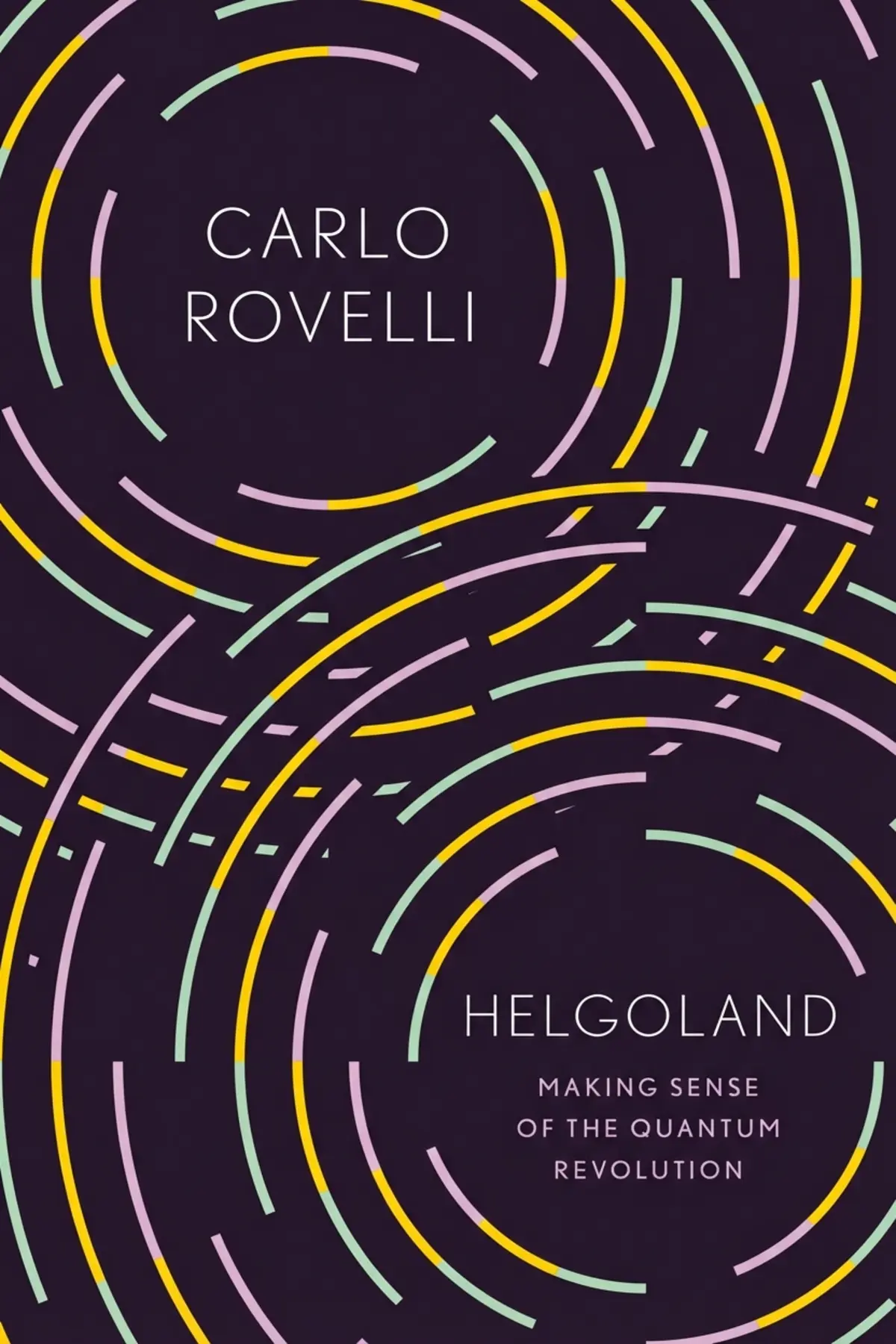
Table of Content
1. Introduction
1 min 03 sec
If quantum physics feels like a wall of paradoxes, the trouble may come from one quiet assumption: that things have properties of their own. In Helgoland, physicist Carlo Rovelli argues that they do not. An electron, a cat or a galaxy has a position, a color or a speed only in relation to something it interacts with.
The story opens in the summer of 1925. A 23-year-old Werner Heisenberg, desperate to escape his hay fever, took refuge on a bare, rocky island in the North Sea and began rethinking the atom. What followed was a theory that predicts experiments superbly yet seems to describe an impossible world. Rovelli’s relational interpretation makes that world readable, because it treats reality as a network of interactions.
Follow his argument and the sleeping cat in the box, the matching photons in distant cities and even the question of how a mind means anything turn into one picture you can explain to a friend.
2. Retell the birth of quantum physics in one story
1 min 47 sec
A young physicist with a blocked nose made a strange decision: ignore everything he could not measure. It worked, and it produced two rival pictures of the electron that seemed impossible to reconcile.
3. Tell the rival readings of quantum weirdness apart
1 min 42 sec
Experiments confirm that a particle can carry two contradictory states at once. Physicists agree on the math, yet they offer wildly different stories about what it means, and each story comes with a steep price.
4. See every object as a knot of interactions
1 min 58 sec
The standard story gives the scientist with a detector a special power over reality. Remove that privilege and something stranger appears: a world where a cat can be asleep for one thing and undecided for another.
5. See how distant photons agree without a secret signal
1 min 56 sec
Two particles thousands of kilometers apart match perfectly every single time, although neither had a color before anyone looked. Faster-than-light messages are ruled out, and so are prearranged answers. Something else must explain it.
6. Use philosophy to get past a scientific dead end
1 min 52 sec
Lenin attacked him, a novelist borrowed from him, and both Einstein and Heisenberg said he shaped their thinking. His unfashionable view of reality opened a door that clockwork physics had kept firmly shut.
7. Spot quantum nonsense and think clearly about minds
1 min 59 sec
The word quantum now sells healing, spirituality and gadgets. The physics cannot explain love or the meaning of life, but it does suggest a sober new angle on how a brain comes to mean anything.
8. Treat what you see as a tested guess
1 min 50 sec
Seeing a cat feels like simply taking in light. A different model says the brain gets there first and the eyes mostly report surprises, and the same loop describes how science itself makes progress.
9. Conclusion
1 min 20 sec
Helgoland begins with a young man escaping pollen and ends with a universe that has no solid furniture. Between the two, Rovelli builds a single picture. Heisenberg kept only what he could observe. Mach had already argued that interactions make the world. The relational interpretation finishes the thought: a property is something that happens between systems, so a cat can be asleep for the trigger and undecided for you, and two photons can match with no message passing between them. The clockwork universe of independent objects gives way to a web of uncertain, probabilistic relations, where what is real depends on which relations are taking place.
That view travels beyond the lab. When a quantum paradox, or a quantum sales pitch, comes your way, ask which interaction defines the property being claimed. When your picture of a situation is contradicted, treat the contradiction as your most useful signal, the way both the brain and science do. And when you think about who you are, remember that the book places even the self inside the web, made of the same correlations as everything else.
Heisenberg went to the island to escape his hay fever. His thinking there, built on what could actually be observed, set quantum physics in motion.
About this book
What is this book about?
Quantum physics is the most accurate theory science has, and also the most baffling. It seems to say a cat can be asleep and awake at once, and that particles in distant cities can agree instantly. Carlo Rovelli, a physicist who works on quantum gravity, starts the story in 1925, when Werner Heisenberg fled hay fever to the island of Helgoland and reinvented the physics of the atom. From there Rovelli compares the main ways of reading the theory, including many worlds, hidden variables and QBism, and makes the case for his own relational interpretation. In this view, nothing has properties on its own. Any interaction counts as an observation, and a thing's color, position or speed exist only relative to something else. That shift removes the mystery from entanglement and makes infinite parallel worlds unnecessary. Rovelli then follows the idea outside physics: to Ernst Mach, the scientist and philosopher who shaped Heisenberg and Einstein, to the question of how a mind gives meaning to what it sees, and to a model of perception as a constantly corrected guess. Readers get a clear map of the quantum debate and a new way to picture reality.
Book Information
Who it's for
Curious professionals
Curious professionals who have heard of Schrödinger's cat and want to finally understand what it means.
Physics or philosophy students
Students of physics or philosophy looking for a clear map of the competing quantum interpretations.
Tired of quantum buzzwords
Readers tired of quantum buzzwords who want to know what the science actually says about reality and the mind.
About the Author
Carlo Rovelli
Carlo Rovelli, born in Verona, Italy, in 1956, is a physicist whose research centers on quantum gravity. He is one of the founders of loop quantum gravity, and he formulated relational quantum mechanics, the view at the heart of Helgoland, as well as the notion of thermal time. He has worked in Italy, the United States, France and Canada and also writes on the history and philosophy of science. His Seven Brief Lessons on Physics has sold more than two million copies, and Foreign Policy named him among its 100 most influential global thinkers in 2019.
Ratings & Reviews
Ratings at a glance
What people think
Listeners find that this work offers a superior clarification of the core of quantum physics and value the accessible, eloquent way the material is handled. It is regarded as a top-tier resource in the field, with one listener highlighting that it depicts quantum theory on a broad canvass. Opinions vary on how much it stimulates the mind; while some find it extremely thought-provoking, others have difficulty with the philosophical debates concerning reality. Listeners portray the work as an undeniable nexus between physics and find it liberating.
Top reviews
Gung
This book is essentially a long prose poem about the death of objective reality as we think we know it. Rovelli takes the birth of quantum mechanics on the barren island of Helgoland and turns it into a gripping narrative about Young Heisenberg’s fever dream. I was particularly struck by the relational interpretation, which suggests that things don't have properties in isolation, but only through their interactions with others. It is a liberating way to view the universe, even if it makes your head spin. While some might find the brevity frustrating, I thought the prose was luminous and accessible for a layperson. The connection between modern physics and the ancient philosophy of Nāgārjuna was an unexpected but welcome highlight. Truth is, I haven't stopped thinking about 'relations without objects' since I closed the back cover.
Show moreEleanor
Wow. I didn't expect a book about subatomic particles to lead me into a meditation on the nature of the self and human connection. Rovelli makes a compelling case that there is no 'outside' observer and that everything in the universe is defined by its relationship to something else. This relational interpretation is a wild departure from standard materialist views, yet it fits the data perfectly. I loved the historical context he provided for the young geniuses like Dirac and Heisenberg, making them feel like real, struggling people rather than just names in a textbook. The sentence structure is beautiful and the translation is seamless, capturing a sense of genuine awe. It is one of those rare science books that actually makes you feel more connected to the world around you rather than alienated by it.
Show moreCaleb
Finally got around to reading this and I’m struck by how liberating Rovelli’s perspective feels. He manages to present quantum theory on a broad canvas that includes history, philosophy, and even sociopolitical theory. The truth is, most science writing is either too dense or too patronizing, but Helgoland hits that perfect middle ground of being understandable without losing its soul. I found the discussion of 'qualia' and the hard problem of consciousness toward the end to be particularly brave for a physicist. Some might call his style 'purple prose,' but I think we need more scientists who can write with this much heart. It’s an undeniable masterpiece of popular science that reminds us that questioning the world is the most human thing we can do.
Show moreHang
After hearing so much buzz about Helgoland, I was surprised by how much ground it covers in such a slim volume. Rovelli doesn't just explain the science; he explains the feeling of being a scientist on the edge of a world-changing discovery. His explanation of entanglement as a manifestation of relations rather than 'spooky action' is the most intuitive I’ve ever read. Even the more difficult sections on the empiriocriticism of Mach were handled with a lightness of touch that kept me turning the pages. It's a beautifully written book that manages to make the most complex theory in history feel personal and relevant. If you've ever felt intimidated by physics, this is the book to pick up. It's less about math and more about the beauty of our interconnected reality.
Show morePaiboon
Ever wonder why quantum physics feels so impossible to visualize for the average person? Rovelli argues it is because we are stuck in an old-fashioned way of seeing the world as a collection of independent 'stuff.' Through Helgoland, he attempts to dismantle this view by showing that reality is more like a web of mirrored relations. The first half is a fantastic historical summary of Heisenberg and Bohr, written with a clarity that few scientists can master. However, I’ll admit the second half gets a bit muddled when it dives deep into the philosophy of mind and information theory. To be fair, it’s a lot of ground to cover in less than 200 pages. It is a thought-provoking journey that manages to be both scientifically rigorous and deeply emotional, though the price point for such a short book might sting some readers.
Show morePan
Picked this up after hearing Rovelli is the new 'poet of physics,' and I can certainly see why people say that. He has a gift for making the most abstract concepts, like the Schrödinger's cat paradox or quantum entanglement, feel like something you could almost touch. The way he describes Heisenberg on that pollen-free island, desperately trying to calculate the behavior of electrons, is genuinely cinematic. I appreciated how he didn't just 'shut up and calculate' but actually wrestled with what these equations mean for our daily existence. My only real gripe is that the ending felt a bit rushed, leaping from physics to Russian political history and Buddhism a bit too quickly. Despite that, it’s a brilliant nexus between hard science and humanistic inquiry that I’d recommend to anyone who enjoys a bit of wonder.
Show moreNitaya
This isn't your typical science read because it focuses more on the 'spirit' of discovery than on dry equations. Rovelli is a master at distilling the essence of quantum theory—the idea that the world is made of happenings, not things. I particularly enjoyed the way he handled the many-worlds interpretation versus his own relational view; it was respectful yet firm. The tone is casual and conversational, which helps when you're trying to wrap your head around the fact that an object might not have a position until it interacts with something else. While it’s true that some of the multidisciplinary comparisons feel a little forced, the central message is powerful. It’s a short, punchy read that challenges your most basic assumptions about what is 'real' in the universe.
Show moreRafael
As someone who has followed Rovelli’s work for years, I found this to be a bit of a mixed bag compared to his previous hits. The writing is still gorgeous, and his ability to explain the 'matrix mechanics' of the early 20th century is unparalleled. But frankly, the book feels a bit thin for the cost, with large fonts and plenty of blank space that suggest a bit of padding. He makes some bold claims about the relational nature of reality that are fascinating, yet he often points to footnotes or external papers just as the argument gets interesting. I found the section on the monk Nāgārjuna intriguing but arguably a bit of a stretch for a physics book. It’s an okay introduction for a novice, but if you’re looking for deep technicality, you might walk away feeling a sense of vacuity.
Show morePawinee
Look, I appreciate what Rovelli is trying to do here, but I’m not sure he entirely succeeds in this specific volume. The first few chapters are a solid five-star history of the quantum revolution, filled with vivid imagery and great pacing. But the transition into the 'relational' argument felt a bit like a leap of faith rather than a grounded scientific conclusion. Personally, I found the comparisons to Buddhist emptiness a bit repetitive after a while. It’s a very quick read, which is a plus, but it leaves you with more questions than answers—and not always in the 'good' way. It’s worth reading for the historical bits alone, but keep your skeptical hat on when the philosophy starts raining down like hail in the final chapters.
Show moreCharlotte
The chapter on Heisenberg’s initial discovery was promising, but the rest of the book unfortunately devolved into a confusing maze of philosophical detours. I found Rovelli’s explanations of the actual physics to be too brief and superficial for a beginner to really grasp the gravity of the mystery. For example, he mentions the Stern-Gerlach experiment but skips over the essential details that make it so baffling in the first place. Not gonna lie, the constant jumping between Mach, Lenin, and ancient Indian philosophy felt more like a distraction than a cohesive argument. It’s a very pretty book with lovely metaphors, but it lacks the solid logical nessi needed to bridge the gap between quantum math and metaphysical reality. It felt more like a collection of vague suggestions than a serious scientific exploration.
Show moreQuestions about this book
What is the main idea of Helgoland by Carlo Rovelli?
Rovelli argues that quantum physics makes sense once we stop assuming objects have properties of their own. In his relational interpretation, any interaction counts as an observation, and properties such as color, position or speed exist only relative to other systems. Reality becomes a web of interactions. He tells the story from Heisenberg’s 1925 work on Helgoland to entanglement, then applies the idea to philosophy and the mind.
How does Helgoland explain Schrödinger's cat?
The cat sits in a box with a sedative device triggered by a quantum event with a one in two chance. Rovelli compares three readings: many worlds, hidden variables and QBism. His relational answer is that the cat is definitely asleep or awake relative to the trigger inside the box, while relative to you outside it is neither yet. Both are true because they describe different relations.
What does Rovelli say about quantum entanglement?
Two entangled photons sent to Vienna and Beijing always match when observed, though neither had a color beforehand. A faster-than-light signal and prearranged colors are both ruled out, the second by Bell inequalities. Rovelli’s view is that nothing can compare the photons until something interacts with both, such as a phone call between scientists. A web of relations, not a mysterious link, connects the two events.
Can quantum physics explain consciousness, according to Helgoland?
Not fully. Rovelli rejects quantum healing and similar claims, but suggests relational ideas can open new paths. He traces meaning, which Franz Brentano called intentionality, to relevant relative information: seeing a falling rock correlates the rock with a brain state, and that correlation makes you move. This covers physical processes only. How subjective experience arises, the hard problem of consciousness, remains open.
How can I apply the ideas in Helgoland?
The book supports a few habits. When a quantum claim appears, ask which interaction defines the property being described, and be skeptical of quantum labels on products or spiritual promises. Anchor stuck problems in what can actually be measured, as Heisenberg did. And treat your view of any situation as a guess to be tested, paying close attention to whatever contradicts it.
Readers also enjoyed


A Life Decoded: My Genome: My Life
J. Craig Venter

A Planet of Viruses
Carl Zimmer

A Short History of Nearly Everything
Bill Bryson

A Thousand Brains: A New Theory of Intelligence
Jeff Hawkins




Alien Earths: The New Science of Planet Hunting in the Cosmos
Lisa Kaltenegger

AUDIO SUMMARY AVAILABLE
Listen to Helgoland in 15 minutes
Get the key ideas from Helgoland by Carlo Rovelli, plus 5,000+ more nonfiction titles.
- 5,000+ titles
- Listen as much as you want
- 7-day free trial
- Cancel anytime









