

13 min 59 sec
Available in: English
Growing Great Employees: Turning Ordinary People into Extraordinary Performers
Shows managers how to turn ordinary, imperfect employees into strong performers by tending them like a garden: listening, hiring through scenarios, coaching mistakes, setting clear agreements, delegating well and letting go when growth stops.
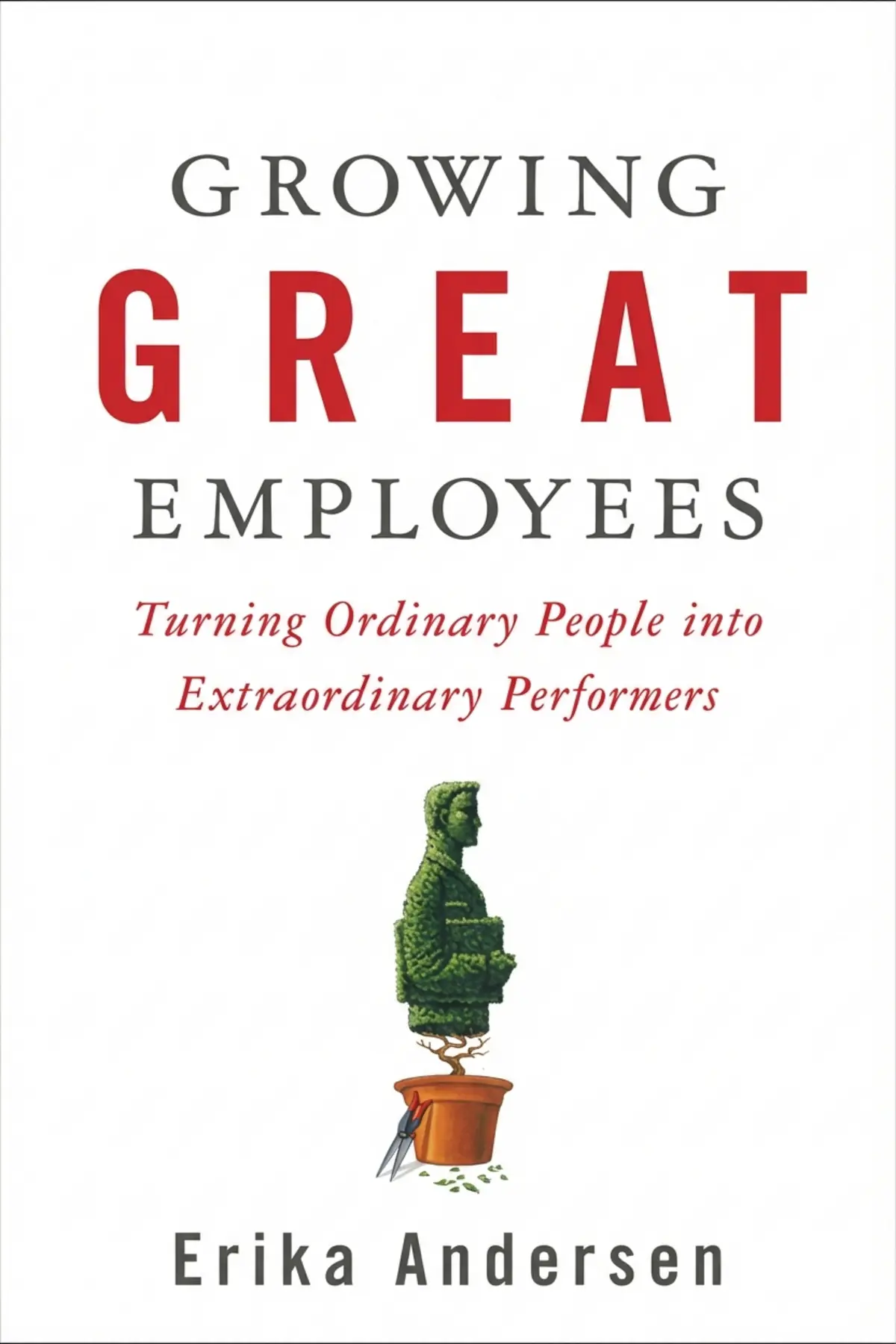
Table of Content
1. Introduction
1 min 04 sec
If you manage people, it is tempting to treat strong employees as something you find, a matter of luck in hiring. In Growing Great Employees, consultant and executive coach Erika Andersen argues that ordinary, flawed people become strong performers when a manager tends them the way a gardener tends a garden. The comparison sounds soft, yet it turns out to be a practical checklist.
A gardener prepares the soil, puts each plant in a spot that suits it, supports it while it grows and removes what will not thrive. Andersen maps each of those tasks onto a manager’s week, from the first job interview to the hardest conversation a boss ever has. Her throughline is that great employees are grown, and growing them is a skill any manager can learn.
What follows is a working sequence: how to listen so people tell you the truth, how to hire past polished answers, how to correct without crushing, how to stretch people toward bigger roles and how to know when to let go.
2. Keep good people by helping them grow
1 min 37 sec
The ideal employee, always right and always rising, is a fantasy. What happens to the real ones depends on something many managers overlook, and ignoring it now has a visible price.
3. Listen first, then hire for what top performers share
1 min 47 sec
Most managers believe they know what their team is thinking. Andersen suggests that belief deserves a test, and that the same attention also reveals what to look for in the next person you hire.
4. Make candidates show how they would really act
1 min 39 sec
Candidates oversell themselves, sometimes honestly and sometimes not. One change to the questions you ask makes bluffing far harder and turns a row of identical answers into something you can actually compare.
5. Answer mistakes like a coach and people improve
1 min 38 sec
Fixing an employee’s error yourself feels responsible and fast. Andersen argues it often guarantees the same error returns, and she offers a different first move, plus a small change in what you tell yourself.
6. Set clear targets and give feedback people can use
1 min 44 sec
A designer can stay busy all month and still miss what matters most. Andersen shows how a simple agreement prevents that, and why the way you open a correction decides whether it helps.
7. Delegate with room and direction to grow leaders
1 min 40 sec
Hover too closely and nobody learns to lead. Step back too far and the team turns on itself. Andersen describes the middle ground, and how one ordinary task can become a training ground.
8. Let go of someone who won't grow, with care
1 min 45 sec
Some employees absorb endless time and still do not change, and they wear down the manager as much as the team. Andersen explains how to be sure, and how to act decently once you are.
9. Conclusion
1 min 05 sec
Andersen’s garden is a useful picture because it removes the excuse that great employees are a matter of luck. In her account, the manager shapes almost every condition that decides whether a person thrives: the attention they receive, the role they are matched to, the way they were chosen, the response to their mistakes, the clarity of what is expected and the room they are given to stretch. Even the hardest decision, removing someone, belongs to the work of tending the whole team.
The practical starting points are small. The next time someone on your team comes to talk, stop what you are doing and listen long enough to learn where they feel pressure. Turn one interview question into a real scenario from the job. When a mistake lands on your desk, ask what caused it before you fix it, and when you correct someone, name the exact moment and say why it matters.
A gardener cannot force a plant to grow. What a gardener can do is make growing possible, season after season, and that is the job Andersen hands to every manager.
About this book
What is this book about?
Most managers would love a team of people who get everything right, bring great ideas and rise smoothly through the ranks. Erika Andersen's starting point is that nobody like that exists. Employees are flawed human beings with some potential, and whether that potential shows up depends largely on the person managing them. Her angle is a gardening metaphor that turns out to be practical. A gardener prepares the soil, puts each plant where it can thrive, stakes it as it grows and prunes what will not take. Andersen maps each of those tasks onto a manager's work: listening so people speak openly, writing job descriptions around what top performers share, hiring through scenario-based interviews, answering mistakes like a coach, setting clear performance agreements, giving specific corrective feedback and delegating with the right balance of freedom and direction. She also covers the part most managers dread: recognizing when an employee will not grow despite real effort, and letting them go with care. Readers get a sequence they can apply from the first interview to the hardest conversation, along with the argument that people today expect this kind of development and will leave for employers who offer it.
Book Information
Who it's for
New and seasoned managers
New and experienced managers who keep hoping for better hires instead of developing the people they have.
Team leads fixing mistakes
Team leads who fix mistakes themselves and wonder why the same errors return.
Founders and HR teams
Founders and HR staff who want simple methods for hiring, feedback, delegation and hard exits.
About the Author
Erika Andersen
Erika Andersen is a founding partner of Proteus International, a firm that provides coaching, consulting and training to prepare leaders. She has advised senior executives at companies including Spotify and Spectrum, and her work spans organizational vision and strategy, executive coaching and leadership development. She speaks to business and nonprofit audiences, writes for Forbes and hosts the Proteus Leader Show, a podcast for managers and leaders.
Ratings & Reviews
Ratings at a glance

What people think
Listeners find the work successful for enhancing staff growth. Even so, the suggestions draw conflicting reviews, with some praising their utility while others believe the material provides minimal direction.
Top reviews
Talia
Finally got around to finishing this management guide, and I’m kicking myself for not picking it up years ago when I first transitioned into a leadership role. Erika Andersen provides a robust framework that covers the essential responsibilities a manager faces daily while offering principles that actually make the work feel manageable. I particularly appreciated the emphasis on listening—truly listening—as the foundational step for developing any team member's potential. To be fair, business books can often feel like a chore, but the organization here allows you to grasp the core concepts through quick chapter intros and helpful summaries at the end. It is a comprehensive resource for anyone who wants to move beyond just supervising and start actually cultivating a high-performing environment. This is exactly the kind of material I wish was standard issue for every new hire in my department.
Show moreMarco
This book changed how I view my one-on-ones by shifting the focus from 'fixing' people to 'tending' to their environment and growth. Not gonna lie, I was skeptical about the gardening theme at first, but it really helps visualize the patience and skill required to lead a diverse group of individuals. The author breaks down complex relationship dynamics into easy-to-understand concepts that you can start practicing with your team the very next morning. I especially liked the emphasis on creating a culture of growth where productivity spreads naturally rather than being forced through rigid, top-down mandates. It’s an amazing guide for those who feel like the 'human' side of human resources is often overlooked in traditional business education. I plan on keeping this on my desk as a frequent reference whenever I feel my team is losing its traction.
Show moreSam
Direct and actionable, this manual provides exactly what new supervisors need: a roadmap for building a functional and thriving workplace culture. I wish I had read this a decade ago because it would have saved me from making so many common mistakes regarding how I communicated with my direct reports. The focus on listening and providing the right 'nutrients' for growth is a refreshing departure from the usual command-and-control style of leadership. In truth, the book is incredibly well-organized, making it easy to find specific advice on hiring or development whenever a specific challenge arises. Even the more basic concepts are presented with a level of clarity that makes them feel fresh and newly relevant to today's workplace. If you care about the people you manage, you owe it to them—and yourself—to read this book and apply its principles.
Show moreTar
The gardening metaphor is laid on thick throughout these pages, yet it actually serves as a surprisingly effective framework for understanding human potential in the office. While the constant references to soil and pruning can get a bit tedious after a few chapters, the underlying logic is incredibly sound and easy to apply. Frankly, the hiring advice alone is worth the price of admission, even if I personally would have preferred a deeper dive into long-term retention strategies. I love how the book is structured for the busy professional; you can skim a chapter in minutes and still walk away with a functional tool. It’s a pragmatic read that acknowledges that relationship-oriented work is what prevents friction and keeps a team moving forward. Not quite a management bible, but a very solid addition to my shelf.
Show morePrim
Ever wonder why some teams flourish while others seem to wither under the exact same corporate conditions? Andersen argues that the difference lies in the manager's ability to consciously tend to their staff like a skilled gardener would tend to a prized landscape. Personally, I found the focus on active listening to be the most profound part of the book, as it’s a skill that is frequently talked about but rarely practiced with this much intentionality. The chapters are designed for efficiency, allowing you to grab the 'a-ha' moments quickly without getting bogged down in unnecessary fluff or academic jargon. My only quibble is that I wanted more on managing difficult personalities and less on the initial recruitment process, though the hiring tips provided are quite practical. It’s a helpful guide that reminds us that people are the primary drivers of productivity.
Show morePing
After hearing several colleagues recommend Erika Andersen’s approach, I decided to see if her 'listening' technique lived up to the hype. The book is incredibly easy to absorb, largely because the author uses a layout that respects the reader's time by including summaries and clear headings. In my experience, most management books are about 200 pages too long, but this one hits the sweet spot of being informative without being dense. You can realistically read and internalize the core message in an afternoon and begin implementing the frameworks immediately. While some might find the gardening metaphor a bit cheesy, it provides a consistent visual language for the entire lifecycle of an employee. It’s a very pragmatic look at how to reduce workplace friction by focusing on the underlying health of your professional relationships.
Show moreKaen
Not what I expected from a standard business text, mostly because the author prioritizes soft skills and human connection over spreadsheets and rigid KPIs. The book treats management as an art form that requires constant practice and a willingness to adapt to the specific needs of each individual on your team. I appreciated the interesting notes and the set of tips provided at the end of each section, which made the concepts feel much more actionable. Even if you don't agree with every single point, the shift in perspective regarding how we 'grow' our talent is worth the read. There is a lot of useful information here regarding how to foster a positive atmosphere that actually encourages people to do their best work. It’s a solid 4-star read that offers plenty of food for thought for any modern leader.
Show morePatcharaporn
Gotta say, the way Andersen organized her chapters—starting with a summary and ending with key takeaways—makes this the ultimate reference for busy professionals. You don't have to slog through every page to get the 'a-ha' moments, though reading the whole thing definitely provides a more holistic understanding of her gardening philosophy. While some of the advice on managing people felt a bit light compared to the extensive sections on hiring, the overall message is one that every manager needs to hear. It’s all about the skill involved in formalizing your relationships so that you get the right traction with your team. This isn't just a self-improvement book; it's a practical guide for anyone who feels that the human element of their job is getting in the way of productivity. It’s a quick, helpful read that provides plenty of value.
Show moreScarlett
As someone who has navigated corporate leadership for over a decade, I found the advice here to be a bit hit-or-miss depending on your specific experience level. The truth is that many of these concepts are very basic, making it a great introductory text but perhaps a bit light for seasoned executives looking for advanced strategy. I did find the sections on formalizing and practicing soft skills to be useful, as those are the areas where most of us experience the most slippage. However, the gardening theme felt a bit forced at times and occasionally distracted from the more serious business applications being discussed. It’s a quick four-hour read that offers a decent shift in perspective, but don't expect a radical paradigmatic shift if you've already read the classics in this genre. It's a pragmatic tool, nothing more and nothing less.
Show moreFort
Look, I understand the appeal of an accessible business book, but this felt more like a collection of common-sense observations than a revolutionary management system. The gardening analogy is pushed so hard on every single page that it becomes an exhausting distraction from the actual advice being offered. While the information on hiring is objectively good, I found the rest of the book to be a bit too elementary for anyone who has spent more than a year in a supervisory position. To be fair, the skimmable layout is a nice touch for those who lack the time for deep reading, but the content itself lacks the grit I was hoping for. If you are looking for a deep dive into complex organizational psychology, you might find this a bit too simplistic for your needs. It’s okay for a quick overview, but it didn't offer the guidance I required.
Show moreQuestions about this book
What is the main idea of Growing Great Employees?
Erika Andersen argues that managers should treat employees the way a gardener treats plants. Ordinary, imperfect people become strong performers when a manager prepares the right environment, places them in suitable roles, hires carefully, coaches through mistakes, sets clear agreements, delegates well and, when growth truly fails, lets them go. Great employees, in her view, are grown by skilled managers rather than simply found.
What is a scenario-based interview in Growing Great Employees?
It is an interview where candidates are given a specific situation and asked what they would do, instead of describing their own strengths. Andersen’s example for a personnel manager asks how they would handle a loyal employee whose work has slipped, and which techniques they would use. General questions get near-identical answers, while scenarios produce varied responses that are harder to fake and reveal how each person thinks.
How does Erika Andersen recommend giving feedback?
She favors corrective feedback over constant praise, delivered specifically. Point to a real moment, such as something you noticed yesterday or in the last meeting, rather than saying every time you do this. Then explain why it matters and how much, as with a salesperson whose missed quota could hurt company growth, profit and eventually her own and her colleagues’ pay.
How should managers handle employee mistakes according to the book?
Andersen warns against jumping in and fixing the error yourself, which teaches the employee nothing and can leave them discouraged. Adopt a coach’s mind-set instead: sit down with the person, listen to their view of what went wrong and find the real cause, which may be your own unclear instruction. Back this with positive self-talk that assumes the person can succeed with help.
Who should read Growing Great Employees?
It suits managers at any level who want a clear sequence for developing people, from hiring to delegation. Team leads who struggle with feedback or who carry an underperformer will find concrete guidance, including how to decide when firing is necessary and how to handle it respectfully. Founders and HR staff will find simple tools for writing job descriptions and interviewing.
Readers also enjoyed

A Bigger Prize: How We Can Do Better Than the Competition
Margaret Heffernan





A Year with Peter Drucker: 52 Weeks of Coaching for Leadership Effectiveness
Joseph A. Maciariello



Acting with Power: Why We Are More Powerful Than We Believe
Deborah Gruenfeld
AUDIO SUMMARY AVAILABLE
Listen to Growing Great Employees in 15 minutes
Get the key ideas from Growing Great Employees by Erika Andersen, plus 5,000+ more nonfiction titles.
- 5,000+ titles
- Listen as much as you want
- 7-day free trial
- Cancel anytime









