

11 min 51 sec
Available in: English
Good Team, Bad Team: Lead Your People to Go After Big Challenges, Not Each Other
Shows team leaders why capable colleagues clash over problem-solving style, and how naming four thinking preferences, a shared purpose, open trust and a common process turns that friction into better solutions.
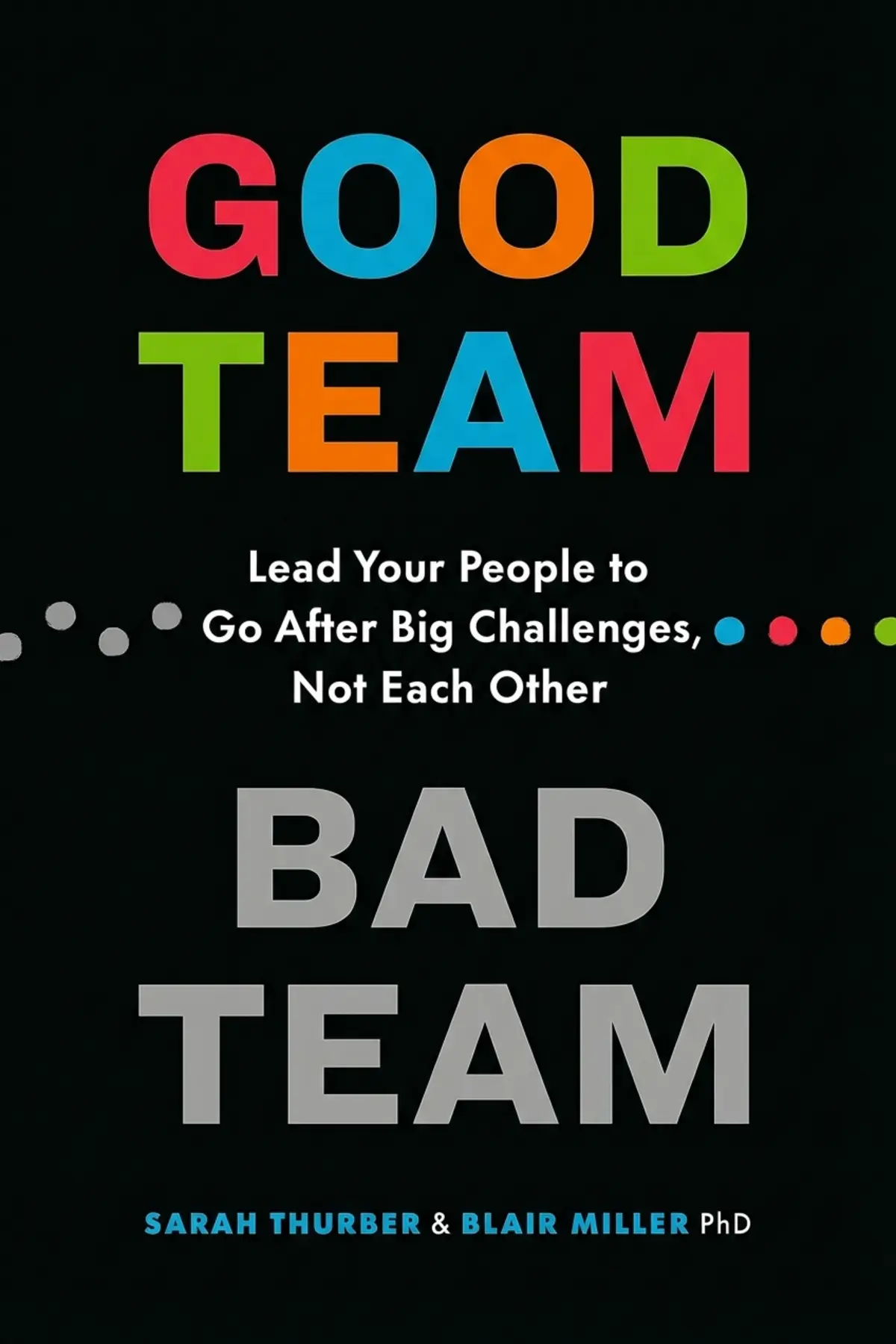
Table of Content
1. Introduction
1 min 06 sec
If you lead a team that spends more energy fighting itself than the problem in front of it, the cause may be simpler than bad personalities. In Good Team, Bad Team, Sarah Thurber and Blair Miller argue that much team friction comes from measurable differences in how people prefer to solve problems. A colleague who seems slow, scattered or reckless is often just thinking in a different order than you.
Thurber, who runs the creative thinking company FourSight, and Miller, its cofounder, build their case on four pieces: those thinking preferences, a shared purpose, trust and a common process for hard problems. The argument running through all of it is that a group becomes a real team when its members understand how each other thinks and point those differences at the same challenge.
What follows gives a team lead a vocabulary for the colleague who drives them mad, a poster exercise that rallied 150 tired experts, and a four-stage routine for any problem too tangled for a quick brainstorm.
2. Read a frustrating colleague as a different thinker
1 min 50 sec
Two smart people in the same meeting each privately decide the other is doing it wrong. The authors suggest both may be right about one thing, and that the real explanation is far more useful than blame.
3. Give scattered experts one purpose they can picture
1 min 59 sec
A team of 150 specialists, worn out by reorganizations, needed a reason to work together. The fix their leader chose sounds almost childish, yet it ended with a record-breaking number of patents.
4. Trust returns in the same measure you give
2 min 02 sec
A leader facing a hard year decided the safest move was to say less. Her team lost trust in her and her top engineers began job hunting, and brain research helps explain why her instinct backfired so badly.
5. Get your team through the storming stage faster
1 min 52 sec
Every new team hits a phase of jockeying and conflict, and some never leave it. The way out the authors propose is not a team retreat or a new rule, but a vocabulary.
6. A four-stage routine for tangled problems
1 min 55 sec
Popular methods for innovation come with their own jargon and training courses. Look underneath them, the authors say, and the same simple engine is running, one any team can learn and run on its own.
7. Conclusion
1 min 07 sec
The book’s real contribution is to take what most teams treat as personality conflict and recast it as a design problem. The four ways of thinking explain why smart colleagues irritate each other, and the same four form the process that cracks hard problems. Purpose aims those differences at one target. Trust lets people say what they see.
Etienne’s posters and Shyla’s silence teach one lesson from opposite sides. People give a team their best when they can see the goal and believe the person leading them.
The practical steps are small. At your next team meeting, ask everyone to name the thinking preference they lean on, and listen for the one your group lacks. Draft a shared answer to why the team exists, then open the meetings that follow with it. When the news is hard, share more of it. And before the next problem gets a solution, check whether anyone has actually clarified it.
The colleague who drove you mad may be the person your team was missing all along, waiting for the stage where their way of thinking leads.
About this book
What is this book about?
Many teams lose more energy to internal friction than to the problems they were formed to solve. Sarah Thurber and Blair Miller argue that much of this friction is not bad personality. It comes from measurable differences in how people prefer to tackle a challenge. Some want to clarify, some to generate ideas, some to develop a plan and some to act at once. The authors build on research by Gerard Puccio to describe those four thinking preferences. They then add three supports that let a team use them. A shared purpose gives everyone the same target, as a division president named Etienne showed with 150 tired experts and a set of posters. Trust, drawn from Paul J. Zak's research, grows when leaders share openly. A common problem-solving process gives each way of thinking its moment to lead. Readers get a practical vocabulary for the colleague who frustrates them, a way to write a team charter, a list of trust-building behaviors and a four-stage routine for complex problems.
Book Information
Who it's for
Team leads facing clashes
Team leads whose capable people keep clashing over how to tackle problems.
Leaders inheriting struggling teams
Managers and founders taking over a tired or divided group who need a shared purpose fast.
Trainers and facilitators
Trainers and facilitators looking for a simple common language for thinking styles and problem solving.
About the Author
Sarah Thurber
Sarah Thurber runs FourSight, a creative thinking company that has reached more than 100,000 people worldwide. She studied at the International Center for Studies in Creativity and coauthored the bestselling The Secret of the Highly Creative Thinker. Blair Miller, who holds a PhD, cofounded FourSight and serves as its Research Coordinator. For about thirty years he has paired teambuilding with problem-solving facilitation to help teams develop new products, patents and strategic plans, and he codeveloped a business simplification process used with Fortune 500 clients such as Mars and Kraft.
Ratings & Reviews
Ratings at a glance
What people think
Listeners find this book an essential read for those in leadership roles, offering an actionable manual filled with research-driven perspectives and stimulating ideas that explain various cognitive styles. The writing is clear and accessible, with one listener highlighting that it incorporates six million data points of research. They value how effectively it fosters unified teams and appreciate the compelling narrative approach used throughout the text.
Top reviews
Anchalee
This book is a game-changer for anyone tired of the usual corporate fluff that populates the leadership genre. Thurber and Miller move beyond vague platitudes to explain the science of thinking preferences—clarifying, ideating, developing, and implementing. Truth is, I finally understand why my 'ideator' colleagues used to drive me crazy during the 'clarifying' phase. It wasn’t a personality clash; it was a cognitive mismatch. The research, particularly the 74% stress reduction in high-trust environments, makes a compelling case for changing how we manage. While the animal mascot exercise seemed a bit whimsical at first, the underlying logic of creating a shared purpose is undeniable. This isn't just a book to read once; it’s a manual for building a cohesive, resilient unit that actually gets things done. It’s practical, evidence-based, and highly readable.
Show moreYam
Picked this up after a colleague mentioned the oxytocin research, and I’m glad I did. The connection Paul Zak makes between trust and physical brain changes is staggering. Who knew that giving people discretion and celebrating excellence could literally rewire a team for 50% higher productivity? The book does a fantastic job of explaining the four key stages: clarifying, ideating, developing, and implementing. It’s easy to read but doesn't sacrifice depth, which is a rare balance in business literature. I’ve already started using the 'shared language' concept to help my team navigate our current 'storming' phase. Frankly, the advice on transparency during rough patches hit home for me—I've seen firsthand how 'need-to-know' communication kills morale. It’s a powerful tool for anyone looking to foster a more innovative, supportive environment where everyone feels valued.
Show moreWipawan
Wow. I wasn’t expecting a leadership book to be this engaging. Thurber and Miller have managed to distill millions of data points into a narrative that feels like a conversation with a brilliant mentor. The 'thinking preferences' framework is incredibly eye-opening—I’m definitely a 'developer' who has been clashing with 'ideators' for years without realizing why! This book gave me the tools to bridge that gap. The sections on trust and oxytocin levels are particularly fascinating, proving that a healthy culture isn't just a 'nice to have'—it’s a biological necessity for high performance. It's concise, research-backed, and filled with actionable steps that you can implement tomorrow. If you’re leading a team, or even just working in one, you need to read this to understand the invisible forces driving your group's success or failure.
Show moreKiattisak
After hearing so much buzz about cognitive diversity, I finally grabbed 'Good Team, Bad Team.' It’s a masterclass in understanding the 'why' behind team dynamics. The authors explain that our frustration with colleagues isn't usually about their personality, but rather their preference for clarifying or implementing. Personally, I found the 'forming, storming, norming, performing' breakdown to be the most useful part for my current project. It helps to know that conflict is a predictable stage, not a sign of failure. The writing style is punchy and direct, which I love. No fluff, just solid insights backed by real-world examples like Etienne’s leadership during corporate reorgs. It’s one of those rare books that changes how you see every interaction at the office. High-performing teams don't happen by accident; this book shows you the blueprint for creating them through trust and shared purpose.
Show morePensri
A must-read for anyone serious about leadership. What sets this book apart is the way it bridges the gap between scientific research and everyday management. The authors use Paul Zak’s work to show how trust literally changes our brain chemistry, which is a far more powerful argument for 'vulnerability' than any inspirational poster. I particularly enjoyed the concept of the 'thinking preference' lens; it’s helped me stop labeling my coworkers as 'difficult' and start seeing them as 'clarifiers' who just need more data. The animal mascot exercise mentioned in the book is a stroke of genius for aligning disjointed groups. This is a practical, no-nonsense guide to building a team that doesn't just work together, but actually thrives together. I’ll be recommending this to everyone in my network who manages people or leads complex projects.
Show moreMichael
Ever wonder why a group of brilliant individuals can’t seem to stop bickering and start performing? Thurber and Miller dive deep into the 'storming' phase, showing how misaligned thinking styles are often the culprit. I found the section on Etienne’s team particularly insightful, especially the bit about using animal mascots to unify 150 experts who had been worn down by reorgs. It’s practical, grounded in research, and mercifully free of the usual jargon. To be fair, some of the problem-solving frameworks (like the overlap with Agile and Lean) felt a bit redundant if you’re already in that space, but the 'thinking preferences' lens adds fresh value. It's a solid 4-star read for any manager struggling to turn a group of 'I's' into a 'We.' Definitely worth a spot on the office shelf for the next time things get rocky.
Show moreMason
The chapter on the structured problem-solving process is worth the price of the book alone. Most teams just jump straight into 'implementing' without ever properly 'clarifying' the challenge, and Thurber and Miller explain exactly why that leads to disaster. I appreciated how they linked their framework to existing methods like Lean Six Sigma and Design Thinking; it makes the advice feel integrated rather than isolated. My only gripe is that the middle section drags slightly with repetitive examples. To be fair, the 'animal mascot' story was a highlight that really illustrated how to align 150 different experts under one banner. It's a very practical guide that moves beyond 'kumbaya' team building into real, measurable cognitive science. Good for any leader who wants a more strategic approach to collaboration and wants to avoid the typical pitfalls of miscommunication.
Show moreJoy
Finally got around to reading this, and the timing couldn't have been better for my department. We’ve been stuck in the 'storming' phase for months, and I was losing hope. Thurber and Miller’s advice on creating a shared purpose and leveraging cognitive diversity provided exactly the roadmap we needed. I loved the breakdown of how different thinking styles—from ideating to developing—power different stages of a problem-solving engine. In my experience, most managers ignore the 'clarifying' stage, which leads to huge waste later on. The book is short and punchy, though I wish there was a bit more on how to maintain these habits long-term once the initial excitement wears off. Still, the focus on oxytocin and trust-building is a refreshing take on corporate culture. It’s an easy 4 stars for the practical tools and the total lack of fluff.
Show moreTakeshi
As someone who has been in management for two decades, I found the core concepts here to be a bit of a refresher rather than a total revelation. The idea of cognitive diversity isn't exactly new, though the authors do a decent job of structuring it into the four preferences. It’s a quick, easy read, and the anecdotes about animal mascots and team posters were charming enough for a workshop setting. However, I felt it leaned a bit too heavily on the SUNY Buffalo research at times, almost feeling like a long-form academic paper dressed as a business book. Not gonna lie, I was hoping for more advanced strategies for remote-first environments. It’s a great introductory text for new leads or those struggling with basic cohesion, but seasoned leaders might find themselves skimming the more 'common sense' sections.
Show moreLily
Not what I expected, but still quite useful in parts. I thought this would be more of a psychology book, but it’s very much a business manual. The four-step framework (clarify, ideate, develop, implement) is logical, but it felt a bit overly simplified at times for complex industries. Look, I get the value of a 'shared language,' but sometimes the corporate stories felt a little too 'perfect' to be relatable to my small, fast-paced startup environment. That said, the data on trust and productivity is impressive and hard to argue with. I think it’s a solid resource for large organizations trying to fix a 'bad team,' but maybe a bit rigid for more fluid work cultures. It’s a decent read if you want a structured way to look at problem-solving, but don't expect it to solve every interpersonal conflict overnight without a lot of extra work.
Show moreQuestions about this book
What is the main idea of Good Team, Bad Team?
Sarah Thurber and Blair Miller argue that much team conflict comes from differences in how people prefer to solve problems, not from bad personalities. Drawing on Gerard Puccio’s research, they describe four preferences: clarifying, ideating, developing and implementing. A team improves when members understand these differences, share a clear purpose, trust their leader and use a common problem-solving process that gives each way of thinking its turn.
What are the four thinking preferences?
Clarifiers want to understand a problem fully before moving, so they ask questions and gather facts. Ideators prefer to explore possibilities right away. Developers like to compare options and build a detailed solution. Implementers want to act and get results. Most people lean on one or two, and the authors say a team needs all four to reach its best solutions.
How do the authors suggest building trust in a team?
They cite Paul J. Zak’s research found that, compared with employees of low-trust firms, people at high-trust companies described 74 percent lower stress, 106 percent greater energy and 50 percent more productivity. The recommended behaviors are sharing information broadly, building relationships deliberately, recognizing excellent work, giving people discretion and showing vulnerability. The story of Shyla shows the opposite: withholding information cost her team’s trust and top performers.
How can I apply Good Team, Bad Team with my own team?
Start by teaching the four thinking preferences and letting each person name their own. Write a team charter together covering purpose, goals, roles and communication, and revisit the purpose often. Share information openly, especially in hard times. When a complex problem arrives, move through clarifying, ideating, developing and implementing in turn, giving each stage enough time and matching people to the stages that suit them.
Who should read Good Team, Bad Team?
It suits team leads and managers whose talented people keep frustrating each other, leaders taking over a group worn down by change, and facilitators who want a shared language for problem solving. Its tools are concrete, from purpose posters like the ones Etienne used with 150 experts to a four-stage process the authors say sits beneath methods such as Design Thinking and Agile.
Readers also enjoyed




A Year with Peter Drucker: 52 Weeks of Coaching for Leadership Effectiveness
Joseph A. Maciariello



Acting with Power: Why We Are More Powerful Than We Believe
Deborah Gruenfeld

All In: How Great Leaders Build Unstoppable Teams
Mike Michalowicz

AUDIO SUMMARY AVAILABLE
Listen to Good Team, Bad Team in 15 minutes
Get the key ideas from Good Team, Bad Team by Sarah Thurber, plus 5,000+ more nonfiction titles.
- 5,000+ titles
- Listen as much as you want
- 7-day free trial
- Cancel anytime









