

14 min 22 sec
Available in: English
Flawless Consulting: A Guide to Getting Your Expertise Used
By Peter Block
Explains why sound recommendations stall and how advisers get them used: clear expectations, honest talk about fears and resistance, and teaching clients to solve their next problems on their own.
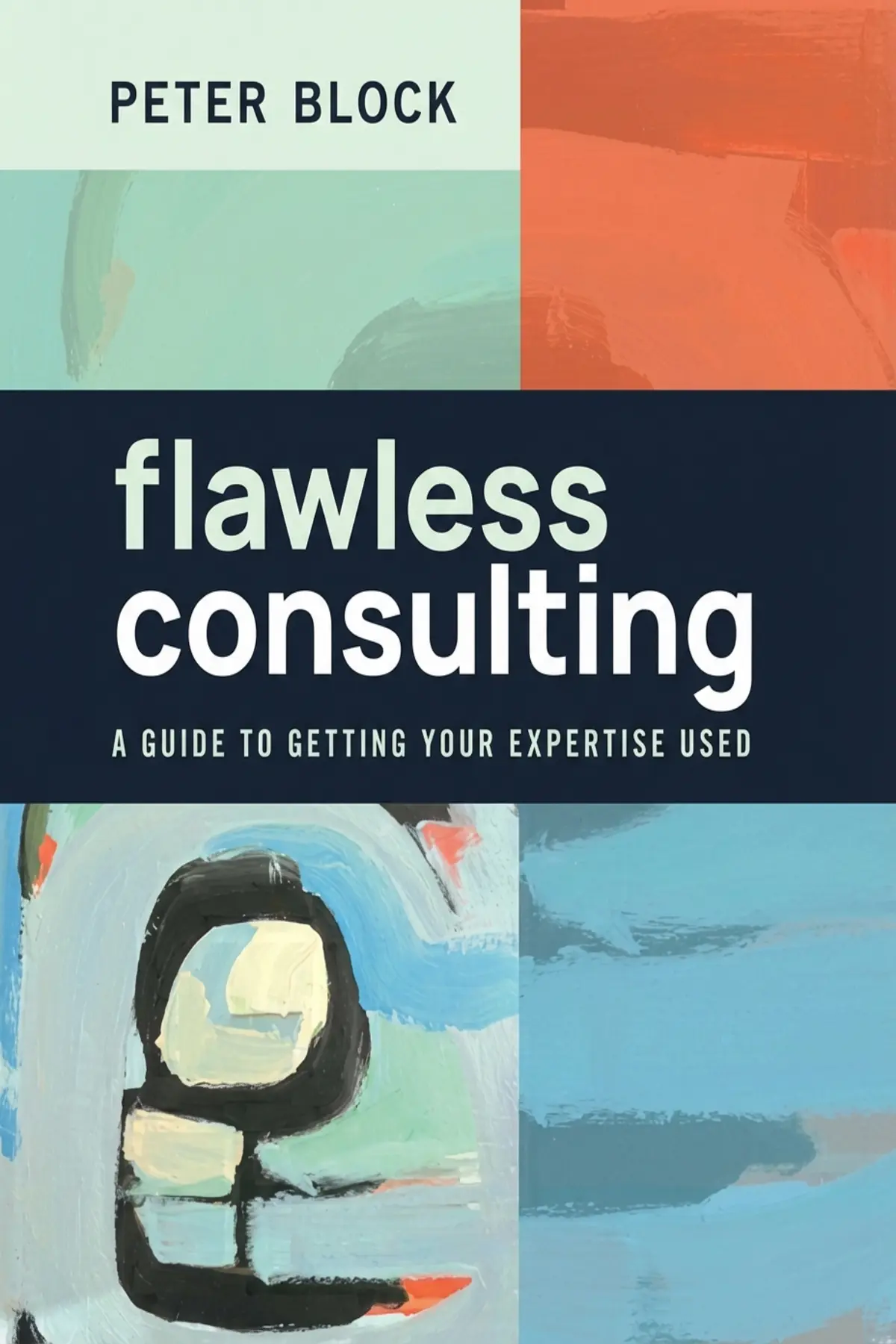
Table of Content
1. Introduction
1 min 03 sec
If you advise people for a living, as an outside expert or from inside a company, you have probably seen a sound recommendation end up forgotten in a drawer. Peter Block’s Flawless Consulting starts from a hard fact about the role: a consultant can advise and teach, but has no power to take over. So, in Block’s view, getting expertise used is never only a technical task. It depends just as much on the people who must act on it, on their feelings, their doubts and their trust in you.
The book’s argument comes down to one claim. Advice turns into change only when the consultant works through people as carefully as through data, from the first talk about expectations to the day the client can manage alone. Along the way, Block shows a retention problem blamed on housing prices that turned out to be about company culture. He explains how a question asked three times can signal a hidden objection, and why the best consultants leave clients who never need to call them back.
2. Diagnose the real problem, not the stated one
1 min 53 sec
A company losing its trainees was ready to build an apartment block for staff. The person it hired saw something else entirely, and the fix she found cost far less than new housing.
3. Read feelings as part of the evidence
1 min 42 sec
A hospital can buy the best database software available and still see nothing improve. The missing piece has nothing to do with terminals or training manuals, and it includes the consultant’s own gut reaction.
4. Earn a hearing by living your own advice
1 min 44 sec
A consultant arrives to preach a flatter, more open company, then answers a manager’s objection in a way that ends the conversation. The mistake is common, and it teaches the exact opposite of the advice.
5. Set expectations before you touch the data
1 min 41 sec
Clients often fear that an outsider will take over their company. The first conversation of a project can settle that fear, and the last one decides whether anyone actually adopts the solution.
6. Spot resistance and bring it into the open
1 min 44 sec
Resistance seldom says its name. It hides in a third repetition of the same question or a gaze that keeps drifting away, and one calm sentence can bring it to the surface.
7. Let people voice their fears to win support
1 min 43 sec
A flawless recommendation built on sound logic can still fail completely. Block traces the cause to something everyone has felt in a dark cinema, and the cure is a particular kind of meeting.
8. Leave behind a client who no longer needs you
1 min 38 sec
A top manager and a consultant friend produced a pile of clever but complicated ideas, and once the consultant left, nothing changed. The gap between those two outcomes reveals how Block measures a consultant’s real success.
9. Conclusion
1 min 14 sec
Block’s guide ends up being about a kind of humility. The consultant holds expertise but no authority, so the value of that expertise depends on what other people choose to do with it. Company A did not need an apartment block. It needed someone who would look past the stated cause to the people involved. The hospital did not need software alone. It needed doctors willing to change how they worked.
That makes the human side of consulting the main work, not a soft extra. It shows up in small, practical moves. Agree on expectations before you collect a single number. Treat your first gut reaction, and other people’s fears, as data worth testing. When the same question comes a third time, stop answering and ask what lies behind it. And judge every engagement by what the client can do once you have gone.
Whether you advise clients from outside or colleagues from a staff role, the measure Block offers is the same. Expertise counts when the people who own the problem understand it, believe in the answer and can carry it forward on their own. The best proof of a consultant’s work is a client who has no reason to call again.
About this book
What is this book about?
Anyone who advises others knows the frustration of a correct recommendation that nobody acts on. Peter Block starts from a simple fact about the role. A consultant can advise and teach, but has no authority to take over, so the value of any expertise depends on what the client's people choose to do with it. Block argues that consulting happens on two levels at once, the technical problem and the human relationships around it, and that ignoring the second makes the first impossible to solve. He follows an engagement through its stages, from agreeing on expectations to collecting data and holding feedback sessions. He shows how to spot resistance in repeated questions and averted eyes, and how to name it calmly so it can be discussed. He also explains why feelings, including the consultant's own first reactions, count as evidence. Readers get a practical way of working with clients and colleagues, with examples from a hospital adopting new software to a company that blamed housing prices for losing its trainees. Block also gives them a demanding test of success: whether the client can handle the next problem without calling them back.
Book Information
Who it's for
Consultants and internal advisers
Consultants and internal advisers whose sound recommendations keep stalling after delivery.
Specialists influencing without authority
Specialists in IT, HR, finance or training who must change how colleagues work without authority over them.
Soon hiring a consultant
Managers about to hire a consultant who want to get lasting value from the engagement.
About the Author
Peter Block
Peter Block, born in 1939, is a partner in Designed Learning, a company that runs workshops he built around the skills in his books. Besides Flawless Consulting, he wrote Stewardship, The Empowered Manager and The Answer to How Is Yes. The Organization Development Network gave him its Lifetime Achievement Award in 2008. He has also received the President's Award from the Association for Quality and Participation, and the American Society for Training and Development has recognized his contributions to workplace learning and performance.
Ratings & Reviews
Ratings at a glance

What people think
Listeners find this guide offers superior strategies for successful consulting. They value its significant influence; one listener highlights how deeply it connects with the audience, while another mentions its ability to get people aligned on purpose.
Top reviews
Tawee
Finally got around to reading this staple of the consulting world, and I’m genuinely surprised by how relevant it remains. Block hits on something most business books ignore: the human element of authenticity in professional relationships. His breakdown of the five phases—from entry to termination—provides a solid framework for anyone trying to exert influence without having formal authority. Truth is, the sections on discovery and dialogue really helped me see why my previous projects hit roadblocks when I tried to act as a surrogate for the client. I did find some of the language a bit dated, and it definitely feels like it was written for a corporate era that’s slowly fading. However, the core message about mutual commitment and symmetry in responsibility is timeless. If you can get past the somewhat dry, academic tone, there is a goldmine of wisdom here for anyone navigating complex organizational politics.
Show moreSomchai
Picked this up during a major career transition and it was exactly the confidence boost I needed to go solo. Transitioning from a steady job to being a 'person with no direct power' is terrifying, but this book helps you find your footing. The emphasis on being an authentic learner rather than an all-knowing teacher changed my entire approach to business development. I’ve used the checklists for every single proposal I’ve written in the last six months, and they have saved me from several 'bad' contracts. It’s true that the book is quite formal and reads a bit slowly, but the depth of insight is incomparable. It teaches you that the struggle itself is the solution, which is a powerful mindset shift for any professional. I wouldn't be where I am today without Peter Block’s guidance on how to stay true to my own worth. Highly recommended for anyone starting their own firm.
Show moreNan
Wow, Peter Block really understands the psychological tension that exists between a consultant and a client. This isn't just a book about business processes; it’s a book about the courage required to be honest in a corporate environment. I loved the idea of 'mining moments of tension for insight' instead of trying to smooth everything over immediately. It’s been incredibly helpful for getting my team aligned on our purpose rather than just focusing on the technical deliverables. The way he describes 'influence without power' is the most accurate description of my job I’ve ever read. While the book is definitely formal and structured like a textbook, the quality of the advice is top-tier. I particularly liked the focus on focusing on strengths rather than deficiencies during the discovery phase. It’s an essential read for anyone who wants to do meaningful work that actually lasts after the contract ends.
Show moreYothaka
As someone who works mostly with smaller startups, I struggled with how much this book caters to massive, slow-moving organizations. The methodologies are rigorous and the checklists at the end are incredibly useful for structuring a project, but the scale feels off for a tiny team. I found the 'contracting' phase to be the most valuable part because it forces you to define boundaries early on. Personally, I think the hardcover price is a bit steep for information that feels like it could be summarized in a long-form blog post. To be fair, though, the way Block explains how to handle client resistance is better than any other resource I’ve found. It teaches you to stop taking pushback personally and see it as a sign of progress instead. It’s a solid four-star read that just needs a bit of mental translation for the modern freelancer.
Show moreKai
The chapter on resistance alone makes this entire book worth the investment for any aspiring professional. Many consultants see a client's hesitation as a personal attack, but Block reframes it as a natural part of the learning adventure. I’ve been implementing the 'discovery and dialogue' techniques this week, and I’m already seeing a shift in how my stakeholders engage with the data. It’s not just about giving advice; it’s about aligning people on a shared purpose so they actually want to implement the solution. My only real gripe is the formal tone, which can make the reading experience feel a bit like sitting through a long lecture. You have to be patient with the text because the insights are packed tightly into every paragraph. It’s a foundational text that I’ll likely keep on my desk for the checklists and the contracting tips.
Show moreCharles
Look, this is basically a very high-quality textbook that probably costs more than it should. I appreciate the clear structure and the emphasis on building collaborative relationships, but the presentation is quite dry. For those of us who prefer a casual, modern business style, Block’s formal prose can be a bit of a hurdle. That said, the content is undeniable in its utility, especially when it comes to the technical vs. business elements of a problem. I found the sections on the 'decision to act' particularly enlightening because they highlight the social pressure inherent in organizational change. It’s a three-star experience in terms of readability, but a five-star resource for actual practice. If you are a coach or a leader, you'll find plenty to use here, provided you have the stamina to finish it. It’s a classic for a reason, even if it feels a bit old-school.
Show moreJonathan
Ever wonder why so many consulting projects end up sitting on a shelf gathering dust? Block argues it’s because the consultant fails to establish a truly collaborative relationship during the contracting phase. I’ve noticed that when I skip the steps outlined here, the client loses confidence almost immediately during the implementation. This book provides a roadmap to prevent that by focusing on authenticity and clearing away the 'taboo' topics that usually derail progress. While I found some of the concepts similar to Edgar Schein’s work, Block’s focus on the consultant’s own needs is a unique and necessary addition. The truth is, we often neglect our own requirements for information and control in an effort to please the client. It’s a very thorough guide, though perhaps a bit too long-winded for what it actually delivers. Still, the fieldbook companion is a must-buy if you want to put these theories into practice.
Show moreDream
Frankly, the content in the appendix is more valuable than half the actual chapters. I found myself skimming the middle sections of the book just to get back to the practical checklists and phase summaries. It's a very detailed look at how to influence organizations, but it feels like it takes the long way around to get to the point. The five phases of consulting are laid out well, but the language used to describe them is often overly academic. I did appreciate the focus on 'choosing learning over teaching,' as it’s a great way to build rapport with difficult clients. However, I’m not sure I agree with the idea that the responsibility is always exactly 50/50. Sometimes the client is just paying you to solve the problem, and they don't want to be 'coerced' into participation. It’s an interesting perspective, but I’m not totally sold on all of Block’s philosophies.
Show moreChamlong
To be fair, the price point of $60+ for a hardcover makes this a tough sell for most students or early-career consultants. You can find much of this information online for free, though it won't be as well-organized as it is here. I appreciated the sections on how to 'say no as often as you say yes,' which is a vital skill for maintaining your integrity. The book excels at helping you navigate the 'entry and contracting' phase, which is where most projects actually succeed or fail. But I found the writing style to be quite dull, and it often felt like I was reading the same advice repeated in different ways. It’s one of those books that functions better as a reference guide than as something you read cover-to-cover. Keep it on your shelf for the checklists, but don't expect a page-turner. It's useful, but definitely not flawless.
Show moreKae
Not what I expected given the glowing reputation this book has in MBA circles. Frankly, I felt like Block spent way too much time teaching consultants how to avoid accountability for actual results. The overarching philosophy seems to be that if a project fails, it’s because the client didn't 'participate' enough in the discovery phase. This strategy of distributing blame under the guise of 'symmetry' feels more like corporate survival than effective problem-solving. While I appreciate the focus on being authentic, it often comes across as a way to stall implementation rather than driving change. I also found the writing style incredibly dense and repetitive, making it a chore to get through certain chapters. Maybe it’s just me, but I prefer a more direct approach to consulting where the expert takes more ownership of the outcome. This book was so boring that I struggled to even finish the final chapters.
Show moreQuestions about this book
What is the main idea of Flawless Consulting?
Peter Block argues that a consultant can advise and teach but cannot take over, so expertise only gets used when people trust and adopt it. Consulting happens on two levels, the technical problem and the human relationships around it. Block shows how to work on both: set clear expectations, collect data thoroughly, bring fears and resistance into the open, and teach the client to solve future problems without outside help.
How does Peter Block suggest handling client resistance?
Block treats resistance as a natural reaction to change. He suggests answering a question twice in good faith and reading a third repetition as a sign of resistance, and watching for people who avoid eye contact. Then name it in neutral words, for example saying you sense doubt about your judgment and asking whether the client thinks your research fell short. Once the objection is spoken, you can explain how you reached your conclusions.
What are the stages of a consulting project in Flawless Consulting?
Block describes a sequence of stages. Contracting comes first, where consultant and client agree on scope and expectations, which also calms fears that the consultant will take control. Discovery and data collection follow, a thorough look at the business that may cover finances, communication or software use. The final stage brings feedback sessions that clear up doubts, plan next steps and win employees over to the solution.
Who should read Flawless Consulting?
It suits external consultants, but also internal specialists in areas like IT, HR or training who must influence colleagues without formal authority. Managers hiring a consultant will benefit too, since Block explains why handing a problem to an outsider and walking away teaches the company nothing. Anyone whose good ideas stall because people do not adopt them will find practical advice on trust, resistance and open discussion.
How can I apply Flawless Consulting in my work?
Start each project with an explicit conversation about scope and expectations. Note your first gut reaction and test it like any other data. Practice the behavior you recommend, since people learn by copying. Hold open meetings where those affected can voice concerns, then answer them, for example with a training plan. Finally, judge each engagement by what the client can now do without you.
Readers also enjoyed

A Bigger Prize: How We Can Do Better Than the Competition
Margaret Heffernan





A Year with Peter Drucker: 52 Weeks of Coaching for Leadership Effectiveness
Joseph A. Maciariello



Acting with Power: Why We Are More Powerful Than We Believe
Deborah Gruenfeld
AUDIO SUMMARY AVAILABLE
Listen to Flawless Consulting in 15 minutes
Get the key ideas from Flawless Consulting by Peter Block, plus 5,000+ more nonfiction titles.
- 5,000+ titles
- Listen as much as you want
- 7-day free trial
- Cancel anytime









