

A Thousand Brains: A New Theory of Intelligence
Jeff Hawkins
 English
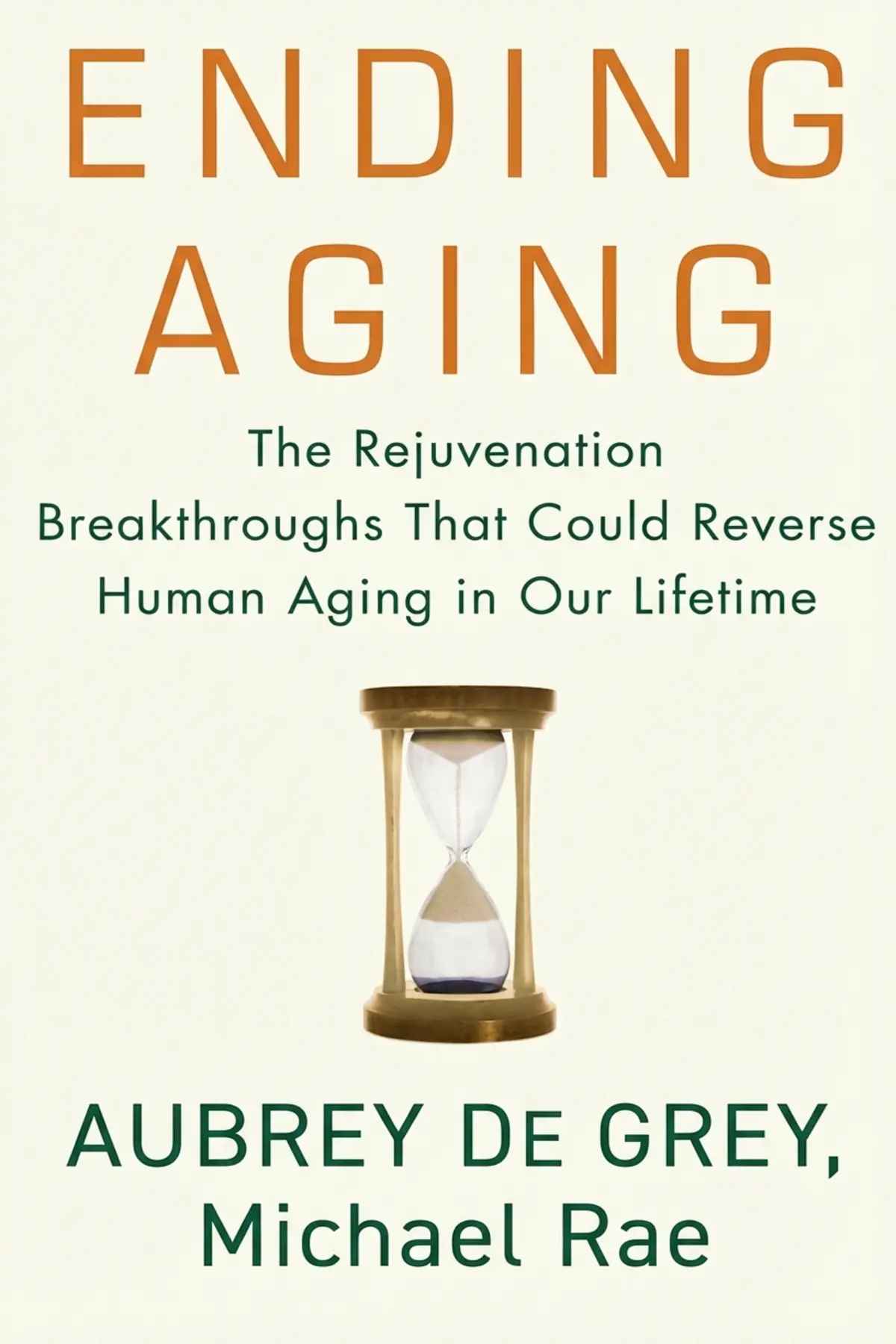
Shows aging as a set of specific kinds of bodily damage, from cell waste to failing mitochondria, and explains the repair therapies Aubrey de Grey believes could one day stop people dying of old age.
1 min 04 sec
Most people treat growing old as the one problem not worth working on, because nothing can be done about it. Aubrey de Grey and Michael Rae disagree. In Ending Aging they argue that aging is the slow buildup of damage in the body, and damage can be repaired.
De Grey, a biomedical gerontologist, has built that idea into a program called SENS, short for Strategies for Engineered Negligible Senescence. Its logic is a mechanic’s logic. Stop asking how to keep the body from wearing out, and start fixing each specific kind of wear, one at a time.
The book names those kinds of damage, from cellular power plants that pollute themselves to waste that cells cannot throw away, and pairs each with a proposed repair. Follow it through and the decline of a grandparent starts to look less like fate and more like a list of engineering problems, with an honest account of what still stands between that list and a cure.
1 min 50 sec
Thinning skin, slower steps and fading memory feel like fate rather than illness. One scientist thinks that feeling is the biggest obstacle of all, and he puts surprisingly specific odds on what happens if it changes.
1 min 56 sec
Slowing aging by half sounds like an enormous win. A simple calculation about one 40-year-old shows why it may be the weaker option, and why a different approach could do far more.
1 min 50 sec
Most of the free radicals that harm us are not in polluted air or bad food. They come from somewhere much closer, and the proposed fix involves moving a copy of something precious to safer ground.
1 min 53 sec
Cemeteries ought to glow at night, and the fact that they stay dark hides a clue. Following it leads to an unlikely ally in the fight against clogged arteries, and a vaccine aimed at the aging brain.
1 min 48 sec
The body’s best defense against runaway cancer might be to take away a gene every cell relies on. That sounds reckless, until you hear how the authors would refill the body afterward.
1 min 51 sec
The browning on a seared steak happens inside you too, and nobody has found a way to stop it. Add cells that refuse to die properly, and the case for cleaning up after the fact gets stronger.
1 min 42 sec
A teenager’s death in a 1999 trial froze an entire field for a year. The authors argue that the delay cost more than it saved, and they propose a small experiment with old mice to change minds.
1 min 11 sec
Ending Aging asks you to stop seeing old age as one vast, mysterious decline and to see it as a handful of specific injuries, each with a name and a proposed fix. Mitochondria get a protected backup of their genes. Lipofuscin meets the microbes that keep cemeteries dark. Amyloids get a vaccine, AGEs a drug, zombie cells a suicide gene, and cancer a telomere clock with stem cells to refill the body. None of it is finished. Funding is uncertain, one drug has already failed in people, and de Grey himself rates the outcome a coin toss.
What lasts is a way of looking. When you hear a promise about longevity, run the arithmetic of the 40-year-old and ask whether it slows damage or clears what has already piled up. When a risky treatment is debated, weigh the lives lost to delay alongside the lives lost to haste.
And the next time you watch someone you love grow older, you may see something other than fate: a body carrying damage that, in de Grey’s view, someone may one day learn to repair.
Almost everyone treats growing old as a fact of life. Skin thins, movement slows, memory fades, and there seems little point in fighting it. Aubrey de Grey and Michael Rae take the opposite view. Aging, they argue, is the steady buildup of damage in the body, and damage can be repaired. De Grey's program, called SENS (Strategies for Engineered Negligible Senescence), sorts that damage into types and proposes a fix for each. Mitochondria get a protected backup of their genes. Waste that cells cannot digest could be broken down with the help of soil microbes. A vaccine could clear protein clumps from around the brain, and drugs could break apart sugar-bound proteins. Gene therapy could remove toxic zombie cells, and cancer could be starved by putting cells on a clock, with stem cells restocking the body. The book explains why repairing damage beats slowing it, using a simple worked example that doubles a lifespan. It also lays out a mouse experiment meant to win over skeptics and makes a pointed argument about the lives lost to slow drug approvals. Readers get a clear map of the biology of aging and a new way to judge any longevity claim they hear.
Curious readers who assume aging is fixed and want the biology explained plainly.
Health-minded professionals who want a sharper way to judge longevity headlines and treatments.
Students and science fans drawn to medical research, gene therapy and the ethics of risk.
Aubrey de Grey is an English biomedical gerontologist. He co-founded the Methuselah Foundation and the SENS Research Foundation, serving as the latter's Chief Science Officer until 2021, and now leads the Longevity Escape Velocity Foundation as President and Chief Science Officer. He edits the journal Rejuvenation Research. Michael Rae, his former research assistant, has written for peer-reviewed journals and is a core scientific investigator on the Calorie Restriction Society's Cohort Study.

Listeners describe this work as being packed with information yet simple to digest, with one listener highlighting how it translates intricate ideas into accessible language. The material on repairing aging and eradicating diseases earns praise, and one listener characterizes it as an excellent discourse on the mechanics of growing old. Listeners value the book's authenticity, with one mentioning that it seldom departs from verified scientific data, finding the perspective both eye-opening and deeply hopeful. Both the creative approach and the narrative flow are well-regarded, with one listener calling the project an ambitious achievement.
Ever wonder if the 'inevitable' decline of old age is actually just a technical problem waiting for a solution? De Grey lays out a compelling case for why we should view aging as a series of repairable cellular damages. The book identifies seven specific categories—like mitochondrial mutations and intercellular junk—and offers a roadmap for 'Strategies for Engineered Negligible Senescence' (SENS). While the biological details are information-dense, the prose remains remarkably accessible for laypeople. It’s a refreshing departure from generic 'eat your greens' advice, focusing instead on real medical interventions. There is an undeniable sense of hope throughout these pages. Even if the timelines feel a bit over-optimistic, the intellectual framework for treating aging as a disease is groundbreaking.
Show moreAfter hearing Aubrey de Grey speak in a documentary, I had to see if the science in his book actually held up to scrutiny. Frankly, I was impressed by the level of detail regarding the seven types of aging damage. The book rarely strays from scientific claims into pure fantasy, grounding even its most 'sci-fi' ideas in existing biochemical pathways. I particularly appreciated the section on 'death-defying' cells and how they contribute to systemic decline. The writing is creative and the arguments are logically sound, even if they are bold. It provides a much-needed sense of agency in the face of what most people consider an unavoidable fate. Truly a superb treatise on the biology of our future.
Show morePicked this up on a whim and ended up staying up until 2 AM finishing the section on extracellular junk and protein cross-linking. The way the authors synthesize the biological causes of Alzheimer’s and other age-related diseases is nothing short of brilliant. It’s more than just a science book; it’s a rallying cry for a new era of human health. I loved the 'maintenance' approach—treating the human body like a classic car that just needs the right spare parts and cleaning to keep running. The book is incredibly information-dense, but the pacing keeps you engaged from start to finish. It’s one of the few books that actually changed the way I think about my own mortality.
Show moreFinally got around to reading this classic and I’m struck by how much of today's biotech landscape was predicted right here in these pages. Aubrey de Grey might be a polarizing figure, but his vision for fixing aging is undeniably creative and rigorous. The book does an excellent job of explaining how we can potentially use enzymes to break down 'junk' that our bodies can't naturally clear. It’s a superb treatise that balances scientific claims with a visionary outlook on curing diseases. While it functions as a fundraiser for his foundation, the information provided is valuable regardless of your stance on his organization. If you want a deep dive into the actual mechanics of rejuvenation, this is the book.
Show moreThis is an incredibly ambitious work that manages to bridge the gap between high-level molecular biology and the average reader's curiosity. Aubrey de Grey doesn't just theorize; he provides a rigorous scientific treatise on why we age and how we might stop it. I found the distinction between preventative and rejuvenating medicine to be particularly enlightening. However, I have to agree with other reviewers that the author’s ego occasionally bleeds through the text, which can be distracting. He often positions himself as the sole visionary in a field of short-sighted peers. If you can look past the slight arrogance, you’re left with a brilliant analysis of cellular atrophy and lysosome overload. It’s a foundational read for anyone interested in the future of human longevity.
Show moreThe chapter on mitochondrial DNA mutations was a total eye-opener for me, even though I don't have a background in gerontology. De Grey has a unique talent for explaining complex concepts in understandable terms without stripping away the necessary nuance. He walks you through how mutations in the 'powerhouse of the cell' lead to free-radical production and eventually systemic failure. It’s fascinating to see a scientist tackle the problem of death with the mindset of an engineer looking at a broken machine. Got to say, the SENS framework makes a lot more sense than the traditional 'geriatric' approach of just treating symptoms. It’s an ambitious work that gives you a lot of hope for what’s possible in medicine.
Show moreAs someone who has followed the longevity field for years, I find this to be the definitive foundational text, despite its age. The moral argument alone makes it worth the price of admission. De Grey convincingly argues that allowing aging to continue is a choice we make every day we don't fund research. The technical chapters on lysosome overload and cell loss are heavy but rewarding if you take your time with them. To be fair, the book is quite verbose and could have benefited from a tighter edit in the later chapters. However, the core message remains as relevant today as it was a decade ago. It’s a must-read for anyone who wants to understand the 'why' behind modern rejuvenation biotechnology.
Show moreTo be fair, de Grey’s writing style can be a bit arrogant at times, but the core logic behind his engineering approach to biology is hard to ignore. He breaks down the terrifying complexity of aging into seven manageable 'engineering projects.' This reductionist view is actually quite comforting because it suggests that the problem is finite and solvable. I was especially interested in the discussion on cancer and 'death-avoiding cells,' which provided a much clearer picture of oncogenesis than I’ve found elsewhere. Not gonna lie, some of the biochemical jargon went over my head, but the overall thesis is clear. It’s an enlightening read that challenges the deep-seated assumption that aging is a natural necessity.
Show moreNot what I expected from a book about longevity, as it reads much more like a dense textbook than a lifestyle guide. Personally, I found the deep dives into mitochondrial DNA and protein cross-linking to be a bit overwhelming at times. It is definitely not a light read. The book spends a lot of time on the technical 'how' of laboratory research rather than practical steps you can take today. While the moral argument for ending aging is powerful, the pace drags in the middle sections where the chemistry gets extremely granular. Truth is, it feels a bit dated now, especially since many of his 15-year predictions haven't quite materialized. It’s interesting as a historical document of the movement, but be prepared for some heavy lifting.
Show moreLook, I wanted to believe in the dream of living forever, but this feels more like a high-stakes pitch for a research foundation than an objective scientific text. While the breakdown of aging into categories like extracellular junk is interesting, the author’s dismissive attitude toward the rest of the scientific community is a major red flag. He spends a significant amount of time defending his own theories while labeling any disagreement as 'political' or 'short-sighted.' In my experience, when a book's primary conclusion is 'donate to my foundation so I can prove I'm right,' you should proceed with caution. The science is highly speculative and borders on pseudo-scientific at points, making it hard to take the more practical insights seriously.
Show moreAubrey de Grey and Michael Rae argue that aging is not an unavoidable process but the buildup of specific kinds of damage in the body. Since damage can in principle be repaired, de Grey’s SENS program proposes a fix for each type, from mitochondrial mutations to cell waste and zombie cells. With enough funding, he puts the chance at 50 percent that people could stop dying of old age.
Prevention requires knowing every cause, and aging has too many tangled causes. His example is a 40-year-old expected to live to 80. Halving the speed of aging gets that person to 120, only a third more total life. Halving the damage already accumulated, repeatedly, could raise remaining life four or five times, roughly doubling lifespan to about 160.
Cancer comes from damaged DNA copied through uncontrolled cell division. De Grey proposes removing the telomerase gene, which rebuilds the protective caps at the ends of chromosomes. Without it, dangerous cells would wear out their caps and die after enough divisions. Because every cell would then have an expiration date, he would pair this with stem cell therapy to restock the body.
A waste product called lipofuscin builds up in cells until death and is fluorescent, so graveyards should glow. They don’t, which means something breaks it down. De Grey identifies soil microbes that turn lipofuscin into usable material, and suggests bringing them into the body so cells could clear junk they currently cannot, despite hurdles still to overcome.
The book offers ways of judging rather than a daily routine. When you read a longevity claim, ask whether it slows new damage or clears damage already built up, since de Grey’s math favors clearing. When a failed drug makes news, separate the treatment from the idea behind it. And when risky research is debated, weigh the cost of delay alongside the cost of acting.
Jeff Hawkins




Lisa Kaltenegger




AUDIO SUMMARY AVAILABLE
Get the key ideas from Ending Aging by Aubrey de Grey, plus 5,000+ more nonfiction titles.









