

13 min 52 sec
Available in: English
Economical Writing: Thirty-Five Rules for Clear and Persuasive Prose
A practical guide to clear, persuasive prose for work or study: start drafts early, write for a real reader, choose concrete words and active verbs, and keep punctuation simple.
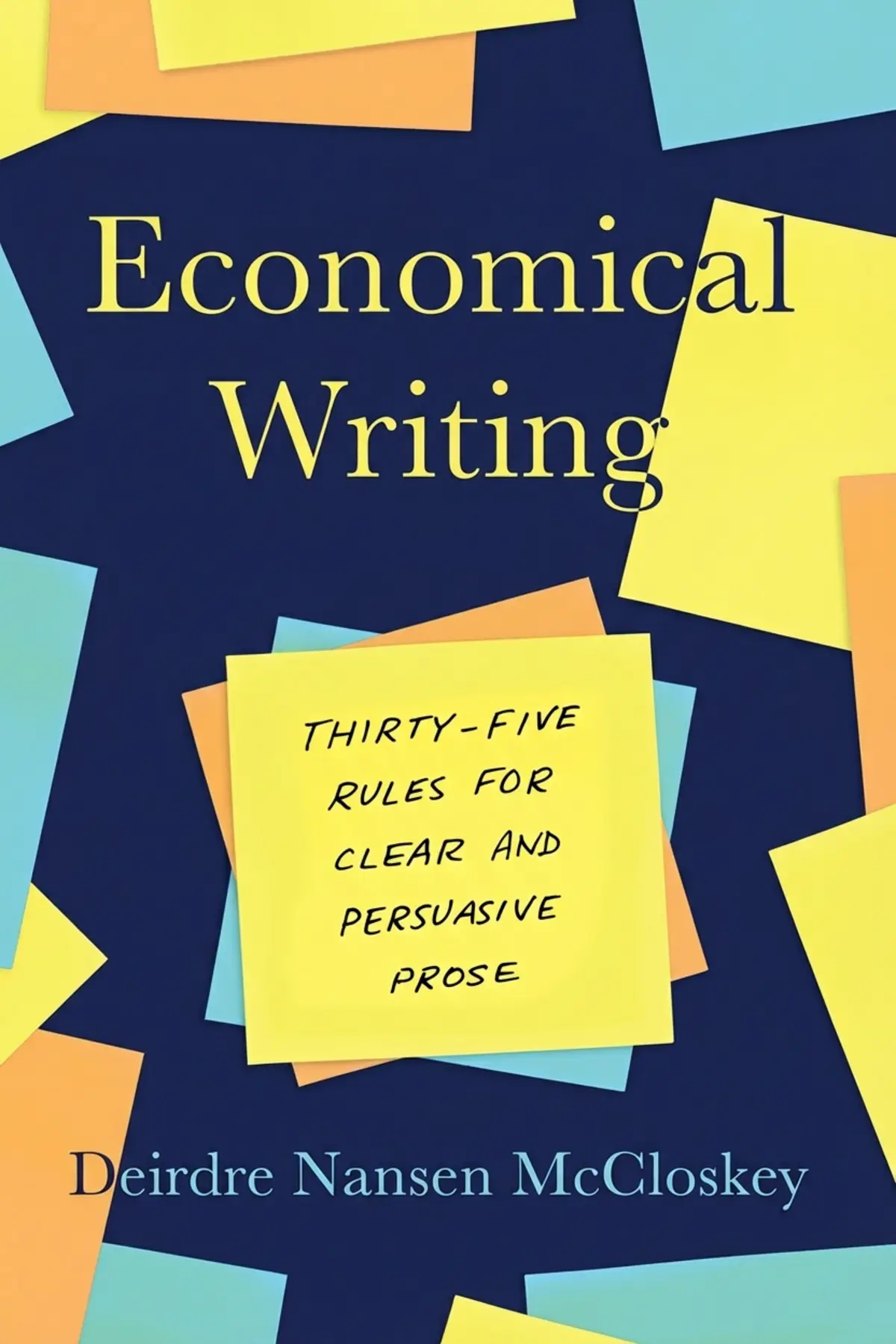
Table of Content
1. Introduction
1 min 01 sec
Most professionals write every day, yet few were ever taught how, and their reports and papers pay for it by being skimmed or set aside. In Economical Writing, Deirdre Nansen McCloskey, who taught economics, history, English and communication, makes a claim that changes how the problem looks: writing is not the packaging for your thinking, it is where the thinking happens.
Her book began as advice for young professionals and grew into principles for anyone who writes, in any field. Its throughline is simple. Clear writing is a craft you can learn, much like mathematics, and every choice you make, from when you start a draft to where you put a semicolon, either helps the reader follow your mind or makes them stumble.
Each idea here targets one of those choices. By the end you will have a short set of tests to run on your next email, report or paper, from swapping an abstract phrase for sheep and wheat to reading the draft out loud.
2. Treat writing as thinking you can train
2 min 05 sec
A child’s innocent question about homework exposes something many professionals learn too late. It also hints at why Galileo and Keynes won arguments, and why a stubborn paragraph is telling you something about your idea.
3. Start the draft before you feel ready
1 min 45 sec
Waiting until the research is finished feels responsible. McCloskey thinks it is exactly what keeps the blank page winning, and she has a different reading of the moment when the next sentence simply will not come.
4. Sound like a person talking to your reader
1 min 49 sec
A report can be correct in every detail and still push its readers away. The cause can be hard to spot on the page, and one check McCloskey recommends takes only your own voice.
5. Keep one name for each idea
2 min 02 sec
Swapping in a new word just to avoid repeating one can feel sophisticated. McCloskey thinks that lesson does real damage to clarity, and she reaches back to the ancient art of persuasive speech for a better way to build a piece.
6. Trade vague nouns for sheep and wheat
2 min 05 sec
Some sentences make readers stop and decode them, even when every word is correct. A single example from economics shows how much life an abstract phrase drains out of prose, and what to put in its place.
7. Punctuation that guides your reader's eye
1 min 57 sec
A semicolon, a stray pair of quotation marks, even the shape of a page margin all send messages about the writer. Some of those messages undercut your authority before the reader has weighed a single argument.
8. Conclusion
1 min 08 sec
What McCloskey offers, in the end, is a form of respect: for your own ideas and for the person reading them. A muddy sentence usually hides a muddy thought, and clearing one clears the other. That is why she can place something as small as a misplaced modifier and something as large as the influence of Keynes inside the same craft. Good prose is thinking done carefully, where someone else can watch.
The practice can begin with whatever you write next. Open a rough draft on the first day of a project and let its gaps tell you what to research. Before sending anything that matters, read it aloud and change whatever you would not say to the reader’s face. In each paragraph, find one abstract noun and replace it with the thing it stands for, the way sheep and wheat replace a phrase about resource-oriented exports.
None of this requires talent you lack. It asks for the same patient practice that makes someone better at mathematics. The child was right that the homework never ends. McCloskey’s reply is that it can get a little better every time you sit down to do it.
About this book
What is this book about?
Most professionals write every day, yet few were ever taught how. Reports get skimmed, papers get rejected, and the ideas inside them never get a fair hearing. Deirdre Nansen McCloskey argues that this is a thinking problem as much as a style problem. The way an idea is expressed shapes what it means and how far it travels. Economical Writing began as advice for young professionals and grew into principles for anyone who writes, in any field. McCloskey treats writing like mathematics: a tool for thinking that anyone can improve with practice. She tells writers to begin a draft before their research feels finished, to picture a real reader and sound like a good conversation, and to keep one term for each idea. She also wants concrete words over abstractions and jargon, active verbs over passive ones, and a light touch with semicolons, dashes, italics and acronyms. Readers get a short set of tests they can run on any email, report or paper, from reading a draft out loud to replacing a vague phrase with something a reader can picture, like sheep and wheat.
Book Information
Who it's for
New professionals and students
Students and early-career professionals whose reports and papers keep coming back marked unclear.
Specialists writing for outsiders
Analysts, economists and researchers who lean on jargon and want readers outside their field to follow them.
Daily writers in management
Managers who write every day and want a short set of revision tests they can actually use.
About the Author
Deirdre Nansen McCloskey
Deirdre Nansen McCloskey, born in 1942, taught at the University of Illinois at Chicago from 2000 to 2015, holding posts in economics, history, English and communication. She has also taught as a visitor at the University of Gothenburg, the University of the Free State and Erasmus University Rotterdam. She has led the Social Science History Association and the Economic History Association and co-founded the Cliometrics Society. Her research covers the rhetoric of economics, the misuse of statistical significance and the history and philosophy of liberalism, and her books include The Rhetoric of Economics, Crossing and Bourgeois Equality.
Ratings & Reviews
Ratings at a glance
What people think
Listeners find the book remarkably helpful, and one listener labels it a necessary desk reference. They also value its easy readability and brisk pacing. However, the standard of the writing itself draws varied reactions.
Top reviews
Ladawan
Finally got around to reading McCloskey’s classic, and it’s essentially the Strunk and White for anyone dealing with data. The core message that writing is an instrument of thought—not just a way to record it—hit me like a ton of bricks. If you cannot express your economic argument clearly, you probably don't understand the underlying math as well as you think you do. It’s a slim volume, yet it packs 35 rules that slash through the dense, jargon-heavy fog of typical academic prose. I especially appreciated the push to avoid 'elegant variation' and the reminder to write so you cannot be misunderstood. Keeping this as a permanent desk reference from now on.
Show moreRose
As someone who spends hours every day drafting reports, this book is a revelation. The truth is that most of us are taught to write 'academically,' which usually just means writing badly to sound smart. McCloskey flips the script. She emphasizes that good writing requires honesty and brutal self-criticism. The idea that style and content are inseparable is a game-changer. I’ve started applying the rule of 'heavy revision' to my weekly memos, and the difference in how my team responds is palpable. It isn't just a book for economists; it’s a book for anyone who wants their ideas to actually land. Highly recommended.
Show moreNang
This book changed how I view my keyboard. McCloskey manages to turn the chore of editing into a creative challenge. The 35 rules for clear and persuasive prose are presented with a touch of humor that makes the medicine go down easily. I particularly liked the focus on 'invention' and 'arrangement'—concepts from classical rhetoric that we’ve sadly lost in modern education. Writing is thinking, and this book provides the whetstone to sharpen those thoughts. It’s tiny enough to fit in a laptop bag, and you should keep it there. Every page is a reminder that being understood is a professional duty.
Show moreSienna
Ever wonder why most economic papers are so agonizing to get through? McCloskey identifies the disease: a lack of care for the reader. This book is the cure. By focusing on 'Economical Writing,' she shows us how to strip away the fluff that hides our best ideas. I loved the section on why we shouldn't use initials for everything—it’s like an alphabet soup out there! The pacing of the book is excellent, and the short chapters make it easy to digest one rule at a time. Whether you're an undergrad or a tenured professor, your prose will improve after reading this. It’s a gem.
Show moreLars
Short, punchy, and surprisingly funny for what is ostensibly a manual for social scientists. McCloskey has a gift for simple readability, making complex rhetorical concepts accessible to those of us who haven't touched a liberal arts syllabus in a decade. I loved the chapters on avoiding the passive voice and the 'Latinate' plague that infects so much business writing. To be fair, she does get a bit 'preachy' toward the end, but the pacing is so quick that you’re through the annoying bits before they can truly grate on your nerves. It’s a solid, practical guide for sharpening your professional voice.
Show moreGai
Look, I appreciate the push for clarity, but the section on 'folk economics' really jumped off the rails for me. Sneering at words like 'skyrocketing' or 'just' seems like an attempt to strip the humanity out of the discipline under the guise of being 'scientific.' However, if you ignore the weirdly aggressive stance on common metaphors, the actual writing advice is gold. The 31 short chapters move at a lightning pace. She forces you to confront your own laziness, particularly when it comes to overusing acronyms and initials. It is an effective, albeit opinionated, toolkit for anyone looking to stop boring their readers to death.
Show moreAkosua
To be fair, I initially picked this up just because it was a required text for my graduate seminar. I expected a dry list of 'thou shalt nots,' but I found a witty, sharp, and deeply useful companion. The advice to 'visualize your target audience' sounds basic, yet so few people actually do it. My only real gripe is that as a non-native English speaker, some of the very specific linguistic prohibitions don't translate well to how we communicate in international contexts. Still, the underlying principles of brevity and precision are universal. It is easily the most readable book on writing I've encountered in years.
Show moreFord
Why did no one tell me that writing advice could be this snarky? McCloskey's disdain for the way modern economists write is palpable, and frankly, it's hilarious. She takes aim at the 'sesquipedalian' vocabulary—five-dollar words used to mask two-cent ideas—and hits the bullseye every time. While I think her total ban on Latinate words is a bridge too far for technical papers, her point about clarity is undeniable. The book is short enough to read in a single sitting, but you’ll want to go back to it every time you start a new project. A must-have for the social science shelf.
Show moreManika
Is it a bit ironic that a book about prose style occasionally feels like a lecture from a very grumpy relative? While the focus on clarity is noble, McCloskey’s rigid stance on certain things feels increasingly dated in the digital age. For instance, the demand that we write out numbers as words regardless of complexity is just bizarre to a modern reader. And don't get me started on the advice regarding spacing; suggesting two spaces after a comma feels like a barbaric relic of the typewriter era. There are certainly gems here about revision and knowing your audience, but you have to sift through a lot of curmudgeonly posturing to find them.
Show moreBunyarit
Frankly, the irony here is thick enough to cut with a knife. For a book titled 'Economical Writing,' it spends a surprising amount of time on repetitive anecdotes and sneering at 'millennial' habits. I agree that passive voice is a problem, and yes, we should all revise more. But do we really need a lecture on why 'skyrocketing' is a bad word while the author uses endless scare quotes? The advice is often contradictory. One page tells you to be brief, and the next is a rambling story about 19th-century historians. It’s useful, but it’s definitely not the masterpiece some of my professors claimed it was.
Show moreQuestions about this book
What is the main idea of Economical Writing by Deirdre McCloskey?
McCloskey argues that writing is a form of thinking and a learnable craft, much like mathematics. Clear expression forces you to examine what you believe, and the way an idea is written shapes how far it travels, as with Galileo and Keynes. She then gives practical principles: draft early, write for a real reader, keep terms consistent, prefer concrete words and active verbs, and use punctuation with restraint.
Who should read Economical Writing?
It began as advice for young professionals, but McCloskey’s principles apply to anyone who writes in any discipline. It suits students who received little writing instruction, academics under pressure to publish, and people in business or government whose reports must be understood quickly. Writers who rely on jargon or abstract phrasing will find especially direct help in her advice on concrete language.
What is elegant variation and why does McCloskey warn against it?
Elegant variation is the habit of using different words for the same concept just to avoid repeating yourself. It can look sophisticated, but McCloskey argues it confuses readers, who start to wonder whether each new word names a different thing. She recommends keeping one term for one idea, and she notes that repeating key words actually helps link sentences into a coherent argument.
How can I apply Economical Writing to my own work?
Start a rough draft early, before your research feels complete, and let its gaps guide what you research next. Picture your reader and aim for the tone of a good conversation. Read the draft out loud to catch awkward phrasing. Turn passive sentences active, replace abstract terms with concrete ones, such as sheep and wheat, and cut unnecessary emphasis marks and acronyms.
What does McCloskey say about punctuation?
She treats punctuation as part of meaning. She favors the Oxford comma because it keeps lists unambiguous. Two closely related complete statements can be joined with a semicolon, while a colon sets up an explanation, a list or an illustration. Dashes, parentheses and quotation marks should be used sparingly, and leaning on italics or quotation marks for emphasis can make writing seem to lack confidence.
Readers also enjoyed







AUDIO SUMMARY AVAILABLE
Listen to Economical Writing in 15 minutes
Get the key ideas from Economical Writing by Deirdre Nansen McCloskey, plus 5,000+ more nonfiction titles.
- 5,000+ titles
- Listen as much as you want
- 7-day free trial
- Cancel anytime









