

14 min 32 sec
Available in: English
Driven: How Human Nature Shapes Our Choices
Explains the four ancient drives behind human choices, to acquire, bond, learn and defend, and shows how naming them leads to wiser decisions, healthier teams and products customers return to.
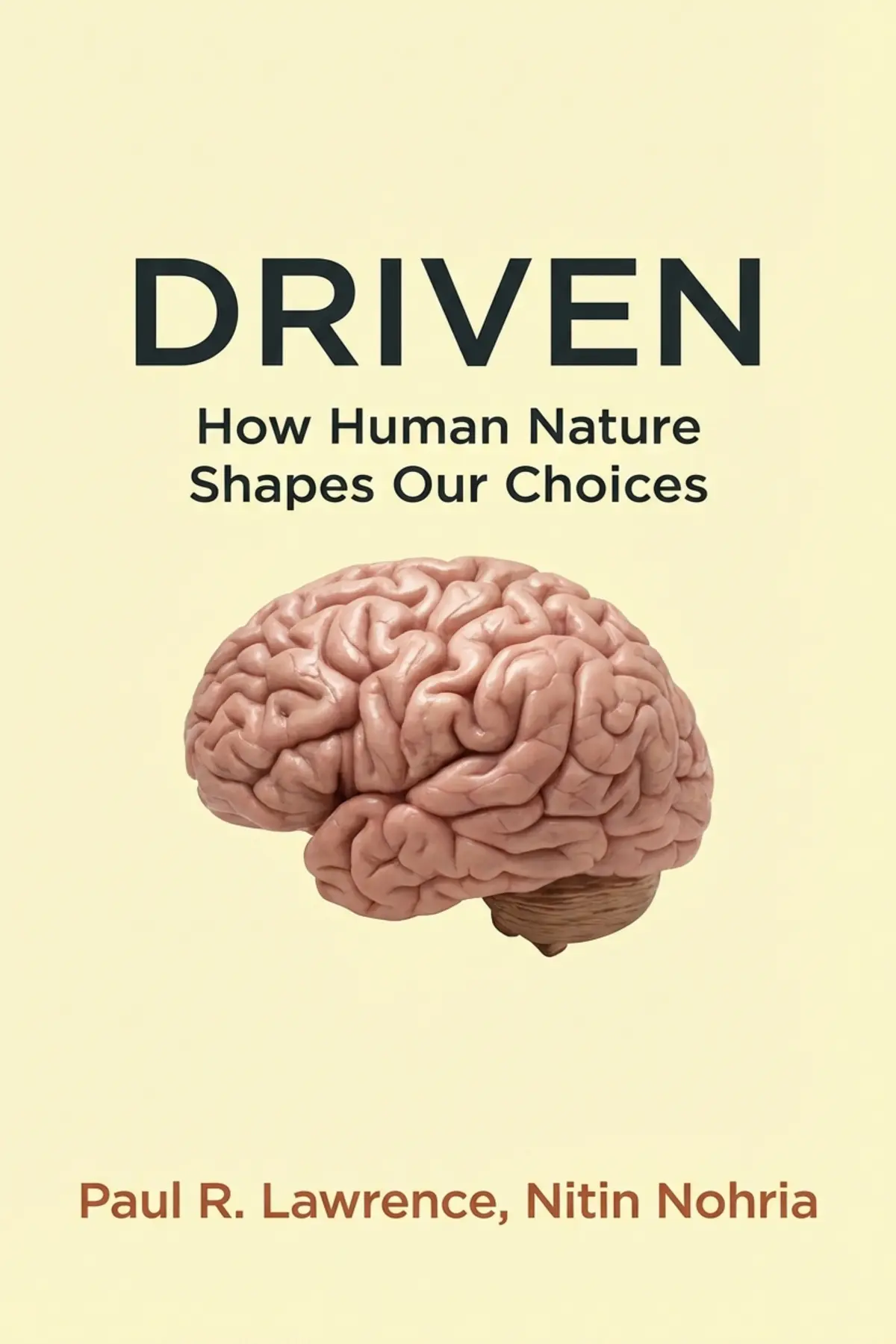
Table of Content
1. Introduction
1 min 10 sec
Most of us explain our choices after the fact, and the explanation rarely matches what actually moved us. In Driven, Harvard Business School professors Paul R. Lawrence and Nitin Nohria argue that four drives inherited from our earliest ancestors sit underneath nearly every decision: to acquire, to bond, to learn and to defend. Those drives were tuned for foraging and escaping saber-tooth tigers, which is why they push us toward odd behavior in an office or a shop.
Turning down free money, finishing a bag of chips you know is unhealthy, standing up to a bully who goes after a friend: each traces back to one of the four. The authors’ case is that once you can name the drive that is firing, your own choices become easier to steer, and a team or a product can be built to satisfy people instead of frustrating them. Along the way comes a ten-dollar experiment that exposes our taste for fairness, and a plain test for any workplace or product: does it feed all four drives?
2. Meet the four drives behind every decision
1 min 48 sec
For ages, early humans used the same simple weapons with barely any change. Then, in a relatively short span, everything sped up. Scientists still argue about the cause, and the authors’ answer reaches into your choices today.
3. Catch the gap between feeling and action
1 min 42 sec
Between spotting something you want and reaching for your wallet, your brain runs a fixed sequence. One step in that sequence is where judgment can still step in, if you know it is there.
4. Spot the hunger to have more than others
1 min 47 sec
People offered free money will often refuse it, leaving with nothing at all. A simple experiment with ten dollars shows what they were protecting, and it changes how you should propose any split of rewards.
5. Use belonging without creating rival camps
1 min 46 sec
The same instinct that makes a team feel like family can turn it against the team next door. It can also leave a manager stuck between the budget and a person they genuinely like.
6. Turn curiosity into work people enjoy
1 min 44 sec
A friend’s magic trick can bother you for days until you learn how it works. That small itch is the same force that makes some jobs absorbing and leaves others draining the life out of people.
7. Keep the defensive instinct from becoming conflict
1 min 55 sec
The urge to fight or flee was the first of the drives to emerge, and war can look like its natural result. The authors argue the real trigger usually sits somewhere else, which points to a more hopeful way out.
8. Design a team and product that feed all four
1 min 35 sec
A smartphone company can provoke a customer’s drive to defend by selling a phone that fails, and work groups that grow too divided can start competing with each other. Both failures trace back to the same overlooked question about what people need.
9. Conclusion
1 min 05 sec
Lawrence and Nohria offer a small set of tools with a long reach. The same four urges that helped bands of early humans outlast the saber-tooth tiger now shape a refused ten-dollar offer, a manager’s hard choice about a well-liked employee and a customer’s anger at a phone that fails. Nothing in modern life has replaced them. We simply meet them in new settings.
That gives you a way to read people, starting with yourself. When a decision feels hard, pause between the feeling and the act and ask which drive is speaking, and whether another one disagrees. When a colleague rejects a deal that seems fair to you, check whether it looks fair from their side. When a team loses energy, ask whether its work still teaches anyone anything and whether people feel part of something larger than their own group. And when something you built disappoints the people it was meant for, look for the drive it left hungry.
The authors’ closing idea fits in a single line: satisfy people’s drives, and you satisfy the people.
About this book
What is this book about?
People often act in ways that make no sense on paper. They turn down free money, finish snacks they didn't want and confront a bully on a friend's behalf. Paul R. Lawrence and Nitin Nohria, both of Harvard Business School, argue that these choices follow a clear pattern. Underneath them sit four drives our ancestors developed during the Great Leap, the period tens of thousands of years ago when human life suddenly grew more complex. These four are acquiring, bonding, learning and defending, each a separate drive. Each one produces its own emotions, and the drives sometimes pull against each other, as when a manager must choose between saving money and keeping a well-liked employee. The authors trace how something we perceive becomes a feeling, then a decision, then an action, and they show where the drives can turn harmful, from needing more than others to us-versus-them thinking to war. The payoff is practical. Readers get a map for reading their own motives and a simple design test for workplaces and products: does this feed all four drives, or does it leave one starved?
Book Information
Who it's for
Managers wanting engaged teams
Managers and team leads who want staff to stay engaged and stop forming rival camps.
Founders and product builders
Founders and product people trying to understand why customers return or walk away.
Professionals curious about themselves
Curious professionals puzzled by their own impulse buys, grudges and hard choices.
About the Author
Paul R. Lawrence
Paul R. Lawrence (1922 to 2011) was an American sociologist and consultant and a professor of organizational behavior at Harvard Business School, known for his work with Jay W. Lorsch on differentiation and integration in complex organizations. Nitin Nohria is a professor at Harvard Business School. Together they drew on two centuries of biological and social science to propose a unified theory of human nature, grounded in how people behave at work.
Ratings & Reviews
Ratings at a glance
What people think
Listeners find the book offers a cohesive framework for human motivation and is quite fascinating.
Top reviews
Ingrid
Finally got around to reading this staple of motivation theory, and it didn't disappoint. Lawrence and Nohria manage to take complex evolutionary biology and distill it into something actually useful for the modern world. The four drives—to acquire, bond, learn, and defend—provide a really elegant framework for understanding why we make certain choices. Truth be told, I found the section on the 'Drive to Bond' particularly poignant given how disconnected society feels today. It’s not just another business book; it’s a deep dive into the biological hard-wiring that dictates our professional and personal success. While it leans a bit heavily on the academic side occasionally, the insights are well worth the effort.
Show moreWoramet
The chapter on the Drive to Defend really hit home for me. It explains so much about why change is so difficult in large organizations and why people get so defensive over their beliefs. Lawrence and Nohria write with an appreciation for the complexity of human nature that you don't often see in business literature. I found their critique of the 'rational self-interest' model to be spot on. We are much more than just calculating machines. The book does a stellar job of showing how these drives evolved to help our ancestors survive. Not gonna lie, it's a bit of a slog through the neurology parts, but hang in there. It’s a brilliant synthesis of disparate fields into one cohesive narrative.
Show moreBoy
Wow, what an insightful journey into the mechanics of the human spirit! This isn't your typical self-help fluff; it's a rigorous exploration of what makes us tick. I found the concept of 'group selection' particularly fascinating, especially the idea that altruism might be a biologically advantageous trait. The book does an amazing job of explaining how our rational minds are often just trying to mediate between these powerful subconscious drives. It’s an empowering read because it helps you recognize your own patterns. Some might find it a bit long-winded, but the depth of research is impressive. If you want a deep, meaningful understanding of human motivation, this is the book for you.
Show moreNattapong
As a manager trying to get the best out of my team, I found this perspective incredibly refreshing. Instead of the usual carrot-and-stick approach, the authors argue that we need to satisfy all four fundamental human drives simultaneously. The breakdown of the 'Drive to Defend' was an eye-opener for me regarding workplace culture and psychological safety. My only gripe is that it can feel a little repetitive in the middle chapters. They really want to make sure you get the point, perhaps a bit too much. Still, the unified theory presented here is far more substantial than most leadership manuals you'll find at the airport. It's grounded in real science, even if the application to corporate life feels a bit speculative at times.
Show moreClaire
Ever wonder why humans are so obsessed with status or why we feel the need to belong to a tribe? This book offers a fascinating look at the biological roots of our behavior. I loved the way it synthesized neurology with economics. The idea that we aren't just rational actors but are balancing competing emotional drives is a game-changer. It makes sense of the 'irrational' choices we see every day. Frankly, I think every policy maker should read the final chapters on society and human nature. It gives you a lens to view global conflicts and social shifts through. It’s a dense read, sure, but the 'Aha!' moments are frequent enough to keep you turning the pages.
Show moreYulia
After hearing about this book for years, I finally dug in and I'm glad I did. It provides a much-needed bridge between the 'black box' of the human brain and the tangible world of management. The authors’ HBS background shines through in the way they apply biological concepts to the workplace. It's an ambitious project to try and create a unified theory of motivation, and for the most part, they succeed. Look, it’s definitely scholarly, so don’t expect a light weekend read. Some of the reasoning feels a bit circular, especially when they discuss natural selection, but the overarching framework is incredibly persuasive. It has certainly changed the way I look at my own motivations and those of the people around me.
Show moreSomchai
To be fair, I went into this expecting a dry textbook and was pleasantly surprised by how engaging it was. The prose is clear and the authors have a genuine passion for the subject matter. I particularly enjoyed the discussion on how the 'Drive to Bond' has changed in affluent nations. It’s a big question that doesn’t have easy answers, but they tackle it head-on. My main criticism is that the 'Drive to Acquire' section felt a bit repetitive. We get it, humans like stuff! But overall, the way they interweave neurology and history is quite masterful. It’s an excellent resource for anyone interested in the 'why' behind human action.
Show moreSurasit
This book is a bit of a mixed bag for me. On one hand, the four-drive model is a great mental shorthand for understanding motivation. On the other hand, the authors really lean into the 'Drive to Learn' to explain away things that don't fit their model. It feels a little like they decided on the number four and then forced the world to fit into it. To be fair, the examples involving companies like HP and GM were interesting, but they felt a little dated. I appreciated the effort to link brain modules to behavior, yet I’m not entirely convinced by their evolutionary logic. It’s a solid three-star read that offers some good dinner-party conversation fodder but maybe not a life-changing epiphany.
Show moreWipada
While the premise is intriguing, I can’t help but feel this book is a bit of a 'just-so' story. The authors are incredibly smart, but they seem to be working backward from their conclusions. It’s a very Harvard-centric view of the world where everything fits into neat little boxes. That said, the four drives—Acquire, Bond, Learn, Defend—are a useful way to categorize behavior, even if the underlying science feels a bit thin at times. It’s a decent read if you’re looking for a framework to organize your thoughts on leadership. Just take the evolutionary psychology parts with a grain of salt. It’s more of a philosophical exercise than a scientific breakthrough, but it’s still worth a look.
Show moreChon
Honestly, I struggled to finish this one because it felt like a classic case of 'just-so' storytelling. The authors have a theory they clearly love, and they seem to cherry-pick evidence from evolutionary psychology to make it fit. It’s a bit too academic for a casual read but not rigorous enough to be a scientific text. I was looking for practical takeaways, but I mostly got a summary of popular science books I've already read. The writing is quite dry and the tone is a bit self-congratulatory for my taste. It’s not that the four drives are a bad idea, it’s just that the execution feels like pseudoscience dressed up in Harvard Business School robes. I’d skip it and read Pinker instead.
Show moreQuestions about this book
What are the four drives in Driven by Lawrence and Nohria?
According to the authors, four drives steer human behavior: acquiring, bonding, learning and defending. Acquiring covers goods and social status, bonding covers relationships and group belonging, learning covers curiosity and prediction, and defending covers our response to threats. Each one produces its own emotions, and they often combine or conflict when we make decisions.
What is the main idea of Driven?
Lawrence and Nohria argue that four drives shape human choices, and that our ancestors developed them during the Great Leap, some 75,000 to 100,000 years in the past. Because those drives evolved for survival in a very different world, they can push us toward behavior that looks irrational today. Understanding them helps people make wiser personal decisions and build organizations that keep employees and customers satisfied.
Why do people reject unfair offers, according to Driven?
The authors describe a study where one person split ten dollars with a partner, and a rejection meant both got nothing. Partners usually refused offers below four dollars. Lawrence and Nohria explain this through the drive to acquire, which pushes us to have more than those around us. People would rather lose a small gain than let someone else come out clearly ahead.
How can managers apply the four drives at work?
The authors suggest creating an environment that satisfies all four drives. Give employees chances to work in teams to meet the drive to bond, but keep groups from becoming so separate that they compete, so people identify with the whole company. Offer new skills and information to feed the drive to learn, since dull, repetitive work kills enthusiasm.
Who should read Driven?
It suits managers, team leads and founders who want a simple model of what motivates staff and customers, and anyone curious about why they act against their own interests. The book links evolution, emotion and brain function to everyday situations, from impulse buys and team sports to layoff decisions and customer loyalty, and ends with practical advice to examine your own drives.
Readers also enjoyed


A Bigger Prize: How We Can Do Better Than the Competition
Margaret Heffernan






A Year with Peter Drucker: 52 Weeks of Coaching for Leadership Effectiveness
Joseph A. Maciariello

AUDIO SUMMARY AVAILABLE
Listen to Driven in 15 minutes
Get the key ideas from Driven by Paul R. Lawrence, plus 5,000+ more nonfiction titles.
- 5,000+ titles
- Listen as much as you want
- 7-day free trial
- Cancel anytime









