


13 min 05 sec
Available in: English
Dream Year: Make the Leap from a Job You Hate to a Life You Love
By Ben Arment
Shows how to escape a job you resent by turning your own dream into a business that solves a real problem, earns a living and grows one small daily task at a time.
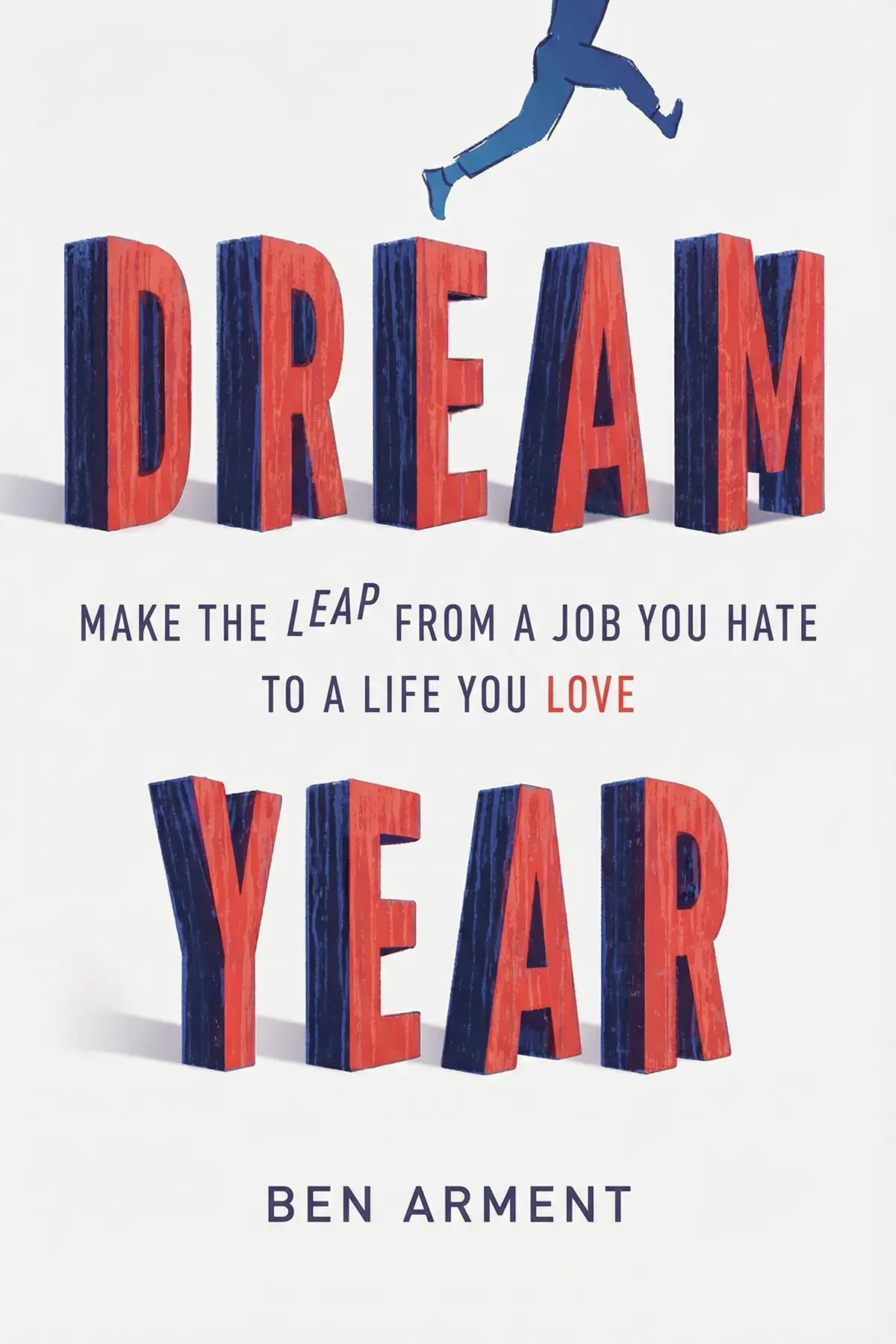
Table of Content
1. Introduction
1 min 05 sec
Feeling stuck in a job that drains you is common, and Ben Arment thinks the drain is a clue. In Dream Year, the entrepreneur and coach argues that most work feels empty because it serves another person’s dream, and that the irritation you feel each morning can power your exit. He cites studies showing that 66 percent of working Americans dislike their jobs, so about two in three.
His throughline is practical. A dream becomes a life when you treat it like a business: one that solves a real problem, pays its own way and moves forward in tasks small enough to finish in a day. Arment builds the case with bodyguards trained under live fire, a reservation service that restaurants at first showed no interest in, a game studio that flopped 51 times and a girl who wrote to world leaders.
What follows is a route from vague longing to a first concrete step. Along the way come the money checks and the asking skills that keep a dream alive once it starts.
2. Turn job frustration and fear into fuel
1 min 44 sec
The irritation you carry into work each morning seems like a reason to feel stuck. A Los Angeles bodyguard trainer hints at why it might be the opposite, and why the fear that matters most is a different one.
3. Find your dream where passion meets talent
1 min 39 sec
Many people ready to leave their jobs cannot say what they would do instead. A child’s model rocket and a music fan who cannot sing point toward a surprisingly simple way to find out.
4. Shape your dream into a business people need
1 min 40 sec
A reservation service once offered restaurants something they had no use for, and a video company refused to open a single store. Both stories reveal the two tests an idea must pass before strangers care about it.
5. Make the numbers work before you leap
1 min 25 sec
Some of the busiest restaurants in town eventually close their doors. The reason exposes the line between a hobby and a living, and what a hair salon and a home office can teach about crossing it.
6. Start now with tasks you can finish today
1 min 31 sec
A game studio released dozens of flops and nearly went broke before its big hit. Its story, and a humble tax form, show why waiting for the right moment keeps most dreams on paper.
7. Ask in a way that invites people in
1 min 32 sec
A young girl wrote to world leaders asking to meet them, and the replies astonished her family. Her letters, and a filmmaker chasing movie rights, reveal how to ask for things without sounding like you are begging.
8. Win loyal fans with an experience worth sharing
1 min 29 sec
People pay more for products with fewer features, and shoppers fall for a supermarket deli sign. Behind both lies the reason some ventures grow by word of mouth while equally good ones never find their buyers.
9. Conclusion
1 min 00 sec
Arment’s promise is modest in a good way: treat the dream as a working business. It answers a real problem, does something its industry doesn’t, covers your rent and grows through people who choose to help and fans who choose to return. The frustration you carry to work each day is the raw material for all of it.
That makes the first moves small. Write the dream down where your childhood passion and your adult skills overlap, then name the problem it solves for someone else. Break the first goal into pieces that each fit inside one day. Arment’s own example replaces a box marked earning the first million with identifying potential customers, drafting a pitch email and sending it off. And the next time you need something from a supplier or a stranger, open with what they gain.
The road will be rough, he admits, and doubt will come. When it does, remember the bodyguards in Los Angeles: after about ten shots, they could stand under fire and stay calm.
About this book
What is this book about?
Most people who dislike their jobs know something is wrong but not what to do next. Ben Arment, an entrepreneur and coach, argues that the dissatisfaction comes from working for someone else's dream, and that the way out is to build a business around your own. Arment treats the leap as a series of manageable steps. He shows how to use frustration and the fear of insignificance as fuel, and how to find a dream where childhood passions meet adult talents. He then shows how to shape that dream into an idea that solves a problem and breaks an industry's rules, as OpenTable and Netflix did. He insists the numbers work, with several revenue streams and low costs. The practical core is action. Readers get a realistic schedule of tasks small enough to finish in a day, a way of framing requests so the other side wins too, and a brand experience strong enough to earn a loyal base of fans. The result is a grounded plan for turning a vague longing into a first concrete step this week.
Book Information
Who it's for
Unhappy employees
Employees who resent their jobs and want a realistic plan for starting something of their own.
Would-be founders with doubts
Would-be founders unsure what their dream is or whether it can pay the bills.
Side-project builders stuck planning
Side-project builders who keep planning and need help taking the first daily steps.
About the Author
Ben Arment
Ben Arment is an entrepreneur who has started several companies and works as a development strategist for several global organizations. He runs a coaching organization, also called Dream Year, which says it has helped hundreds of people realize an audacious dream. That hands-on experience of launching ventures and coaching others through the leap shapes the book. He lives in Virginia Beach, Virginia, with his wife Ainsley and their four children.
Ratings & Reviews
Ratings at a glance

What people think
Listeners consider this an excellent resource filled with useful guidance, with one listener highlighting the inclusion of real-world examples and case studies. It is described as motivational and valued for its focus on taking action, as one listener points out that it pushes people to think about making a major change. Opinions on the tempo vary; while some listeners find the progression thrilling, others feel the material eventually grows tedious.
Top reviews
Hiroshi
Truth is, I needed a massive kick in the pants, and Ben Arment delivered exactly that with a succinct presentation of ideas. This book is jam-packed with stories of successful marketing plans and innovative ideas that I hadn't considered before I started reading this morning. I love the '1000 true fans' concept as a way to make a living from what you love. It feels achievable. This isn't just another book about dreaming; it’s about doing, testing, and tracking your progress in a way that produces actual results. I’ve already started deconstructing my own model to see where I can break the rules of my industry, even if some of the case studies felt a bit repetitive. Absolutely powerful stuff for those ready to leap.
Show moreTaw
The way the author breaks down the intersection of passion and giftings is worth the price of admission alone. I was expecting a boring business text, but this was a stellar resource that felt incredibly personal and urgent. The biographical snapshots are diverse and provide a lot of insight into how different people navigated their 'dream years' successfully. Not gonna lie, I was skeptical at first, but the advice on asking for what you want really hit home for me. It’s easy to follow and the motivational quotes aren’t just filler; they actually serve the larger point of the chapter. If you want to start something new, read this immediately. It’s a wonderful read for any aspiring creator.
Show moreSaovapa
Finally got around to finishing this, and I’m already deconstructing my current business model based on his suggestions. The focus on creating a unique brand experience to build a loyal fanbase is exactly what I needed to hear at this stage of my career. Arment is gifted at helping others see the potential in their own unconventional ideas. While the pacing receives mixed reactions from some, I found the momentum to be perfect for my needs. It’s motion-focused and filled with concrete instances of how to transition from a day job to a dream career. Stop being a lazy ass and just buy the book already. It’s the ultimate guide for anyone tired of being frustrated with their 9-to-5 life.
Show moreSomrutai
Arment is clearly gifted at lighting a fire under people who are stuck in a rut. I found the concrete instances of various startups to be quite helpful for visualizing how a pivot might actually look in practice. The section about finding value in your current employment was a refreshing change of pace compared to other 'quit your job today' manifestos. Look, the book isn't perfect, and some of the marketing plans felt a little dated, but the core message is solid. It challenges readers to consider a major move without being totally reckless or irresponsible. I’m definitely inspired to finish several projects I’ve been procrastinating on for months. It’s a motion-focused and very practical guide for the aspiring entrepreneur.
Show moreNit
After hearing several friends rave about this, I decided to see if the 'Dream Year' framework actually holds water. Personally, I think the most valuable takeaway is the concept of building an unconventional business idea that solves a specific problem. Arment emphasizes that you need to subvert industry norms to stand out, which is a great perspective for someone feeling like a loser in their current cubicle situation. The success stories of various entrepreneurs kept me interested even during the slower, more repetitive chapters. It’s a stellar resource for anyone who needs a kick in the pants. Just be prepared for a bit of fluff between the gems. Overall, it’s a strong push toward action that I really needed right now.
Show moreSau
To be fair, I wasn't expecting a technical manual, so the high-level motivational approach worked for me. The author’s advice on harnessing fear as a motivational fuel rather than a roadblock was particularly resonant. I appreciated how he focused on the financial viability of a dream, rather than just the 'passion' side of the coin. It’s easy to follow with plenty of quotes that make you want to get up and do something productive. The tempo fluctuates throughout the middle, and some anecdotes are a bit smug, but the ending is strong. If you are currently frustrated with your life, this provides a decent step-by-step plan to start shifting your trajectory. It's a solid, action-oriented guide.
Show moreWitthaya
Maybe the most helpful part of this read was the chapter discussing exactly when it's time to throw in the towel. Most motivational gurus never talk about giving up, but Arment treats it as a strategic regrouping that is sometimes necessary for growth. That level of honesty is rare in this genre. I also liked the focus on the intersection of passion and giftings to find your niche. However, some of the anecdotes about his 'heroes' felt a little off-putting and distracted from the main business points. Despite the occasional smug tone, the book provokes a shift in mindset that is undeniably valuable. It’s a good balance of inspiration and concrete instances of success. I'm glad I finished it.
Show moreTanawan
Picked this up because I’m desperate to leave my 9-to-5, but I ended up feeling a bit lukewarm about the whole thing. The truth is, the book feels more like a motivational pep talk than a manual for starting a business while working full-time. I liked the suggestion that even 20-30 minutes of daily effort puts you ahead of the crowd. That is a manageable goal. However, the 'how-to' portions felt incredibly thin compared to the biographical snapshots. The questions designed to help you determine your actual dream job were somewhat interesting, though. It’s a stellar resource if you just need a nudge, but don't expect a technical roadmap for your specific industry. Some parts drag significantly while others fly by too quickly.
Show moreLandon
Is it just me, or does every 'dream big' book follow the exact same tired script? I was genuinely hoping for a recipe with specific ingredients, but what I got was a collection of two-sentence platitudes. The author spends way too much time reciting the bios of 'special people' who have already reached the finish line. Where is the actual meat and potatoes? To be fair, I appreciate the enthusiasm, but the execution sections are entirely too fluffy and didn't engage me at all. I was looking for a bridge to help me jump from the job I hate, but instead, I found a reason to put this book back on the shelf and keep looking. It’s frustrating when the tempo fluctuates so wildly between chapters.
Show moreFang
This book is basically a compilation of privilege masquerading as advice. Frankly, the author’s tone is incredibly smug, which made it nearly impossible to get through the first few chapters without rolling my eyes at every turn. I hit a breaking point when he started praising some 'hero' who apparently spent his time slaughtering wildlife in the Amazon for sport. Why is that in a business book? Not to mention the weirdly sexist way he talks about his wife, volunteering her for things onstage without even asking her first. It’s obnoxious. If you have real responsibilities and bills that aren't paid by a trust fund, stay far away from this nonsense. It lacks any real grounding in the reality of most working people.
Show moreQuestions about this book
What is the main idea of Dream Year by Ben Arment?
Arment argues that most job frustration comes from serving someone else’s dream, and that the remedy is to build a business around your own. He breaks the leap into steps: use frustration and fear as fuel, find where passion meets talent, solve a real problem in an unconventional way, make the numbers work, act through small daily tasks, ask boldly and build a loyal fanbase.
How does Dream Year suggest finding your dream?
Arment suggests looking back at childhood, before society’s goals of wealth and fame took over, and noticing what you chased freely. Then test it against your gifts. A real passion is something you would do unpaid, but the role must suit your talents: a music lover who cannot sing might thrive as a producer, a concert organizer or a music teacher.
How do you know if a business idea is financially viable?
In Dream Year, the difference between a business and a hobby is that a business earns enough to live on. Arment notes that popular, cheap restaurants often close because a steady stream of diners does not guarantee profit. He recommends several related revenue streams, such as a hair salon that also sells products and spa treatments, and low costs, for example running a web design agency from home.
How can I apply the ideas in Dream Year?
Start by breaking your dream into steps, then break those into tasks that fit inside a single day. Arment’s example swaps a goal like earning the first million for identifying potential customers, drafting a pitch email and sending it. Keep the schedule realistic so you don’t fall behind, and when you need help, frame the request around what the other person gains.
Who should read Dream Year?
It suits people stuck in jobs they dislike who want to start a business but feel afraid or unsure where to begin. Career switchers get a method for finding their dream, and early founders get practical rules on profit, daily planning, asking for help and building a base of at least 1,000 true fans, a figure Arment borrows from Kevin Kelly.
Featured in
Readers also enjoyed









AUDIO SUMMARY AVAILABLE
Listen to Dream Year in 15 minutes
Get the key ideas from Dream Year by Ben Arment, plus 5,000+ more nonfiction titles.
- 5,000+ titles
- Listen as much as you want
- 7-day free trial
- Cancel anytime









