
16 min 26 sec
Available in: English
 ไทย
EnglishไทยCosmos
By Carl Sagan
Shows how a tiny planet among billions learned its true place in the universe, from a shadow in ancient Alexandria to the Voyager probes, and why careful testing, not pure theory, made each step possible.
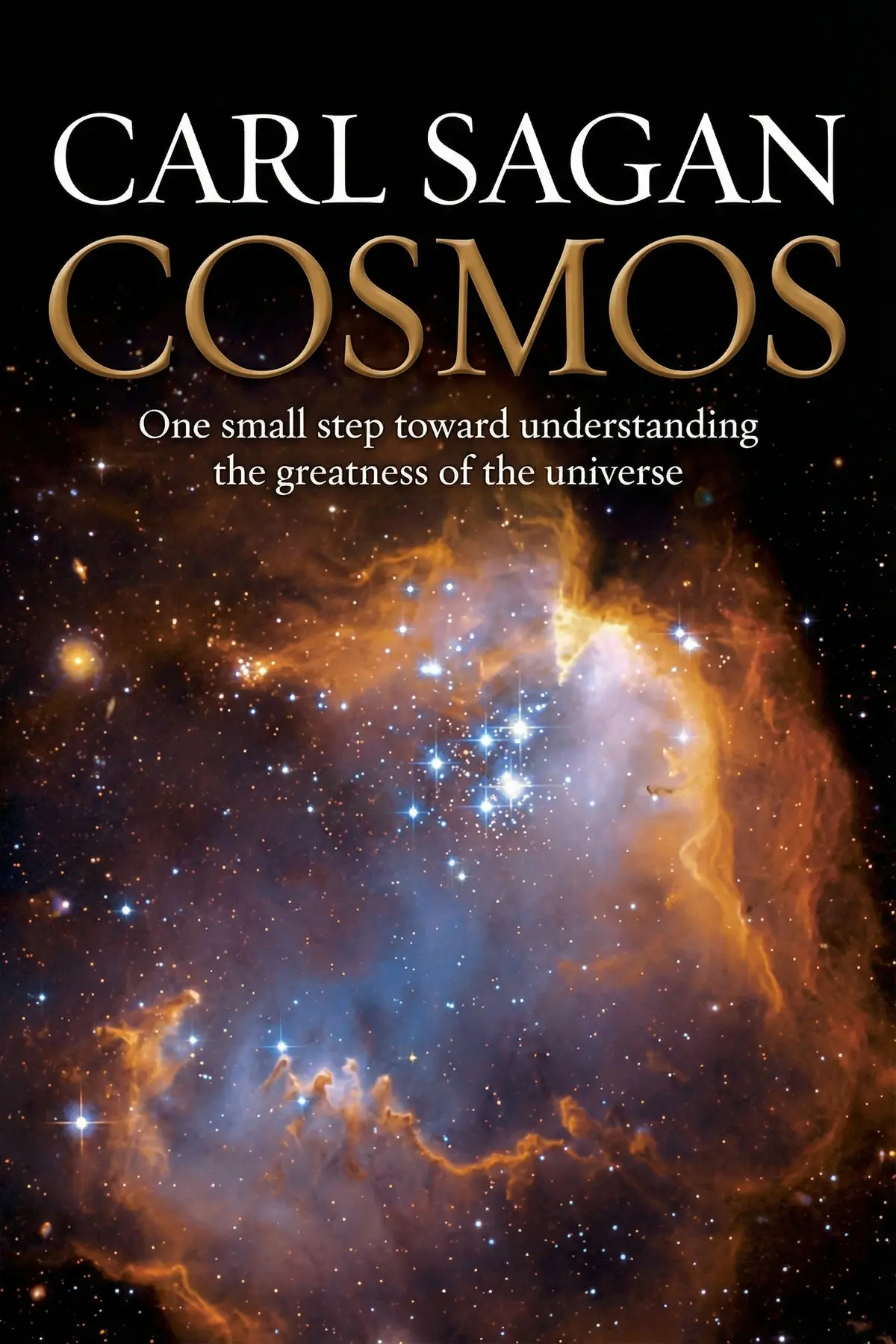
Table of Content
1. Introduction
1 min 01 sec
Most of us move through the day as if our own worries filled the sky. In Cosmos, astronomer Carl Sagan offers a cure: Earth is one planet among roughly ten billion trillion, a speck within a speck of dust. Sagan, who worked on NASA’s Viking and Voyager missions, treats that discovery as one of our species’ finest achievements.
His story is as much history as science. Humans found their real place in the universe whenever they trusted careful looking and testing over pure belief, and progress stalled whenever that habit was dropped. Along the way you will meet a library director in Alexandria who measured the planet with a stick, an ancient idea that sidelined experiments for centuries, Einstein reasoning about light at a railroad crossing, and a golden record now traveling out into space. Afterward the night sky reads less like decoration and more like a map with our address on it.
2. Picture the true size of the universe
1 min 33 sec
Ordinary miles and kilometers break down the moment you leave Earth. A single count of galaxies, stars and planets turns our home into one entry on an almost endless list, and that can change how big your problems feel.
3. Measure a planet with a stick and a shadow
1 min 37 sec
More than two thousand years ago, a scholar in Egypt read one odd line on a scroll and decided to check it himself. What he did next needed no telescope, only patience and a very long walk.
4. Learn what buried the experimental method for centuries
1 min 49 sec
The ancient Greeks had already split the world into atoms and empty space. Then some of the most admired minds in history turned against the very habit that made such ideas possible, and the damage lasted for ages.
5. See the Sun take its place at the center
1 min 46 sec
For centuries the best minds agreed that everything in the sky circled us. Overturning that took one bold claim, a dead nobleman’s notebooks and a strange force nobody could see.
6. Understand Einstein's railroad crossing in plain words
1 min 41 sec
A car, a train and a friend by the roadside sound like an ordinary near miss. Push both vehicles close to the speed of light, though, and the scene breaks in a way that forced Einstein to rewrite the rules.
7. Know which neighbor planet humans could live on
1 min 54 sec
One planet next door is named for the goddess of love, the other for the god of war. Their real conditions flip that picture, and one of them may someday hold human settlers, if a single problem gets solved.
8. Guess what aliens look like and how they'd call
1 min 56 sec
Science fiction gives aliens arms, legs and faces. Sagan thinks real ones would be stranger, that their first hello would arrive in a surprising form, and that a treaty on Earth closed one road to meeting them.
9. The record we sent to introduce ourselves
1 min 52 sec
Two spacecraft launched decades ago are still carrying something unusual away from Earth. Their builders worried about the picture of us that aliens would otherwise get, and tried to offer a better one.
10. Conclusion
1 min 17 sec
Cosmos makes two moves at once. It shrinks us, placing Earth among some ten billion trillion planets, and it raises us, because a species on that speck worked out the size of its world with a stick, a shadow and a man paid to walk. Sagan’s history shows what made the difference each time: Eratosthenes going outside to check, Kepler trusting Tycho Brahe’s records, Einstein following a thought experiment past common sense. When Pythagoras’s admirers decided that pure thought was enough and experiment was work for slaves, the method stalled for centuries.
That habit is available on an ordinary day. When a belief feels obvious, look for the cheap test that could prove it wrong, the way one stick in Alexandria did. When a problem seems to fill your whole world, remember that light circles the Earth seven times in a second and still needs years to cross the gaps between stars. And now and then, look up. The ancestors who timed their gatherings by the stars were reading the same sky we have.
Far out in space, two golden records carry greetings in 60 languages, our best attempt to say where we live and who we are.
About this book
What is this book about?
Earth feels like everything to us, yet it is one planet among roughly ten billion trillion, spread across a hundred billion galaxies. Carl Sagan, an astronomer who worked on NASA's planetary missions, sets out to make that scale understandable without heavy math. He tells the story of the universe as much as a history lesson as a science lesson. His angle is that working out our place in the Cosmos is a story of history as much as one of science. Eratosthenes measured the round Earth with a stick and a shadow. Kepler trusted Tycho Brahe's records and found that orbits are ellipses. Einstein followed a thought experiment about a railroad crossing to the fixed speed of light. When Pythagoras and his admirers decided that pure thought was enough, experiment fell out of favor for centuries. Readers get a clear picture of the size of the Cosmos, the hellish heat of Venus, the real chances of living on Mars, how aliens might look and contact us, and the golden records the Voyager spacecraft carry as humanity's introduction to whoever finds them.
Book Information
Who it's for
Adults curious about space
Curious adults who want the scale of the universe explained without heavy math.
Learners and educators
Students and teachers looking for the human history behind astronomy, from Eratosthenes to Einstein.
Burdened by daily worries
Anyone weighed down by daily worries who would welcome a sense of proportion from the night sky.
About the Author
Carl Sagan
Carl Sagan, who lived from 1934 to 1996, taught astronomy and space sciences at Cornell University and led its Laboratory for Planetary Studies. He worked actively on NASA's Mariner, Viking and Voyager missions and co-founded the Planetary Society, becoming its first president. He co-wrote and narrated the television documentary Cosmos: A Personal Voyage, the series this book was written alongside. His book The Dragons of Eden earned him the Pulitzer Prize for General Nonfiction, and in The Demon-Haunted World he made the case for skepticism and the scientific method.
Ratings & Reviews
Ratings at a glance

What people think
Listeners view this work as a spectacular experience that offers deep insight and stimulating material, with one review comparing the narrative to a mystery novel. The prose is easy to follow, mirroring Carl Sagan's own way of speaking, and listeners value the thorough exploration of the cosmos and the way it blends historical events with scientific discovery. They characterize the work as mind-blowing and an excellent resource for fueling curiosity, with one listener mentioning it's required reading in public schools. Although some listeners feel it is timeless, others observe that the information is somewhat dated.
Top reviews
Henry
"We are made of starstuff." This iconic phrase alone captures the soul of the book, doesn't it? Sagan has this incredible ability to make complex astrophysics feel like a personal love letter to humanity. I was struck by how he connects the iron in our blood to the deaths of distant stars. It’s not just a textbook; it’s a philosophical journey through time and space. Even though it was written decades ago, the core message about our place in the universe remains staggering. His writing is lyrical, almost poetic, yet grounded in rigorous logic. It makes you realize how precious our tiny blue dot really is. Every chapter feels like a revelation that stays with you long after you've finished.
Show moreBun
Watching the series first made this reading experience even better. I could practically hear Sagan’s distinct, soothing voice narrating every sentence on the page. He had such a unique way of articulating the grandeur of the cosmos without ever being condescending. This book is a magnificent bridge between the hard sciences and the humanities. He explores how our ancestors looked at the same sky and tried to make sense of the chaos. The illustrations and the focus on the Ionian awakening were highlights for me. It’s more than just a science book; it’s a plea for sanity and unity in a world often obsessed with petty, meaningless conflicts.
Show moreSaranya
The way Sagan weaves history into the stars is nothing short of genius. Most science writers stick to the "what," but Sagan is obsessed with the "why" and the "how." He takes us from the dusty halls of the Great Library of Alexandria to the edge of the known universe. I loved the emphasis on how fragile our knowledge is and how easily it can be lost to superstition or violence. His defense of libraries as the indicator for the "health of our civilization" really resonated with me. It’s a deeply human book that looks outward to the galaxies to help us look inward at ourselves. It really is a life-changing read for any curious mind.
Show moreOlivia
An absolute masterclass in science communication. If you’ve ever felt intimidated by physics or astronomy, you should definitely start here. Sagan doesn't lecture; he invites you on a voyage. The book is structured perfectly, building from our local neighborhood out to the furthest reaches of space and time. I’ve given this as a gift to so many people because it nurtures that sense of childhood wonder we all tend to lose as adults. It makes the universe feel less like a cold, empty void and more like a home waiting to be understood. His excitement is contagious and makes the most complex topics accessible to everyone. It’s a masterpiece that deserves every bit of praise it gets.
Show moreDuangjai
Picked this up on a whim and it completely blew my mind. I’m not typically a non-fiction reader, but the prose here is so engaging that it felt like a narrative. It honestly felt like I was sitting around a campfire with the world’s smartest teacher. He makes things like the curvature of spacetime or the lifecycle of a star feel intuitive rather than impossible. I especially appreciated his take on the search for extraterrestrial intelligence and why it matters to our own ego. It’s a mind-expanding experience that stays with you long after you close the cover. If you want to understand the scale of reality, this is the definitive guide to the heavens.
Show morePenelope
While the science has naturally evolved since the 1980s, the sense of wonder remains completely intact. I’ll admit some of the data on planetary flybys feels like a time capsule now. We've learned so much more about the Martian surface and the outer rim since this was first published. However, the way Sagan explains the scientific method is timeless. He doesn't just give you facts; he teaches you how to think critically. The prose is conversational and easy to follow, even when he's diving into relativity or the Library of Alexandria. Truth is, I found the historical sections just as fascinating as the astronomy. It’s a bit dense in the middle, but absolutely worth the effort.
Show moreKae
It’s rare to find a science book that reads like a gripping mystery novel. Not gonna lie, I expected something much drier when I first picked this up. Instead, I found myself hooked on the stories of Eratosthenes and Kepler. Sagan presents scientific discovery as a series of clues left by the universe for us to find. The language is accessible enough for a layman but never feels like it's being "dumbed down." I did find some of the biology sections toward the beginning a little slow compared to the space exploration parts. Still, the breadth of topics covered is impressive. It’s a comprehensive account of everything that makes us human specimens in a vast vacuum.
Show moreAnong
Few books manage to make you feel both incredibly small and deeply significant at once. Sagan’s perspective on the "pale blue dot" mindset is a necessary antidote to modern cynicism. He reminds us that we are the "eyes of the cosmos" looking back at ourselves. My only minor gripe is that he occasionally gets a bit repetitive with the sweeping, grandiloquent tone. Some sections on chemical evolution are a bit technical if you don't have a background in it. But look, the overall message of unity and curiosity is something we need now more than ever. It’s a thoughtful, provocative piece of writing that challenges you to think about our long-term survival.
Show moreAubrey
Reflecting on the sections about our self-destructive tendencies made me realize how little has changed since 1980. Sagan was writing during the height of the nuclear arms race, but his warnings about tribalism and the misuse of technology are still incredibly relevant today. He makes a compelling case for science as a "self-correcting tool" for survival rather than just a collection of facts. Personally, I think every student should be required to read the final chapters on the "Encyclopedia Galactica." The science might be forty years old, but the sociology and ethics are spot on. It’s a sobering but ultimately hopeful look at our potential as a species. A solid four stars for the message alone.
Show moreMeen
To be fair, this is a product of its time. I know this is considered a "classic," but I genuinely struggled with the pacing in several of the chapters. Some of the long-winded passages about 17th-century astronomers felt like they belonged in a completely different history book. Also, if you’re looking for the most up-to-date information on things like dark energy or exoplanets, you obviously won't find it here. The heavy Cold War anxiety is palpable throughout, which makes the tone feel a bit dated and paranoid for a modern reader. It’s certainly an important work of literature, but as a practical science guide, it’s clearly showing its age. I appreciate the grand vision, but frankly, it was a bit of a slog to finish the final third.
Show moreQuestions about this book
What is Cosmos by Carl Sagan about?
Cosmos explains the size of the universe and how humans worked out their place in it. Sagan treats this as history as much as science: Eratosthenes measuring the round Earth, Copernicus and Kepler moving the sun to the center, Einstein reasoning about light. He also covers Venus and Mars, how alien life might look and contact us, and the golden records carried by the Voyager spacecraft.
How did Eratosthenes prove the Earth was round?
Eratosthenes, head of the Library of Alexandria in the third century BCE, read that sticks in Syene, now Aswan, cast no shadow at noon. A stick in Alexandria did cast one at the same hour. On flat ground both sticks would behave the same, so the surface had to curve. Using the shadow difference and a distance of about 1,000 kilometers paced out by a hired man, he calculated the circumference correctly.
Could humans live on Mars, according to Carl Sagan?
Sagan thinks it is possible. Mars has polar ice caps, clouds, dust storms and 24-hour days, and its temperatures, from 0 to minus 80 degrees Celsius, are not far from Antarctica’s. The main obstacle is water: there is none open or in the air, and low pressure makes it boil away fast. Melting the polar ice into canals could one day make humans the Martians.
What is on the Voyager golden record?
Each Voyager spacecraft, launched in 1977, carries a gold-plated copper record with a cartridge, a stylus and playing instructions on its aluminum cover. It contains information about the human brain’s cerebral cortex and limbic system, greetings in 60 languages, an hour of music from cultures around the world, and sounds of nature and modern technology. It was meant as a better introduction than our stray TV and radio broadcasts.
Who should read Cosmos?
It suits readers who want to grasp the scale of the universe without difficult math, and those who enjoy the stories behind discoveries, from ancient Alexandria to Einstein’s thought experiments. Students get a clear history of astronomy. Anyone feeling overwhelmed by daily problems gets a sense of proportion: Earth is one planet among roughly ten billion trillion, yet people on it measured the heavens with simple tools.
Readers also enjoyed

A Short History of Nearly Everything
Bill Bryson

A Thousand Brains: A New Theory of Intelligence
Jeff Hawkins




Alien Earths: The New Science of Planet Hunting in the Cosmos
Lisa Kaltenegger



AUDIO SUMMARY AVAILABLE
Listen to Cosmos in 15 minutes
Get the key ideas from Cosmos by Carl Sagan, plus 5,000+ more nonfiction titles.
- 5,000+ titles
- Listen as much as you want
- 7-day free trial
- Cancel anytime









