

15 min
Available in: English
Competition Demystified: A Radically Simplified Approach to Business Strategy
Shows why barriers to entry are the one force that decides long-run profit, how to tell real advantages from ones rivals can copy, and why dominating a small local market beats chasing a big one.
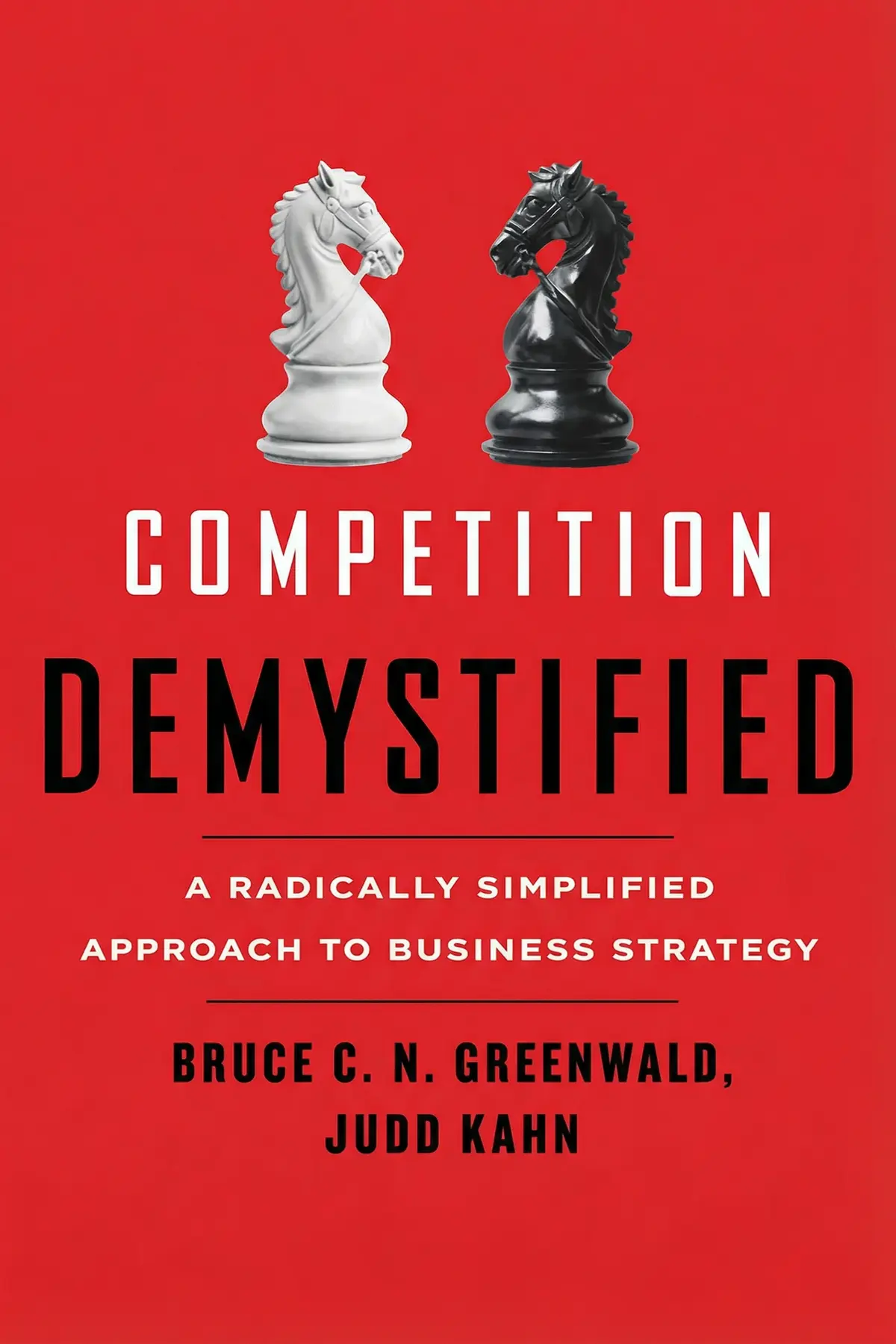
Table of Content
1. Introduction
1 min 08 sec
Strategy meetings often weigh a dozen forces at once, yet one factor decides whether a business can outearn its rivals for years: how hard it is for newcomers to get in. That is the case Columbia economist Bruce Greenwald and his co-author Judd Kahn make in Competition Demystified. Michael Porter’s 1980 model listed five competitive forces, and the authors argue that barriers to entry matter far more than the other four. Where a barrier exists, a company can plan, defend its ground and earn superior returns. Where none exists, strategy has little to offer and efficiency is the whole game. And barriers, they find, are nearly always local: a region, a product niche, a set of customers who will not leave.
The book grew out of Greenwald’s strategy course at Columbia, which within about a decade was taken by more than 80 percent of each MBA class. It gives a manager or investor a quick way to tell whether a business is protected, which advantages are real, and how to handle the few rivals who share the same ground.
2. Check whether your market is protected before planning
2 min 08 sec
Cadillac and Lincoln kept their prices, kept their famous names and still watched their profits slide. Two simple checks reveal whether your own market offers the same false comfort.
3. Separate real advantages from ones rivals can copy
2 min 11 sec
Quality, service, a beloved brand and a fat bank account all sound like advantages. The authors accept only three sources of lasting edge, and one of the world’s most admired car brands fails their test.
4. Small markets you can own beat big ones
2 min 23 sec
Kmart was far bigger, yet Walmart earned more on its sales. The explanation turns the usual story about size upside down and carries a warning for any company eager to go national.
5. Defend your stronghold the moment a rival moves
2 min 02 sec
Pepsi announced a global campaign against Coke and lost an entire country in response. The episode shows where market leaders really win their fights and how fast they must answer an attack.
6. Avoid price wars that leave everyone earning less
1 min 52 sec
The most dangerous rivals are often the few already inside your protected market. Game theory explains why price cuts so often backfire and what kind of restraint pays better than a fight.
7. A clear test for every merger, launch or exit
1 min 56 sec
Microsoft, Intel and Dr Pepper each found a place to dominate, while most small players never do. One question about barriers sorts the bets worth making from the ones to drop.
8. Conclusion
1 min 20 sec
What the authors offer is a smaller definition of strategy, and the smaller definition turns out to be a relief. Much of what companies call strategy is really planning or efficiency. The real thing starts only where something keeps rivals out, and that something is usually captive customers combined with scale in a market small enough to own. Walmart’s tight store clusters, the Venezuelan bottler Pepsi lost and Coors’s costly push national all show it from different angles.
The thesis has critics. Some argue it has dated: platforms built on network effects have raised barriers that span the globe, which the book considered unlikely, and Walmart’s regional strength did not shield it from Amazon. The questions themselves still travel well.
Look at your own market’s share history and its returns against the cost of capital. If neither shows protection, put your energy into running leaner than anyone and spend less on grand plans. If they do, name which of the three advantages you hold, guard it hard against every intruder, and think twice before starting a price war with the rivals who share it. When growth tempts you, expand only from the edge of ground you already dominate.
Where you choose to compete decides more than how hard you compete.
About this book
What is this book about?
Most strategy frameworks ask managers to weigh many forces at once: suppliers, buyers, substitutes, rivals and newcomers. Bruce Greenwald and Judd Kahn argue that this buries the one question that matters, which is how easily competitors can get into your market. If they can, returns fall to the same low level for everyone, and the only sensible goal is efficiency. If they cannot, there is room for real strategy. Built from Greenwald's popular strategy course at Columbia Business School, the book narrows competitive advantage to three sources: cost advantages, customer captivity and economies of scale. The strongest barrier pairs captivity with scale, and it almost always lives in a bounded market, a region or a niche. Cases such as Walmart's store clusters, Coors's national expansion and Coke's capture of Pepsi's Venezuelan bottler show how that edge is won and lost. The second half turns to the few firms that share a protected market. Using game theory, the authors show how to avoid ruinous price wars, how entry battles like Kodak against Polaroid play out, and how to judge mergers, new ventures and valuations by asking which barrier protects the returns.
Book Information
Who it's for
Deciding where to expand
Founders and managers deciding where to expand and which fights to avoid.
Investors weighing lasting profits
Investors who want a clear test for whether a company's profits are actually protected.
MBA students and strategists
MBA students and strategy teams tired of frameworks that never tell them what to do.
About the Author
Bruce C. N. Greenwald
Bruce C. N. Greenwald is an economist who teaches at Columbia University's Graduate School of Business and advises First Eagle Investment Management. He is known as an authority on value investing and also works on productivity and the economics of information; The New York Times once described him as a guru to Wall Street's own gurus. He also wrote Value Investing: From Graham to Buffett and Beyond. Judd Kahn has taught history, worked in city government and served as a securities analyst, chief financial officer and management consultant. He holds a doctorate in history from the University of California, Berkeley.
Ratings & Reviews
Ratings at a glance
What people think
Listeners describe the book's analysis as top-tier, with one noting that it delivers practical mental models for judging corporate strategy. Additionally, the text provides a straightforward take on strategy that is quite accessible, as one listener draws attention to its comprehensive examination of Porter's 5 forces. Listeners also value the book’s clarity, readability, and value for the price, while giving high marks to its focus on barriers to entry and sustainability.
Top reviews
Ingrid
If you’re tired of wading through the dense, academic jargon of Michael Porter, this book is a breath of fresh air. Greenwald successfully strips away the complexity of the Five Forces and hones in on what actually matters: barriers to entry. I found the emphasis on customer captivity and local economies of scale particularly illuminating for my own portfolio analysis. While some of the case studies feel a bit dated now—it was written in 2006, after all—the underlying logic remains incredibly sound. The prose is clear, direct, and avoids the usual 'consultant-speak' that plagues most business literature. It provides a solid mental model that helps you identify whether a company's high returns are sustainable or just a fluke. Truth is, most 'moats' are just illusions, and this book helps you spot the difference.
Show moreKiattisak
Why does strategy always have to be so complicated? Greenwald and Kahn argue that it doesn't have to be, and they prove it by demystifying the competitive landscape. I loved the breakdown of how local dominance can often trump global scale; the Wal-Mart and Coors examples were eye-opening. This isn't just a book for CEOs; it's a toolbox for anyone who needs to assess the health of a business. The writing style is punchy and accessible, making a potentially dry subject feel like a page-turner. To be fair, some might find the heavy focus on ROIC a bit repetitive, but it’s a necessary drum to beat. This has earned a permanent spot on my 'must-read' list for business strategy.
Show moreSurasit
Finally got around to reading this classic after years of hearing it mentioned in earnings calls and investor letters. It’s a masterclass in clarity. The way it simplifies Porter’s 5 Forces into a single, coherent focus on entry barriers is just brilliant. I found the section on 'customer captivity'—the search and switching costs—to be the most useful part of the entire text. It helps you understand why some mediocre companies stay profitable for decades while innovative ones go bust. Sentence lengths are varied, making it a surprisingly easy read for a business book. It definitely provides a superior mental model for anyone looking to evaluate corporate strategy without getting lost in the weeds.
Show moreTeng
Greenwald managed to distill the essence of competitive advantage into a single, actionable variable: barriers to entry. This book is an essential bridge between academic theory and practical investing. I’ve read a lot of business books, and few provide this level of clarity without descending into fluff. The focus on 'Big where it counts' is a game-changer for understanding why local players can often beat out global giants. It’s readable, insightful, and provides a much-needed reality check on the 'first-mover advantage' myth. If you want to understand why some businesses consistently print money while others struggle despite having a great product, read this. It’s a comprehensive guide that actually lives up to its title.
Show morePensri
Picked this up on a recommendation from a value investing forum, and I have to say the framework is surprisingly easy to follow. The authors argue that strategy really boils down to just one thing: the presence or absence of entry barriers. Everything else is just operational efficiency, which is important, but not a true strategic advantage. I did find the game theory sections in the middle a bit tedious and overly theoretical for my taste. Also, the analysis of Apple’s 'failure' in the early 2000s is hilariously wrong in hindsight, which might make some readers skeptical of the overall methodology. Still, if you can look past the age of the examples, the core message is vital for anyone trying to understand long-term profitability.
Show moreKanokporn
The chapter on local economies of scale changed how I look at regional businesses forever. Most people assume that bigger is always better, but Greenwald demonstrates that it's density and local market share that truly drive margins. I appreciated the distinction between 'strategy' and 'operational efficiency'—it's a mistake I've seen countless managers make. The book is well-structured, with theory followed by practical case studies, though the writing can occasionally veer into 'textbook territory.' It’s a bit of a mixed bag because the game theory stuff feels a little disconnected from the reality of a messy business world. However, the insights on M&A and the flaws of DCF valuation are worth the price of admission alone.
Show moreChloe
As someone who works in corporate development, the section on M&A was surprisingly grounded in reality. The authors rightly call out the 'synergy' myth and explain why most acquisitions fail to create actual value for shareholders. I did find the heavy reliance on historical data a bit limiting at times, especially when looking at fast-moving tech companies. For instance, their take on Intel vs. Apple shows a bit of a surface-level understanding of the actual tech involved. But the core concepts—the 'search, switch, and habit' costs—are spot on. It’s a dense read in some spots, and you’ll need to pay attention, but the payoff is a much sharper eye for competitive advantages.
Show moreJirapat
Look, the game theory portions are a bit of a slog, but the rest of the content is gold. Greenwald has a knack for taking complex economic concepts and making them feel intuitive. I especially liked the emphasis on how differentiation is often overrated; a brand is only a barrier if it actually influences customer behavior and switching costs. Most 'brands' are just expensive labels that don't provide a real edge. The book is a bit old-fashioned in its examples, which can be a turn-off if you're looking for insights on modern SaaS models, but the fundamental economics don't change. It’s a solid 4-star read that will definitely make you think harder about 'moats.'
Show moreValentina
Is it perfect? No. But it’s one of the few strategy books that actually feels applicable to the real world. Many authors just throw buzzwords at you, but Greenwald provides a rigorous, quantitative framework. I found the discussion on 'Return on New Invested Capital' (RONIC) particularly useful for weeding out growth-trap stocks. It's true that the book feels a bit like a collection of Harvard Business School case studies, which can be hit or miss depending on the industry. Some of the generalizations are a bit sweeping, yet the overall focus on sustainable competitive advantage is exactly what most managers are missing. It’s a thorough breakdown that rewards multiple readings.
Show moreJonathan
Not what I expected given the high praise from the Columbia crowd. Frankly, I found parts of this book so excruciatingly dry that it was a struggle to get through the middle chapters. While the central thesis about barriers to entry is strong, it feels a bit like the authors are trying to fit the entire world into a very small box. If you've read Hamilton Helmer’s '7 Powers,' this book might feel like a step backward or at least a less complete version of the same ideas. The case studies are thorough, but their lack of in-depth knowledge in certain tech industries leads to some sweeping generalizations that don't hold up under scrutiny. It's okay as a historical piece of literature, but there are better, more modern resources available now.
Show moreQuestions about this book
What is the main idea of Competition Demystified?
Greenwald and Kahn argue that barriers to entry decide whether a company can earn more than its rivals over time. Where newcomers can enter freely, returns fall to the same minimum for everyone and only efficiency matters. Where barriers exist, real strategy becomes possible. Those barriers usually come from captive customers combined with economies of scale, and they are almost always local, so the authors urge firms to dominate bounded markets.
What are the three competitive advantages in Competition Demystified?
The book names supply advantages, meaning lower costs from proprietary technology, patents or cheaper inputs; demand advantages, meaning customer captivity through habit, switching costs or search costs; and economies of scale, where cost per unit falls as volume grows. The authors treat quality, service, reputation and deep pockets as things rivals can copy, and they consider scale strongest when paired with captivity.
How is Competition Demystified different from Porter's five forces?
Michael Porter’s 1980 model asked managers to weigh five competitive forces. Greenwald and Kahn argue that one of them, barriers to entry, matters far more than the others, and that the rest bury the central question. Their approach is simpler: first check whether a market is protected, then, if it is, manage the few rivals who share the protection, using game theory and cooperation.
Why do Greenwald and Kahn say competitive advantage is local?
Scale advantages fade as markets grow, because fixed costs shrink as a share of total costs. In a small market an entrant must win a big share from a strong incumbent just to compete. Walmart’s high 1980s returns came from dense store clusters around distribution centers in Arkansas and nearby states, and its margins sank where it entered regions it did not dominate.
How can I apply Competition Demystified to my business?
Start with two checks: whether leading firms’ market shares have stayed stable for about ten years, and whether returns stay above the cost of capital. If neither holds, focus on efficiency. If they do, identify your advantage, match any intruder’s price and product moves quickly, avoid price wars with established rivals, and expand only into markets next to the ones you already dominate.
Readers also enjoyed




A Year with Peter Drucker: 52 Weeks of Coaching for Leadership Effectiveness
Joseph A. Maciariello



Acting with Power: Why We Are More Powerful Than We Believe
Deborah Gruenfeld

All In: How Great Leaders Build Unstoppable Teams
Mike Michalowicz

AUDIO SUMMARY AVAILABLE
Listen to Competition Demystified in 15 minutes
Get the key ideas from Competition Demystified by Bruce C. N. Greenwald, plus 5,000+ more nonfiction titles.
- 5,000+ titles
- Listen as much as you want
- 7-day free trial
- Cancel anytime









