

15 min 13 sec
Available in: English
Communicate with Mastery: Speak With Conviction and Write for Impact
Shows how to speak and write with impact by starting from your audience, then shaping your intent, delivery, prose, pitches, stories and answers to hard questions around what those people need.
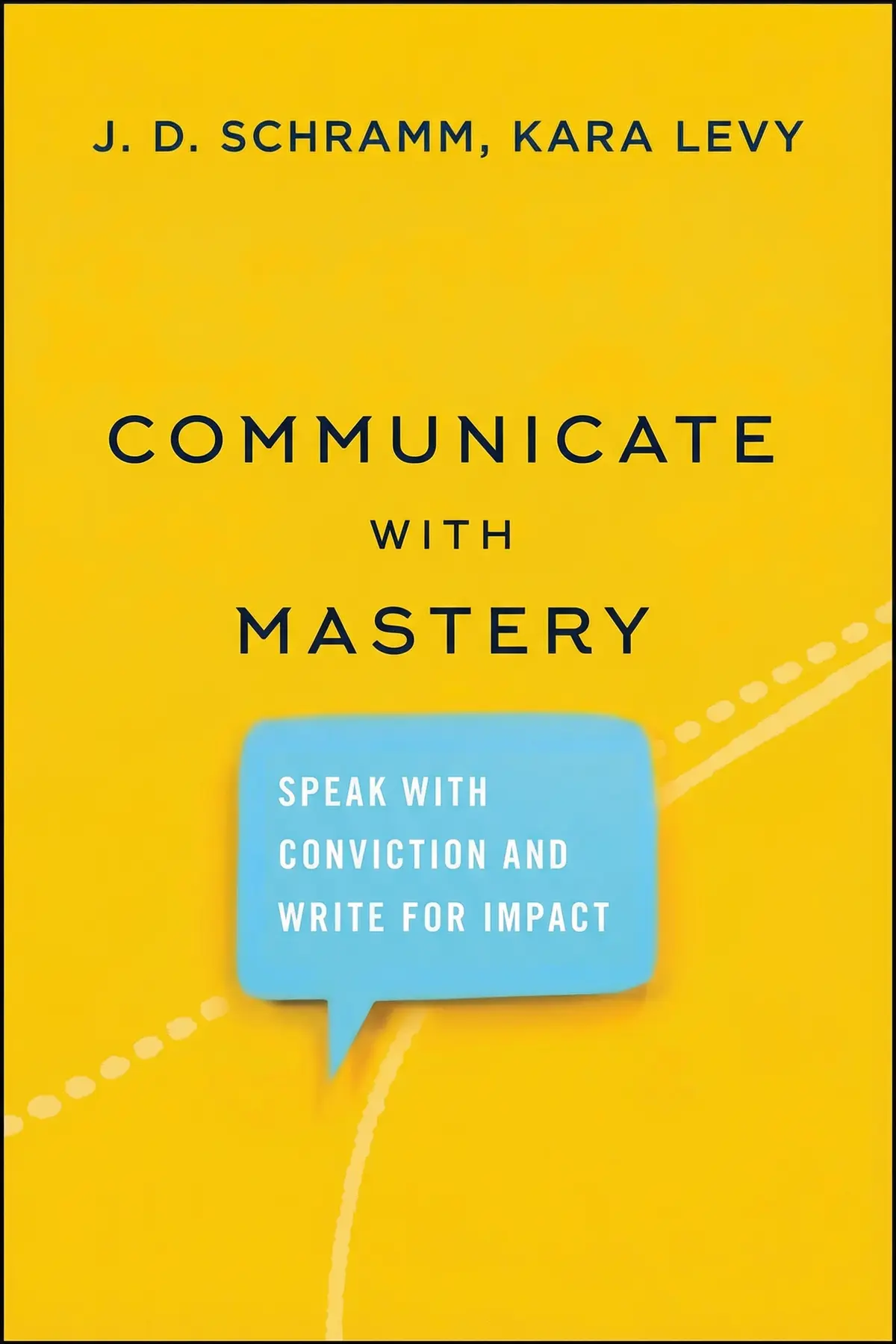
Table of Content
1. Introduction
54 sec
A message can reach thousands of people in seconds and still change nothing, because sending words is easy and landing them is hard. In Communicate with Mastery, Stanford communication professor J. D. Schramm and executive coach Kara Levy argue that impact is decided before the first line, by asking who will receive the message, what you want them to do and what they should take away. They call this sequence the AIM framework.
Their case is that every communication skill, from calming nerves to answering a hostile question, works only when it is shaped for a specific audience. They argue it through a recording from a private donor meeting that spread online, a Steve Jobs launch line and a televised Senate debate. The tools that come out of it fit the next email you send, the next pitch you give and the next tough question someone throws at you.
2. Know who is listening before you say a word
1 min 35 sec
A presidential candidate spoke freely in a room he thought was private and paid for it in the final weeks of his campaign. His mistake is common, and the fix begins long before you choose a single word.
3. Turn nerves into energy and command the room
1 min 42 sec
Most speakers spend the minutes before a big talk hunched over their phones. One small change in how you sit or stand in that waiting room can shift how nervous you feel and how you come across.
4. Write emails people actually read and act on
1 min 49 sec
Busy readers decide in seconds whether a message is worth their effort. Three letters and a short headline test separate the emails people act on from the ones they skim and forget.
5. Pitch investors on the problem before the product
1 min 41 sec
Steve Jobs launched a new device without dwelling on its memory or its size. The order he used to win people over works just as well when you ask investors for money.
6. Make any point stick with a story of change
1 min 39 sec
Telling people your team changed its practices rarely moves them. A plain detail about plastic straws shows what is missing, and a few seconds of silence can do more than another sentence.
7. Win the room when the questions start
1 min 44 sec
A Boston speakers group kept shrinking its talks, and audiences liked the events more each time. What the organizers noticed reshapes how to end a presentation and how to face a hostile question.
8. Lead in your own voice, accent included
1 min 42 sec
Leaders speaking in a second language often try to hide their accent. A slow, awkward speaking drill and a First Lady’s teacup point to a better way of sounding like yourself.
9. Choose a coach who makes you stronger
1 min 25 sec
Elite athletes rely on more help than weekend players, and the same holds for strong communicators. Choosing who helps you, and how you work with them, decides whether the investment pays off.
10. Conclusion
1 min 02 sec
Communicate with Mastery treats every message as something built for particular people. The bartender’s iPhone, the hour that became mostly questions, the thousand songs and the teacup all point the same way: mastery of words counts for less than knowing who receives them and what should happen next. Strategic, analytical and empathetic attention to the audience comes first, and confident speech and clean prose follow.
The habits this supports are small enough to start this week. Before your next important message, name every audience, including anyone it might be forwarded to, and write one line on what you want them to do. Let the first draft be messy, then come back later, trade weak verbs for strong ones, test the headline with what, so what and now what, and read it aloud. When the hard question arrives, restate it, find the ground you share and answer from there.
A message only counts once it lands with someone, so start every one with that someone.
About this book
What is this book about?
Plenty of people can write a tidy email or deliver a polished slide deck and still fail to move anyone. J. D. Schramm and Kara Levy argue that the missing step comes earlier: understanding who will receive the message, what you want them to do and what they should remember. Their AIM framework puts audience, intent and message in that order, and every later choice follows from it. From there the authors work through the situations professionals face most. They offer ways to turn speaking nerves into energy and to manage the words, voice and body language that carry a talk. They set out an ABC for business writing, a four-part structure for pitching investors, and techniques for stories that show change instead of announcing it. They also cover question sessions, including how Hillary Clinton reframed a divisive debate question, speaking in a second language, and choosing a coach. Readers get concrete habits: researching primary and secondary audiences, swapping weak verbs for strong ones, testing headlines with what, so what and now what, slowing speech to cut fillers, and restating every question before answering it.
Book Information
Who it's for
Managers and founders
Managers and founders who pitch, present or write updates and want people to act on them.
Professionals with stage nerves
Professionals who get nervous before big talks or dread the question period.
Leading in another language
Leaders working in a second language who want to sound clear without hiding their accent.
About the Author
J. D. Schramm
J. D. Schramm teaches communication at the Stanford Graduate School of Business, which he joined in 2007 to build courses for its new curriculum, including Strategic Communication and Entrepreneurial Communication. Before that he spent five years on the faculty of New York University's Stern School of Business, rising from adjunct to associate professor. He coaches students who have presented at TED events and the Aspen Ideas Festival. Kara Levy is an executive communication and leadership coach who has given thousands of people tools to speak and write with more confidence. She holds a Master of Fine Arts in fiction writing from Columbia University, where she also taught creative writing.
Ratings & Reviews
Ratings at a glance
What people think
Listeners find the book filled with practical insights and highly effective at sharpening communication abilities. They view it as an excellent resource, with one listener highlighting it as essential for those in leadership roles.
Top reviews
Watcharaporn
Truth is, I wasn't expecting to find so many gems in what I thought would be another standard business guide. The chapter on managing anxiety by reframing 'nervousness' as 'excitement' was a total game-changer for my stage fright. I also appreciated the very specific visual cues, like holding eye contact for a full thought and avoiding 'T-rex arms' by keeping gestures away from the elbows. Schramm and Levy do a great job of explaining the importance of the message your audience actually retells. It is an ongoing practice, and this book serves as a perfect coach for those willing to put in the work to improve their habits. I have already recommended it to several colleagues who want to level up their presence.
Show moreAisha
Even after years of professional speaking, I found myself taking pages of notes on the nuances of delivery and structure. The suggestion to never close with a summary but instead with a synthesis of highlights is something I will use forever. I loved the practical drill of watching a recording of yourself four different times with different focus areas like vocal variety and body language. It’s painful to do, but the book explains exactly how to turn that uncomfortable critique into measurable growth. This isn't just a book you read once; it’s a manual for anyone who wants to be taken seriously in a high-pressure corporate environment. Simply excellent work by Schramm and Levy.
Show moreMai
Ever wonder why some speakers just click while others fall flat? This book breaks down that 'magic' into repeatable systems that anyone can learn if they are disciplined enough to practice. From the KISS principle for slides to the specific 'no laser pointers' rule, no detail is too small for the authors. I found the section on coaching others to be particularly insightful, emphasizing that we should ask guiding questions rather than just editing a mentee’s work for them. It creates a culture of mastery rather than just one-off successes in the office. If you want to move people to act, think, or feel differently, the strategies here are your best bet. A must-read for my whole leadership team.
Show moreBook
Schramm delivers a solid toolkit here that I have already started applying to my weekly team emails. Look, writing for impact is much harder than it sounds, but the ABCs (Active, Brief, Clear) provide a straightforward checklist that actually works. I particularly liked the section on soliciting early feedback from 'devil’s advocates' to find holes in your logic before you go public. The book acknowledges that perfection is an unattainable goal, which is a refreshing take in a genre full of 'secrets to success.' My only minor gripe is that some of the visual slide advice felt a bit dated for a modern tech environment. Regardless, the core principles of audience research are worth the price of admission alone.
Show moreNim
The frameworks provided in these pages are actually actionable for once, which is a rarity in business literature. I have read dozens of these books, but the CUE model for pitching—taking an audience from curiosity to evangelism—gave me a new way to look at my deck. Instead of just dumping data, the authors encourage us to chart a meaningful change through our stories. The specific tips on vocal variety, like slowing down to add weight to a point, were immediately useful in my last client meeting. It is a dense read at points, but if you look past the filler, the core methodology is incredibly robust for any working professional. It definitely helps you think about the 'secondary audience' who hears your message later.
Show moreSamroeng
Leaders who struggle to get their point across need to pick this up immediately, even if they think they are already experts. After hearing so much about the Stanford curriculum, I was curious to see if the book lived up to the hype. It mostly does, providing a clear roadmap for everything from board presentations to one-on-one coaching sessions. I was especially struck by the advice on synthesis versus summary when closing a talk. It is a perceptive look at how communication ripples through an organization over time. While it is a bit repetitive in the middle, the takeaways regarding ‘Why you?’ and credibility are worth the slog. This book will help you move people to act, not just listen.
Show moreEmily
Finally got around to finishing this one, and I am left with mixed feelings about the final product. On one hand, the AIM model (Audience, Intent, Message) is a fantastic starting point for any project. However, the book struggles with the very thing it tries to teach: concise storytelling. There are moments of brilliance buried under a mountain of repetitive references that make it feel like a Stanford marketing brochure. It is a decent introduction for a novice, but if you have read any other modern business communication books, you might find this redundant. It’s a middle-of-the-road resource that provides a few solid templates for your desk without revolutionizing the field. Not bad, just not essential.
Show moreParichat
As someone who used this as a text for a graduate course, I think it serves as a competent introductory manual. The early chapters are particularly strong, offering a deep look into the tools necessary for high-stakes interactions. I found the incorporation of Radical Candor to be a highlight, especially regarding the balance between personal care and direct challenge. Still, the tone can be a bit dry at times, and the focus on public speaking over written communication felt slightly unbalanced to me. It is a good reference to keep on the shelf for specific frameworks, even if you don't find every single personal story particularly relevant. It works well as a classroom tool but might feel a bit slow for a casual reader.
Show moreBond
Is the title of this book even remotely accurate for the content provided? While the authors claim to cover the broad spectrum of communication, they spend an overwhelming amount of time on how to present on a stage. Frankly, I felt it was geared almost entirely toward students rather than seasoned professionals looking for nuanced leadership insights. The advice often veers into common sense territory—telling us to be clear and brief isn't exactly groundbreaking in this day and age. I appreciated the effort to include advice for different groups, but the execution felt generic and didn't offer the specific 'how-to' I really needed. I finished the last page feeling like my skills hadn't actually progressed at all. It is just too basic for anyone already in a management role.
Show moreMarasri
This felt like a total missed opportunity for me personally. To be fair, Schramm clearly knows his subject matter, but the ratio of actual insight to personal anecdotes from his time at Stanford is way off. I was looking for a deep dive into communication theory, yet I ended up with dozens of stories that didn't really go anywhere significant. If you spend twenty minutes on a search engine looking for presentation tips, you will find almost everything here without the unnecessary fluff. The AIM model is briefly mentioned, but the surrounding text is just a massive knowledge dump that lacks the very focus it preaches. It is disappointing because the title promised mastery, but the delivery felt like a collection of recycled blog posts. I wanted more substance and fewer 'GSB' name-drops.
Show moreQuestions about this book
What is the main idea of Communicate with Mastery?
Schramm and Levy argue that effective communication starts with strategic thinking about your audience. Their AIM framework asks you to understand the audience, set your intent and then shape the message. Everything else in the book, from managing nerves and writing clearly to pitching, storytelling and handling questions, applies that principle to a particular situation, so each message is reshaped for the people who will actually receive it.
What is the AIM framework in Communicate with Mastery?
AIM stands for audience, intent and message. First research who will receive your words, using sources such as LinkedIn, company bios, Glassdoor and personal contacts, and include secondary audiences who may hear it later. Then decide what you want those people to do. That intent guides your choice of channel and an outline of main points, reasons and examples. Mitt Romney’s leaked 2012 donor remarks show the cost of forgetting secondary audiences.
What are the ABCs of business writing?
Active, brief and clear. Active voice puts the doer first, as in Tim kicked the ball, and uses fewer words than the passive. Brevity comes from replacing weak verbs like was or had with strong ones, so made a decision becomes decided. Clarity means checking that the reader knows what action you want and will not stumble over any phrase. The authors also recommend headlines built on what, so what and now what.
How do you handle difficult questions from an audience?
Restate the question so everyone hears it and knows you listened. Then validate it with empathy, for example by thanking the person or saying you can see their view, and try to understand their perspective before answering. The authors point to Hillary Clinton’s 2000 Senate debate with Rick Lazio, where she opened on common ground about abortion and then reframed the issue around the economy and jobs.
How can I manage anxiety before public speaking?
The authors suggest three tactics. Think of the talk as a conversation with your audience. Treat it as a chance to share your message. And adopt a power pose that takes up space, which researchers have linked to cortisol drops of up to 25 percent. Schramm calmed himself before an important pitch by holding a newspaper open with his arms spread wide, and the pitch won him the work.
Featured in
Readers also enjoyed

A Bigger Prize: How We Can Do Better Than the Competition
Margaret Heffernan





A Year with Peter Drucker: 52 Weeks of Coaching for Leadership Effectiveness
Joseph A. Maciariello



AUDIO SUMMARY AVAILABLE
Listen to Communicate with Mastery in 15 minutes
Get the key ideas from Communicate with Mastery by J. D. Schramm, plus 5,000+ more nonfiction titles.
- 5,000+ titles
- Listen as much as you want
- 7-day free trial
- Cancel anytime









