

15 min 36 sec
Available in: English
 ไทย
EnglishไทยChange by Design: How Design Thinking Transforms Organizations and Inspires Innovation
By Tim Brown
Shows how to turn new ideas into products and services people actually want: observe real behavior, prototype early, tell stories customers can join, and build mixed teams that are free to fail and to ask why.
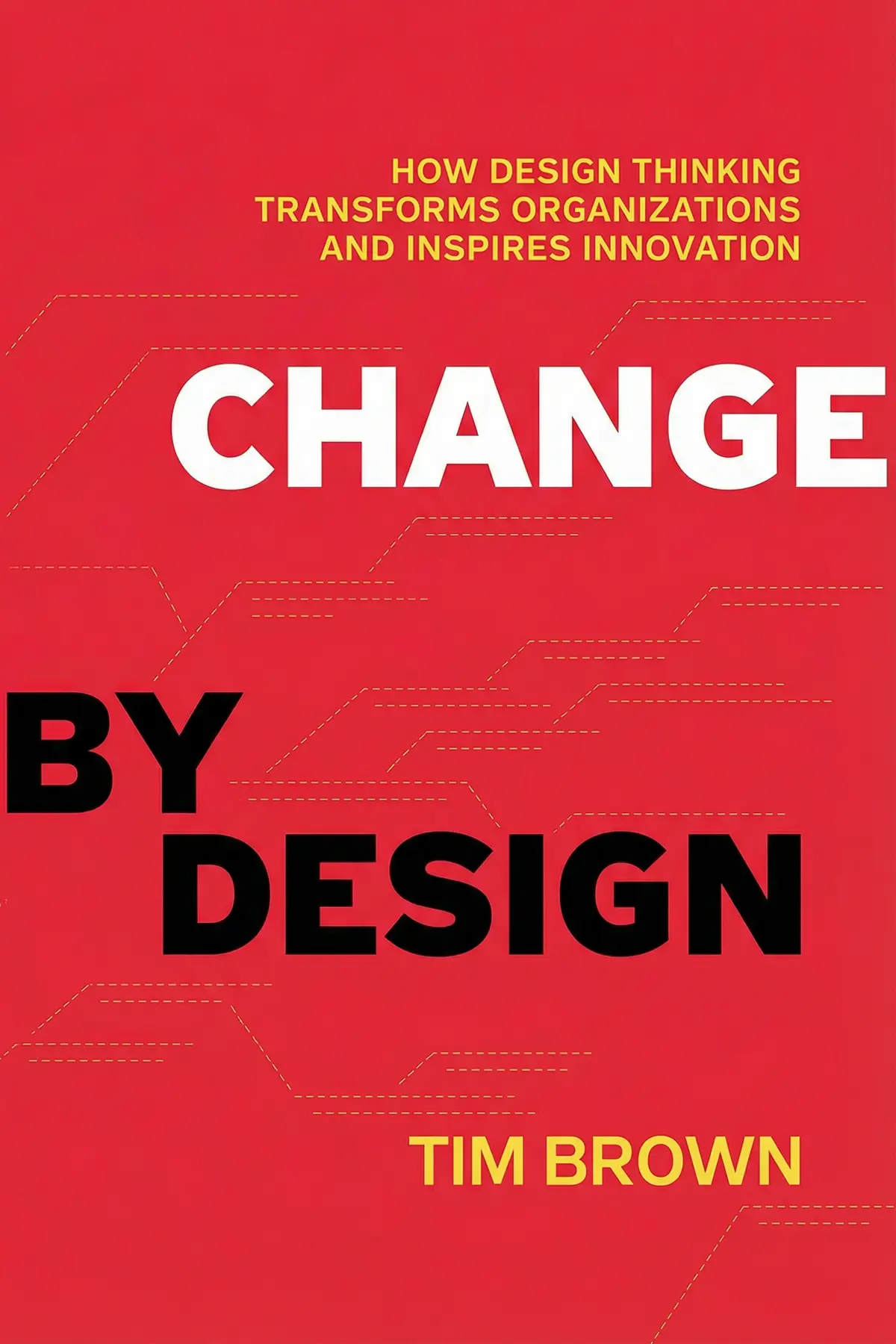
Table of Content
1. Introduction
1 min 03 sec
Most teams treat innovation as a race to invent new technology, then wonder why a clever product goes unused. In Change by Design, industrial designer Tim Brown, a leader at the consultancy IDEO, argues that a new technology on its own is not innovation at all. What turns an invention into something that improves lives is a way of working he calls design thinking.
It starts from people rather than machines: how they really behave, what they need beyond the basics, and the stories they want to be part of. Brown’s case is that this method can be learned. It means watching before asking, building rough models before an idea feels finished, inviting customers into the process and giving mixed teams the freedom to fail. The examples run from a butter dish that helped create Apple’s first mouse to blood donors who tell their own stories. Follow them and you gain a way to spot needs nobody mentions, test answers cheaply, and a daily question that keeps problems open.
2. Balance what works, what pays and what people want
1 min 56 sec
A product can function perfectly and still find no buyers, or win buyers and lose money. A video game console shows what it looks like when a company gets three competing demands right at the same moment.
3. Find hidden needs by watching people's workarounds
1 min 54 sec
Ask customers what they need and they will rarely tell you anything new. The most useful clues hide in small habits people no longer notice, like what one office worker did to the mess under his desk.
4. Build a rough model before the idea is ready
2 min 00 sec
Most adults keep their inventions in their heads until the very end. Brown argues the reverse order is faster, and a piece of Apple history shows how little material a first attempt really needs.
5. Turn customers into characters in your product's story
1 min 50 sec
A jacket you can trace to a single sheep farm, a sailor’s imaginary voyage and a mother saved by a transfusion all did the same job. Each made people feel part of something before they bought or gave.
6. Make it safe to fail and mix your experts
1 min 58 sec
Flamingos, beach huts and ping-pong tables are the famous signs of a creative company. Brown says such perks are not strictly necessary, and points instead to something harder to install: how an organization treats an experiment that goes wrong.
7. Ask why until the real problem appears
1 min 57 sec
Children wear out their parents with one word. Brown argues that the same word once ended thousands of years of exhausting routine, and that keeping your best answers to yourself slows everyone down.
8. Design green choices people actually want
1 min 48 sec
Telling people the climate facts has not changed how most of them shop. Design thinkers found a different lever, and one company even made packaging that turns into a garden.
9. Conclusion
1 min 10 sec
Brown’s book ends up redefining what counts as innovation. A new technology is a beginning. It becomes progress only when it can be built, makes business sense and fits how people live, and the route there runs through people: the worker labeling his cables, the shopper cooking in a grocery store, the donor explaining why she gives blood. Design thinking keeps those people at the center while an idea loops from inspiration to experiment to market and back again.
What it asks of you is modest and practical. Watch someone use what you make and count the workarounds. Build the roughest possible version of your next idea this week, the way a butter dish once stood in for a mouse, and put it in front of a real user. Give failure a place on your team, so the next test does not feel like a risk to anyone’s career. And ask why at least once a day, especially about the things everyone else accepts.
The first farmers did not invent a machine. They asked a better question about seeds, and the world changed shape around the answer.
About this book
What is this book about?
Many companies treat innovation as inventing new technology, then wonder why clever products go unused or lose money. Tim Brown, an industrial designer and a leader at the consultancy IDEO, argues that invention alone is too thin a definition. Real innovation balances what can be built, what can make money and what people want, and it comes from a method he calls design thinking. Brown describes innovation as a loop through three spaces, inspiration, ideation and implementation, and fills each with practical habits. Watch people's small workarounds to find needs nobody voices. Think with your hands, as when a butter dish and a deodorant ball became Apple's first mouse. Use stories that customers can join, like the Red Cross inviting donors to explain why they give blood. Build interdisciplinary teams in a culture where failure counts as learning, and ask why until the real problem appears. Readers get a clear picture of how design thinking works in practice, examples from Nintendo to Whole Foods, and a daily habit for keeping problems open long enough to solve the right one, including the problem of making greener choices appealing.
Book Information
Who it's for
Founders and product managers
Founders and product managers whose clever ideas keep missing what customers want.
Team leads
Team leads trying to build a culture where people test ideas without fear of failing.
Wanting a shared method
Designers, marketers and engineers who want a shared method for working on problems together.
About the Author
Tim Brown
Tim Brown trained as an industrial designer and has won many design awards, with work shown at the Design Museum in London and New York's Museum of Modern Art. He has held a leadership role at IDEO, the global design and innovation consultancy, and has advised senior executives and boards of Fortune 100 companies. He takes part in the World Economic Forum in Davos, has given talks on design thinking that appear on TED.com, and has written for the Harvard Business Review and The Economist.
Ratings & Reviews
Ratings at a glance
What people think
Listeners find the writing highly accessible and value the excellent demonstrations of how to put design thinking into practice.
Top reviews
Duangjai
Ever wonder why some products just 'click' while others feel like a chore to use? Change by Design answers that by putting the human experience at the very center of the creative process. Tim Brown does a fantastic job of explaining why we need to stop looking for better drill bits and start figuring out how to make better holes. This shift in perspective is what separates a good company from a great one. I loved the stories about reimagining the healthcare experience and how simple prototypes can save millions in the long run. Even though I’m not a professional designer, I found myself highlighting passages on every other page. It’s a call to action for everyone—from CEOs to teachers—to approach their work with more curiosity and less fear of failure. Truly inspiring stuff that manages to make a complex methodology feel like common sense.
Show moreVera
Wow. This book completely changed how I approach problem-solving in my daily life. The 'quarter-inch hole' analogy is something I now use in every project meeting to keep the team focused on what the customer actually needs. Instead of obsessing over the tools we currently have, Brown teaches us to obsess over the needs of the people we are serving. The writing is accessible and engaging, avoiding the dense jargon that usually bogs down business books. I was particularly moved by the chapters on applying design thinking to social issues like poverty and healthcare. It’s refreshing to see a designer argue that their skills should be used for more than just the next tech gadget or consumer product. If you want to understand how to cultivate a culture of innovation that actually produces results, this is the book you need to read. Absolutely essential for non-linear thinkers.
Show moreOak
The chapter on 'Design for Spaceship Earth' alone makes this a five-star read for me. Tim Brown isn't just talking about making more stuff; he's talking about how we can design a better future for everyone. I loved the emphasis on 'divergent thinking' and the idea that we should be creating more options at every stage of a project. It’s a highly readable book that manages to be both practical and philosophical at the same time. While some critics point out the dated tech examples like the Palm Pilot, I think the underlying principles are what matters most. Whether you're designing a new app or a new school curriculum, the human-centered approach advocated here is the only way forward. It’s an empowering read that makes you feel like you have the tools to actually make a difference in your organization and beyond.
Show moreSun
After hearing so much buzz about design thinking, I finally dove into Tim Brown's foundational text. It’s less of a 'how-to' manual and more of a manifesto for a specific way of seeing the world. Brown argues that we should move away from just making things look pretty and instead focus on solving complex human problems through empathy and prototyping. I found the emphasis on 'failing early' particularly refreshing for a corporate-minded reader. However, I can’t ignore that some of the case studies feel trapped in 2009. Mentioning Nokia as a titan of innovation feels like a lifetime ago in the tech world. Still, if you can look past the dated examples, the core philosophy remains incredibly relevant for anyone trying to foster innovation in a stagnant environment. It’s a solid entry point for beginners who want to understand the 'why' behind the process.
Show moreJun
Picked this up on a recommendation from a colleague, and I’m glad I did. The book provides a great framework for understanding how design thinking can be applied to business strategy rather than just aesthetic choices. Truth is, most companies are terrified of the 'divergent' phase where you just throw ideas at the wall, but Brown makes a compelling case for why it's necessary. My only gripe is that the book is a bit repetitive in its praise for IDEO's specific methodology. It would have been nice to see more examples from outside their immediate orbit. That said, the sections on 'building to think' through physical prototyping are gold. It’s a great read if you need to convince your boss that innovation requires a culture that tolerates a little bit of messiness. It definitely helps bridge the gap between creative teams and linear-thinking executives.
Show moreSai
Look, this isn't a textbook, and that's exactly why I enjoyed it so much. Tim Brown writes with a passion that is contagious, making you want to go out and prototype a new solution for the world’s biggest problems. I specifically appreciated the distinction between 'design' as a noun and 'designing' as a verb. The book is packed with real-world cases that illustrate how a shift in mindset can lead to breakthrough innovations in surprising places like hospital emergency rooms or local banks. Is it a bit of an advertisement for his company? Sure. But when the company in question is IDEO, there’s actually a lot to learn from their track record. My favorite takeaway was the importance of visual thinking in a world that is far too verbal. It helped me realize why our meetings are so unproductive and how to fix them.
Show moreAurora
Finally got around to reading this classic, and I can see why it’s considered a staple in the design world. The core message—that design is too important to be left just to designers—is incredibly powerful. Brown’s anecdotes about prototyping everything from hospital rooms to bank services are fascinating and easy to digest. Personally, I think the book's strength lies in its ability to demystify the creative process for the 'linear thinkers' among us who are afraid of messiness. It encourages a level of bravery and experimentation that is often missing in traditional corporate settings. I do wish the chapters were a bit more focused, as it can feel a little scattered at times with the constant name-dropping. However, the insights on empathy and observation are timeless, even if the tech examples are a bit dusty. Definitely worth the time for any aspiring change agent in any industry.
Show moreTanyaporn
Not what I expected based on the glowing reviews from my peers. Don't get me wrong, there are some pearls of wisdom buried in here, but the signal-to-noise ratio is a bit off. To be fair, if you’ve never heard of design thinking, this will probably blow your mind. But if you’ve spent any time in the software industry or are familiar with Agile, most of this will feel like common sense dressed up in fancy terminology. The writing style is a bit 'corporate-chic' and tends to meander through stories without always landing on a concrete takeaway. I also struggled with the age of the examples; reading about the Blackberry as the pinnacle of design in 2024 is a bit jarring. It’s a decent introductory text for students, but it’s definitely showing its age and could use a modern update to reflect today's digital landscape.
Show moreBird
As someone who has been in the UX space for a decade, I found this a bit underwhelming. The book attempts to introduce high-level design philosophies, but it often stays at a very surface-level 'executive summary' height. It’s great for getting buy-in from stakeholders who think design is just about choosing colors, but it lacks the 'blueprints' I was hoping for. The structure is a bit hyperactive, jumping from one success story to another without much time to digest the actual process. Also, some of the companies he holds up as paragons of innovation, like Nokia and Best Buy, haven't exactly aged well, which makes the advice feel a bit precarious. It’s a good book to keep on your shelf to lend to people who don't 'get' design, but for practitioners, it's mostly a collection of things you already know or could find on a sticky note.
Show moreTar
This book felt more like a 200-page brochure for IDEO than an actual educational resource. Frankly, I was disappointed by how much Tim Brown spends time patting himself on the back for projects his firm handled years ago. While the concept of design thinking is interesting, the writing is incredibly dry and structured like a never-ending PowerPoint presentation. He talks about the beauty of constraints while simultaneously asking for unlimited resources to do his best work, which feels contradictory. Also, the chapter on sustainability was shockingly shallow; he basically says we can't control where products end up after they are sold. For a book about 'change by design,' that’s a pretty irresponsible stance. If you're looking for substance or a practical guide, you won't find much here beyond some shiny anecdotes and name-dropping. I was one of the suckers who bought it based on the hype.
Show moreQuestions about this book
What is the main idea of Change by Design by Tim Brown?
Brown argues that inventing a new technology is not the same as innovating. Real innovation balances feasibility, viability and desirability, and it comes from design thinking: a people-centered method that loops through inspiration, ideation and implementation. Its habits include observing real behavior, prototyping early, telling stories customers can join, building interdisciplinary teams that are free to fail, and constantly asking why.
What are the three spaces of design thinking?
Brown describes inspiration, where a team studies a problem or opportunity; ideation, where it develops and tests ideas; and implementation, where the idea reaches the market. Projects do not march through them in order. They loop back, for example when a prototype reveals a feature that could solve a different problem, sending the team back to inspiration.
Why does Tim Brown recommend prototyping early?
Building an idea, even crudely, exposes its limits and reveals new directions much faster than thinking alone. Apple’s first mouse was prototyped with a deodorant ball and a butter dish. Brown adds that prototypes should be tested with real people, as T-Mobile did by launching two versions at once, and that prototyping touches all three spaces of innovation at the same time.
How can I apply design thinking at work?
Start by watching how people actually use your product and noting their workarounds, which Jane Fulton Suri calls thoughtless acts. Build a rough prototype early and show it to a real user. Bring people from different departments together from the start, treat failed experiments as learning, and follow Brown’s advice to ask why at least once a day.
Readers also enjoyed




A Year with Peter Drucker: 52 Weeks of Coaching for Leadership Effectiveness
Joseph A. Maciariello



Acting with Power: Why We Are More Powerful Than We Believe
Deborah Gruenfeld

All In: How Great Leaders Build Unstoppable Teams
Mike Michalowicz

AUDIO SUMMARY AVAILABLE
Listen to Change by Design in 15 minutes
Get the key ideas from Change by Design by Tim Brown, plus 5,000+ more nonfiction titles.
- 5,000+ titles
- Listen as much as you want
- 7-day free trial
- Cancel anytime









