


A Thousand Brains: A New Theory of Intelligence
Jeff Hawkins
 English
Shows how misleading claims borrow the look of evidence through statistics, charts, algorithms and scientific papers. It gives you quick tests for catching them and a fair way to correct them without starting a fight.
1 min 03 sec
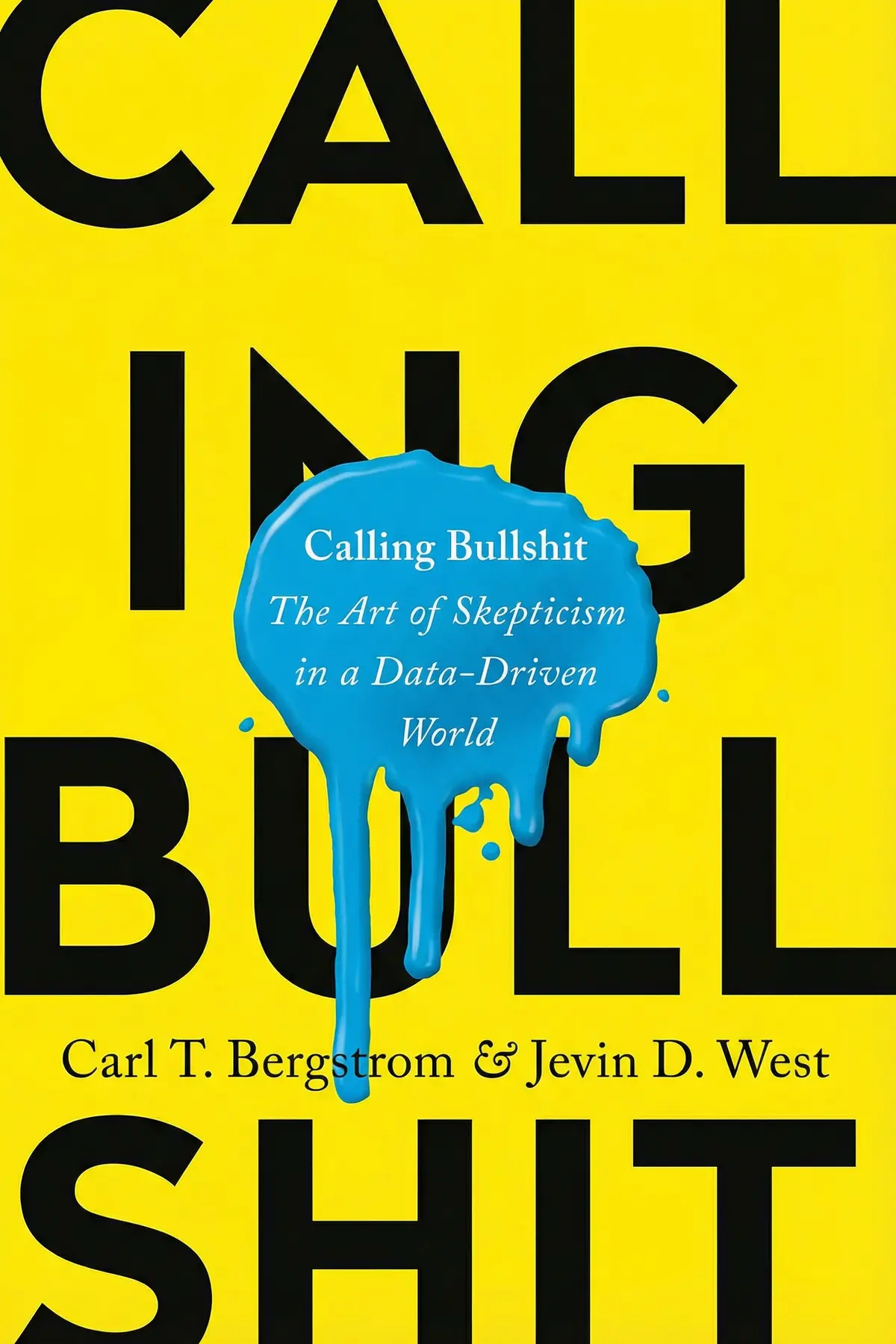
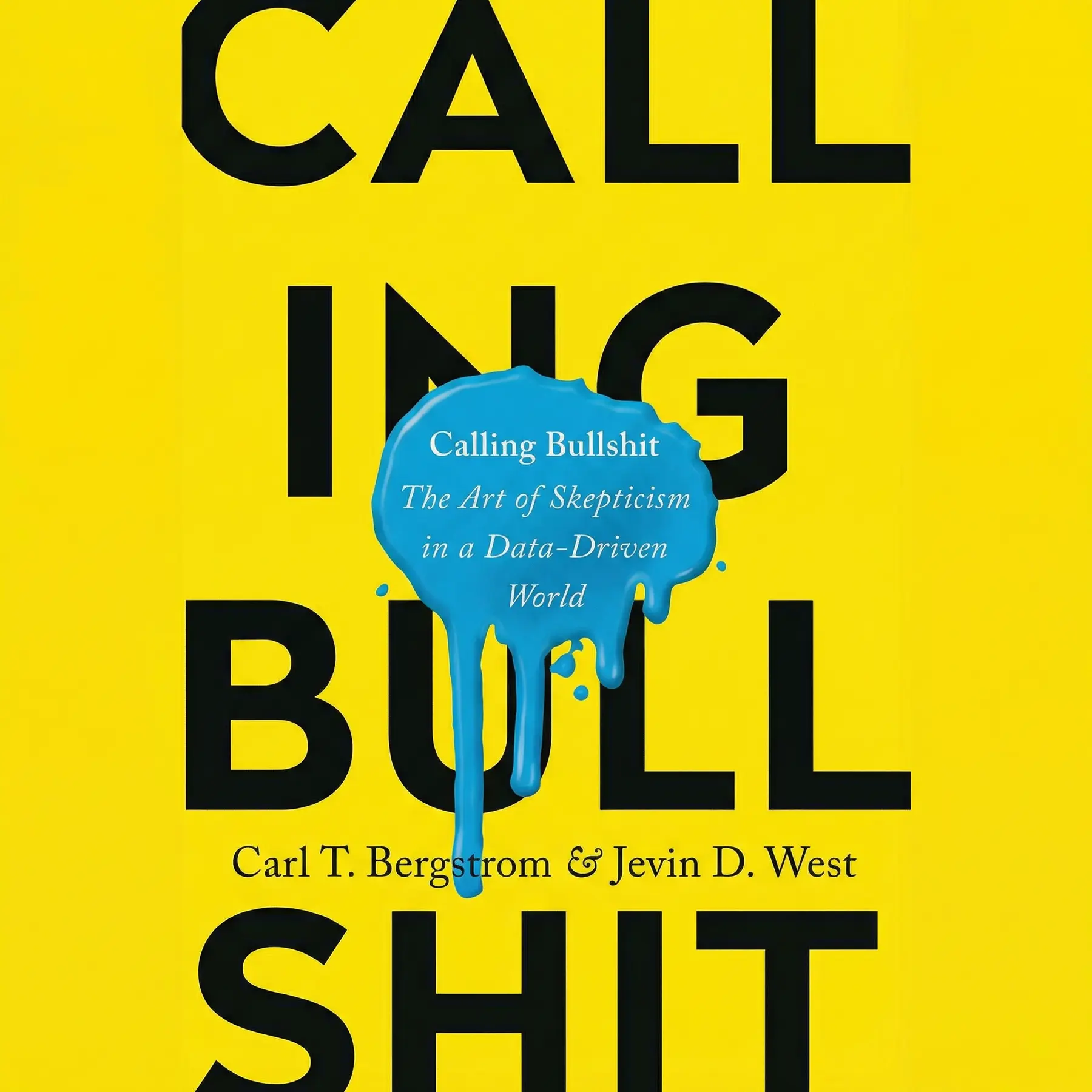
If your feeds hand you a confident chart or a shocking statistic every hour, you probably suspect some of it is rubbish but have no quick way to prove it. In Calling Bullshit, University of Washington professors Carl T. Bergstrom and Jevin D. West show that most of it falls apart under plain questions. One study claimed an algorithm could spot criminals by their faces, but the authors point out that the criminals came from ID photos and everyone else from professional headshots.
The authors argue that modern bullshit wins by wearing the costume of evidence: numbers, charts, algorithms and scientific papers. Asking where the data came from and what it really measures strips the costume off. The cases run from a retracted vaccine paper to a packet of hotel cocoa and a Google flu tracker that lost its way. Each one gives you a test to run on the next headline, sales pitch or slide deck, and a fair way to speak up when a claim fails.
1 min 49 sec
A medical paper was retracted, discredited and replaced by better research, yet its damage keeps growing. The reason has less to do with science than with how beliefs travel, and with what happens before you hit share.
1 min 47 sec
A study linked early first kisses to high self-esteem, and a housing report linked rising prices to fewer babies. Both findings were real. What the headlines did with them is where the trouble started.
1 min 47 sec
A hot drink label, a political news story and a medical press release all used true figures. Each one still left readers with the wrong picture, and none of them needed to lie to do it.
1 min 40 sec
Insurers say switching saves customers hundreds a year, and a dating puzzle seems to prove good-looking men are unkind. Both claims come from the same quiet flaw in who ends up being measured.
1 min 46 sec
A medical scanner seemed to diagnose heart and lung trouble, and Google built a tool to forecast flu. Both looked impressive. Both were fooled by something no human expert would have mistaken for a signal.
1 min 42 sec
Science is built to correct its own mistakes, yet the way studies get published, measured and reported lets errors slip through at every stage. One of those weaknesses hands ordinary readers a surprisingly quick test.
1 min 45 sec
Most bad claims reach you when you have no time, no data and no expert nearby. A journalist’s habit and a bit of mental arithmetic can still expose them, and the hardest part is checking yourself.
1 min 17 sec
What Bergstrom and West offer is a change of posture toward evidence. Bullshit rarely announces itself. It arrives as a percentage, an algorithm, a published paper or a moving photo, and it counts on you being too busy to look behind it. Their reply is that ordinary arithmetic and a few stubborn questions see through most of it. A headshot set against an ID photo, text in the corner of an X-ray, a count with no total beside it: the flaw is usually in plain view once you ask where the data came from.
The stakes are real, because belief outruns correction. Wakefield’s paper was retracted in 2010, yet the movement against vaccines that it fed is still going. Each careful reader is part of the defense.
So when a number reaches you in a meeting or a feed, ask how many people it came from and what it is being compared with. When two trends rise together, look for a third cause before accepting the obvious story. And when you speak up, bring correct figures and a polite tone.
Then remember the hotel cocoa. By that packet’s standard, even coffee is 99.9 percent caffeine free.
Every day brings new charts, percentages and study results, and plenty of them are built to persuade rather than to inform. Carl T. Bergstrom and Jevin D. West, both professors at the University of Washington, call this bullshit: claims made by people who care more about winning than about the truth, dressed up to look like hard evidence. The authors show that you rarely need advanced math to see through it. A study that claimed to spot criminals by their faces collapses once you look at the photos it used. A cocoa packet's 99.9 percent caffeine-free label means nothing once you work out the caffeine in coffee. A tiny rise in health risk looks scary when it is reported as a relative change. Insurance savings claims and drug trials get bent by who ends up in the sample, and an algorithm trained on chest X-rays learned to read printed text in a corner. Readers get a set of habits for meetings, news feeds and reports: separate correlation from cause, put every number against its real scale, ask who was left out of the data, distrust big claims in small journals, and run quick estimates in their head. The book also argues for calling out bad claims politely, with the facts right.
Professionals who read reports, dashboards and studies and want to catch misleading numbers before acting on them.
Managers and team leads who need to challenge a bad claim without embarrassing a colleague.
News readers tired of viral stories and scary statistics they cannot check.
Carl T. Bergstrom is a theoretical and evolutionary biologist and professor at the University of Washington in Seattle. He studies how information flows, from animal communication to social media, and is known as a critic of shoddy studies. Jevin D. West is an associate professor at the university's Information School and directs its Center for an Informed Public, researching how technology and data help and hinder science and democratic debate. Bergstrom also teaches a university course called Calling Bullshit.
Listeners find the text readable and well-crafted, with one noting how it makes technical content accessible. It is packed with excellent examples and provides an impressive guide to critical thinking. They also enjoy the humor, with one review highlighting the use of plain English illustrations. Furthermore, listeners value its precision, with one mentioning its effectiveness in spotting falsehoods and considering it a vital resource for informed citizens.
Finally got around to reading "Calling Bullshit," and it's basically a survival guide for the 21st century. Bergstrom and West do a brilliant job of deconstructing how data can be used to mislead us without technically lying. I loved the deep dive into p-hacking and the "black box" of algorithms; they make complex statistical concepts feel surprisingly intuitive for a layperson. The writing is sharp and frequently funny, keeping the tone light even when the subject matter feels overwhelming. It’s not just about debunking fake news, but about understanding the structural reasons why misinformation spreads so fast. In my experience, the section on data visualization alone is worth the price of admission. It truly feels like essential reading for anyone who wants to navigate the internet without losing their mind.
Show moreEver wonder why it takes five minutes to make up a lie but five hours to debunk it? This book introduces Brandolini’s Law, and truth is, that concept alone changed how I view my social media feed. The authors move past old-school rhetoric to tackle the "new-school" bullshit that hides behind fancy charts and scientific jargon. It’s written with a fantastic sense of humor that makes even the technical sections on selection bias and correlation versus causation fly by. I particularly appreciated the distinction they make between spotting bullshit for yourself and the social performance of "calling" it out. They warn us not to become "well-actually" guys, which is a trap many of us fall into. This is a powerful tool for informed citizens.
Show morePicked this up hoping for a way to win arguments online, but I walked away with something much more valuable: a mirror. The authors brilliantly point out that the person most likely to bull-shit you is actually yourself, especially when a factoid confirms your existing prejudices. Their advice to pause when something feels "too good or too bad to be true" is simple yet profoundly difficult to implement in the heat of the moment. The writing style is engaging, mixing academic rigor with casual anecdotes that make the material feel incredibly accessible. I loved the section on "Fermi estimation" as a way to quickly check the logic of a claim. It’s a fantastic guide for anyone who wants to be a more discerning consumer of information in a data-drenched world.
Show moreWow. This is a must-read for anyone who feels exhausted by the constant "tsunami of crap" we face every day. Bergstrom and West are total masters at taking technical, intimidating material and making it feel like a conversation at a bar. I especially liked the examples involving the Covid epidemic and how science being done in real-time creates the perfect breeding ground for misinformation. The book is accurate, well-researched, and manages to be funny without being flippant about the very real dangers of bad data. It teaches you how to look for the "mendacious element" in a claim without needing a PhD in mathematics. This is truly the art of skepticism refined for a world where everyone has a megaphone.
Show moreAs someone who works in data, I found the breakdown of "mathiness" to be the most satisfying part of this entire book. The authors explain how people use complex-looking formulas to intimidate others into silence, which is a tactic we see everywhere in business today. Frankly, the way they explain the "Trust Equation" as a nonsensical formula was both hilarious and eye-opening. The book is filled with great examples that use plain English to explain why certain graphs are designed to deceive our eyes. My only real gripe is that it feels very US-centric, often ignoring international contexts or cases that might be more familiar to global readers. Still, it provides an amazing guide to critical thinking that is desperately needed in our current media landscape.
Show moreThe chapter on AI and machine learning was the absolute highlight of this book for me. Most people treat algorithms like magic oracles, but the authors strip away that mystique to show how "garbage in" always leads to "garbage out." It’s a sobering look at how automated systems can perpetuate bias while maintaining an air of objective authority. I also found the discussion of p-hacking in scientific journals to be incredibly illuminating, if a bit disheartening for my faith in academia. While the book can get a little repetitive with its warnings about confirmation bias, the examples are current and relevant. Not gonna lie, I’ll never look at a "wine is good for your heart" headline the same way again. It’s a very readable and necessary reality check.
Show morePersonally, I think every high school student should be required to read the section on misleading graphics. We are constantly bombarded with "ducks" and "glass slippers" that warp our perception of reality, and this book gives you the goggles to see through them. To be fair, some of the statistical deep dives went a little over my head, but the authors always brought it back to a practical takeaway. I appreciated that they didn't just focus on "fake news" but also on well-intended scientists who accidentally misinterpret their own data. It makes the whole problem of bullshit feel more like a collective challenge than a battle against villains. My only complaint is that the section on actually calling out the bullshit was a bit short. I wanted more scripts for those awkward family dinners!
Show moreFrankly, the authors deserve a lot of credit for making a book about statistics actually feel fun to read. They tackle everything from the Wakefield vaccine debacle to the Prosecutor's Fallacy with clarity and a healthy dose of wit. I did find the book a bit long-winded in the middle sections, but the "Top Tips" summary at the end is pure gold for quick reference. It’s a wonderful resource for learning how to spot selection bias and the dangers of unrepresentative samples in the media. While it doesn't solve the problem of people who want to believe lies, it empowers the rest of us to stay grounded in reality. It’s a solid, well-written guide that turns complex data into something you can actually use.
Show moreWas this book actually bull-shitting me? I found it incredibly dense, with a relentless barrage of examples that made the reading experience feel heavier than it needed to be. While the information on p-values and statistical methods is certainly accurate, it felt a bit like a textbook disguised as a popular science read. To be fair, the authors are clearly experts, but the "negative lilt" of the prose wore me down after a few chapters. I would have preferred more interactive exercises where I could practice calling bullshit on headlines before they gave away the answer. It's a solid refresher for anyone who has studied stats, but I didn't feel like I was truly being trained in a new skill. It’s useful, just a bit of a slog to get through.
Show moreLook, the title is "badass" and the marketing is great, but there just wasn't enough new information here to justify three hundred pages. Much of what is covered—correlation isn't causation, checking sources, etc.—is ground that has been trodden a thousand times before in better books. The truth is, if you’ve watched a couple of TED Talks on data literacy, you’ve already got the gist of what Bergstrom and West are selling. I also found the tone to be a bit condescending at times, as if the authors assume the reader is constantly being duped by the simplest tricks. It’s fine for a total beginner, but for anyone with a modicum of skepticism, it’s a lot of fluff around a few simple ideas. I’d recommend just reading the last chapter and moving on.
Show moreCarl T. Bergstrom and Jevin D. West argue that bullshit is persuasion by people who care more about winning than about the truth, and that today it usually arrives disguised as data: statistics, charts, algorithms and scientific papers. Their point is that you rarely need advanced math to expose it. Asking where the data came from, what the numbers mean in context, and whether a link is really a cause catches most of it.
For Bergstrom and West, bullshit differs from a lie. A liar knows the truth and hides it, while a bullshitter is trying to impress or persuade and is indifferent to whether the claim is true. The tools are language, statistics and graphics, often piled on to overwhelm the audience, and the result is made to look as close to the truth as possible.
A Fermi estimate is a rough calculation done in your head to see whether a claim is the right size. The authors test a claim of 121,000 John Smiths in the UK by assuming about 100 million people, one in a hundred named John and one in a hundred named Smith. That gives about ten thousand, enough to show the claim is far too high.
Ask who is behind a claim, how they got the information and what they are selling. Check any number against its total and its starting point, and look at whether a percentage is relative or absolute. Ask who was left out of a sample, look at what data an algorithm was trained on, and check that chart axes start at zero. When you challenge something, get your facts right and stay polite.
It suits anyone who regularly meets numbers they cannot easily check: knowledge workers reading reports, managers weighing vendor claims, students learning research methods and news readers facing viral stories. The examples are concrete, from a cocoa label and car insurance savings to a Google flu tracker and a retracted vaccine study, so no statistics background is needed to follow them.
Jeff Hawkins




Lisa Kaltenegger




J. Craig Venter
AUDIO SUMMARY AVAILABLE
Get the key ideas from Calling Bullshit by Carl T. Bergstrom, plus 5,000+ more nonfiction titles.









