

14 min 57 sec
Available in: English
Built: The Hidden Stories Behind Our Structures
By Roma Agrawal
Structural engineer Roma Agrawal explains how buildings, bridges and water systems stay up by channeling compression and tension. She draws on deadly collapses, ancient materials and towers that survived typhoons and earthquakes.
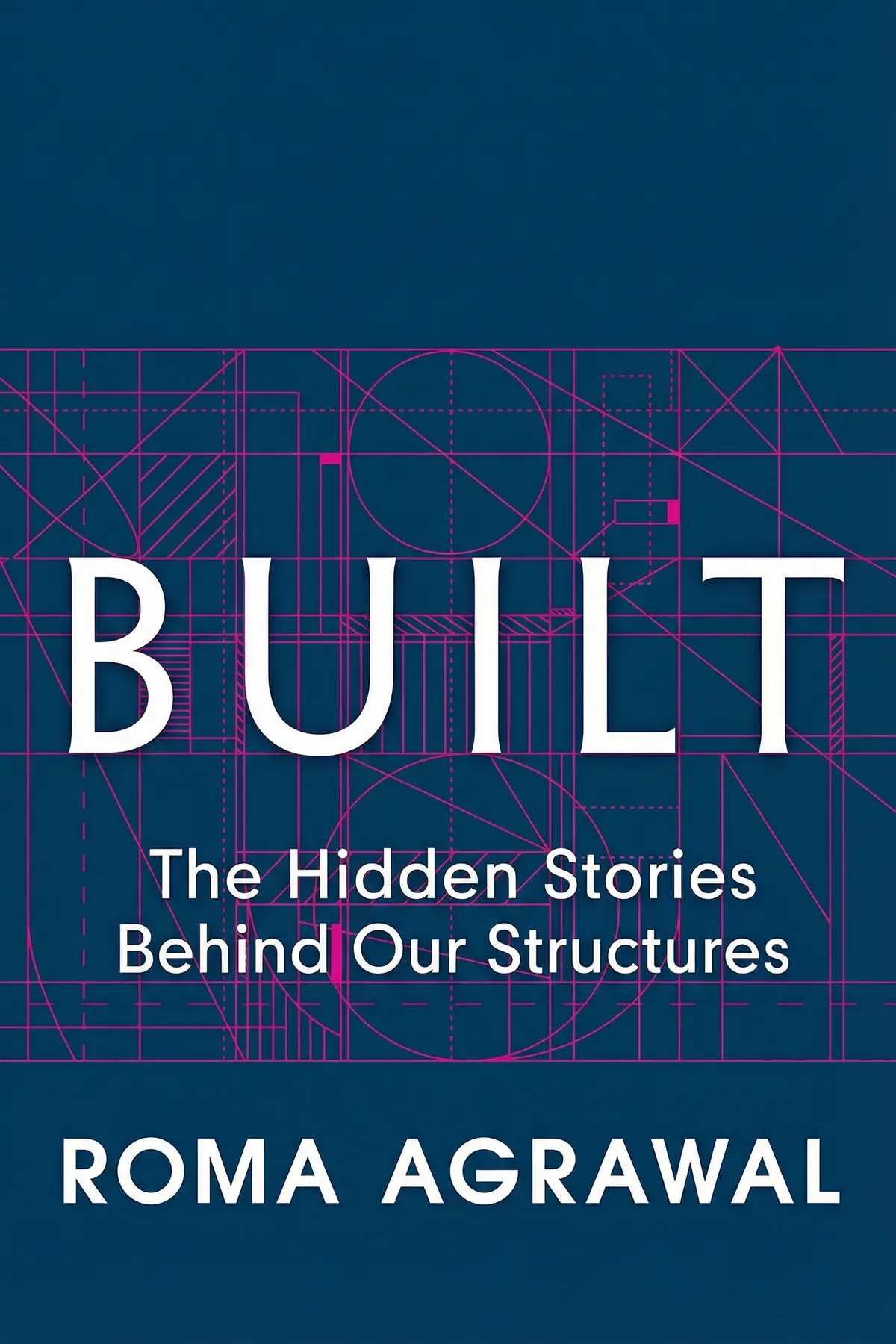
Table of Content
1. Introduction
59 sec
Most people notice buildings only when one falls. In Built, structural engineer Roma Agrawal shows that every structure still standing after a storm records how well its builders understood nature’s forces. Her first lesson is that everything that stands is managing just two of them, compression and tension. Agrawal, a London-based engineer who worked on the design of The Shard, argues that the history of building is the story of channeling those two forces better, through new parts, new materials and hard lessons from collapse.
That thread runs from mud huts to a 660-ton pendulum hanging inside a Taiwanese tower, and from a French gardener’s cracked flowerpots to the sewers under London. Follow it and the city around you becomes readable. The habits of its engineers also turn out to be useful for any large project you run, from checking the ground before you start to hunting down the weakest link.
2. Spot the two forces holding everything up
1 min 39 sec
A bridge in Canada fell in less than 20 seconds, killing 75 workers. Behind that failure, and behind every success, are two simple forces you can feel in your own legs and arms.
3. A building is simple parts plus a spine
1 min 30 sec
A glass tower and a child’s toy model have more in common than most people think. Once you know a handful of names, a skyline stops being decoration and starts to show you how it stays up.
4. Towers that sway safely through storms and quakes
1 min 49 sec
One tower in Taiwan hides a 660-ton pendulum high up, between its eighty-seventh and ninety-second floors. A tower in Mexico City survived a huge quake so smoothly that the people inside never noticed it.
5. Find the one failure that topples everything
1 min 52 sec
A woman lit her stove to make tea, and part of a London tower block came down. Her flat had a hidden weakness, and so did two of the most famous towers in the world.
6. Pair materials so their weaknesses cancel out
2 min 05 sec
Bricks go back more than 11,000 years, and the Romans’ skill with them vanished for six centuries. The material that reshaped modern cities came from someone tired of broken flowerpots.
7. Know your ground before you draw anything
1 min 55 sec
A great cathedral was built on a giant platform to keep it level, and it tilted anyway. Fixing it meant digging out soil, hole by hole, from beneath a cathedral whose construction began in 1573.
8. Build water systems for the next century
1 min 57 sec
A 2,700-year-old water tunnel still supplies a city of 40,000. A Victorian engineer in London made a bet about the future that the city is still living off.
9. Conclusion
1 min 11 sec
Built adds up to a way of seeing. A tower, a sewer or a brick wall is the latest entry in a record that runs from Jericho to Dubai’s 828-meter Burj Khalifa. Every entry exists because someone understood the forces, the ground or the material, often after watching something fail. Agrawal believes the record is far from closed. A fully 3D-printed footbridge was completed in Madrid in 2016, robots are starting to lay bricks and pour concrete, and Stuttgart’s Landesgartenschau Exhibition Hall copies the plated dome of a sea urchin’s skeleton to be both strong and light.
The engineer’s habits carry into ordinary work. Before starting something big, learn the ground it will stand on. Find the one part whose failure would bring down the rest, and tie it more firmly to everything around it. When a system will be costly to rebuild, size it for the future, as Bazalgette did.
The next time a city rides out an earthquake, think of the Torre Mayor, where the people inside never knew anything had happened. The best engineering is the kind nobody notices.
About this book
What is this book about?
We walk past bridges, towers and brick walls every day and rarely think about them, unless one falls down. Roma Agrawal, a structural engineer who worked on the design of The Shard, thinks that is a pity. Every building still standing after a storm records how well its engineers understood the forces of nature. She starts with the two forces every structure has to manage, compression and tension. From there she follows the parts that carry them, the materials that resist them and the disasters that taught engineers where they had gone wrong. Her stories run from mud huts and Roman arches to a 660-ton pendulum inside Taipei 101, from a London gas explosion to a cathedral in Mexico City that had to be straightened by drilling out soil. Readers come to see the built world as a series of decisions they can actually read. Along the way they pick up engineering habits that work far beyond construction: check the ground before you start, find the single point that could bring everything down, and build what is expensive to replace for the demand of the future.
Book Information
Who it's for
Professionals curious about structures
Curious professionals who walk past bridges and towers every day and want to understand how they stay up.
Prospective engineers and architects
Students weighing engineering or architecture who want the human stories behind the discipline.
Project managers
Project leads who want lessons on hidden risks, weak links and building for future demand.
About the Author
Roma Agrawal
Roma Agrawal is a chartered structural engineer born in Mumbai and based in London. She spent fourteen years in the construction industry, including work on the design of The Shard, and has also designed bridges and sculptures. She later became a full-time author, broadcaster and speaker, presenting shows for the BBC, Channel 4 and Discovery, and she champions women in engineering. She has written two non-fiction books for adults and three for children, and her books have won or been shortlisted for international awards.
Ratings & Reviews
Ratings at a glance
What people think
Listeners find the work both educational and accessible, with one listener mentioning the short chapters on various engineering technologies. The prose is expertly written, and listeners admire how the author simplifies sophisticated topics. Additionally, the book’s design-focused content is well-received, with one listener drawing attention to the discussion of stormwater and sewer networks. However, the transparency of the explanations gets varied feedback, as some listeners find them easy to follow while others find them confusing.
Top reviews
Nam
This book is a masterclass in making the invisible visible for the average person walking down a city street. I was particularly captivated by the sections on the Shard, where Agrawal’s personal involvement adds a layer of intimacy you don't usually get in technical science writing. She has a gift for explaining how forces like tension and compression dictate the shape of our world without making the reader feel overwhelmed by calculus. Occasionally, the narrative drifts into personal anecdotes that feel a bit self-indulgent, but her infectious enthusiasm usually carries the reader through those moments. It’s refreshing to see a woman leading the conversation in such a male-dominated field, providing a much-needed perspective on the built environment. If you’ve ever looked at a bridge and wondered 'how does that stay up?', this is your answer. It is a stylish, smart, and highly readable journey through the history of human ingenuity.
Show moreSomkid
Ever wonder why the skyscrapers in London don't just sink into the clay or how Mexico City's cathedral was saved from a slow-motion disaster? Agrawal answers these questions with a blend of historical storytelling and basic physics that makes structural engineering feel like a high-stakes adventure. The segment regarding the stabilization of the Cathedral of the Assumption was particularly gripping, detailing how engineers used cylindrical shafts to correct centuries of uneven sinking. Not gonna lie, I found some of the diagrams a bit too simplistic for my taste, and the hand-drawn text was occasionally hard to decipher. However, the book excels at providing a 'how it works' overview of the infrastructure we take for granted every day. It covers everything from the ancient kariz water systems to the complex drainage and sewer networks beneath our feet. For a general audience, this is a perfect entry point into understanding the skeletons of our cities.
Show moreJong
Picked this up for my niece who is interested in STEM, but I ended up devouring the entire thing myself over a single weekend. The way Agrawal breaks down complex concepts into chapters titled 'sky' or 'earth' makes the daunting world of civil engineering feel incredibly approachable. I was especially fascinated by the history of the London sewer system and the evolution of waste management, which is something most people never stop to think about. The book manages to be both educational and inspiring, showing that engineering is as much an art as it is a science. Look, it’s not a textbook, but it does a fantastic job of sparking curiosity about how our world is constructed. It’s the kind of book that makes you look up at the ceiling of a train station and actually see the trusses for the first time. Highly recommended for young readers and curious adults alike!
Show moreEmma
Wow, I never expected a book about structural engineering to feel this human and personal. Agrawal’s storytelling turns what could have been a dry subject into a series of fascinating vignettes about how humanity overcomes physical obstacles. The way she describes the challenges of building in earthquake zones or on soft soil is both terrifying and enlightening. In my experience, most science writers struggle to balance the technical with the emotional, but she finds that sweet spot with ease. The stories about the Brunel family and the Thames Tunnel were particularly evocative of a time when engineering was a wild, dangerous frontier. While the hand-drawn elements are a bit 'cutesy', they do help to demystify the core concepts for a layperson. This is the perfect gift for anyone who enjoys learning about the hidden mechanics of our world. It’s an uplifting, eye-opening read that stays with you long after the final page.
Show morePalm
To be fair, the writing style is breezy and engaging, but I found the author’s tendency to ignore the collaborative nature of construction quite jarring. Agrawal writes about massive projects like the Shard as if she were the sole designer, rarely acknowledging the architects or the hundreds of other stakeholders involved in such mega-structures. It creates this strange 'me-centric' narrative that doesn't reflect how modern engineering teams actually function in the real world. While the diagrams are helpful, they sometimes feel a bit 'YA' and lack the technical depth I was hoping for as an adult reader. Frankly, it’s a decent introduction for the general public, but the omissions of team dynamics made it feel a bit hollow. I wanted to love it more given the author's impressive credentials, yet it still serves as a solid primer for anyone curious about the basics of buildings.
Show moreChatchai
The chapter on bridge foundations and the use of caissons was a standout moment for me in an otherwise light read. Agrawal explains the terrifying pressure of working underwater with a clarity that made my own lungs feel heavy. While the book leans heavily into the author's own career highlights, her personal stories provide a grounded context for the abstract physics she describes. I did notice a few oversimplifications in the historical segments that felt a bit like reading a Wikipedia summary, but for a popular science book, it’s acceptable. The focus on the John Hancock Center and other iconic skyscrapers provided a great look at how wind and gravity are managed at scale. It’s an easy, digestible read that doesn't require a math degree to enjoy. My only real complaint is that I wanted more detail on the materials science side of things. Still, it’s a very solid four-star effort.
Show moreNing
As someone who appreciates the 'How It’s Made' aesthetic, Agrawal’s breakdown of materials like steel and glass felt incredibly rewarding. She manages to weave together the ancient history of mud bricks with the futuristic glass of the Shard in a way that feels seamless and logical. I particularly appreciated the coverage of stormwater systems, as urban drainage is such a vital but ignored part of our modern lives. Some critics might find her 'I-heavy' narrative voice annoying, but I found it made the professional world of engineering feel more human and less like a series of blueprints. The book is well-executed, though some of the photos were a bit grainy and didn't quite show the details mentioned in the text. Overall, it’s an informative look at the built environment that successfully avoids being dry or overly academic. It definitely changed the way I look at my commute through the city.
Show moreLeah
Finally got around to reading 'Built' and I must say the diagrams really helped clarify some of the more complex physics concepts for me. I’ve always been curious about the London underground and the sewers, so those chapters were a real treat to read. Agrawal’s writing style is punchy and direct, which keeps the pacing fast even when she’s talking about soil density or concrete pouring. There were times when the focus on her personal feelings about a project felt a little out of place, but it didn't ruin the experience for me. The book does a great job of highlighting the beauty in functionality, something we often overlook in our daily lives. It’s a quick read that packs a lot of information into a very manageable format. Even with the minor criticisms about the illustrations, I’d still recommend this to anyone looking to understand the world around them. It turns a walk through a city into a much more interesting experience.
Show moreAnchalee
After hearing so much buzz about this title, I found the actual experience of reading it to be a bit of a mixed bag. The writing is certainly accessible, but it often borders on being too simplistic, making it feel more like a Young Adult book than a serious exploration of engineering. I was disappointed that Agrawal didn't spend more time discussing the collaborative relationship between engineers and architects, which is a massive part of the building process. The chapters are brief and move quickly, which is great for a light read, but I often found myself wishing for more technical depth. To be fair, her passion for the subject is obvious and her career at the Shard is impressive. However, the factual errors regarding Roman history and the transition into the Iron Age were distracting enough to pull me out of the narrative. It’s a fine introductory text, but seasoned builders might find it a bit thin.
Show moreAhmed
While Roma Agrawal's passion is undeniable, the book is riddled with frustrating historical inaccuracies that make it hard to trust the technical portions. For instance, claiming that Roman bricks were mostly sun-dried adobe is factually wrong, as fired brickwork is what actually survives in those ancient ruins today. Furthermore, her explanation for the end of the Bronze Age felt overly simplistic and ignored the actual metallurgical shifts regarding iron smelting. I also struggled with the hand-written legends on the illustrations because they were nearly unreadable at times, which is a real shame for an engineering book. Truth is, a good editor should have caught these glaring errors before publication. It’s a breezy read, sure, but the lack of depth in basic material science left me skeptical about the rest of the content. I found myself skimming large sections just to get to the end.
Show moreQuestions about this book
What is the main idea of Built by Roma Agrawal?
Agrawal argues that every structure still standing is managing two forces, compression and tension. Building history is the story of channeling those forces better. She traces how engineers learned to do it through basic parts like columns, beams and trusses, through materials from sun-dried bricks to reinforced concrete, and through hard lessons from collapses such as the Quebec Bridge and a London tower block.
What is the difference between compression and tension in Built?
Compression happens when weight presses down on something, the way your legs carry your body when you stand. Tension happens when weight hangs from something and pulls it, the way your arm strains when you lift a bowling ball. Agrawal shows that early mud huts relied on compression through thick walls. Frames of lashed logs relied on tension.
How do skyscrapers survive wind and earthquakes according to Built?
Tall towers are tested as scale models in wind tunnels. Some also carry a tuned mass damper, a huge pendulum that swings against the sway. Taipei 101’s 660-ton damper moved a full meter during Typhoon Soudelor in 2015. Against earthquakes, engineers avoid matching the frequencies of past quakes, use rubber bearings or add dampers, as in Mexico City’s Torre Mayor.
What lessons from Built apply outside engineering?
Several of the book’s stories carry over to any large project. The Ivy Hodge collapse shows why one weak point must never be able to bring down the whole. Mexico City’s tilted cathedral shows how unevenly compacted soil can defeat even a foundation planned for soft ground. Joseph Bazalgette built London’s sewers for twice the city’s population, which shows the value of sizing hard-to-replace systems for future demand.
Who should read Built?
It suits curious readers who want to understand the bridges, towers and pipes around them without studying engineering formally. It also works for students thinking about engineering careers. Agrawal mixes clear explanations of forces and materials with stories, from Roman bricks and a French gardener’s concrete pots to the Great Stink of 1858.
Readers also enjoyed

A Life Decoded: My Genome: My Life
J. Craig Venter

A Planet of Viruses
Carl Zimmer

A Short History of Nearly Everything
Bill Bryson

A Thousand Brains: A New Theory of Intelligence
Jeff Hawkins




Alien Earths: The New Science of Planet Hunting in the Cosmos
Lisa Kaltenegger

AUDIO SUMMARY AVAILABLE
Listen to Built in 15 minutes
Get the key ideas from Built by Roma Agrawal, plus 5,000+ more nonfiction titles.
- 5,000+ titles
- Listen as much as you want
- 7-day free trial
- Cancel anytime









