

15 min 20 sec
Available in: English
Both/And Thinking: Embracing Creative Tensions to Solve Your Toughest Problems
Shows how to handle competing demands, like career and family or profit and purpose, by treating them as linked opposites and finding ways to serve both instead of sacrificing one to the other.
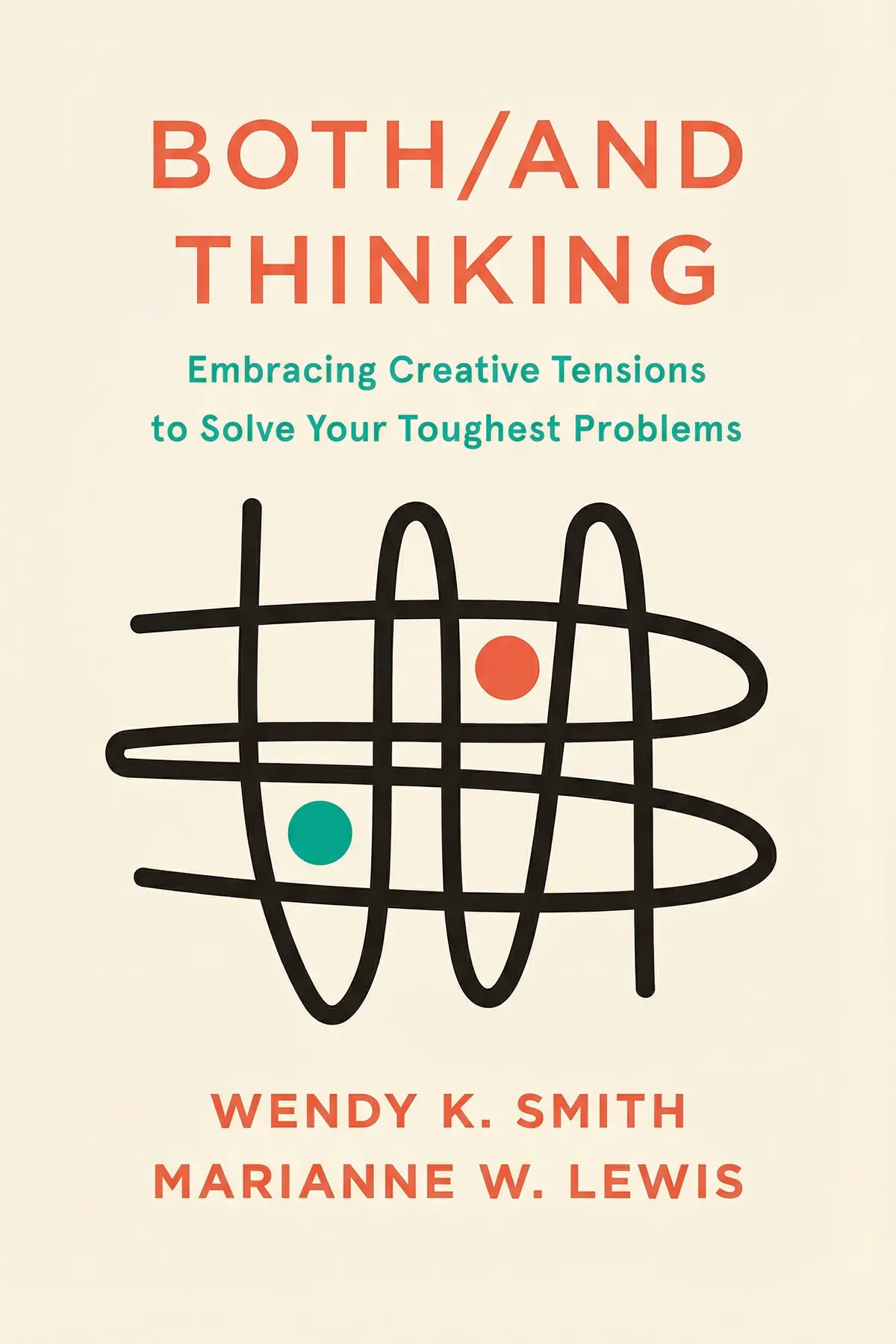
Table of Content
1. Introduction
58 sec
If every big decision at work or at home feels like giving something up, the trouble may lie in the question itself. In Both/And Thinking, management scholars Wendy K. Smith and Marianne W. Lewis argue that most dilemmas sit on top of paradoxes: two opposing demands that compete with each other and also depend on each other. Treat them as a contest with one winner, and you often lose both.
Their case, built on roughly 25 years of research, is that when you stop asking which option to pick and start asking how to serve both, tension turns from a trap into a source of new ideas. The evidence runs from LEGO’s near collapse to a social enterprise in Cambodia and a struggling Unilever. Along the way come tools for blending or balancing competing goals, limits that keep tension from wearing you down, and ways to stay calm while the answer is still unclear.
2. Your hardest choices hide linked opposites you can use
1 min 47 sec
Career or family, today or tomorrow, yourself or others. These choices feel like forced sacrifices, yet the authors see something hidden underneath them, and a very human reason we keep missing it.
3. Catch the vicious cycles before they take over
1 min 38 sec
A toy company once owned most of its market, then nearly went bankrupt, and both moves came from the same mistake. The pattern shows up in teams and careers more often than you might expect.
4. Rewrite the question you are stuck on
1 min 34 sec
A founder in Cambodia kept being asked whether his organization was a business or a charity. His reply sounded like a dodge, yet it described exactly how the enterprise managed to survive and grow.
5. Blend two goals or balance them over time
1 min 40 sec
A leadership retreat and a family wedding land on the same day. The authors offer two very different ways to keep both, one borrowed from an animal and one from a circus act.
6. Set limits that keep tension from wearing you out
1 min 33 sec
Holding two opposing demands at once can drain anyone. A shared pizza and a carefully chosen board of advisers show how the right assumptions and boundaries make the effort sustainable.
7. Learn to sit with the unease of not knowing
1 min 42 sec
Try not to think about a white bear, and watch what happens. That simple experiment explains why pushing away the discomfort of a tough choice usually makes it louder.
8. Keep the mindset fresh with small experiments
1 min 33 sec
A few small 50cc bikes that executives rode on errands helped open a huge market for Honda. The story shows why both/and thinking works best as a habit you keep adjusting, never a finished plan.
9. A rescue plan that served profit and planet
1 min 41 sec
Morale at one global company had sunk so low that its canteen served a rival’s tea. Its new chief refused the obvious trade-off between survival and responsibility, and the tension became fuel.
10. Conclusion
1 min 14 sec
What Smith and Lewis offer, in the end, is a different relationship with conflict. An either/or mind sees life as a run of sacrifices: the wedding or the retreat, the crust or the toppings, profit or the planet. A both/and mind sees the same moments as raw material. LEGO lost its way twice by choosing a side and found it again with a bifocal view. Hockenstein built his Cambodian enterprise by refusing a label. Polman turned a company in crisis into a test of whether doing good and doing well could feed each other.
None of this makes tension disappear. Lewis says plainly that both/and is no cure-all, and the work stays tiring. What changes is your stance. Take the next decision that feels like a loss and rewrite it as a how-can-we question, ideally with a colleague who sees what you miss. Decide whether it calls for a mule or a tightrope, and when the unease arrives, let it sit before you reach for closure.
The authors want people to treat tension as a force of life, something they have the agency to meet in a new way. That begins with one question, asked better.
About this book
What is this book about?
Career or family, profit or purpose, today's results or tomorrow's growth: hard choices tend to arrive as either/or decisions, and picking one side often means losing something you needed. Wendy K. Smith and Marianne W. Lewis argue that most of these dilemmas rest on paradoxes, opposing demands that compete with each other and depend on each other at the same time. Drawing on roughly 25 years of research, the authors show how either/or thinking sends people and companies into vicious cycles, as it did at LEGO, and how a both/and approach turned tension into innovation at Unilever, IBM and Digital Divide Data in Cambodia. Their paradox system combines new assumptions, firm boundaries, comfort with discomfort and an ongoing habit of adjustment, with each tool supporting the others. Readers get practical moves to use on their own dilemmas: rewriting the question, deciding whether to blend two goals or balance them over time, setting limits that keep tension manageable, and staying steady while the answers are still unclear.
Book Information
Who it's for
Managers caught between timeframes
Managers caught between short-term results and long-term bets who keep being told to pick one.
Social enterprise leaders
Founders and leaders trying to run an organization that serves both profit and a social mission.
Weighing career against family
Professionals and parents torn between career and family who want options beyond sacrifice.
About the Author
Wendy K. Smith
Wendy K. Smith is the Dana J. Johnson Professor of Management at the University of Delaware's Lerner College of Business and Economics, where she directs the Women's Leadership Initiative. Educated at Harvard and a fellow of the Academy of Management, she studies how leaders respond to linked tensions that seem contradictory. Marianne W. Lewis has been dean of the Carl H. Lindner College of Business at the University of Cincinnati since 2019, after leading Cass Business School in London. A former Fulbright scholar, she researches paradox theory, with articles in Harvard Business Review and Academy of Management Journal.
Ratings & Reviews
Ratings at a glance

What people think
Listeners find the text accessible and value its scholarly perspective, with one listener characterizing it as a must-read. They also find the content intellectually stimulating, with one noting it offers vital insights into navigating tensions. Feedback on the writing is split; some find it unengaging, while one listener mentions it is authored by business school professors.
Top reviews
Madison
Ever wonder why you feel trapped by impossible dilemmas where every choice seems like a compromise? Wendy Smith and Marianne Lewis offer a truly liberating path out of that trap by teaching us how to embrace paradox rather than fear it. This is a thought-provoking deep dive into mental flexibility that shifted my entire perspective on conflict. Not gonna lie, the pace can be a bit deliberate at times, but the depth of research makes every chapter feel essential. I especially appreciated the way they bridge the gap between academic theory and practical inclusionary thinking. It has made me a wiser, calmer leader who can now see the 'both/and' potential in situations that previously felt like dead ends. Highly recommend for anyone ready to upgrade their brain's operating system.
Show moreConnor
Wow, this really changed the way I approach conflict in my personal and professional life by offering a path out of the binary trap. Wendy Smith and Marianne Lewis have created something truly special here that goes beyond simple decision-making. I’ve gone from making swift, sometimes impulsive choices to pausing and finding the fascinating opportunities between the alternatives. In my experience, the 'Both/And' approach makes you a more inclusive thinker and a more resilient human being. The writing is deep, smart, and puts expertise to immediate use in a way that feels both practical and poetic. It’s rare to find a book that offers such essential lessons on addressing the tensions of the world while remaining so readable. Truly a game-changer.
Show moreAlice
Finally got around to reading this and it’s become essential for my management team as we navigate a very difficult transition. The chapters on convergent versus divergent thinking were particularly enlightening for us. I love how the authors brought the possibilities of 'both/and' to vivid life through their research. It’s helped me become calmer in the face of chaos, seeing impossible choices as chances for innovation instead of just problems to be solved. Frankly, I think every leader should have a copy of this on their desk. It’s accessible, well-researched, and provides a clear path forward when you feel stuck between two equally important priorities. This is the kind of book you’ll find yourself highlighting on almost every single page.
Show moreDen
As someone who struggles with 'either/or' decision fatigue, I found this quite refreshing and surprisingly practical for a book written by business school professors. The authors explore the science of the 'paradox mindset' in a way that feels both rigorous and accessible. Truth is, our minds crave consistency so much that we often shut down when faced with competing priorities, but this book gives you the tools to pause and find the middle ground. Some sections felt a little slow, and I can see why people might find the business focus a bit heavy. However, the insights on divergent thinking are gold. It’s not just for CEOs; it’s for anyone trying to navigate the messy realities of modern life. It’s an essential read for those looking to master the art of the 'and'.
Show moreZoe
After hearing about the 'paradox framework' in several circles, I finally dug into the source material and found it to be a very solid study. The authors do a nice job of explaining how to move from convergent to divergent thinking, which is crucial in today's chaotic environment. While the pace is a bit slow and the writing can feel a tad academic, the actual content is actionable if you're willing to put in the mental work. I loved the summaries at the end of the chapters because they really help distill the main points. Gotta say, it's not a light beach read, but it's an important one for anyone in a leadership role. It taught me essential lessons on how to sit with tension rather than rushing to a premature conclusion.
Show moreOrm
Look, I’ll be the first to admit that academic writing can be a slog, but the insights here are worth the effort for anyone facing complex dilemmas. This book is a fascinating study in mental flexibility that challenges our natural craving for simple answers. The authors use a mix of science and storytelling to illustrate how we can thrive by embracing contradictions. To be fair, some of the examples are ones I’ve seen before, but the way they are framed within the paradox mindset feels fresh. I found the section on inclusionary thinking to be particularly relevant in today’s polarized climate. It’s a thought-provoking read that requires patience, but it rewards you with a much more nuanced way of looking at the world.
Show moreEthan
Picked this up after hearing the authors on a podcast, and while the core idea is strong, the delivery is a bit hit-or-miss. Many of the examples they use—like the classic man in a gorilla suit experiment—have been quoted so many times in other books that they feel recycled. Frankly, I think Barry Johnson’s work on 'Polarities' offers a much more robust process for handling these kinds of systemic tensions. To be fair, Smith and Lewis do include his work, which shows they’ve done their homework, but the book often feels like a corporate-academic hype fest. The charts and summaries are useful for visualization, though the overall tone can be a bit pompous. It’s a decent enough starting point if you’ve never explored paradox, but experienced readers might find it redundant.
Show moreManee
The truth is, this is a solid business book that could have been a great general-interest one if it wasn't so narrowly focused. I wasn't sold on the beginning because it felt too geared toward corporate environments, which made it hard for me to relate as a non-leader. Still, the research is well-done and the conceptualization of conflict as a paradox is helpful. I just wish they had gone deeper into personal applications rather than sticking so close to the boardroom. Some of the stories felt a bit 'packaged' and lacked the punch of authors like the Heath brothers. It’s a bit of a mixed bag for me—valuable skills are definitely buried in here, but you have to wade through a lot of vague business speak to find them.
Show moreChon
This book feels like a missed opportunity because the authors bury their core message under a mountain of business school jargon. While the concept of 'Both/And' thinking is valid, the execution here is remarkably dry and repetitive. Personally, I found the stories failed to engage me, feeling more like forced corporate case studies than genuine human experiences. If you want insightful storytelling about decision-making, you are much better off sticking with something by Chip and Dan Heath or even Annie Duke. The authors keep insisting their solutions are revolutionary, but to be fair, they mostly just describe the tensions without giving clear, actionable steps to resolve them. It was a frustrating experience that left me feeling like I’d just sat through a very long, very expensive lecture.
Show moreGabriel
Not what I expected at all, and I found the entire experience quite grating. The book claims to provide solutions for complex problems, but it mostly just circles around vague academic concepts without ever landing on anything concrete. Look, if you’re a fan of business school buzzwords and circular logic, you might enjoy this, but for me, the term 'paradox' started to feel like a bludgeon by the end. I listened to the audiobook version and the narrator’s tone was extraordinarily pompous, which only highlighted how self-important the writing felt. I’d much rather read Malcolm Gladwell if I wanted engaging stories that actually lead somewhere. This just felt like a collection of boring observations packaged as a groundbreaking framework. Save your time and your money.
Show moreQuestions about this book
What is the main idea of Both/And Thinking?
Wendy K. Smith and Marianne W. Lewis argue that most hard dilemmas rest on paradoxes: opposing demands that compete and depend on each other, such as today versus tomorrow or self versus others. Choosing one side often backfires. Instead, they suggest asking how to serve both, and they offer a paradox system of new assumptions, firm boundaries, comfort with discomfort and ongoing adjustment to make that possible.
What is the difference between a dilemma and a paradox?
In the book, a dilemma is a situation that seems to demand a clean resolution, which pulls people toward either/or decisions. A paradox is the deeper structure underneath: interdependent opposites that pull against each other yet need each other. Smith’s example is time. Energy today gives you more for tomorrow, and imagining tomorrow energizes today, so the two reinforce each other.
What is the mule versus tightrope walker approach?
These are two ways to honor competing demands. Breeding a mule means blending them into one solution, such as helping plan a work retreat in advance and then attending a family wedding on the day. Walking the tightrope means balancing them over time, such as skipping the retreat after a stretch of long work hours and leaning back toward work later.
How can I apply both/and thinking to a personal decision?
Start by rewriting the choice of A or B as a question of how to have both, ideally with a partner, since Smith found people struggle to do this alone. Decide whether to blend the options or alternate between them. Set boundaries by naming your mission, limits, must-haves and deal-breakers. Then pause, accept the discomfort, and adjust based on feedback.
Who should read Both/And Thinking?
It suits managers balancing short-term results with innovation, founders building organizations that serve both profit and purpose, and anyone torn between career and family. Its cases range from LEGO’s near collapse and Unilever’s turnaround under Paul Polman to Digital Divide Data in Cambodia, so readers in business, social enterprise and team leadership will find examples close to their own tensions.
Readers also enjoyed




A Year with Peter Drucker: 52 Weeks of Coaching for Leadership Effectiveness
Joseph A. Maciariello



Acting with Power: Why We Are More Powerful Than We Believe
Deborah Gruenfeld

All In: How Great Leaders Build Unstoppable Teams
Mike Michalowicz

AUDIO SUMMARY AVAILABLE
Listen to Both/And Thinking in 15 minutes
Get the key ideas from Both/And Thinking by Wendy K. Smith, plus 5,000+ more nonfiction titles.
- 5,000+ titles
- Listen as much as you want
- 7-day free trial
- Cancel anytime









