

15 min 32 sec
Available in: English
Being You: A New Science of Consciousness
By Anil Seth
Neuroscientist Anil Seth explains consciousness as a natural function of the living body. Your perceptions, and even your sense of self, are the brain's best guesses, built from predictions and corrected by the senses.
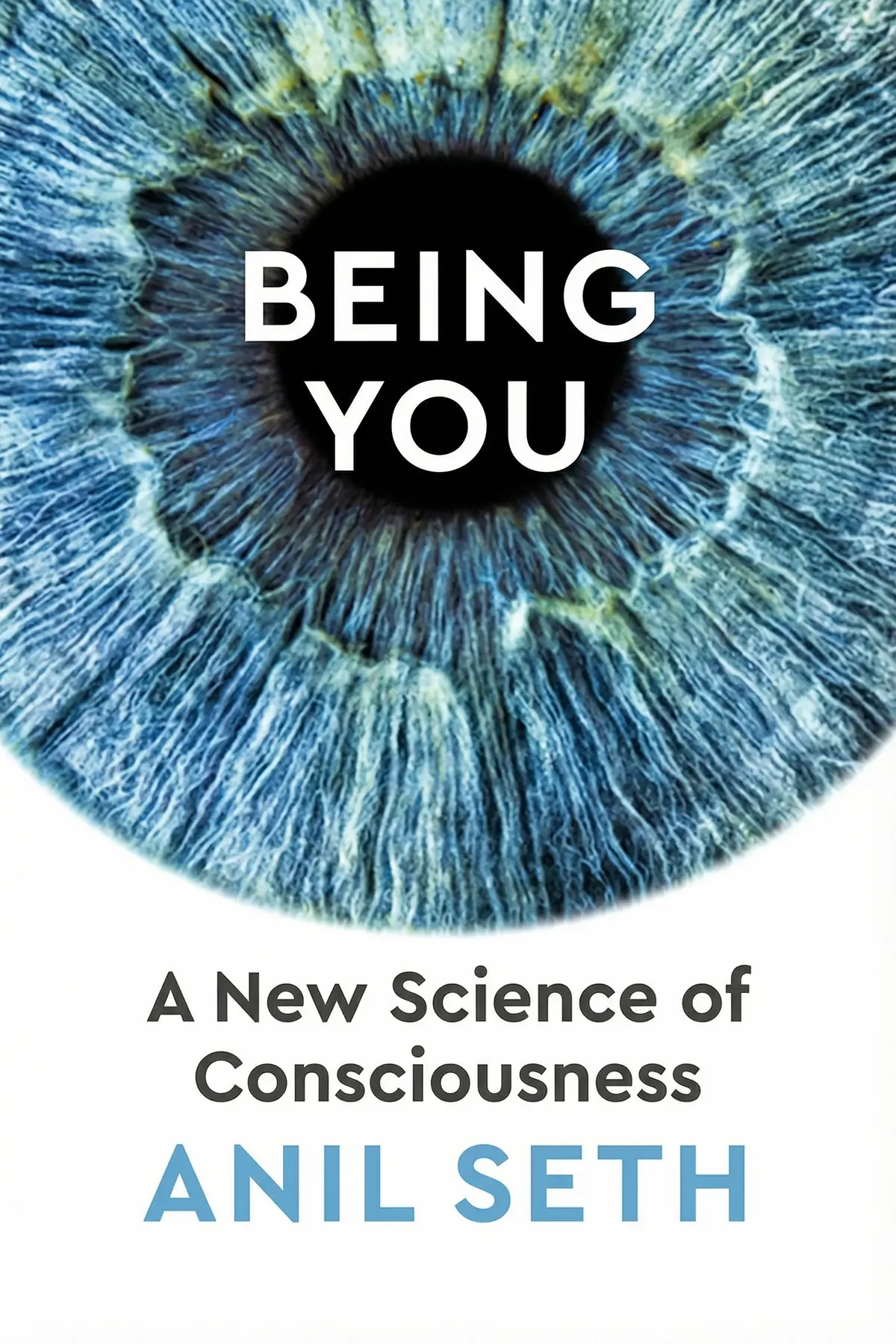
Table of Content
1. Introduction
53 sec
Most of us assume we see the world as it is, and that a self sits somewhere inside doing the seeing. In Being You, neuroscientist Anil Seth argues that both are guesses. Everything you experience, including the feeling of being you, is a controlled hallucination your brain builds from predictions and checks against the senses.
Seth’s larger claim is that consciousness is a natural function of a living body, and that science can explain it one piece at a time. The case moves from an essay about bats and a magnetic pulse sent through the brain to a wet lawn, a body-swap lab in Barcelona and pigs put on trial. What you get is a working model of your own mind: why perception misleads, why the self can split apart, and why a clever computer may still feel nothing.
2. Break the biggest mystery into answerable questions
1 min 33 sec
Even a perfect map of the brain might never explain why being you feels like anything. Seth borrows a trick from the history of biology to make that wall far less solid than it looks.
3. Tell how conscious a silent brain really is
1 min 35 sec
Some surgical patients have woken mid-operation while the monitor said they were under. A new way of reading the brain’s echo may tell doctors who is truly absent and who is still there.
4. See consciousness as information bound into one
1 min 49 sec
One respected theory says consciousness can be captured in a single number. The idea is elegant and explains a lot, but calculating that number for a real brain runs into a stubborn obstacle.
5. See that everything you see is your brain's guess
1 min 42 sec
Your senses feel like open windows onto the world. A nineteenth-century German scientist suspected the traffic runs the other way, and Seth builds his boldest claim on that reversal.
6. Spot how expectations steer what you notice
1 min 45 sec
A wet lawn on a quiet morning holds the logic your brain uses every second. An experiment with houses, faces and flickering shapes shows how much your expectations decide what you see first.
7. Your sense of self has five moving parts
1 min 39 sec
Being you feels like one solid thing behind the eyes. Rare syndromes, split brains and a virtual reality lab where strangers trade bodies suggest that feeling is assembled, and can come apart.
8. Understand feeling alive through the work of staying alive
1 min 47 sec
A nearly forgotten science of how animals and machines regulate and communicate holds a surprising key to why consciousness helps us survive. It also offers an unexpected reason why the feeling of free will is worth having.
9. Judge which creatures and machines might feel
1 min 38 sec
Medieval courts put pigs on trial, and most mammals fail a famous test of self-awareness. Neither tells us much about animal minds, and Seth’s view of consciousness casts doubt on talk of feeling machines.
10. Conclusion
1 min 11 sec
Imagine being offered a deal: swap your brain for an identical mechanical copy and live forever. Most people would hesitate, and Seth’s science explains the instinct. The feeling of being you belongs to a body that breathes, holds its temperature steady and works every moment to stay alive. Perception is that body’s best guess about the world, the self is its best guess about itself, and both were shaped for survival.
Progress on the mystery, in this view, comes in small pieces. A sharper meter in the operating room, a tested prediction about houses and faces, a body swap in a Barcelona lab: each makes the puzzle smaller.
His model gives you something to try this week. The next time you feel certain about what you saw or heard, remember that part of it came from what you expected, and look again as if another explanation were possible. When you replay a mistake, take the sense that you could have acted otherwise for what it is: a lesson your brain is filing for next time.
Being you, in Seth’s account, is the best guess a living body makes, and it keeps updating.
About this book
What is this book about?
At every moment you seem to look straight out at a world of colors, sounds and objects, with a steady self doing the looking. Neuroscientist Anil Seth argues that this is the brain's own work of prediction. Locked inside the skull, it guesses what is out there, uses the senses to correct those guesses, and you experience the result. He calls it a controlled hallucination. Seth sets aside the famous hard problem of why consciousness exists at all. He splits it into smaller questions that science can answer. Along the way he covers new ways to measure consciousness in patients, Integrated Information Theory and its untestable measure, Bayesian reasoning in the brain, and the five parts that make up a sense of self, from owning a body to knowing how others see you. His larger claim is that consciousness belongs to living bodies and evolved to keep them alive. That view changes how we think about free will, animal minds and whether computers could ever feel. Readers get a clear model of their own mind and a better sense of why perception and the self sometimes go wrong.
Book Information
Who it's for
Curious about consciousness
Curious readers who want a clear, science-based account of what consciousness is.
Curious how perception works
Students and professionals in psychology, medicine or tech who want to know how perception and the self are built.
Following conscious AI debates
People following the debate on conscious AI who want a neuroscientist's skeptical view.
About the Author
Anil Seth
Anil Seth is a British neuroscientist and professor of cognitive and computational neuroscience at the University of Sussex. He studied natural science at King's College, Cambridge, and completed a doctorate in computer science at Sussex. He edits the journal Neuroscience of Consciousness, writes for New Scientist, The Guardian and the BBC, and received the 2023 Royal Society Michael Faraday Prize. His 2017 TED talk has passed fifteen million views, and Being You, published in 2021, was a Sunday Times bestseller.
Ratings & Reviews
Ratings at a glance

What people think
Listeners find the book deeply insightful, particularly appreciating the clear way it addresses long-standing questions regarding consciousness. The writing quality is also praised, and listeners generally find the material accessible. Nonetheless, feedback on readability is inconsistent, as several listeners found the text hard to read. Furthermore, several listeners noted manufacturing flaws, specifically citing missing pages and pages not being in consecutive order.
Top reviews
Madison
Anil Seth manages to navigate the murky waters of neuroscience without drowning the reader in jargon, though you definitely need your thinking cap on to keep up. His "controlled hallucination" framework is a total revelation that completely shifts how you view your morning coffee or the colors in your garden. I especially appreciated how he sidesteps the "hard problem" to focus on the "real problem," making the science feel applicable rather than just speculative. The prose is elegant and the arguments for the "Beast Machine" are grounded in fascinating biological reality. It's rare to find a scientist who writes with this much empathy for the human condition while remaining strictly empirical. This book is a life-changing existential insight into what it means to be you.
Show moreAraya
Picked this up after seeing a recommendation on a science podcast and it did not disappoint at all. Seth’s theory that we are "beast machines" whose consciousness is tied to our biological drive for survival is both humbling and deeply thought-provoking. It’s a refreshing departure from the usual AI-centric views that suggest we’re just software that can be uploaded to a cloud. The writing is incredibly accessible for such a complex topic, though it still demands your full attention to follow the logic. This book changed how I perceive my own "self" and my connection to other living beings in nature. It’s the kind of science writing that actually shifts your worldview.
Show moreSaranya
This book is a masterclass in making the most difficult mystery in science feel approachable and urgent for the general reader. Seth’s "real problem" approach is a stroke of genius because it allows us to actually measure and map consciousness instead of just arguing about its existence. I was particularly fascinated by the discussion on how anesthesia works and what that tells us about the different levels of "being." The idea that our "self" is just another perception designed by evolution to keep us alive is a powerful existential insight. It's written with a warmth and curiosity that is often missing from high-level science books. Truly a life-changing read.
Show moreKanchana
Finally, a book that treats the study of consciousness with the rigor it deserves while remaining genuinely fun to read for the layperson. Seth bridges the gap between hard neuroscience and deep philosophy with such ease that you almost forget how complex these topics are. I loved the deep dives into how our brains predict the world and how errors in that prediction lead to what we call hallucinations. The book is comprehensive, referencing everything from Kantian philosophy to the latest in fMRI technology. It’s a dense volume, but the short, punchy chapters help maintain momentum throughout the more theoretical sections. Highly recommended for any science buff.
Show moreNadia
Ever wonder why your brain creates the world the way it does? This book dives deep into the "predictive processing" model, explaining that our reality is basically a guess that happens to be useful for staying alive. The example of "The Dress" from a few years ago was a perfect way to illustrate how our brains "color in" the world based on expectations rather than objective data. Look, it’s a bit dense in parts, and I had to re-read a few pages to really grasp the Free Energy Principle, but the payoff is worth the effort. It’s a mind-bending journey that makes you question every sensation you’ve ever had. My only gripe was that some of the philosophical detours felt a little repetitive by the end.
Show moreHugo
Wow, this was a challenging yet deeply rewarding exploration of what it means to be a sentient creature in a physical world. Seth does a fantastic job explaining that our brains are essentially "prediction machines" that use sensory data to update our internal models of reality. I found the sections on interoception—the way we perceive our internal organs—to be the most enlightening part of the whole text. Personally, I think he handles the "free will" debate a bit too dismissively, but his biological perspective is a necessary counterweight to traditional dualism. It’s a thick read, but the clarity of his metaphors keeps you moving through the more technical neurobiology.
Show moreThitiwan
After hearing Seth's TED talk, I had high expectations for this book, and it met almost every single one of them. The way he breaks down the "controlled hallucination" of our daily lives is nothing short of brilliant. It’s not just a book about the brain; it’s a book about how we inhabit the world as biological organisms. Gotta say, the link between our metabolism and our consciousness—the "beast machine" idea—makes so much more sense than any "consciousness-as-computer-program" theory I've encountered recently. It’s a beautiful, smart, and deeply humane look at the very core of our existence. Definitely a must-read for anyone interested in the mind.
Show moreJib
While the concepts are undoubtedly groundbreaking, I found myself getting bogged down in the more abstract sections like Integrated Information Theory. Frankly, Seth is clearly an expert, but his explanations sometimes assume a level of prior knowledge that left me feeling like a confused undergraduate again. I also struggled with his dismissal of color as a physical property; as someone with a physics background, it’s hard to accept that a wavelength isn't a "real" thing in itself just because our perception of it is subjective. To be fair, the "controlled hallucination" bit is a great metaphor, but the middle of the book is a bit of a slog. It’s an important work, but certainly not the light read I expected.
Show moreCamila
The chapter on IIT was where the author lost me, as the logic started to feel more like "waffly" philosophy than actual hard science. I appreciate the attempt to quantify consciousness, but these sections were incredibly hard to follow for a non-specialist reader like myself. Furthermore, I was disappointed by the physical quality of my copy, as several pages were out of order, which made an already difficult text nearly impossible to navigate. Truth is, Seth is a brilliant thinker, but the narrative flow is constantly interrupted by overwhelming context and academic side-quests. If you’re looking for a straight answer on how the brain creates "you," you might find this more philosophical than neuroscientific.
Show moreKofi
I really wanted to love this given the rave reviews, but the reading experience was quite frustrating due to the circuitous writing style. Seth has a tendency to circle around his points with personal anecdotes that don't always clarify the complex physics or biology he’s discussing. Not gonna lie, I felt like I was back in a boring lecture hall where the professor loves the sound of his own voice but forgets the students are lost. To make matters worse, my edition arrived with missing pages right in the middle of the "Beast Machine" argument. Between the dense, sometimes waffly prose and the manufacturing errors, I just couldn't fully engage with the material.
Show moreQuestions about this book
What is the main idea of Being You by Anil Seth?
Seth argues that consciousness is a natural function of the living body. What we perceive is a controlled hallucination: the brain predicts what is out there and corrects those predictions with sensory signals. The sense of self is built the same way, from several parts. Instead of attacking the hard problem of why consciousness exists head-on, he splits it into real problems that science can study one at a time.
What does Anil Seth mean by controlled hallucination?
Following Hermann von Helmholtz, Seth describes perception as working from the inside out. The brain uses prior beliefs to guess what is out there, the way you might reason about whether rain or sprinklers wet your lawn, and then updates those guesses with incoming signals. When the senses keep the guesses in check, the result is ordinary perception. When expectations grow too strong and lose touch with reality, it becomes a hallucination in the clinical sense.
Does Being You say animals or computers can be conscious?
In Seth’s view, every living being has some measure of consciousness. Most mammals fail the mirror test of self-recognition, but he argues that proves little, and the octopus shows that animal minds can be very different from ours. He questions whether a machine could ever replicate consciousness, because in his view it is rooted in a living, breathing body, and every cell contributes to the feeling of being you.
How can I apply the ideas in Being You?
Treat your perceptions as best guesses. Experiments by researcher Zair Pinto showed that people spot what they expect faster, so when you feel certain about what you saw, look again with another explanation in mind. Seth also suggests the feeling that you could have acted differently exists to help you learn, so use regret as a note for next time. Knowing the self has several parts can make odd experiences of it less mysterious.
Featured in
Readers also enjoyed


A Life Decoded: My Genome: My Life
J. Craig Venter

59 Seconds: Change Your Life in Under a Minute
Richard Wiseman

A Planet of Viruses
Carl Zimmer

A Short History of Nearly Everything
Bill Bryson


A Thousand Brains: A New Theory of Intelligence
Jeff Hawkins

AUDIO SUMMARY AVAILABLE
Listen to Being You in 15 minutes
Get the key ideas from Being You by Anil Seth, plus 5,000+ more nonfiction titles.
- 5,000+ titles
- Listen as much as you want
- 7-day free trial
- Cancel anytime









