

11 min 48 sec
Available in: English
Becoming a Changemaker: An Actionable, Inclusive Guide to Leading Positive Change at Any Level
By Alex Budak
Shows how anyone, with or without a title, can lead change at work or in their community by taking informed risks, leading with values and trust, and testing ideas in small steps with allies.
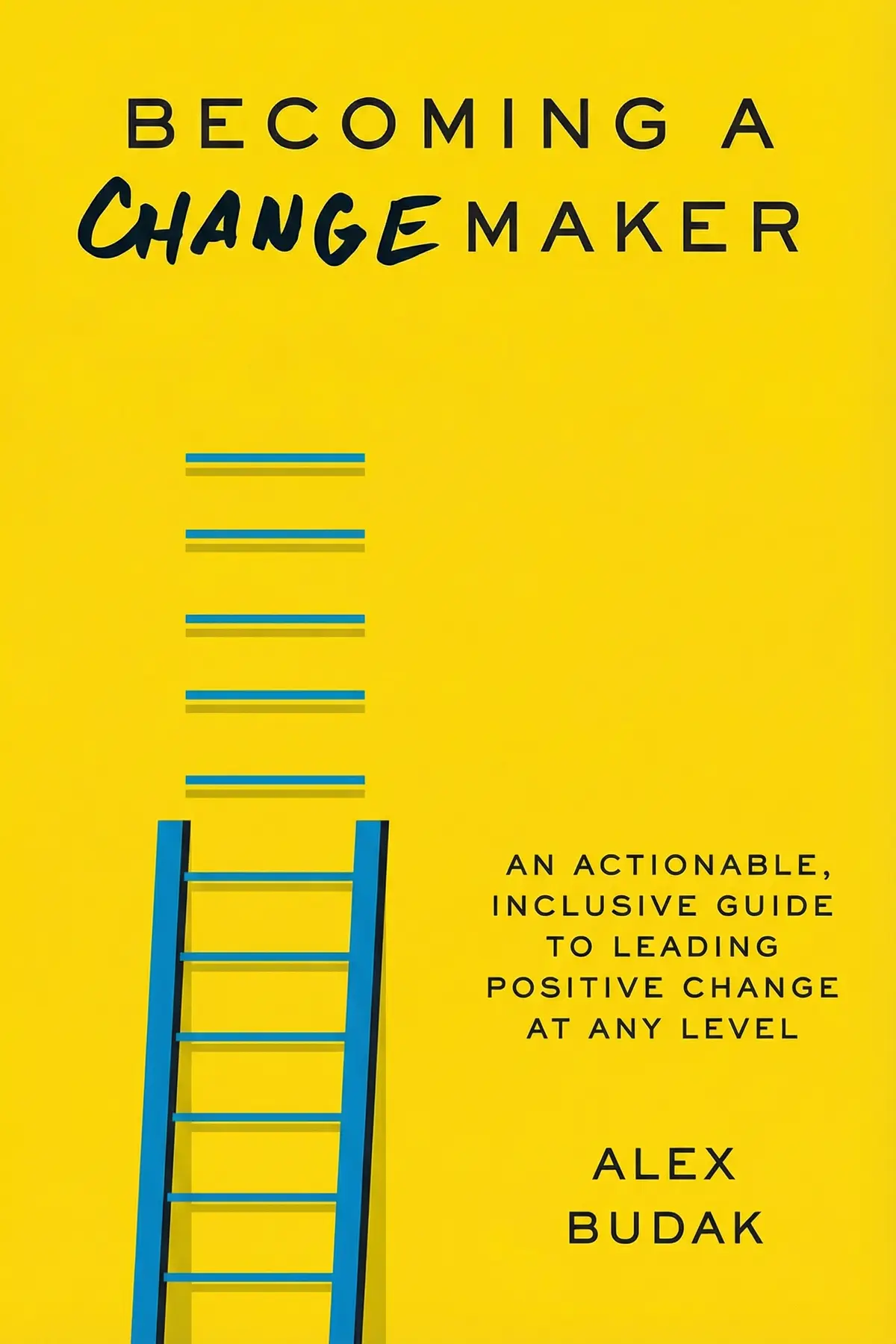
Table of Content
1. Introduction
1 min 00 sec
Plenty of capable people wait for a promotion before they try to change anything at work or in their community. In Becoming a Changemaker, social entrepreneur and Berkeley faculty member Alex Budak argues that the wait is unnecessary. The role of changemaker, he says, belongs to anyone who chooses it, and leadership starts the moment you decide to lead.
The case rests on one claim: change gets made by ordinary people who combine a way of thinking, a way of leading and a way of acting. The thinking runs on curiosity, informed risk and resilience. The leading runs on values and trust, with or without authority. The acting starts small, gets tested early and pulls other people in.
What follows takes those three in turn and turns each into something to try. By the end you will know how to choose a risk worth taking, how to lead from the seat you already have, and how to test an idea before betting much on it.
2. Pick the risks that are worth taking
1 min 40 sec
Rather than simply taking more risks, the changemaker focuses on making informed choices that can lead to real impact. Budak describes a way of thinking that decides which bets deserve your nerve, and it depends on switching between two very different mental gears.
3. Keep going when change takes longer than planned
1 min 42 sec
Many promising efforts fail without anyone defeating them; their champions simply run out of strength. Budak names the inner qualities that keep a changemaker standing, and one of them is usually mistaken for a weakness.
4. Start leading today, whatever your job title
1 min 32 sec
Most people think influence arrives with a promotion. Budak points to a kind of leadership hiding in ordinary days, small everyday moments, and argues that enough of them can significantly shape your immediate surroundings whatever your title.
5. Safe, inclusive teams produce better ideas
1 min 37 sec
Warmth and fairness at work are often treated as nice extras that come after results. Budak argues the opposite order, and he asks leaders to meet a standard higher than the one many famous names in the news are held to.
6. Test a small version before you bet big
1 min 32 sec
Big plans often collapse because they try to be finished before anyone has tried them. Budak borrows a method from startups that shrinks the risk of any new idea, and adds a surprising step involving the people who doubt you.
7. Change the unwritten rules where you work
1 min 33 sec
Every team runs on rules nobody wrote down, and they are often the hardest thing to move. Budak explains who gets to change them, why resistance is guaranteed and what keeps a changemaker going when the effort drains them.
8. Conclusion
1 min 12 sec
Budak’s book adds up to a simple claim with a demanding edge. The only entry requirement for leading change is the courage to begin from where you stand, using what you already have. The higher standard he describes, of humility, care for others and integrity, is the price of that open door.
Obstacles are certain along the way, and Budak asks readers to treat them as stepping stones, chances for new ideas and growth. Leadership in his frame means inspiring and empowering others to join a shared purpose. When people unite around one, he sees the possible impact growing far beyond what any single person could reach.
What to do with this is modest and concrete. Write down the values you want to steer by. Take the next small moment where someone needs to step up, and step up. Turn one idea into a rough version you can show people, and invite both a supporter and a doubter to react to it.
Budak’s picture of change is a ripple, each small act done with intention spreading outward. Nobody hands out permission to drop the first stone.
About this book
What is this book about?
Many capable people hold back from changing things around them because they assume leadership belongs to managers, founders and executives. Alex Budak, a social entrepreneur who teaches at UC Berkeley's Haas School of Business, argues that this assumption is wrong. In his view, becoming a changemaker is open to anyone who decides to take it on. Budak organizes his guide around three shifts. The first is a way of thinking built on curiosity, calculated risk, humility and resilience. The second is a way of leading that starts without permission, runs on clear values and small everyday acts of leadership, and builds teams where people feel safe and included. The third is a way of acting borrowed from the lean startup approach: build a simple version of an idea, test it, involve advocates and skeptics early, and work to shift the norms that keep things stuck. Readers get a practical frame for starting change from wherever they sit, whether that means a company-wide policy or a livelier team call, and for keeping going when the effort gets tiring.
Book Information
Who it's for
Hoping to improve work
Employees and young professionals who want to improve things at work but have no formal authority.
Team leads wanting openness
Team leads who want more open, inclusive teams that try new ideas.
Hoping to test initiatives
Volunteers and community organizers looking for a simple method to start and test an initiative.
About the Author
Alex Budak
Alex Budak is a social entrepreneur and a faculty member at the Haas School of Business at the University of California, Berkeley. Before Berkeley, he co-founded StartSomeGood, a platform that has supported changemakers in more than 50 countries, and served as Country Director for Reach for Change in Sweden. He speaks and runs workshops for organizations including Airbnb, Sony and the World Bank. Inc. has listed him among the world's top 50 leadership experts, and he has been named to the Thinkers50 Radar.
Ratings & Reviews
Ratings at a glance
What people think
Listeners find the work both empowering and insightful, specifically mentioning one listener's observation of how it interweaves real-world stories throughout. The book’s readability is also highly regarded, with one listener calling it the best business book of the year. Additionally, the changemaking approach is praised; one listener highlights how it lays out steps to effect powerful change. Its user-friendly nature has earned positive feedback, with one listener describing the text as a step-by-step manual for all levels. Listeners also value the comprehensive content, with one listener noting how it covers elements for all levels, and another mentioning how it uses real examples with real companies and people.
Top reviews
Hugo
Alex Budak manages to bridge the gap between academic theory and real-world application with such grace that you almost forget you’re reading a business text. It’s rare to find a book that feels this inclusive; the stories feature people from all walks of life, making the concept of 'changemaking' feel attainable rather than some abstract corporate buzzword. I particularly loved the focus on micro-actions—the small things we can do daily to push for progress. Truth is, most business books are dry, but this one is incredibly vibrant and readable. If you’ve ever felt like you didn't have the 'right' title to lead, this is the manual you need. It’s empowering, insightful, and honestly, just a joy to get through.
Show moreChamp
Wow, what a refreshingly human take on what it means to lead in the modern world! I’ve spent years looking for a guide that balances inspiration with actual, tactical steps, and this is the first one that hit the mark perfectly. The book is packed with real-world stories from actual companies that illustrate exactly how to apply the principles in real-time. It feels like a masterclass in how to be an agent of change regardless of where you sit on the ladder. Not gonna lie, I was skeptical at first, but the chapter on overcoming the fear of failure changed my entire perspective on my current project. This is easily one of the most relatable and usable business books I've picked up this year.
Show moreMilk
Ever wonder how some people just seem to make things happen, even when they aren't the boss? This book is the answer key. Alex Budak has created something truly special here—a step-by-step manual for anybody who wants to see the world (or just their office) get a little bit better. The way he interweaves diverse stories with the 'Changemaker Mindset' is brilliant because it proves that changemaking isn't a personality trait you're born with, but a skill you can learn. I found myself taking notes on every other page. It’s transformational, empowering, and deeply practical. I’ve already recommended it to several of my colleagues because we all need this mindset right now.
Show moreSebastian
After hearing so much hype about this being one of the best business books of the year, I went in with high expectations—and they were exceeded. The way Budak lays out the framework for powerful change is so intuitive that you’ll wonder why you weren't taught this in school. It’s a masterfully written guide that feels relevant to every level of an organization, from the intern to the VP. The stories are real, the people are relatable, and the companies mentioned are ones we all recognize. It’s the perfect blend of theory and practice. If you want to stop waiting for permission and start making an impact, you need to read this book immediately.
Show moreYuki
As someone just starting out in an entry-level role, I often feel like my voice gets lost in the noise of a massive organizational hierarchy. Budak’s book felt like a roadmap specifically designed for people in my position. It doesn't just tell you to 'be a leader,' it explains how to influence others when you don't actually have any formal authority yet. My only gripe is that it occasionally feels a bit like a college syllabus—which makes sense given the author's background—but it can be slightly repetitive in the middle chapters. Still, the actionable strategies for navigating office politics are worth the price alone. I wish I had this during my first internship.
Show moreMaksim
Finally got around to finishing this, and I’m genuinely impressed by how accessible the tone is. Instead of using dense jargon, Budak writes like he’s having a conversation with you over coffee. The step-by-step approach to identifying opportunities for change makes the whole process feel much less daunting than I expected. I really appreciated the diverse range of changemakers featured; it wasn't just the usual Silicon Valley suspects, which was a refreshing change of pace. While some parts felt a little too much like a self-help book for my liking, the practical exercises at the end of each chapter kept me grounded in reality. It’s a solid read for anyone looking to make a dent in the world.
Show moreRodrigo
This book isn't your typical leadership manual, and that is exactly why I enjoyed it so much. Instead of focusing on C-suite strategies, it stays focused on the people actually doing the work in the trenches. The emphasis on the 'Changemaker Canvas' helps turn vague ideas into actual action steps, which is where most other books in this genre fail. Frankly, the middle section dragged just a little bit with too many student examples, but the overall message is so strong that it’s easy to overlook. It’s a fantastic guide for anyone who sees an opportunity for change but doesn't know where to start.
Show moreAir
The 'Changemaker Canvas' is definitely the highlight here, providing a structured framework that many other leadership books lack. It’s a smart blend of business logic and social impact theory, and I can see it being very useful for workshops or classroom settings. However, I found some of the anecdotes to be a little too 'polished' for my taste. Look, the advice is solid and follows best practices, but don’t expect a total revolution in management thought. It’s a well-organized compendium of existing wisdom rather than a brand-new philosophy. It’s a good addition to a shelf if you need a practical guide, but seasoned executives might find it a bit basic.
Show moreNarut
To be fair, this is a very well-written book, but it’s geared much more toward the 'aspiring' leader than the seasoned pro. If you've been in the workforce for twenty years, a lot of the 'influence' strategies will likely feel like things you’ve already learned the hard way. The structure is clearly based on the author's course at Berkeley, which gives it a logical flow, but also makes it feel a tad academic at times. It’s a great introductory text for students or new managers who need a confidence boost. It’s polished, professional, and certainly helpful, but it just didn't quite provide the 'aha' moment I was hoping for personally.
Show moreBond
While the sentiment is lovely and the writing is clear, I struggled with how much this felt like a mass-market self-help book. I was expecting something a bit more rigorous given the Berkeley Haas connection, but it leans heavily into motivational stories. That said, for someone who has never thought of themselves as a leader, this could be a life-changing read. The layout is easy to follow and the 'challenges' at the end of the chapters are a nice touch for those who want to practice the concepts. It's a decent compendium of best practices, though it might feel a bit light for those looking for deep organizational theory.
Show moreQuestions about this book
What is the main idea of Becoming a Changemaker by Alex Budak?
Budak argues that anyone, whatever their position or background, can lead positive change. He builds the case in three parts: thinking like a changemaker through curiosity, calculated risk, humility and resilience; leading through values, questions and small everyday acts of leadership; and acting by testing simple versions of ideas, involving supporters and skeptics early, and shifting the norms that hold things in place.
Do you need a leadership title to be a changemaker?
No. Budak says leadership begins when you stop waiting for permission and decide to lead. Much of it works through influence instead of authority. He highlights microleadership, the small daily moments when someone needs to step up, and argues that enough of these moments can reshape your surroundings no matter what your job title is.
How does Becoming a Changemaker use the lean startup method?
Budak recommends starting any initiative by looking again at the problem and at the resources you already have. Then build a minimum viable product, a simple version of your idea, test it with real people and improve it from their feedback. This lets you move in small steps, reduce risk and learn quickly, whether the idea came from research or personal experience.
What is norm entrepreneurship?
Norm entrepreneurship is Budak’s term for changing the formal and informal rules of a group. A formal example is pay equity across a company; an informal one is making video calls livelier. He warns that people naturally favor the status quo, so expect resistance and extra effort, but he also says small shifts can have a large effect.
Who should read Becoming a Changemaker?
It suits people who want to improve their workplace or community but feel they lack the authority to do it, as well as team leads who want safer, more inclusive teams. Its tools are practical: defining core values, switching between generating and narrowing ideas, testing a rough version of an idea, and recruiting both advocates and skeptics.
Featured in
Readers also enjoyed



A Year with Peter Drucker: 52 Weeks of Coaching for Leadership Effectiveness
Joseph A. Maciariello



Acting with Power: Why We Are More Powerful Than We Believe
Deborah Gruenfeld

All In: How Great Leaders Build Unstoppable Teams
Mike Michalowicz


AUDIO SUMMARY AVAILABLE
Listen to Becoming a Changemaker in 15 minutes
Get the key ideas from Becoming a Changemaker by Alex Budak, plus 5,000+ more nonfiction titles.
- 5,000+ titles
- Listen as much as you want
- 7-day free trial
- Cancel anytime









