

15 min 42 sec
Available in: English
Aware: The Power of Seeing Yourself Clearly
By Les Csorba
A guide for leaders who get less honest feedback the higher they rise. It shows how to find your blind spots, test your assumptions, build a candid team and identify the strengths that set you apart.
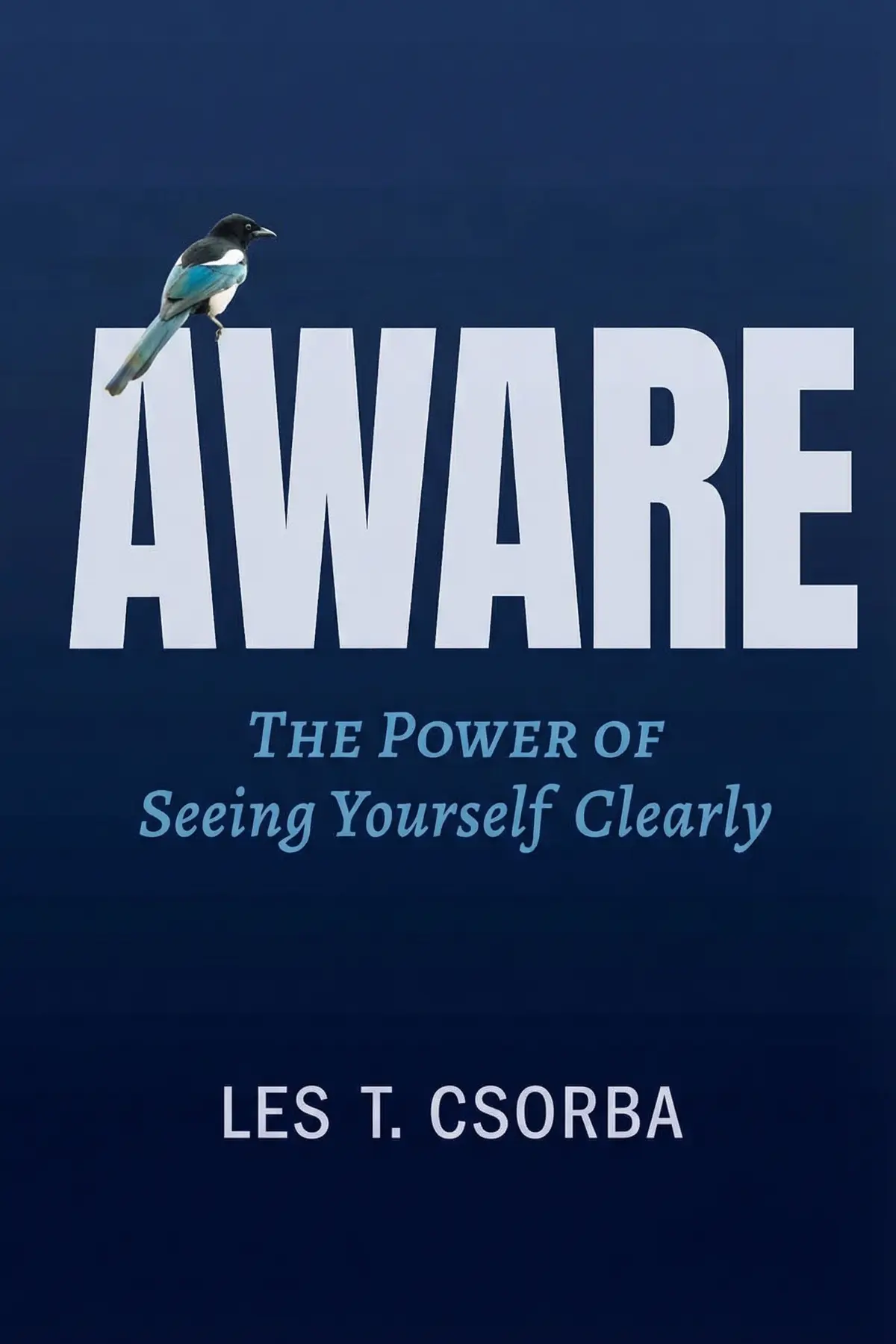
Table of Content
1. Introduction
1 min 02 sec
If you lead people, honest feedback gets scarcer just as your decisions start to matter more. In Aware, executive search partner and chief executive coach Les Csorba argues that this is the central danger of rising: your weaknesses do not vanish with promotion, they become invisible, above all to you. A leader in that state can build a toxic culture or steer a company toward disaster while feeling sure things are going well.
Csorba’s case is that seeing yourself clearly is a skill. It is built through feedback, reflection and the courage to act on what you find, and it reveals your greatest strengths as well as your flaws. His evidence runs from the fall of Lehman Brothers to a chief executive who took every chair out of his office. Along the way you will pick up practical habits, from a weekly decision review to one question that exposes a plan’s weak spots, plus a way to find the thing you do better than anyone else.
2. Spot the blind spots that grow with promotion
1 min 47 sec
Expert after expert brought one chief executive the same warning, backed by data, starting as early as 2005, before his firm collapsed. He heard every one of them. The reason none got through is common among people at the top.
3. Hear hard feedback without proving it true
1 min 36 sec
One executive lost the top job in a single hour, and nobody had to fire him. He talked himself out of it while trying to show his colleagues they were wrong about him.
4. Design your day so your weakness cannot hide
1 min 32 sec
A successful chief executive took on a problem with how his staff saw him by making one unusual change to his own office. He changed one thing about his office, and it made avoiding his weakest behavior almost impossible.
5. Get honest feedback from people who watch you work
1 min 39 sec
A vice president was sure her style was clear and efficient, and her peers did value that clarity. Her direct reports saw something very different, and it took a structured 360-degree review to show her the gap.
6. A weekly review beats good intentions
1 min 42 sec
A department head thought he was helping every time he jumped in to fix a problem. A weekly habit of reviewing his decisions showed him the cost, and the listen-first approach he adopted dramatically improved his team’s trust.
7. Ask what could go wrong before you launch
1 min 41 sec
A team spent weeks on a plan that seemed to cover everything. Once implementation began the complaints flooded in, because the team had never seriously asked what might go wrong.
8. Build a team where bad news travels up
1 min 45 sec
Teams become more candid with the boss when they trust that telling an uncomfortable truth will be rewarded, not punished. That trust depends on systems that reward learning and on how the leader reacts when the criticism is aimed at them.
9. Find your superpower and protect it
1 min 48 sec
Apple was led by two men with almost opposite talents, and both succeeded. Their contrast points to a strength most leaders overlook in themselves, precisely because it feels too easy to count.
10. Conclusion
1 min 10 sec
Aware comes down to a trade. Leaders who accept the discomfort of seeing themselves, warts and all, get two rewards: they stop being steered by flaws they cannot see, and they learn which strengths deserve their full attention. Leaders who refuse the trade risk ending up like Fuld, explaining after the damage why outside forces were to blame.
What makes Csorba’s case practical is that none of this rests on character alone. It rests on structures anyone can set up: a review that collects views from above, beside and below, a journal with sharp questions, a planning session that asks how things could fail, and a team that has watched you take criticism with curiosity.
A good start this week is small. Write down the assumption behind your biggest current decision and ask what happens if it is wrong. And the next time someone criticizes you, ask for an example before you say anything else.
The chief executive who cleared the chairs from his office did not need more talent. He took away his own place to hide, and that is the courage this book asks of every leader.
About this book
What is this book about?
Promotion brings power, but it also thins out the truth. As leaders rise, fewer people are willing to tell them what they are getting wrong, and their weaknesses become invisible, most of all to themselves. Les Csorba, an executive search partner who coaches chief executives, argues that this gap explains many leadership failures, from toxic cultures to the collapse of Lehman Brothers. His answer is self-awareness treated as a practice instead of a personality trait. Csorba sets out tools for seeing yourself clearly: 360-degree reviews, outside mentors, peer advisory groups, focused journaling, weekly decision reviews and mindfulness. He then turns to plans and teams, showing how scenario planning, perspective-taking, psychological safety and after-action reviews help a whole organization notice what it has missed. The book also argues that self-awareness has a second purpose. Beyond exposing flaws, it reveals each leader's distinctive strength, which Csorba calls a superpower, and shows how to protect and develop it. Readers get a concrete set of habits for hearing hard truths, acting on them and doing more of what they do best.
Book Information
Who it's for
Managers and team leads
Managers and team leads who suspect they hear less truth the more senior they become.
New leaders wanting candor
Newly promoted leaders who want honest feedback habits before blind spots set in.
Executives and founders
Executives and founders trying to build a team that reports bad news early.
About the Author
Les Csorba
Les T. Csorba is a partner at Heidrick and Struggles, an executive search and leadership advisory firm, where he coaches chief executives. That work gives him a close view of how senior leaders succeed and stumble. He is also the author of Trust, and he has served on the board of the Bettering Human Lives Foundation, which helps African families in severe poverty get cleaner fuel for cooking.
Ratings & Reviews
Ratings at a glance

What people think
Listeners find that the book delivers useful leadership strategies and does an outstanding job of explaining the importance of awareness. They also view it as essential reading for any leader, with one listener observing that it fosters deeply engaging conversations. Furthermore, the material earns high marks, with one listener calling it a candid guide, and listeners value its pertinence, with one mentioning that its lessons are applicable to every facet of existence.
Top reviews
Anawin
This book is a wake-up call for anyone sitting in a corner office who thinks they’ve already figured it all out. Les Csorba dismantles the illusion of competence by focusing on the '15% reality'—the tiny fraction of us who are actually self-aware. Truth is, your title often acts as a barrier to the very feedback you need to survive. I loved the distinction between self-belief and self-absorption; it’s a fine line that most leaders trip over. The writing is incredibly punchy, moving from data-driven studies to personal anecdotes without losing momentum. It’s a candid guide that doesn't just preach about blind spots but gives you the actual shovel to start digging them up. If you want to turn introspection into a strategic advantage, this is the playbook you need.
Show moreMason
Csorba’s mantra about having 'incredible self-belief without self-absorption' is something I’ll be carrying with me for a long time. It’s such a simple phrase, yet it articulates the power of awareness in a way few other business books manage to capture. I was particularly struck by the sections on feedback systems like 360s and mentoring circles. Look, most people hate hearing the truth, but this book makes a compelling case for why seeking out that discomfort is the only way to grow. The tone is encouraging but firm, serving as a must-read for all leaders who find themselves insulated from reality. It’s addictive, consumable, and filled with actionable clarity that cuts through the usual corporate platitudes.
Show moreHassan
As someone who has coached executives for over a decade, I can say this is one of the most relevant guides on the market today. Csorba captures the isolation of leadership perfectly, explaining how higher titles often lead to fewer hard truths. The playbook here is tailored for those who crave strategic edge through introspection. I found the chapter on 'seeing what’s true' to be particularly resonant; it challenges you to replace defensiveness with a genuine curiosity about your own failures. This isn't just a business book—it’s a manual for life. The sentence structure is varied and the pacing is excellent, making it an easy read despite the heavy subject matter. It truly is a must-read for anyone in a position of influence.
Show moreMats
The chapter on feedback systems alone justifies the purchase price for any rising manager who wants to stay grounded. Gotta say, Csorba has a way of making complex psychological hurdles feel manageable through his 'see what’s true' approach. The book is rich with data but remains highly consumable, which is a rare feat for non-fiction in this genre. I particularly enjoyed the discussion on how blind spots create internal derailers that can ruin even the most promising careers. It’s a thought-provoking read that forces you to look in the mirror and be honest about what you see. Every leader needs to understand that greatness follows goodness, not the other way around. Highly recommended for any professional library.
Show moreNiphon
Ever wonder why some talented leaders suddenly hit a ceiling? In my experience, it’s rarely a lack of skill and almost always a lack of awareness regarding their internal derailers. Csorba’s central premise—that what you are unaware of controls you—lands with absolute precision. Frankly, the middle chapters on stakeholder mapping felt a bit dense, but the overall message about pursuing goodness over greatness is a refreshing pivot from typical alpha-male leadership tropes. The book provides practical lessons that apply far beyond the boardroom, touching on how we show up in our personal lives too. It’s a solid, thought-provoking read for anyone who is serious about radical self-honesty and disciplined reflection. Definitely worth the time for rising managers.
Show moreJune
Finally got around to reading this after hearing it generates some intense conversations in leadership circles. The core concept—that your greatest career blocker is usually the part of yourself you refuse to look at—is visceral. To be fair, some of the 'practical' exercises felt a little like things I’ve seen in other management workshops, but Csorba frames them within a much more cohesive 'operating system.' The blend of executive coaching wisdom and psychological data makes for a very compelling argument. I particularly appreciated the advice on journaling and decision reviews as a way to pressure-test our daily assumptions. It’s a well-written guide that turns self-awareness into a tangible skill rather than just a fuzzy, abstract feeling.
Show moreManop
Not what I expected from a standard leadership book, but in a very refreshing way. Instead of the usual 'how to manage others,' Csorba focuses entirely on how to manage yourself. The truth is, we are often our own worst enemies, and 'Aware' provides the tools to stop that self-sabotage. I loved the focus on turning feedback into a daily habit rather than an annual event. My only minor gripe is that the writing style occasionally leans a bit too heavily on anecdotes, but they are at least interesting ones. The emphasis on being uniquely valuable while shedding the 'extra' baggage is a great takeaway for any career stage. It's practical, honest, and very well put together.
Show moreBae
Picked this up on a whim and was immediately struck by the statistics regarding how few of us are actually self-aware. In my experience, most leaders think they are open-minded, but Csorba proves that we all have hidden risks that we're ignoring. The book does an exceptional job of articulating why awareness is the ultimate power move. Some of the journaling prompts felt a little basic, but the overall framework for a 'self-awareness operating system' is brilliant. It encourages a level of disciplined reflection that most of us simply don't make time for. If you’re a senior executive who feels like something is missing in your leadership style, you'll likely find the answer here.
Show moreJoseph
While the core concept of radical self-honesty is vital, I found the execution to be a bit repetitive in certain sections. Not gonna lie, I expected a few more ground-breaking frameworks given the high praise it receives. However, the data point about the massive disconnect between perceived and objective self-awareness is truly fascinating and makes you pause. The book is certainly a candid guide, and the focus on 'pursuing goodness' is a nice touch, but the application felt a bit pedestrian for a seasoned executive. It’s a good introductory text for someone just starting their self-improvement journey, but I was hoping for a deeper dive into the psychology behind our blind spots.
Show moreThitiwan
I honestly struggled with how dry the writing became during the sections on stakeholder mapping and 360-degree reviews. The concepts are undoubtedly important, but the delivery felt a bit like a corporate HR manual at times. That said, the opening chapters are fantastic and the core mantra about self-belief is a total game-changer. It’s a useful tool for surfacing hidden risks, but I think it could have been about 50 pages shorter without losing the impact of its message. It’s a decent resource for professional development, though it requires some patience to get through the more technical bits. Good, but perhaps not as life-changing as some of the other reviews suggest.
Show moreQuestions about this book
What is the main idea of Aware by Les Csorba?
Csorba argues that leaders are held back most by what they cannot see in themselves, and that this problem grows with seniority because fewer people tell the boss the truth. Self-awareness, in his view, is a practice built through feedback, reflection and testing assumptions. It also has a second purpose: revealing each leader’s distinctive strength, which he calls a superpower, so they can focus on it.
How can a leader find their blind spots?
The book recommends combining outside and inside views. Outside, use a 360-degree review that gathers scores from bosses, peers and direct reports, a mentor from another organization and a peer advisory group that meets regularly. Inside, keep a journal with pointed questions, hold a weekly review of important decisions and practice mindfulness to notice reactions as they happen. Each method catches things the others miss.
What does Aware say about the collapse of Lehman Brothers?
Csorba uses Lehman as his main warning. Chairman and chief executive Richard Fuld received warnings about real estate risks from as early as 2005, including data from credible experts who approached him independently. He kept pushing risky mortgage-backed securities, believing his judgment was better. Even after the collapse, he said he would not have changed much and blamed outside factors, showing how blind spots can survive overwhelming evidence.
How do you build a self-aware team or organization?
Csorba says it starts with the leader modeling vulnerability by sharing personal development goals openly. Psychological safety follows when the leader responds to criticism with curiosity instead of defensiveness, so people trust that honesty is rewarded. He also recommends rewarding learning from mistakes and running regular after-action reviews on both successes and failures, along with scenario planning and perspective-taking before big decisions.
What is a leadership superpower in Aware?
It is the distinctive mix of talents a leader brings at their best. Csorba contrasts Steve Jobs, whose gift was visionary product design, with Tim Cook, whose strength was operations and supply chains. Other examples include empathy, calm in a crisis, fast learning and discernment. He advises identifying yours through feedback, practicing it deliberately, delegating routine work and removing anything that blocks it.
Featured in
Readers also enjoyed



A Year with Peter Drucker: 52 Weeks of Coaching for Leadership Effectiveness
Joseph A. Maciariello



Acting with Power: Why We Are More Powerful Than We Believe
Deborah Gruenfeld

All In: How Great Leaders Build Unstoppable Teams
Mike Michalowicz


AUDIO SUMMARY AVAILABLE
Listen to Aware in 15 minutes
Get the key ideas from Aware by Les Csorba, plus 5,000+ more nonfiction titles.
- 5,000+ titles
- Listen as much as you want
- 7-day free trial
- Cancel anytime









