

14 min 07 sec
Available in: English
Yes, And: How Improvisation Reverses “No, But” Thinking and Improves Creativity and Collaboration
Shows how the habits improv comedians rely on, such as building on each other's ideas, sharing failure and listening closely, can make any workplace more creative and collaborative, and less afraid of mistakes.
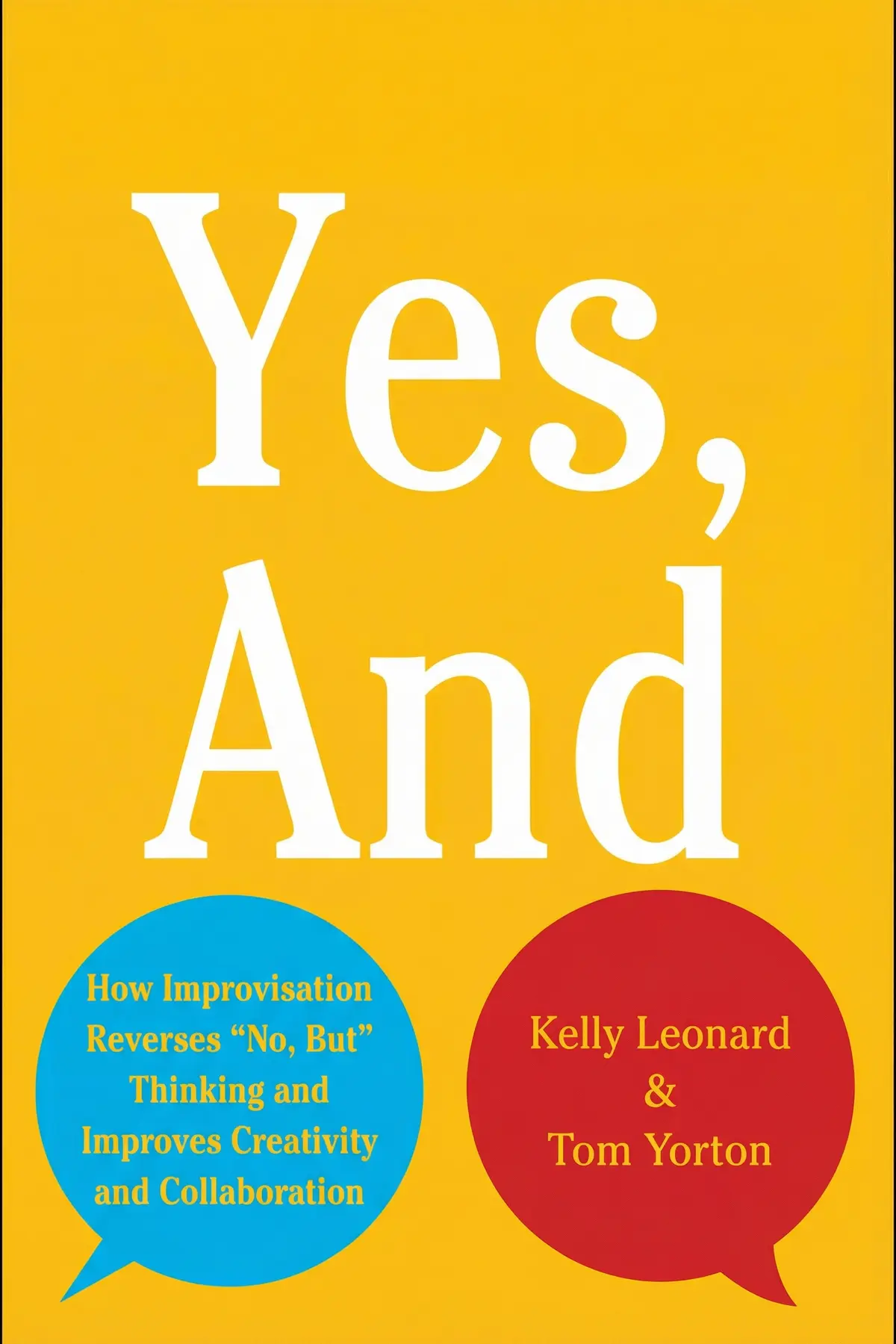
Table of Content
1. Introduction
1 min 05 sec
If your meetings end with good ideas shot down before anyone has tested them, the culprit may be two small words: no, but. In Yes, And, Kelly Leonard and Tom Yorton, two leaders from the comedy theater The Second City, argue that improv actors have already solved this problem. On stage, with no script, they accept whatever a partner offers and then add to it.
That single move, the authors show, can change how any group works, but only inside the right conditions. It needs a group without rigid ranks, a room where nobody fears looking foolish, mistakes that belong to everyone, leaders who know when to step aside, and listening that takes in more than words.
Along the way you will meet a failed television network takeover, a camera company that froze in admiration of its own product, and an ad agency that learned to translate gibberish. You will also leave with a few stage exercises simple enough to run in your next meeting.
2. Turn every offer into a starting point
1 min 36 sec
One improv actor mentions the stars, and her partner can either kill the scene or send it somewhere nobody expected. The same split second happens in your meetings, and most people choose badly without noticing.
3. Pick people who fill the group's gaps
1 min 48 sec
The word team sounds harmless, yet the authors think it sets people up to compete and stay in their lanes. A comedy theater that stalled for years shows what kind of group works better, and how to hire for it.
4. Give up ownership so the best idea wins
1 min 44 sec
A much-loved comedy show took ideas from its makeup and wardrobe crews and collected Emmy nominations. Then new managers arrived from a television network, and the most talented people started walking out.
5. Use a well-aimed joke to loosen a tense room
1 min 47 sec
A single sketch about a political scandal made a whole audience laugh without offending it. Its ingredients double as a working recipe for tense meetings, and a giant photography company shows the cost of taking your best product too seriously.
6. Make mistakes cheap and share them
1 min 43 sec
A software company gathers its staff to tear apart its own product, and an ad agency hands out prizes for near disasters. Both rituals look silly from outside, and both are aimed at the fear that blocks new ideas.
7. Lead by letting the right person lead
1 min 34 sec
Taking charge and giving orders is the usual picture of a boss. An improv pioneer taught the opposite move, and a rehearsal-room rule at The Second City even keeps producers outside the door.
8. Train your listening like a muscle
1 min 36 sec
Most of what we know arrives through our ears, yet we grasp a surprisingly small share of it. An ad agency that kept losing clients found a fix in two odd stage exercises, one built on pure nonsense.
9. Conclusion
1 min 14 sec
Leonard and Yorton’s case is that creativity at work depends mostly on how people respond to each other. The performers on a Second City stage are not braver or funnier by birth. They work inside habits that make it safe to offer something unfinished: a partner who says yes, and, a group chosen to fill its own gaps, a joke that takes the sting out of a mistake, a hug before the lights go up, and a director who keeps visitors out of rehearsal.
Each of those habits can be copied by an ordinary manager on an ordinary Monday. Begin by catching your own no, but and replacing it with something you can build on. Give your group a regular, slightly silly way to name what went wrong, so failure belongs to everyone. Agree when work will be shown, and stay away until then. And run the conversation without the word I once, just to notice how much more you hear.
SCTV lost many of its best performers when new managers stopped taking ideas from the makeup room. Somewhere in your own organization, a good idea is probably sitting in a room like that, waiting for someone to say yes.
About this book
What is this book about?
Many workplaces reject ideas by reflex. Someone proposes a plan, the answer starts with no, but, and the idea is gone before anyone has explored it. Over time people stop offering anything unfinished, and creativity dries up. Kelly Leonard has held creative and leadership roles at The Second City, the improv comedy ensemble, and Tom Yorton has led its business arm, Second City Works, since 2002. They argue that the stage offers a better model. Improv actors build whole scenes without a script by accepting what a partner offers and adding to it, a habit they call yes, and. The authors show how that one move depends on a wider culture. It needs groups built as ensembles rather than ranked teams, rooms where fear and yelling are banned, humor that releases tension, failure that the whole group owns, leaders who know when to step back, and real listening. Readers get the stories behind each lesson, from Kodak and New Coke to SCTV, Basecamp and Ogilvy & Mather, plus stage exercises they can run with their own colleagues, such as a conversation in which nobody may say the word I.
Book Information
Who it's for
Supervisors with stuck meetings
Managers whose meetings end in silence or reflexive objections.
Company and team leaders
Founders and team leads who want more ideas from their people and less fear of failure.
Workshop facilitators
Trainers looking for simple improv exercises to build listening and collaboration.
About the Author
Kelly Leonard
Kelly Leonard has held creative and leadership roles at The Second City, where he produced shows with performers including Tina Fey, Stephen Colbert, Amy Poehler, Seth Meyers and Steve Carell. He speaks on how improvisation can change business and personal life and has hosted the podcast Getting to Yes, And. Tom Yorton has been CEO of Second City Works, the theater's business arm, since 2002. Before that he worked at advertising agencies including Ogilvy and Grey and was a marketing vice president at Sears and 3Com, where he hired Second City Works himself.
Ratings & Reviews
Ratings at a glance
What people think
Listeners find the book enjoyable and appreciate its core improv principles, with one listener highlighting how these skills are applicable to every part of life. They also find value in the practical ways it can be used professionally to foster creativity and teamwork. However, the prose and comedic timing receive mixed reviews, with several listeners pointing out that it isn't very funny. The business-centric material also gets a range of responses from listeners.
Top reviews
Owen
Wow. I didn't expect a book about improv to have such a profound impact on my management style. The core lesson of 'Yes, and' is a perfect antidote to the typical 'No, but' attitude that kills so many good ideas in our weekly strategy sessions. I especially appreciated the 'One Last List' at the very end—it's currently taped to my office wall because it's the most practical part of the whole thing. It covers everything from making your partner look good to understanding your audience. The authors really emphasize that team success comes before individual ego, which is a message more corporate leaders need to hear. This isn't just for actors; it's for anyone who wants to foster a truly collaborative culture. Highly recommended for every level of leadership.
Show moreElla
After hearing about the 'Yes, And' concept in a workshop, I had to dive into the full text. This book is a masterclass in how to build a high-performing culture by simply changing how we communicate with one another. The idea of bringing a 'brick, not a cathedral' to a meeting has completely changed how I approach collaborative projects. It reduces the pressure to be perfect and allows for much more organic growth of ideas within our group. I loved the section on 'reading the room' and the importance of empathy in leadership. It’s a refreshing take that moves away from the typical adversarial models we see in most corporate environments. Truly an inspiring read for anyone who wants to lead with more possibility and less fear.
Show moreLiam
As someone who thrives in creative environments, I found the connection between improv and corporate culture absolutely fascinating. The authors argue that practicing improvisation is basically yoga for your professional development, which is a vivid way to think about building emotional intelligence. In my experience, the advice on 'reading the room' and sharing the conversation is exactly what’s missing in modern leadership. The book does a great job of explaining how to move from a state of fear to a state of possibility. I did feel that the authors spent a bit too much time name-dropping Second City alumni, which felt unnecessary after a while. Still, the practical applications for brainstorming and team-building make this a very worthwhile read for any ensemble.
Show moreGai
The chapter on listening skills was worth the price of the book alone. We tried the 'Last Word Response' exercise during our last team-building retreat, and the results were eye-opening for everyone involved. It forces you to actually hear what the other person is saying rather than just waiting for your turn to speak. In a world of 'No, but' responses, these improv techniques offer a way to navigate professional friction without shutting down creativity. I did feel that some sections leaned a bit too heavily into the 'Second City' brand history, which slowed down the pacing of the advice. Still, for a manager looking to break down organizational silos and foster empathy, this provides a very practical roadmap. I’ll definitely be revisiting the appendix of exercises.
Show moreWipawan
Look, the business world is often plagued by a crippling fear of failure, and this book tackles that head-on. The authors argue that improvisation helps you become a more compelling leader by teaching you to pivot out of uncomfortable spaces. I appreciate the focus on 'ensemble' rather than just 'teams,' because it removes the competitive baggage and focuses on mutual support. While some of the corporate anecdotes felt slightly self-promotional, the underlying principles are solid and easy to apply. My only real gripe is that it occasionally overlooks the benefits of creative tension by pushing for constant agreement. Not every situation needs a 'yes,' but most could certainly benefit from more 'and.' It’s a very useful tool for anyone in a leadership position.
Show moreJoshua
Truth is, I wasn't sure if improv games would actually translate to a real-world office environment. But after reading this, I’m convinced that the principles of adaptability and support are universal. The book does a great job of explaining how to 'take focus' and 'give focus' to ensure everyone on the team feels heard. I docked one star because the writing can get a bit repetitive, and the authors tend to lean on their own success stories quite a bit. However, the core message about listening to understand rather than listening to respond is something I’ll be practicing for a long time. It’s a solid resource for anyone looking to shake up a stale workplace culture and improve their emotional intelligence.
Show moreKoi
Finally got around to reading this one after seeing it on several business leadership lists. To be fair, the central premise of replacing the idea-killing 'no, but' with a collaborative 'yes, and' is transformative for meeting dynamics. It offers a refreshing antidote to the adversarial models that dominate most corporate environments today. However, the book often feels like an over-extended article rather than a fully realized manual. I found my mind wandering during the middle sections, which relied heavily on success stories that felt like self-promoting filler. While the improv exercises are interesting, they are difficult to fully grasp without actually practicing them in a group setting. It is a solid resource for managers, but don't expect it to be a page-turner from start to finish.
Show moreJackson
Ever wonder why business meetings feel so stagnant? This book explores that through the lens of improv comedy, and the basic concept of building on others' ideas is undeniably strong. However, I found the narrative quality to be a bit hit-or-miss. It lacks the humor you’d expect from the Second City crew. Some of the exercises, like the 'Gibberish Game,' are fun to read about, though actually doing them would be much more meaningful than just reading the description. It’s a good book for a new perspective, but it assumes everyone always has the best intentions, which isn't always reality in a high-stakes office. It’s a decent 3-star read if you want some new brainstorming tools.
Show moreLeo
Picked this up expecting a laugh-out-loud guide to business, but it’s actually quite serious in its tone. While the authors' background with Second City is impressive, the humor is surprisingly sparse throughout these pages. The advice on brainstorming and collaboration is excellent, yet it often feels like the authors are trying too hard to prove their business credentials to a skeptical audience. I found the summation in the appendix to be the most valuable part, as it distills the essence of the book into actionable bullet points. Personally, I would have preferred fewer celebrity stories and more focus on how to use these tools when you aren't the one in charge. It’s a decent read, but not quite the game-changer I was hoping for.
Show moreWin
This book feels more like a 200-page marketing brochure for Second City than a groundbreaking leadership manual. If you can push past the constant name-dropping of famous comedians on every other page, the actual advice is pretty thin. Most of it is just a regurgitation of concepts you’ve already seen in better business books, merely wrapped in a skin of self-promotion. I was expecting something much more captivating given the comedic background of the authors, but instead, it felt quite dry and corporate. There are a few enjoyable anecdotes, but they are buried under layers of self-aggrandizing filler that makes it hard to stay engaged. Frankly, a long-form article would have been more than enough to cover the core message.
Show moreQuestions about this book
What is the main idea of Yes, And by Kelly Leonard and Tom Yorton?
The authors argue that improv comedy offers a model for creative business. On stage, actors accept a partner’s idea and add to it, which they call yes, and. That habit works best inside an ensemble without rigid ranks, where fear is removed, failure is shared, leadership moves to whoever has the right expertise, and people listen closely to each other.
What does yes, and mean in business?
It means accepting what a colleague offers and building on it instead of answering with no, but. In the book’s stage example, one actor mentions the stars at night and her partner adds that the earth looks small from the moon. The authors cite Wikipedia, where each user adds to others’ work, as the approach at enormous scale.
What is the difference between a team and an ensemble?
In the authors’ view, a team exists to beat another team, so roles are fixed and members stick to them. An ensemble has no hierarchy or internal competition, and anyone can contribute at any point. Hiring for an ensemble means choosing people who fill its gaps, as The Second City did when it diversified a cast made up almost entirely of white men.
How can teams get over the fear of failure?
The book recommends making failure low-stakes and shared. Basecamp holds product roasts where staff openly criticize their own product, and Ogilvy & Mather hosts a mock awards night for career-endangering stunts. Second City actors hug and encourage each other before shows so everyone knows the group fails and succeeds together. Banning yelling also keeps people willing to share rough ideas.
What listening exercises does Yes, And suggest?
One is to pair people up for a conversation in which nobody may say the word I, which forces attention onto the other person. The authors also describe exercises used with an ad agency: making eye contact before speaking, and translating a colleague’s gibberish by reading her tone and posture. The agency went on to win and keep new clients.
Readers also enjoyed

A Bigger Prize: How We Can Do Better Than the Competition
Margaret Heffernan





A Year with Peter Drucker: 52 Weeks of Coaching for Leadership Effectiveness
Joseph A. Maciariello


AUDIO SUMMARY AVAILABLE
Listen to Yes, And in 15 minutes
Get the key ideas from Yes, And by Kelly Leonard, plus 5,000+ more nonfiction titles.
- 5,000+ titles
- Listen as much as you want
- 7-day free trial
- Cancel anytime









