

A Bigger Prize: How We Can Do Better Than the Competition
Margaret Heffernan
 English
 ไทย
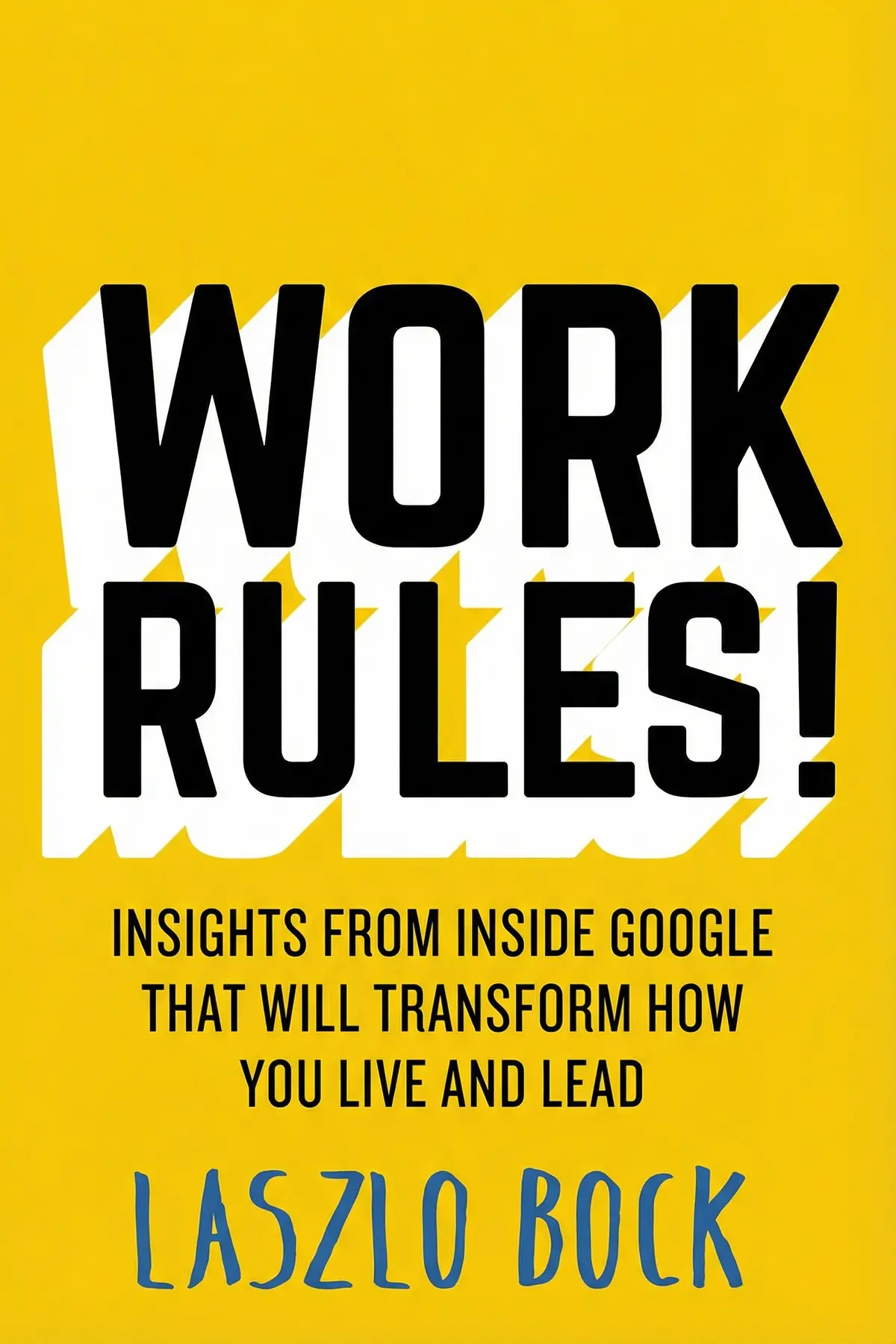
Laszlo Bock, Google's former head of People Operations, shows how the company hires, trains, pays and empowers its staff, and how any team can use the same evidence-based methods to attract and keep strong people.
1 min 06 sec
Most managers build a team by hiring fast and patching the gaps later with training, perks and bonuses. In Work Rules!, Laszlo Bock, who ran People Operations at Google, argues that this gets the order backwards: waiting for an exceptional hire will most likely save money over time. Google hires roughly 5,000 people a year from one to three million applicants, about a quarter of one percent.
Bock’s wider case is that a celebrated culture does not come from beanbags and free lunches. It comes from choosing people with great care, then giving them meaning, information and real power, with hard questions settled by evidence instead of rank. From that base, Google rethought almost every people practice, from who teaches training sessions to why two people in the same job can earn wildly different amounts. What follows works at any scale: a hiring habit that resists bias, a cheaper way to train, rewards people actually remember, and a way to stay open when openness gets abused.
1 min 49 sec
Outsiders credit Google’s success to free food and playful offices. Bock points to something far cheaper and harder to copy, and it starts with a goal that can never be finished.
2 min 00 sec
Google turns away applicants at a rate that makes Harvard look relaxed, and it stopped caring much about famous schools. The reason has to do with what happens when a hire disappoints.
1 min 52 sec
Companies ask staff to show initiative while managers keep every lever of control. Google found a way out of that contradiction, and it also stopped a damaging rumor about promotions in its tracks.
1 min 54 sec
Most companies fire their weakest people and leave their strongest alone. Google treats both groups as a research opportunity, and one internal study put a number on what a good manager is worth.
1 min 58 sec
Companies pour enormous sums into training that changes almost nothing. A consulting firm’s workshop on angry clients and Google’s choice of sales coach point to a cheaper method that sticks.
1 min 53 sec
Google once handed out tens of millions in performance awards and made its staff less happy. What it learned about pay, gifts and failed projects runs against most company instincts.
1 min 54 sec
Sharing everything invites leaks, encouraging ideas floods the company with products, and generous perks can turn staff sour. Google faced all three, and it handled each one in the open rather than quietly.
1 min 06 sec
What Bock describes is a bet on trust, backed by evidence. Google chooses people with unusual care, then treats them as adults: it tells them what the company is doing, lets them shape how it runs, and settles disputes with numbers anyone can check. Its money goes to the edges, to finding exceptional people, studying its best managers and rewarding those who take a sensible risk.
You do not need Google’s size to use this. The next time you hire, put a small panel on the decision and be willing to wait for the right person, because an average hire costs more in the end. Before paying for training, look inside your own team for the person who already does the job best. When you want to thank people, give them something to remember together instead of another bonus. And when a hard decision lands, show the data behind it.
Bock’s deeper lesson is that freedom and rigor travel together. The people given the most room are the ones chosen most carefully and trusted with the most information.
Google's culture is famous for free food and beanbags, but Laszlo Bock, who led its People Operations, argues that the perks explain very little. What makes the company work is a set of choices about people: who gets hired, how much they are told, how much power they hold and how they are rewarded. Bock walks through those choices with Google's own numbers and stories. The company accepts about a quarter of one percent of applicants and looks for resilience over famous degrees. It keeps only four levels of hierarchy and settles disputes with data. An internal research team studies its best managers and teaches what they do to weaker ones. Its top salespeople run sales training. It pays people in the same role very differently and rewards teams whose smart bets fail. Readers get a practical model for building a team on trust and evidence, from hiring panels that resist bias to rewards people remember. Bock also shows what to do when openness backfires, through leaks, product overload and entitled staff.
Managers and team leads who want to hire better and keep their strongest people.
Founders and HR professionals designing pay, training and promotion from scratch.
Employees curious about how Google runs its workforce and what they could borrow.
Laszlo Bock, born in 1972, was Senior Vice President of People Operations at Google, responsible for attracting, developing and keeping its staff. During his time there, Google was named a top employer more than 30 times around the world, and HR Executive Magazine named him Human Resources Executive of the Year in 2010. He earlier worked at General Electric and McKinsey and later co-founded Humu, serving as its CEO. Work Rules! is his first book.

Listeners find this work packed with actionable advice regarding Google’s human resources methods, labeling it essential reading for managers and HR experts. The prose is skillfully written, and listeners value the depth of information, with one review mentioning how it clarifies the beginnings of Google's methods. Listeners describe the work as motivational; one listener points out that it offers useful takeaways on staff satisfaction, while another emphasizes its concentration on collaborative efforts. Listeners prize the concepts for fostering innovative thought and believe it offers great worth for the price.
Finally finished Bock's manifesto on corporate culture, and it’s a powerhouse. While some call it a Google commercial, I found the breakdown of "People Operations" incredibly practical for my own small team. The focus on employee happiness isn't just fluffy; it's backed by rigorous data and psychological experiments. Frankly, the advice on "spreading the wealth" by having top performers teach others is a game-changer. It’s well-crafted and offers creative ways to think about hiring without relying on gut feelings. Some parts felt a bit self-congratulatory, but the actionable steps at the end of each chapter provide immense value for money. If you want to move beyond 1980s management models, this is the blueprint.
Show moreThe chapter on nudges alone is worth the price of admission for any manager. I loved how Bock explains that small, subtle changes—like where you place the healthy snacks in the kitchen—can dramatically improve employee focus. It’s an inspiring look at how engineering principles can be applied to human behavior without being overly cold. In my view, the section on "hiring people smarter than you" is the most challenging and rewarding piece of advice in the whole book. It’s a brave way to lead that requires checking your ego at the door. Every leader should read this to understand how to build a culture of high freedom. It is creative thinking at its best.
Show moreWow, this really changed my perspective on what it means to be a "manager." Instead of command-and-control, Bock argues for a culture of transparency where everyone knows what everyone else is working on. The idea of "Googlers teaching Googlers" (G2G) is so simple yet so powerful for building community. I’ve already started implementing the "post-meeting learning" habit with my department. Not gonna lie, the book is quite dense and takes a while to get through, but the wealth of research citations makes the effort feel justified. It’s a must-read for anyone who actually cares about the people they lead and wants to see them happy.
Show moreGotta say, the section on G2G was inspiring because it gives employees a sense of purpose beyond their daily tasks. Bock writes with a lot of passion, and his belief that people are fundamentally good shines through the text. I appreciated how he balanced the "rainbows and unicorns" stories with a few examples of where their policies failed during a crisis. It made the book feel more authentic than your average business manual. It’s a bit cheerleadery at times, but the creative thinking behind their "People Operations" is undeniable. Good value for money if you’re looking to modernize your workplace culture and focus on teamwork.
Show moreAs an HR professional navigating the "new normal," Bock’s insights felt like a breath of fresh air compared to traditional textbooks. The most striking takeaway was the radical idea to separate performance reviews from compensation discussions. In my experience, mixing the two makes employees shut down during the growth part of the talk because they’re only waiting for the money number. Bock uses data to prove why this works, which helps when trying to convince skeptical upper management. The writing is engaging, though I’ll admit the constant "Google is perfect" vibe got a bit old by the halfway mark. Still, the checklists for onboarding are gold.
Show moreLook, I know Google is a bit of a cult, but you can’t argue with their results. Bock gives a detailed, almost forensic account of how they built their hiring engine. I found the section on "calibration" particularly useful for ensuring fairness in promotions across different teams. It’s refreshing to see a company admit that their first attempts at things like certain hiring algorithms were failures and then show how they learned from those mistakes. The book is definitely long-winded, and some of the "insider stories" feel a bit too polished for comfort. Nonetheless, the core "Work Rules" provide a solid framework for anyone trying to foster teamwork in a rigid industry.
Show moreTruth is, I was skeptical about the "science" of management before picking this up. I always thought leadership was about intuition, but Bock makes a compelling case for data-driven iteration. The explanation of why you should pay "unfairly"—giving massive rewards to the top 10% who drive 90% of the value—is controversial but logically sound. It’s a brutal reality that most companies ignore. The book is well-crafted, though it occasionally feels like a recruitment tool for the Silicon Valley elite. I’m giving it four stars because the "What You Can Do Starting Tomorrow" section is actually useful and doesn’t require a billion-dollar budget to implement.
Show morePicked this up for a leadership course and found it to be a massive but rewarding read. The book is packed with practical insights about HR processes, though they are sometimes buried under layers of self-laudatory stories about the author’s career. To be fair, the research on "deliberate practice" and why most corporate training is a waste of money was genuinely eye-opening. It made me rethink how we approach onboarding. Even if the tone is a bit back-slapping, the "What You Can Do Starting Tomorrow" section at the end is worth the effort of digging through the fluff. It provides real, actionable steps that don't require a Google-sized budget.
Show moreEver wonder why Google employees seem so obsessed with their company? This book explains the origins of those practices, but it does so with an exhausting amount of name-dropping and corporate posturing. To be fair, there are brilliant nuggets buried under the fluff, particularly the "two tails" analysis of performance. However, the author spends way too much time reciting the "tragic backstories" of every executive he’s ever met. It feels like a 400-page PowerPoint that could have been a sleek 80-page handbook. I appreciated the specific details on OKRs, yet the tone often drifts into "techno-libertarian" preaching that assumes Google’s way is the only way. It's a decent read for HR types, but keep your cynicism handy.
Show moreNot what I expected given the glowing reviews on the jacket. This book is a thick wad of virtue signaling wrapped in a "look how smart I am" package. It starts with the author humble-bragging about every CEO he’s ever shared a latte with and goes downhill from there. The "nudge" chapter is actually quite scary if you think about the ethics of manipulating employee behavior under the guise of "well-being." While there is some good stuff regarding hiring committees to remove bias, the arrogance of the prose makes it a very tedious read. Personally, I felt like I was being lectured by a robot that thinks statistics can solve every human problem.
Show moreBock argues that Google’s culture comes from people practices, not perks. The company hires extremely selectively, shares information widely, gives employees a real voice, keeps hierarchy flat and makes decisions with data instead of managerial opinion. It also studies its best performers, uses top staff as trainers, pays stars far more than average performers and rewards smart risks even when they fail.
Google accepts about 5,000 people a year from one to three million applicants, roughly 0.25 percent. It moved away from favoring Ivy League graduates and now looks for resilience and a history of overcoming obstacles. It aims to hire people better than the interviewer, uses hiring panels to reduce confirmation bias, and is willing to wait years for the right candidate, as it did with Karen May.
Bock explains that strict pay bands push top performers to leave for better offers. Google believes a brilliant engineer can be worth vastly more than an average one, so two people in the same role may get stock awards of $10,000 and $1 million. Yet Google also learned that cash awards can backfire, and that shared experiences like a team trip often reward people better.
Start with hiring: use a panel of interviewers and wait for the right person instead of filling a seat fast. Share more information with your team and explain decisions with data. Ask your best performer to coach others on one specific skill with practice and feedback. Recognize good work with experiences people enjoy together, and avoid punishing a well-judged bet that fails.
Margaret Heffernan





Joseph A. Maciariello




AUDIO SUMMARY AVAILABLE
Get the key ideas from Work Rules! by Laszlo Bock, plus 5,000+ more nonfiction titles.









