

14 min 45 sec
Available in: English
 ไทย
EnglishไทยWinning: Proven Leadership and Management Principles for Strategic Career Excellence and Business Success
By Jack Welch, Suzy Welch
A blunt management guide from GE's former chief executive on running people, plans and careers with candor: ranking teams fairly, hiring on integrity, setting stretch targets, handling change and crises, and earning promotions.
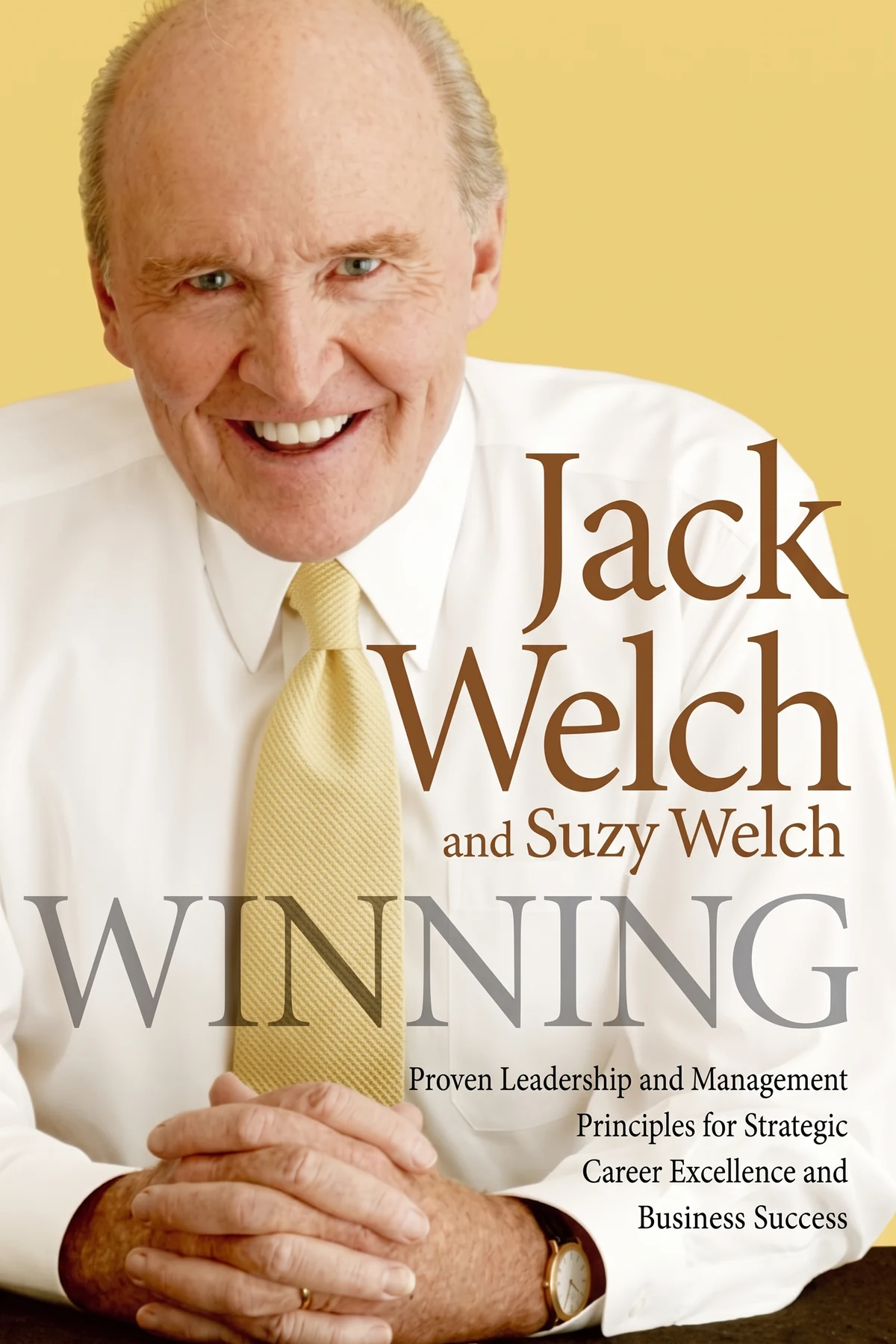
Table of Content
1. Introduction
50 sec
If you lead a team, much of what your people know never reaches you, because polite workplaces punish whoever says the awkward thing. In Winning, former General Electric chief executive Jack Welch and Suzy Welch, once editor-in-chief of the Harvard Business Review, call that silence a waste of brainpower and make candor the base for everything else. Their argument runs from hiring to strategy, budgets, change, crises and your own career: organizations win when they tell the truth about their people and plans, then act on it fast.
Most of the examples come from GE. What you gain is a fair way to rank and grow a team, a test for any mission statement or budget target, a rule for the first hours of a crisis and a frank view of what bosses reward.
2. Get honest ideas from people who stay silent
1 min 26 sec
Most of your colleagues are sitting on ideas they will never voice in a meeting. GE found a blunt way to drag those ideas into the open, and to force managers to answer them fast.
3. Sort your team fairly and lift the middle
1 min 30 sec
Treating every employee the same feels kind and fair. The Welches argue it shortchanges the stars, traps the weakest, and leaves the largest group of all without the push it needs.
4. Hire on three tests and fire without humiliation
1 min 32 sec
An elite degree tells you less than you think about a candidate. Three tougher tests come first, and the way you handle an exit says as much about you as the way you hire.
5. Earn your team's trust with honesty and nerve
1 min 31 sec
Being liked feels like the safest path for any manager. The authors point to a different source of loyalty, built on fair credit, confessed mistakes and the willingness to keep asking awkward questions.
6. A mission and strategy your people can act on
1 min 44 sec
Most mission statements could hang on any company’s wall unchanged. GE’s version read differently, and a visit to a toilet bowl factory shows where useful strategic ideas sometimes come from.
7. Plans that stretch and bets that pay off
1 min 49 sec
A growth target that everyone hits can still be a failure. The Welches explain why the yearly budget fight wastes potential, and why buying a company demands a calm that launching one does not.
8. Push change through and come out of scandal stronger
1 min 35 sec
One newspaper redesign was blamed for the end of Western civilization. The authors show why people fight even sensible change, and what to assume in the first hours after a scandal breaks.
9. Build a career on excitement and results
1 min 40 sec
A dentist in a small Vermont town taught Jack Welch something about choosing work. What follows is equally blunt advice on getting promoted, including a firm view on work-life balance.
10. Conclusion
1 min 08 sec
Winning sounds like a long list of rules, yet one demand runs under all of them: look at the facts about people and plans without flinching, then act. The meeting with no bosses present, the 20-70-10 ranking, the target judged against rivals, the crisis assumed to be worse than it looks: each strips away a comfortable fiction. A compromise at 9 percent, a mission any company could sign, a resister kept on to avoid a scene are, for the Welches, the polite habits that quietly cost companies their best ideas and people.
The approach can be tested in small ways. Let your team propose fixes without you in the room, and promise an answer within days. Sort your people honestly and choose one middle performer to coach toward the top. When a problem surfaces, name and define it before someone else does. And if your own work leaves you cold, treat the job as one experiment, not your final answer.
Candor stings for a moment. Silence, on the Welches’ account, costs far more.
About this book
What is this book about?
Most organizations run on polite silence. People keep criticism and new ideas to themselves, budgets settle on comfortable compromises, and weak performers stay because nobody wants a scene. Jack Welch, who led General Electric from 1981 to 2001, and Suzy Welch, a former editor-in-chief of the Harvard Business Review, argue that this habit steadily drains a company of its best ideas and people. Their answer is candor applied everywhere. They describe GE's Work-Out sessions, where employees proposed fixes without bosses present, and the 20-70-10 system for rewarding stars, coaching the middle and letting the bottom tenth go. They set out three tests for hiring, a definition of mission that names how you will win, a plain approach to strategy and a replacement for the annual budget fight. They also cover new ventures, acquisitions, change, crises and personal careers. Readers get a direct, opinionated playbook drawn largely from GE's experience, with rules a manager can try the same week and frank advice for anyone choosing a career or aiming for a promotion.
Book Information
Who it's for
Managers avoiding hard conversations
Managers who avoid hard conversations and want a fair system for rating, rewarding and letting people go.
Frustrated founders and executives
Founders and executives tired of mission statements and budget battles that change nothing.
Unsure of career direction
Early-career professionals unsure what job to pursue or how to earn a promotion.
About the Author
Jack Welch
Jack Welch (1935 to 2020) trained as a chemical engineer, earning a master's degree and a doctorate at the University of Illinois, and joined General Electric in 1960. He was GE's chairman and chief executive from 1981 to 2001, and Fortune named him Manager of the Century in 2000, though historians and journalists have questioned his legacy, especially GE's growing reliance on financial services. Suzy Welch is a public speaker and former editor-in-chief of the Harvard Business Review. The two shared a BusinessWeek column and later wrote The Real Life MBA.
Ratings & Reviews
Ratings at a glance
What people think
Listeners find the text both practical and insightful, praising a clear writing style that ensures an easy read. They appreciate the diverse topics and applicable content, regarding it as essential for those in charge, with one listener noting how it helps examine leadership style. The book gains favorable reviews for its management tips, with one review highlighting its strategic approach to daily business challenges.
Top reviews
Cameron
Finally got around to reading Welch’s manifesto, and I’m genuinely surprised by how much it energized me. Most business books are a slog, but this one is filled with vibrant anecdotes and a palpable passion for 'winning' in the right way. I loved the emphasis on finding the right people and then actually trusting them to do their jobs. The way he describes HR as both 'pastors and parents' gave me a new appreciation for a department I usually ignore. Look, it’s not all sunshine; his approach to firing is brutal and unsentimental. However, his advice on maintaining a positive attitude and avoiding a 'victim' mentality is something every professional needs to hear. It’s an inspiring read for anyone with ambition.
Show moreWittaya
Wow, the section on elevating HR to a position of power was a total game-changer for my perspective on organizational structure. Usually, HR is seen as a bureaucratic hurdle, but Welch argues they should be the heartbeat of the company. The writing style is punchy and direct, which I appreciated given how busy my schedule has been lately. He tackles everything from crisis management to the 'big aha' of strategy without getting bogged down in theory. I did feel like his take on work-life balance was a bit harsh, essentially saying it’s the employee's problem to solve. Still, for a primer on how to lead with confidence and transparency, you really can’t beat this. It’s practical, aggressive, and undeniably effective.
Show moreMatteo
Truth is, the concept of 'candor' as a cost-cutting tool is something every MBA student needs to internalize before they step into a boardroom. Jack and Suzy Welch have managed to distill decades of high-level experience into a guide that feels both personal and profoundly strategic. I was especially impressed by the 'Work-Out' sessions described, which aim to eliminate bureaucracy by letting every voice be heard. It’s about creating an idea-rich environment where the best thoughts win, regardless of who they come from. The advice on 'organic growth' was another highlight for me, emphasizing the need to put the most passionate people in charge of new ventures. This is easily one of the most important management books on my shelf.
Show moreAraya
This book provides a remarkably clear window into the high-stakes world of corporate management. Welch doesn't hide behind academic jargon, opting instead for a conversational tone that makes complex strategies feel like common sense. I was particularly struck by his insistence on 'candor'—the idea that being blunt isn't just rude, it’s actually a necessary tool for speed and efficiency. Frankly, it makes you realize how much time we waste in pointless meetings with fancy PowerPoint slides. While his 'differentiation' model for ranking employees feels a bit cold, his reasoning is hard to ignore. If you want a roadmap for creating a high-performance culture, this is a solid choice, though it does feel geared toward massive organizations like GE.
Show moreRapee
The 20-70-10 rule is easily the most controversial part of this book, yet it makes a brutal kind of sense if you want a high-performance culture. Welch isn't here to win a popularity contest; he’s here to show you how to build a team that actually delivers results. I found his thoughts on 'candor' as a way to cut costs particularly insightful. When people stop dancing around the truth, things get done ten times faster. The book is structured logically, moving from internal culture to external competition. Some might find his tone a bit arrogant, but he’s earned the right to be confident. It’s a must-read for any aspiring manager who wants to understand the mechanics of a winning organization.
Show moreSven
Picked this up during a transition into a management role, and it functioned like a survival guide for my first ninety days. The checklists for hiring and the eight rules of leadership provided a much-needed framework when I was feeling overwhelmed. Welch emphasizes that leaders shouldn't steal credit from their people, which is a lesson a lot of my former bosses could have used. I loved the focus on 'celebrating' small wins to keep the team's energy high. Not gonna lie, the sections on Six Sigma were a bit dry and technical for my taste. However, the overarching message about being authentic and surrounding yourself with people smarter than you are is timeless. It’s a book that encourages you to be courageous and decisive.
Show moreYuwadee
After hearing about Jack Welch for years, I expected a dry, academic treatise, but what I got was surprisingly down-to-earth advice. This book covers the 'real world' of business—hiring, firing, and the messy reality of trying to balance a career with a personal life. Welch is a straight talker who doesn't sugarcoat the fact that winning requires hard choices and a lot of energy. I particularly liked the section on 'The Right Job' and the warning not to settle for a position that doesn't 'turn your crank.' Frankly, some of the advice on differentiation felt a little repetitive by the end of the book. Even so, the sheer volume of practical wisdom makes this an essential read for anyone serious about their career trajectory.
Show moreAstrid
While I appreciate the 'no-nonsense' approach Jack Welch takes here, I struggled with how applicable some of this is for a small business owner. The strategies regarding mergers and acquisitions or Six Sigma are fascinating, but they feel like they belong in a different universe than my ten-person startup. To be fair, the sections on hiring for 'edge' and 'passion' were incredibly helpful and provided a great framework for my next interview. I found the 20-70-10 differentiation rule a bit too rigid for a close-knit team where everyone wears multiple hats. It’s a well-written book with a very clear voice, but it definitely skews toward the 'Big Corporate' mindset. A decent read, just take it with a grain of salt.
Show moreAndrei
To be fair, Welch’s advice on budgeting—treating it like a way to beat last year rather than a negotiation—is probably the most practical part of the text. Most companies get stuck in these mind-numbing cycles of 'sandbagging' and corporate politics. Welch cuts right through that nonsense with his focus on beating the competition instead of the internal targets. I also appreciated the chapter on 'bad bosses' and how to handle them without becoming a victim. The writing is clear and accessible, even for someone without an MBA. My only gripe is that it feels a bit dated in its view of the global market, especially regarding China. Overall, it's a solid manual for navigating the complexities of modern business management.
Show moreBenjamin
Is it just me, or does this entire philosophy feel a little too much like a guide on how to treat humans as mere tools for efficiency? I picked this up hoping for leadership inspiration, but I found the obsession with 'differentiation' and cutting the bottom 10% to be quite draining. It’s a very 'us versus them' mentality that seems to ignore the value of loyalty and psychological safety. In my experience, treating people like software that needs an upgrade is a recipe for burnout, not long-term success. Sure, Welch is a legend, and his results at GE speak for themselves, but this cold-blooded approach to management left a bad taste in my mouth. It's informative if you want to understand the corporate shark mindset, but I wouldn't call it 'inspiring' by any means.
Show moreQuestions about this book
What is the main idea of Winning by Jack Welch?
The Welches argue that companies win through candor: telling the truth about people, plans and problems, then acting quickly. That idea shapes their advice on everything from GE’s Work-Out sessions, where employees proposed fixes without bosses present, to ranking staff with the 20-70-10 system, replacing annual budgets with stretch targets, pushing change through and handling crises. The book closes with blunt career advice on finding exciting work and advancing in it.
What is the 20-70-10 rule in Winning?
It is the authors’ method for differentiating employees. The top 20 percent are stars who deserve praise, recognition, training and financial rewards. The middle 70 percent, most of the staff, should be kept engaged with bold goals and coaching aimed at moving them into the top group. The bottom 10 percent must leave, though the Welches note they often find roles that fit them better. The system depends on simple, fair and strictly applied evaluations.
What does Jack Welch look for when hiring?
Candidates first pass three tests: integrity, intelligence and maturity. Intelligence does not require an elite degree, since some top GE executives came from little-known schools such as the University of Dubuque. Interviews and background checks are the main tools, but the authors say gut instinct matters, especially for integrity. After that, they favor people with positive energy who lift others, and who can make tough decisions without complete information and then carry them out.
Why do the Welches criticize annual budgets?
They see budgeting as a negotiation in which headquarters pushes high and division managers push low to protect bonuses, so both settle on a compromise, such as 9 percent growth when 12 was asked, and nobody explores what more was possible. They propose flexible operating plans and stretch targets that can change during the year. GE judged its units against their previous year and against competitors instead of against a budget.
How can I apply Winning to my own career?
Treat career choice as iteration: decide which trade-offs matter, such as money against free time, try a job and learn from it until the work excites you. Once there, the authors advise exceeding expectations, taking on projects others are too busy for, gathering mentors and treating subordinates fairly. They warn against resisting change or making your boss defend you, and say to prove yourself with results before asking for work-life flexibility.
Readers also enjoyed

A Bigger Prize: How We Can Do Better Than the Competition
Margaret Heffernan





A Year with Peter Drucker: 52 Weeks of Coaching for Leadership Effectiveness
Joseph A. Maciariello


60 Seconds & You’re Hired!
Robin Ryan

AUDIO SUMMARY AVAILABLE
Listen to Winning in 15 minutes
Get the key ideas from Winning by Jack Welch, plus 5,000+ more nonfiction titles.
- 5,000+ titles
- Listen as much as you want
- 7-day free trial
- Cancel anytime









