

16 min 47 sec
Available in: English
When Einstein Walked with Gödel: Excursions to the Edge of Thought
By Jim Holt
Jim Holt makes relativity, infinity, prime numbers, computing and string theory understandable through vivid pictures, and tells the dramatic, often tragic stories of the minds behind them, from Einstein and Gödel to Alan Turing.
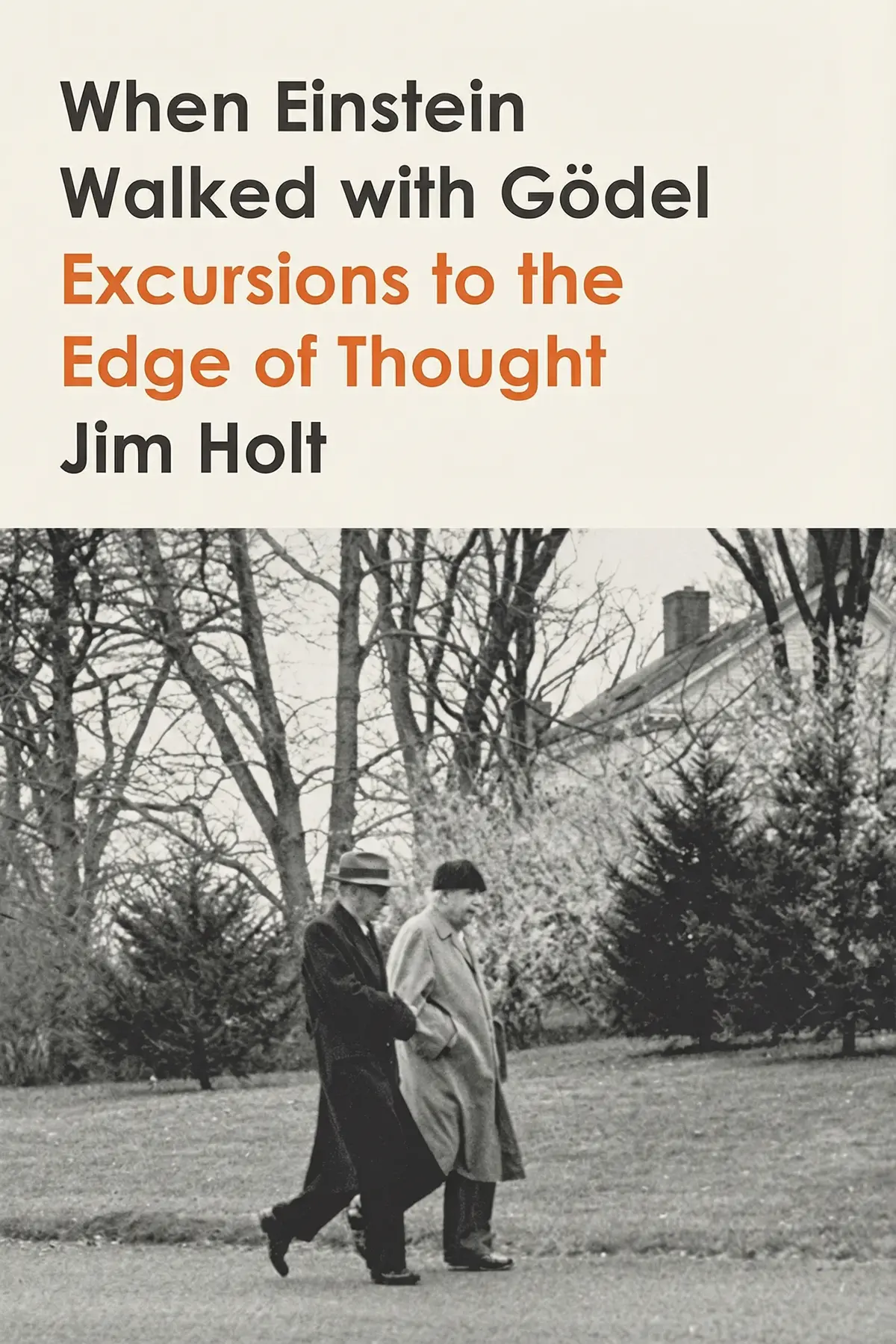
Table of Content
1. Introduction
57 sec
Relativity, prime numbers and infinity can feel too abstract to bother with, yet each one quietly changes how you picture time, knowledge and your own place in the cosmos. In When Einstein Walked with Gödel, journalist and essayist Jim Holt shows that late in life the world’s most famous physicist had become an outsider, and his favorite walking partner was a logician who had proved that no system of logic can be made perfectly watertight.
Holt’s argument is that the strangest ideas in math and physics can be grasped through a good picture, that they change how we see reality, and that the people who found them were brilliant and painfully human. Along the way you get a car chase that explains relativity, a reason to trust your feel for numbers, a test for theories that explain too much and a theater-audience estimate of how long humanity has left.
2. Understand the friendship behind two great ideas
1 min 41 sec
The most famous scientist alive spent his last years walking alone, until a strange young logician fell into step beside him. What drew these opposites together says a lot about how unpopular ideas survive.
3. Grasp relativity with one imagined car chase
1 min 35 sec
If you chase a beam of light, common sense says it should seem to slow down. It doesn’t, and working out why led one of Einstein’s companions to doubt that time exists at all.
4. Trust the number sense you already have
1 min 45 sec
A patient with a brain injury kept getting simple sums wrong, but never wildly wrong. That small clue revealed something built into every brain, and it reaches all the way to a million-dollar puzzle.
5. Use beauty as a guide to good answers
1 min 57 sec
Mathematics is meant to be the most rigorous of subjects, yet many of its best minds judge their work by an artist’s standard. A broken head of cauliflower helps explain what they are looking for.
6. Trust a tool before you can prove it real
1 min 54 sec
For centuries mathematicians used infinitely small quantities while doubting they existed at all. How they finally made peace with that doubt holds a lesson about trusting tools you cannot fully see.
7. Learn the unfinished story of computing's founder
1 min 58 sec
The man who designed the modern computer on paper and helped crack a wartime code died after eating a poisoned apple. The official verdict never settled the questions raised by how his country treated him.
8. Spot a theory that explains too much
1 min 53 sec
Physics’ favorite candidate for a theory of everything looks elegant at first glance. Look closer and it needs hidden dimensions, and a pair of brothers once got pure nonsense about it into serious journals.
9. Learn why humanity likely has millennia left
1 min 54 sec
Physicists offer three grim endings for the universe, each with a strange twist. A simple piece of reasoning borrowed from a theater audience then suggests how much time our own species probably has left.
10. Conclusion
1 min 13 sec
Holt’s excursions add up to a double portrait. On one side are ideas that seem built to keep ordinary people out: clocks that slow in a moving car, nine dimensions, a universe that may freeze, collapse or dissolve. On the other are the people who found them: Einstein drifting out of favor, Gödel starving himself out of fear of poison, Turing punished by the country he had helped save. The ideas proved more approachable than their reputation, and the minds behind them more fragile.
When relativity comes up, the slow-light car chase lets you explain it in a minute. When numbers intimidate you, remember the patient who missed simple sums by one and never wildly, and begin from estimates. When an explanation fits every outcome, ask how it could ever be tested, the question Woit put to string theory. And when the future feels short, the theater-audience reasoning offers a horizon of thousands of years at least.
Two men once walked the Princeton campus together, both out of step with their colleagues. The questions they carried are still open, and anyone willing to think slowly can walk beside them.
About this book
What is this book about?
Quantum mechanics, relativity and the logic of prime numbers can seem so abstract that most people never get past the jargon. Jim Holt argues that these ideas are within reach and far from academic: they change how we understand time, knowledge and our place in the universe. The people who produced them also lived lives as dramatic as their theories. Holt opens with an unlikely friendship in Princeton, where an isolated Albert Einstein took long walks with the young logician Kurt Gödel, who later used Einstein's own equations to argue that time cannot exist. From there he moves through the brain's built-in number sense, the unsolved puzzle of how primes are spread, mathematicians' devotion to beauty, the long quarrel over infinitely small quantities, Alan Turing's computing machine and mysterious death, the doubts surrounding string theory and three rival forecasts for the end of the universe. Readers get a set of big ideas they can actually explain to someone else, simple tools for thinking about evidence and estimates, and a sober reminder that genius rarely protects anyone from loneliness or cruelty.
Book Information
Who it's for
Professionals who dropped math
Curious professionals who gave up on math and physics at school but still want to understand relativity, infinity and computing.
Students wanting human stories
Students looking for vivid pictures and human stories to anchor abstract science.
Drawn to scientists' lives
Readers drawn to the lives of Einstein, Gödel and Turing as much as to their ideas.
About the Author
Jim Holt
Jim Holt, born in 1954, is an American journalist, popular-science author and essayist. His writing has appeared in Slate, The New Yorker, The New York Review of Books and The New York Times, among other publications, and in 1997 he edited the political magazine The New Leader. His other books include Stop Me If You've Heard This, an exploration of jokes, and Why Does the World Exist?, which became a New York Times bestseller in 2013.
Ratings & Reviews
Ratings at a glance
What people think
Listeners find this work highly accessible and well-crafted, containing numerous thought-provoking essays that examine fundamental topics in philosophy and mathematics. They value the broad collection of pieces regarding time, while one listener points out that it delivers an extensive historical overview. Listeners describe the text as intellectually invigorating, with one review highlighting the unique glimpse into the minds of two exceptional men.
Top reviews
Joy
This book is essentially a masterclass in making the most intimidating corners of human thought feel like a casual conversation at a cocktail party. Jim Holt has this incredible gift for taking concepts like string theory or the Riemann zeta conjecture and stripping them down to their absolute essence without losing the inherent wonder. I’ve always been intimidated by the philosophy of science, but these essays are so stimulating and readable that I found myself finishing three or four in a single sitting. While the title suggests a narrow focus on Einstein and Gödel, the book is actually a much wider-ranging exploration of the 20th century's greatest intellectual leaps. From the nature of time to the paradoxes of infinity, Holt provides a comprehensive historical recount that feels both deeply researched and remarkably accessible to a layperson. It’s the kind of writing that makes you want to immediately go out and buy five more books on the same topics.
Show moreSureerat
Wow, I didn't expect a collection of math and physics essays to be this juicy. Holt doesn't just explain the theories; he dives into the scandals and the personal quirks that shaped the history of science. The anecdote about John Wheeler getting thrown out of Gödel’s office while asking about Heisenberg's uncertainty principle was a highlight for me. It really brings these 'exceptional men' down to earth. The book serves as a perfect sample platter of the most interesting ideas known to man, ranging from the philosophy of BS to the heat death of the universe. Some people might find the lack of dense equations a drawback, but for a science journalist, Holt does a great service by keeping things focused on the conceptual beauty rather than the technical weeds. It’s an intellectual stimulant that leaves you questioning the very nature of reality and time.
Show moreTang
A comprehensive historical recount that feels less like a dry lecture and more like a guided tour through the 20th century’s greatest minds. I loved the way Holt weaves together the personal lives of these mathematicians with their abstract discoveries. Learning about Cantor’s obsession with infinity and his subsequent stay in an asylum adds a layer of human drama to the math that you just don't get in a classroom. The book is remarkably well-written, with a brisk pace that prevents the denser philosophical arguments from becoming tedious. I particularly enjoyed the essays on the 'anthropic' reasoning and why we live in a three-dimensional world. It’s a stimulating read that manages to be both funny and profound. For anyone who enjoys thinking about the big questions of existence, this collection is an absolute must-read.
Show moreRatchanee
I honestly feel like my brain grew three sizes after reading the section on the 'four-color problem' and the nature of infinity. Jim Holt is such an accomplished writer; he knows exactly how to pitch these ideas so they are challenging but never impossible to grasp. The book is a treasure trove of thought-provoking essays that span everything from the philosophy of naming to the dynamics of academic life. I found the ending piece on Kripke especially interesting, as it touched on the more human side of the philosophy world that we rarely see. Even when the topics got incredibly abstract, Holt’s wit and humor kept me engaged. This is the kind of nonfiction that reminds you how beautiful and strange our universe really is. Highly recommended for anyone who wants a serious but accessible look into the minds of geniuses.
Show moreClara
Picked this up because I wanted to brush up on my understanding of Gödel’s Incompleteness Theorem without drowning in a textbook. Holt is a fantastic guide through these 'excursions to the edge of thought,' and his writing style is brisk and engaging. He manages to humanize these legendary figures, like the eccentric von Neumann or the tragic Alan Turing, by mixing juicy biographical details with serious philosophical inquiry. I particularly enjoyed the section on the four-color map problem—it was a fascinating look at how mathematical proofs have evolved with the advent of computers. To be fair, some of the shorter essays at the end feel like filler and don't have the same depth as the core chapters. However, as a general overview of the central concepts in mathematics and philosophy, it’s a highly readable and thought-provoking collection that I’d recommend to any curious mind.
Show morePete
As a casual fan of science writing, I appreciated how Jim Holt manages to strip these profound ideas down to their absolute essence. He tackles the philosophy of language, the mystery of prime numbers, and the weirdness of quantum entanglement with equal flair. The truth is, many of these topics are usually buried in academic jargon, but here they are presented with a wit that keeps you turning pages. I did find the transition from physics to analytic philosophy a bit jarring at times, and the book lacks a strong through-line because it’s a collection of previously published pieces. That said, the individual essays are so well-written that it hardly matters. It’s a wide-ranging set of reflections that provides a great starting point for anyone who wants to understand why people get so obsessed with the 'unimaginable' parts of our universe.
Show moreSun
Frankly, some of these essays are much better than others, which is the inevitable curse of any collection like this. The core pieces on Einstein, Gödel, and the limits of logic are five-star material—stimulating, clear, and genuinely mind-blowing. Holt has a way of making you feel like you’re finally 'getting' relativity before he pivots to the next big idea. However, the shorter reviews tucked into the back half feel less essential and sometimes a bit dated. I also noticed the biting tone he uses when discussing certain figures, which felt a little unnecessary at times. Despite those minor quips, the book is a wealth of human knowledge packed into a very accessible format. It’s a great 'choose your own adventure' type of nonfiction where you can skip around to the topics that interest you most, from the end of the universe to the nature of truth.
Show moreTawee
The chapter on Alan Turing and his tragic end was moving, but I found myself frustrated by the author’s tone elsewhere. Not gonna lie, the title is very misleading—only the very beginning touches on the walks Einstein and Gödel took at Princeton. The rest is a mixed bag of essays where Holt explains his own understanding of relativity and logic. Some of it is brilliant, like his take on the 'Four Color Problem,' but other parts feel shallow. He asserts that Gödel believed time doesn't exist but fails to explain the notion well enough for it to make sense in a practical context. There are also some minor factual errors, like misidentifying the subject of the Bogdanov scandal. It’s a decent enough read if you want a light introduction to these themes, but serious science buffs might find it a bit too 'pop' and occasionally repetitive.
Show moreKasemsan
Not quite the mind-blower I was hoping for, mostly because Holt covers a lot of ground that feels a bit repetitive if you’ve read any pop-science before. The essays are entertaining and readable, but they rarely go deep enough into the 'mechanism' of how these theories actually work. He uses the 'cocktail-party' approach, which is fine for a quick overview, but I often felt like I was getting the sparknotes version of much more interesting books. Also, as others have mentioned, the title is a bit of a marketing gimmick. If you’re looking for a detailed account of the relationship between Einstein and Gödel, you’ll be disappointed after the first twenty pages. It’s a fine guide for newcomers, but if you’ve already read your share of Hawking or Penrose, you might find this a bit too shallow for your liking.
Show moreKwame
Why title a book after one specific friendship if you're only going to devote the introduction to it? It felt like a bait-and-switch. Most of this volume consists of Holt’s simplified explanations of complex math, and frankly, his tone can be incredibly condescending. The most glaring issue for me was the chapter on Ada Lovelace. In a book that almost entirely ignores female contributors to science and philosophy, Holt chooses to include one essay about a woman just to spend the entire time undermining her achievements. It felt mean-spirited and unnecessary. Beyond that, the quality of the essays drops off significantly in the second half. By the time he started explaining the Copernican principle for the second time, I was ready to put it down. If you want a deep dive into Einstein and Gödel, look elsewhere; this is just a collection of uneven columns with a misleading cover.
Show moreQuestions about this book
What is When Einstein Walked with Gödel about?
Jim Holt takes readers on short excursions through big ideas in math and physics: relativity, the brain’s number sense, prime numbers, beauty in proofs, infinity, computing, string theory and the end of the universe. He argues these ideas can be grasped through simple pictures and that they change how we see reality. He also tells the dramatic, often tragic stories of the people behind them, starting with Einstein’s late friendship with Kurt Gödel in Princeton.
Why did Kurt Gödel believe time does not exist?
Working through Einstein’s equations of relativity, Gödel found a solution describing a rotating universe in which travel into the past becomes conceivable. He reasoned that if time travel is mathematically possible, time itself cannot truly exist. Holt presents this as Gödel taking his friend’s theory further than Einstein did. Gödel’s own life ended sadly: he grew paranoid about poison and died of starvation at Princeton Hospital in 1978.
What does Jim Holt say about string theory?
String theory proposes that the smallest building blocks of the world are vibrating strings of energy, which could unite relativity and quantum mechanics. It looks elegant, but its math needs at least nine spatial dimensions. Holt reports Peter Woit’s criticism that no experiment can confirm it and that its many versions predict anything. He notes that nonsense papers by the Bogdanov brothers reached respected journals, and suggests the theory lasts mainly because nothing better exists.
How long will humanity last according to the book?
Holt applies the Copernican principle. Just as a theatergoer can be 95 percent sure of being neither among the first nor the last 2.5 percent of the audience, we can be 95 percent sure we are not among the last humans. Since our species has existed for 200,000 years, that suggests at least another 5,100 years and possibly as many as 7.8 million, long before any big chill, crunch or crack-up.
Readers also enjoyed

A Guide to the Good Life: The Ancient Art of Stoic Joy
William B. Irvine

A Life Decoded: My Genome: My Life
J. Craig Venter


A Planet of Viruses
Carl Zimmer
A Little History of Philosophy
Nigel Warburton

A Short History of Nearly Everything
Bill Bryson

A Theory of Justice
John Rawls

A Thousand Brains: A New Theory of Intelligence
Jeff Hawkins

AUDIO SUMMARY AVAILABLE
Listen to When Einstein Walked with Gödel in 15 minutes
Get the key ideas from When Einstein Walked with Gödel by Jim Holt, plus 5,000+ more nonfiction titles.
- 5,000+ titles
- Listen as much as you want
- 7-day free trial
- Cancel anytime









