
15 min 36 sec
Available in: English
The Human Edge: How Curiosity and Creativity are Your Superpowers in the Digital Economy
By Greg Orme
Shows why AI takes routine work but cannot replace four human strengths, and how to build curiosity, creativity, focus and collaboration through small daily habits that keep your career valuable.
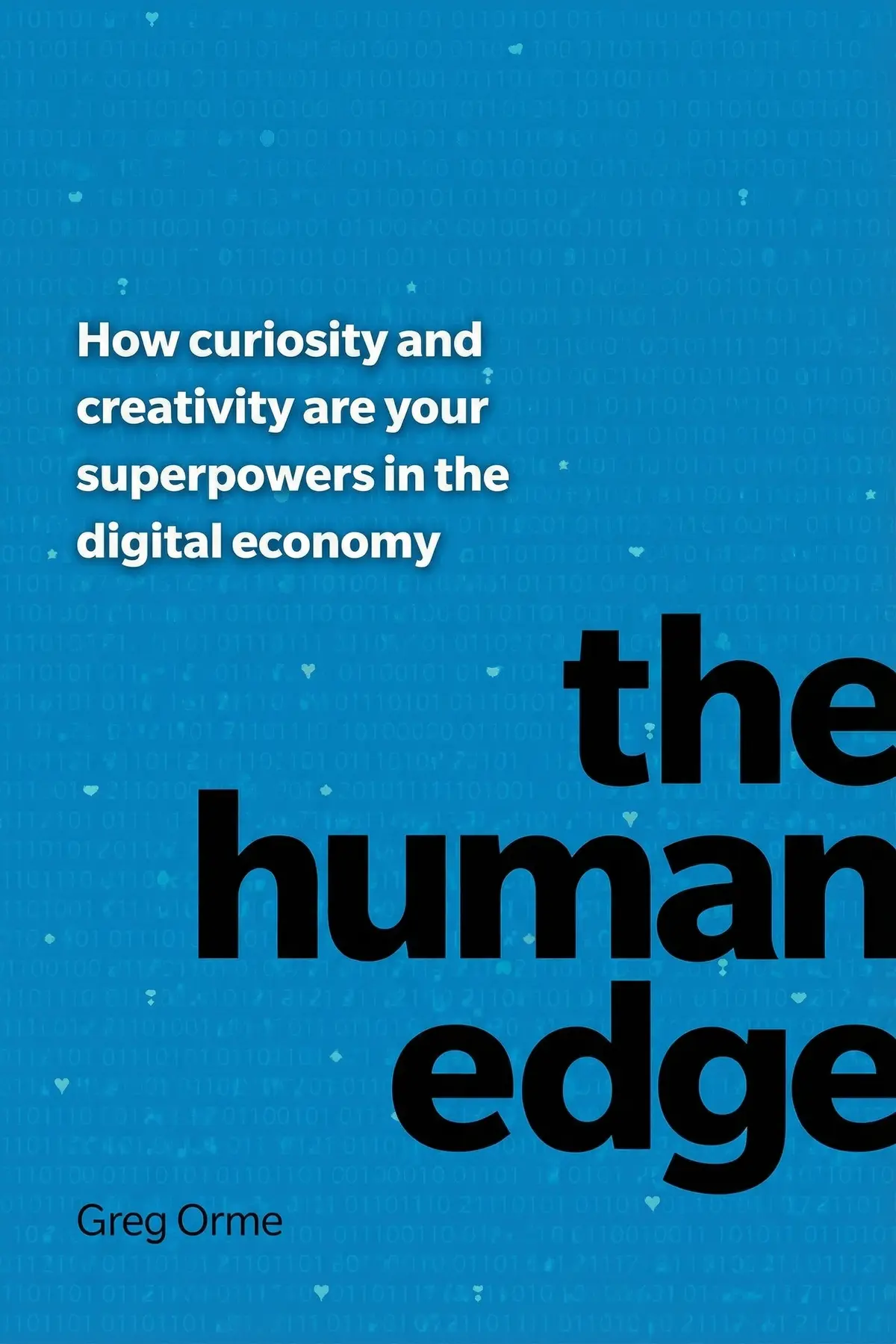
Table of Content
1. Introduction
1 min 04 sec
If you suspect a machine could do parts of your job, you have company: in a 2017 Pew Research Center survey, 76 percent of American employees said they feared AI could replace them. In The Human Edge, Greg Orme of London Business School offers a calmer view. AI only works toward goals that people set for it, and it cannot match four things humans do by nature. Orme calls them the 4Cs: creativity, curiosity, consciousness and collaboration.
His argument is that these four skills feed one another and that each one grows through small, ordinary habits. The sensible plan is to build what machines lack, rather than race them at routine work. The evidence ranges from art students tracked for six years to a melted candy bar that led to a kitchen invention. What follows is a working routine for staying hard to replace: what to learn, which questions to ask, how to protect your attention and when to bring other people in.
2. See which parts of your work machines can take
1 min 56 sec
A singer can hit every note perfectly and still leave the judges cold. Orme argues that today’s AI has the same flaw, and spotting it shows you where your own value at work actually sits.
3. Reclaim the creativity school trained out of you
2 min 02 sec
Almost every five-year-old in one long study tested at genius level for creativity. Ten years later, very few did. What happened in between explains why so many capable adults believe they have no ideas.
4. One hour a day of wide and deep learning
1 min 48 sec
Leonardo da Vinci studied plants and Steve Jobs took a class in handwriting. Neither looked useful at the time, yet both changed their best-known work. The pattern suggests a simple way to spend part of every working day.
5. Find the problem worth solving and ask better questions
1 min 55 sec
Two groups of art students got the same assignment and the same time. Six years later, every one of the successful artists came from just one group, and the difference had nothing to do with drawing skill.
6. Win back the attention your phone keeps taking
1 min 51 sec
Most people guess they check their phone every half hour or so. The real figure is far more frequent, and it threatens the one resource every other human skill quietly depends on.
7. Three habits that keep ideas coming
1 min 53 sec
An engineer testing radar equipment noticed something odd in his pocket and ended up changing kitchens everywhere. Orme argues that moments like his are less lucky than they look, and that you can make them happen more often.
8. Build weak ties to bring the best ideas your way
1 min 48 sec
The laboratory that gave the world the first laser had corridors so long nobody could see the end of them. That odd design points to a source of good ideas most people overlook, and a time to avoid it.
9. Conclusion
1 min 19 sec
Orme’s case comes down to a trade. Machines are absorbing the routine, single-goal work people have done for generations, and racing them there is a losing plan. What stays human is the work only a person can start: wondering about something new, deciding which problem deserves effort, protecting the focus to think it through and finding the stranger whose view changes the idea. Because each of the four skills strengthens the others, small gains in one spread to the rest.
He also names the fuel underneath. When work feels meaningful, he argues, motivation rises, and so do the curiosity, creativity and determination people bring to it. Look for the ways your job makes a difference in other people’s lives, or the parts of it you care about most, and give those more of your energy.
From there the habits are modest. Guard an hour a day for learning, some of it deep and some of it wide. Meet a stubborn problem with five whys before choosing a fix, and keep asking after you have one. Take a different route now and then, and talk to whoever you meet along it.
Almost every child in George Land’s study began as a creative genius. That ability does not disappear with age, and it returns with the hour you give it.
About this book
What is this book about?
Machines are moving from factory floors into offices. Chatbots answer customers, software screens job applications, and forecasts suggest a large share of today's jobs could go to AI within 15 years. Many workers feel that pressure already. Greg Orme's response is to change the contest, because there are things machines cannot do at all. His case rests on one limit: AI is fast and increasingly self-taught, yet it only works toward goals people set, and each system stays inside a single task. Humans learn across fields, invent new questions and connect ideas. Orme names four human strengths, the 4Cs of creativity, curiosity, consciousness and collaboration, and shows how they reinforce each other. The book turns each one into habits you can start this week. You set aside an hour a day for learning and ask why five times before fixing a problem. You answer messages in fixed windows, sleep on hard problems and meet people outside your usual circle. Its examples run from a psychologist's long study of art students to the hallways of Bell Labs.
Book Information
Who it's for
Office workers fearing AI
Office workers who worry that AI will take over the routine parts of their job.
Professionals planning their careers
Professionals planning a long career or a career change who want skills that machines cannot copy.
Team managers and leads
Managers and team leads looking for practical ways to bring more ideas, focus and collaboration to their teams.
About the Author
Greg Orme
Greg Orme works on creativity, innovation and organizational change. He is a program director at London Business School, where he founded the Centre for Creative Business, and he has given more than 350 talks around the world. He has led change programs for large international companies in banking, automotive and technology, with clients including Sky, BMW, eBay and the International Olympic Committee. His first book, The Spark, was published in 2014.
Ratings & Reviews
Ratings at a glance

What people think
Listeners view Greg Orme’s blueprint for future-proofing professional paths as a relevant and highly practical manual. While some listeners feel that certain suggestions address well-known concepts, most value the concentration on the "4Cs"—Creativity, Curiosity, Consciousness, and Collaboration—as an essential strategy for refining distinctively human talents. Additionally, they appreciate the author's talent for demystifying intricate digital developments through compelling stories, with one listener describing the text as a "bible" for both individual and career development. They also highlight the functional utility of discovering how to ask "smart questions" to drive innovation, characterizing the book's perspectives as vital for succeeding in an era defined by AI.
Top reviews
Pick
Wow. This book is basically a manual for the next decade of my professional life. Greg Orme has managed to take the terrifying prospect of AI and turn it into a roadmap for personal growth. The way he describes AI as a 'skilled-yet-uninspiring singer' perfectly captures the limitations of machine logic compared to human passion. I’ve started implementing the 'five whys' method from Toyota in my own problem-solving sessions at work, and the results are already showing. This isn't just about surviving the AI revolution; it's about thriving by leaning into our consciousness and creativity. It’s a bible for anyone who wants to stay relevant. I cannot recommend it enough for those who feel their routine tasks are being swallowed by software.
Show moreBua
Not what I expected, but exactly what I needed. I thought this would be a dry tech book about algorithms, but it's actually a deeply human exploration of how we work and live. The epilogue quote about machines being tools that need people to use them really hit home for me. We often fall into this trap of thinking AI is some mystical force, but Orme brings it back to reality. His focus on 'Curiosity' as a must-have habit for self-learning is something I’m already trying to instill in my kids. This book is underrated and deserves a much wider audience. It’s rare to find a business book that feels this personal and urgent at the same time.
Show moreElise
After hearing so much doom and gloom about robots taking over our jobs, Greg Orme’s optimistic take is a breath of fresh air. He makes a compelling case that our biological 'superpowers' are more valuable than ever. The way he bridges the gap between complex digital trends and everyday work habits is masterful. I particularly liked the focus on 'Collaboration' and how machines can't replicate the nuances of human teamwork. The book is filled with great analogies—like the melting ice cubes—that make the concepts easy to remember and share with colleagues. If you want to feel empowered rather than replaced by technology, read this book immediately. It is truly an indispensable roadmap for the future.
Show morePia
Picked this up because the AI hype was starting to give me anxiety, and honestly, Greg Orme provides exactly the kind of grounded perspective I needed. He doesn’t dismiss the technology, but instead, he reframes the whole conversation around what we as humans actually bring to the table. The '4Cs' framework—Creativity, Curiosity, Consciousness, and Collaboration—is remarkably easy to digest and apply. I particularly enjoyed the section on curiosity and the power of asking smart, open-ended questions like the 'How Might We?' technique used by IDEO. While some of the career advice felt like common sense, the way it’s packaged with such engaging storytelling makes it stick. It’s a fast, insightful read for anyone feeling a bit lost in the digital economy.
Show moreSukit
As someone who works in a creative field, I found the section on 'Smart Questions' to be the most valuable part of the whole book. Orme argues that finding the right problem is actually more important than finding the perfect solution, and he uses a fascinating study of art students to prove it. The focus on 'How Might We?' questions has already changed the way I lead my team meetings. The book is well-written and the tone is encouraging without being overly optimistic. My only gripe is that the chapter on consciousness felt a little disconnected from the rest of the career advice. Still, the practical tips on avoiding the 'auto-pilot' mode of life are worth the price of admission alone.
Show moreEmily
Finally got around to finishing this, and I'm walking away with a much clearer perspective on where I fit in a world of algorithms. The core message is simple: don't compete with machines on their home turf. Instead, we should double down on things like empathy, teamwork, and a sense of humor. Orme’s writing style is punchy and accessible, making even the more abstract concepts like 'Consciousness' feel practical. I especially appreciated the advice on 'weak ties' and finding people who share your passions but aren't in your immediate circle. It’s a timely reminder that our humanity is our greatest asset, even if it feels like the machines are winning the efficiency race. A solid four-star read.
Show morePun
The chapter on Consciousness really hit home for me. In a world where we are constantly bombarded by notifications, Orme’s plea for uninterrupted attention is vital. He explains how learning new things and finding creative solutions requires a level of focus that AI simply doesn't have. I loved the Toyota 'five whys' example as a way to dig deeper into problems. The book is structured logically, and the 'Actionable Advice' sections at the end of chapters are actually useful rather than just being fluff. It’s a great guide for anyone looking to reclaim their time and mental energy from the digital noise. Very glad I picked this up during a career transition.
Show morePenelope
To be fair, much of what Greg Orme discusses here isn't exactly groundbreaking if you've been following tech trends for the last few years. We’ve heard about the importance of soft skills and 'uniquely human traits' many times before in various business books. However, the author does a solid job of simplifying complex digital shifts into actionable insights. The writing is clear, though it occasionally feels a bit repetitive in its emphasis on the 4Cs. I found the 'weak ties' concept in the collaboration chapter to be the most interesting part of the book, as it offers a practical way to expand one's professional horizon. It's a decent primer for someone new to the topic, but seasoned professionals might find it a little light on new information.
Show moreSiriphen
In my experience, books about 'future-proofing' often lean too heavily on buzzwords, and Orme doesn't entirely escape that trap here. The 4Cs are a helpful mnemonic, but I found myself wanting more concrete examples of people actually using these skills to pivot their careers in real-time. That said, the storytelling is top-notch. The analogies are vivid and help clarify his points about why AI can't replicate human intuition or the 'X-factor.' It’s a quick read, and the advice to 'space out' and protect our attention from mobile phone distractions is something we all need to hear. It’s a good book, just not necessarily a life-changing one for me. It’s a solid addition to the genre nonetheless.
Show moreVera
Ever wonder why business books feel like they could have been a long blog post? That was my primary feeling while finishing this. While the 4Cs are important, the author spends a lot of time on analogies and stories that feel like filler. The 100-story building comparison for computing power was interesting for a second, but it didn't really help me understand how to do my job better today. I was looking for more technical depth or perhaps more rigorous data to back up the claims about consciousness and creativity. Instead, it felt like a collection of motivational speeches. It’s fine for a quick airplane read, but don't expect a deep dive into the mechanics of the future economy.
Show moreQuestions about this book
What is The Human Edge by Greg Orme about?
The book argues that AI is taking over routine work but can only pursue goals people set, inside narrow tasks. Orme’s answer is to build four human strengths machines lack: creativity, curiosity, consciousness and collaboration. He shows how they reinforce each other and turns each one into everyday habits, from an hour of learning a day to asking why five times and meeting people outside your usual circle.
What are the 4Cs in The Human Edge?
Orme’s 4Cs are creativity, curiosity, consciousness and collaboration. Creativity is producing new ideas. Curiosity is learning both widely and deeply so those ideas have material to work with. Consciousness means protecting your time and attention from constant digital interruption. Collaboration means bringing in other perspectives, especially from weak ties outside family and friends, at the right moment. He argues that each skill feeds the others.
How can I make my career harder to replace with AI, according to Greg Orme?
Stop competing with machines on routine tasks and invest in what they cannot do. Orme proposes setting aside sixty minutes every workday for study, following the example of Benjamin Franklin. He recommends open questions such as IDEO’s How Might We and Toyota’s five whys, and handling messages in two 30-minute windows a day. He also advises sleeping on hard problems and seeking chance encounters with new people.
Who should read The Human Edge?
It suits knowledge workers uneasy about automation, people facing a long working life who may want to switch careers, and managers trying to get more ideas and focus from their teams. Its advice needs no technical background. The habits are small and concrete, such as taking a new route to work, choosing a thinking space or checking why you need help before you ask for it.
Readers also enjoyed








AUDIO SUMMARY AVAILABLE
Listen to The Human Edge in 15 minutes
Get the key ideas from The Human Edge by Greg Orme, plus 5,000+ more nonfiction titles.
- 5,000+ titles
- Listen as much as you want
- 7-day free trial
- Cancel anytime









