

13 min 02 sec
Available in: English
The Adaptation Advantage: Let Go, Learn Fast, and Thrive in the Future of Work
Shows why automation frees time instead of simply taking jobs, and how individuals, leaders and companies can turn that time into a lasting edge by learning in cycles and building on human skills.
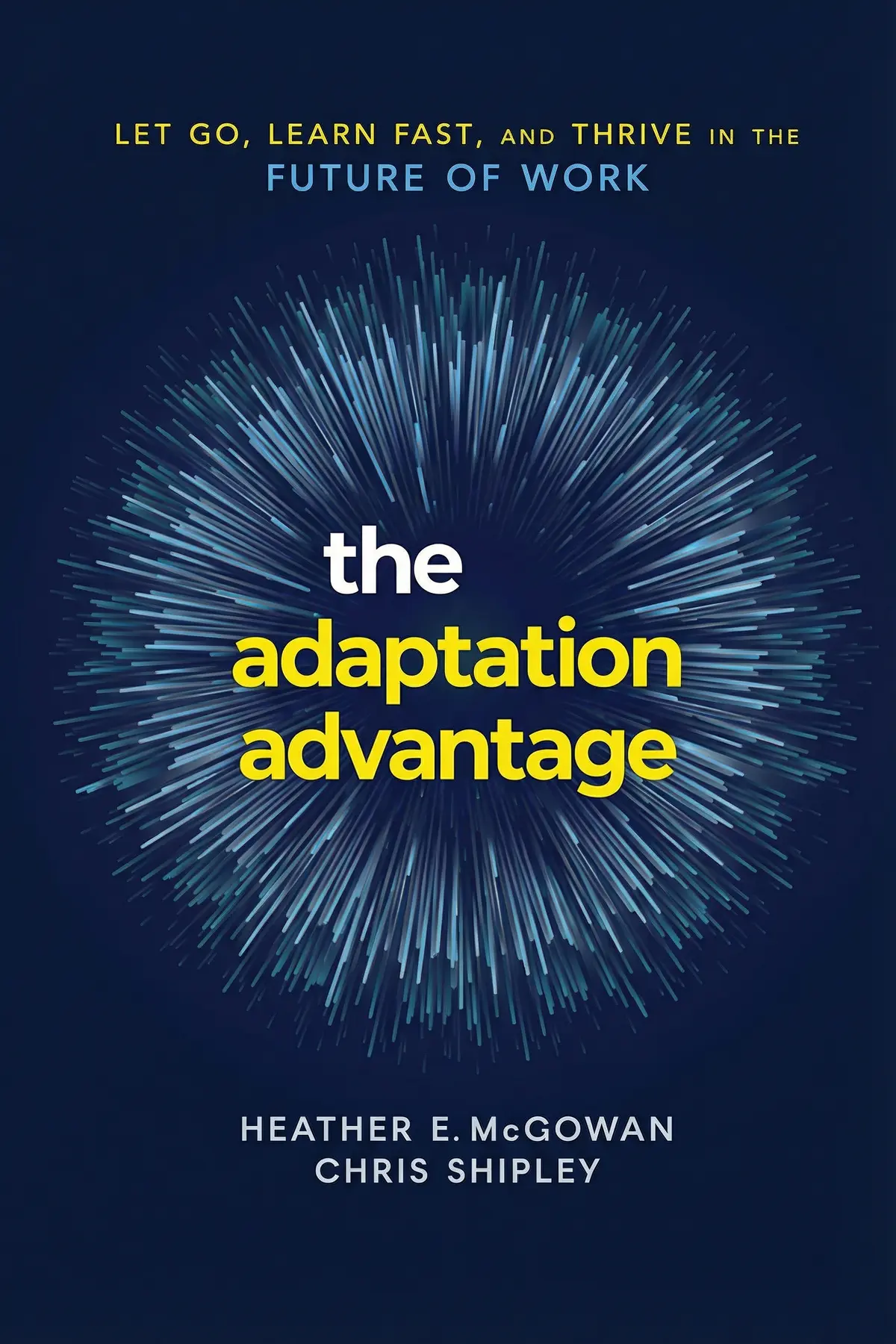
Table of Content
1. Introduction
57 sec
If headlines about robots taking jobs leave you uneasy, Heather E. McGowan and Chris Shipley offer a different reading of the same facts. In The Adaptation Advantage, they argue that technology is handing workers back time, and that the people who win spend that time learning. Machines, they note, are simply better at routine, well-defined tasks.
What machines cannot match is our capacity to adapt. That means letting go of a fixed professional identity, learning in repeated cycles and leaning on the creative and social skills no machine has. Practiced by individuals, leaders and whole organizations, that capacity is the advantage the book is built around.
The ideas ahead offer a better answer to the question of what you do. They add a four-step loop for learning anything new and a way to judge whether your company is ready to change shape.
2. Turn automation into time you can reinvest
1 min 59 sec
In one second, millions of emails fly and robots pack parcels, and the pace only accelerates from here. The usual reading of these numbers is fear. The authors find something very different hiding inside them.
3. Swap your job title for a reason to work
1 min 42 sec
Almost every first conversation with a stranger includes the same harmless question. The authors think it does real damage, narrowing careers before they begin and hiding a hard truth about work today.
4. A four-step loop for learning anything new
1 min 37 sec
Being agile sounds like a personality trait you either have or lack. The authors describe it instead as a cycle with clear stages, and the trick lies in what happens after the last one.
5. Human skills now matter more than coding
1 min 52 sec
Schools around the world push science and math as the ticket into a digital economy. Yet chief executives report a very different shortage, and it points to abilities most people already have.
6. Lead by going first and trusting others
1 min 58 sec
Put one random person in charge of a small group, add a plate of cookies, and watch. The result is funny until you remember who runs your team, and what it takes to lead well.
7. Build a company that can change shape
1 min 50 sec
For decades, one idea told companies what they were for. The authors replace it with two measures borrowed from the human body, and the change reaches all the way down to how you write a job ad.
8. Conclusion
1 min 07 sec
The Adaptation Advantage adds up to a change in where you look for security. A title, a fixed skill or a single product once felt safe. In McGowan and Shipley’s view, the safe thing now is the habit of adapting itself. It is carried by people who know why they work, leaders who go first and share control, and companies that measure themselves by what they can become.
The book’s closing advice is personal and easy to start tonight. Recall the hardest moment of your career so far and write down what you learned from it and how you adapted. The authors expect most people to find they are more agile than they believed. Bad news often pays off later, they argue, because it pushes us past what we thought we could do. Steve Jobs lost his own company and went on to build Pixar.
Before you worry that you lack tech or science skills, remember what machines still do poorly. Creativity and skill with people are already yours. The robots will keep getting faster, and the edge stays with whoever keeps learning.
About this book
What is this book about?
Headlines warn that robots are coming for our jobs, and the pace of change makes the warning feel real. Heather E. McGowan and Chris Shipley read the same facts differently. Machines are better at routine, well-defined tasks, they argue, but by splitting, automating and extending our work, technology hands people back time. The real question is what we do with it. Their answer is adaptation. Individuals should stop defining themselves by a job title and ask why they work instead. They should learn in a repeating four-stage cycle and invest in the social and creative skills that employers struggle to find. Leaders should go first, trust people who know more than they do and know when to pivot. Organizations should judge themselves by culture and capacity, and hire with that in mind. Readers get a calmer way to think about technology and a simple learning loop. They also get a frame for leading teams and building companies that can change direction without falling apart.
Book Information
Who it's for
Professionals worried about automation
Professionals worried that automation will make their job or skills obsolete.
Switching careers
Career switchers whose identity is tied to a single job title and who want a sturdier way to plan.
Leaders rethinking their approach
Managers and founders rethinking how they lead, hire and keep a company able to pivot.
About the Author
Heather E. McGowan
Heather E. McGowan trained as an industrial designer at Rhode Island School of Design and holds an MBA from Babson College. She designed products for Safety 1st and Wilson Sporting Goods, led the Center for Design and Business at Rhode Island School of Design, and helped create an interdisciplinary college at Philadelphia University whose curriculum won a national design award for education. Her LinkedIn series on the future of work drew 100,000 readers in 24 hours. Chris Shipley reported on the tech industry as a journalist and spotted startups as an analyst. She went on to counsel hundreds of young companies on positioning, business models and the human side of disruption.
Ratings & Reviews
Ratings at a glance
What people think
Listeners find the text intellectually stimulating regarding education and professional growth, with one listener emphasizing the inclusion of practical exercises. They view it as an essential and highly relevant resource.
Top reviews
Bee
This book is a complete game-changer for anyone feeling the "robot anxiety" that seems to dominate every headline these days. McGowan and Shipley argue convincingly that we need to stop asking kids what they want to *be* and start asking *why* they want to do it. Connecting my identity to a sense of purpose rather than a static job title felt like a massive weight off my shoulders. The writing is punchy, and the anecdotes—like the comparison between the Sony Walkman and the iPod—hit home. It’s an empowering read that makes the future feel like an opportunity rather than a threat.
Show moreYuwadee
Ever wonder why you feel so burned out despite having a "good" job? This book might have the answer. McGowan and Shipley explain how our obsession with job titles creates a fragile identity that shatters the moment the market shifts. By focusing on adaptation and purpose, we become much more resilient. The story about Steve Jobs being fired from Apple and then returning was a great reminder that setbacks are just pivots. Not gonna lie, I was skeptical at first, but this is a must-read for anyone feeling stuck in their career.
Show moreWanida
To be fair, I expected another dry business book, but this was surprisingly emotional and thought-provoking. It’s essentially a guide on how to stay relevant as a human in an age of machines. The authors don't just talk about tech; they talk about the human spirit and our innate ability to evolve. I particularly liked the focus on wellness and respect as pillars of a modern organization. If you’re worried about your career longevity, do yourself a favor and read this.
Show moreSurasit
As a manager in a mid-sized firm, I found the section on "intentional culture" versus "accidental culture" absolutely vital. The authors describe culture as the heart and capacity as the brain, which is a brilliant way to look at organizational health. I’ve already started implementing some of the practical exercises with my team to help them navigate the "S-curve" of learning. Some of the talk about a "technocratic world" felt a bit detached from reality, but the leadership advice on vulnerability and trust is top-tier.
Show moreOlivia
Finally finished this and it’s surprisingly timely given how fast AI is moving right now. The "Three A's"—atomization, automation, and augmentation—provide a clear framework for understanding how technology actually supports human labor rather than just replacing it. I liked the focus on neurodiversity and the idea that our capacity to learn is more important than what we already know. It’s a bit redundant at times, and some sections feel like a slog, but the message about shifting from "learning to work" to "working to learn" is powerful.
Show moreAdam
Picking this up was the best decision I’ve made for my professional development this year. The authors dive deep into the concept of "psychological safety" and how leaders must model vulnerability to build trusting teams. It’s not just about the bottom line anymore; it’s about creating an environment where people feel safe enough to unlearn old habits. The writing is accessible, though the tech-heavy examples might alienate readers who aren't into the startup scene. Still, the message about our uniquely human skill set is universal.
Show moreNim
The concept of the "Adaptation Advantage" is exactly what we need in the Fourth Industrial Revolution. Personally, I think the rate of change is so fast that we’re all living through a constant state of "climate change" in the market. I loved the distinction between "modeling the way" and "enabling others to act." It challenges the traditional, hierarchical view of leadership in a way that feels fresh and necessary. A few of the diagrams were confusing, but the overall takeaway is worth the effort.
Show moreSamroeng
What on earth is going on with some of these charts and diagrams? Honestly, I spent more time trying to decode the visuals than I did actually absorbing the text. The central thesis about the "Adaptation Advantage" is solid and well-researched, but the delivery feels a bit clunky in places. While I appreciate the focus on "uniquely human" skills like empathy and creativity, the book gets repetitive by the halfway mark. It’s a good primer on the future of work, but frankly, it could have been a long-form essay instead of a full book.
Show morePatchara
While the core message is fantastic, the book feels like it’s trying a bit too hard to be "visionary" with its layout. The content itself is high quality, but the execution is a bit of a slog in the later chapters. Truth is, once you get the point about detaching your identity from your job, you’ve gotten 80% of the value. I appreciated the evidence-backed approach to human skills like social intelligence, though I wish there was more documentation for some of the specific studies mentioned.
Show moreJeeranan
I’m tired of these "Future of Work" manifestos that sound like they were written in a Silicon Valley bubble. The authors lean heavily on loose assumptions and futuristic speculation that just doesn’t apply to blue-collar or high-stakes utility industries. Look, if I encourage my workers to "embrace failure" in a water treatment plant, people get sick. The stakes of failure are just too high for this kind of paper house reality. To be fair, the research on AI is interesting, but the practical application for most industries is basically zero.
Show moreQuestions about this book
What is the main idea of The Adaptation Advantage?
Heather E. McGowan and Chris Shipley argue that technology is not mainly stealing jobs. By splitting, automating and extending work, it frees up time. Our edge is the capacity to adapt: stop defining yourself by a job title, keep learning in cycles, build human skills like creativity and social intelligence, and organize companies around culture and capacity instead of any single product.
What are the three A's in The Adaptation Advantage?
The authors call them atomization, automation and augmentation. Atomization breaks large jobs into smaller pieces, as platforms like Upwork and Fiverr allow. Automation handles routine chores such as sending bulk emails or updating calendars. Augmentation extends human abilities, the way surgical robots help doctors and GPS helps drivers. Together, they argue, these give people back time to invest in learning and in their lives.
What is the learning S-curve in The Adaptation Advantage?
It is a four-stage cycle the authors use for both people and businesses: explore what needs to improve, experiment with new ideas, execute the best ones and expand them by refining as you learn how they perform. The experiment stage is where the curve rises steeply. The cycle is meant to be repeated whenever conditions change, which is what the authors mean by agility.
Which skills does The Adaptation Advantage say matter most?
Human skills rather than purely technical ones. The book cites the Institute for the Future on social intelligence and adaptive thinking, the World Economic Forum on creativity and emotional intelligence, and a 2019 PricewaterhouseCoopers survey. In that survey, 77 percent of chief executives said they could not find workers with skills like creativity, problem solving, leadership and adaptability.
How can I apply The Adaptation Advantage to my own career?
Start by describing your work through why you do it instead of your title. Run the explore, experiment, execute and expand loop on one stuck area. Invest in social and creative skills. The authors also suggest writing down the hardest moment of your career, what you learned from it and how you adapted, to see how agile you already are.
Readers also enjoyed

A Bigger Prize: How We Can Do Better Than the Competition
Margaret Heffernan





A Year with Peter Drucker: 52 Weeks of Coaching for Leadership Effectiveness
Joseph A. Maciariello


60 Seconds & You’re Hired!
Robin Ryan

AUDIO SUMMARY AVAILABLE
Listen to The Adaptation Advantage in 15 minutes
Get the key ideas from The Adaptation Advantage by Heather E. McGowan, plus 5,000+ more nonfiction titles.
- 5,000+ titles
- Listen as much as you want
- 7-day free trial
- Cancel anytime









