

14 min 56 sec
Available in: English
Strategy Rules: Five Timeless Lessons From Bill Gates, Andy Grove and Steve Jobs
Shows how Bill Gates, Andy Grove and Steve Jobs used the same few strategic rules to dominate computing. It also shows how to set priorities, time launches, size risks and build platforms with those rules.
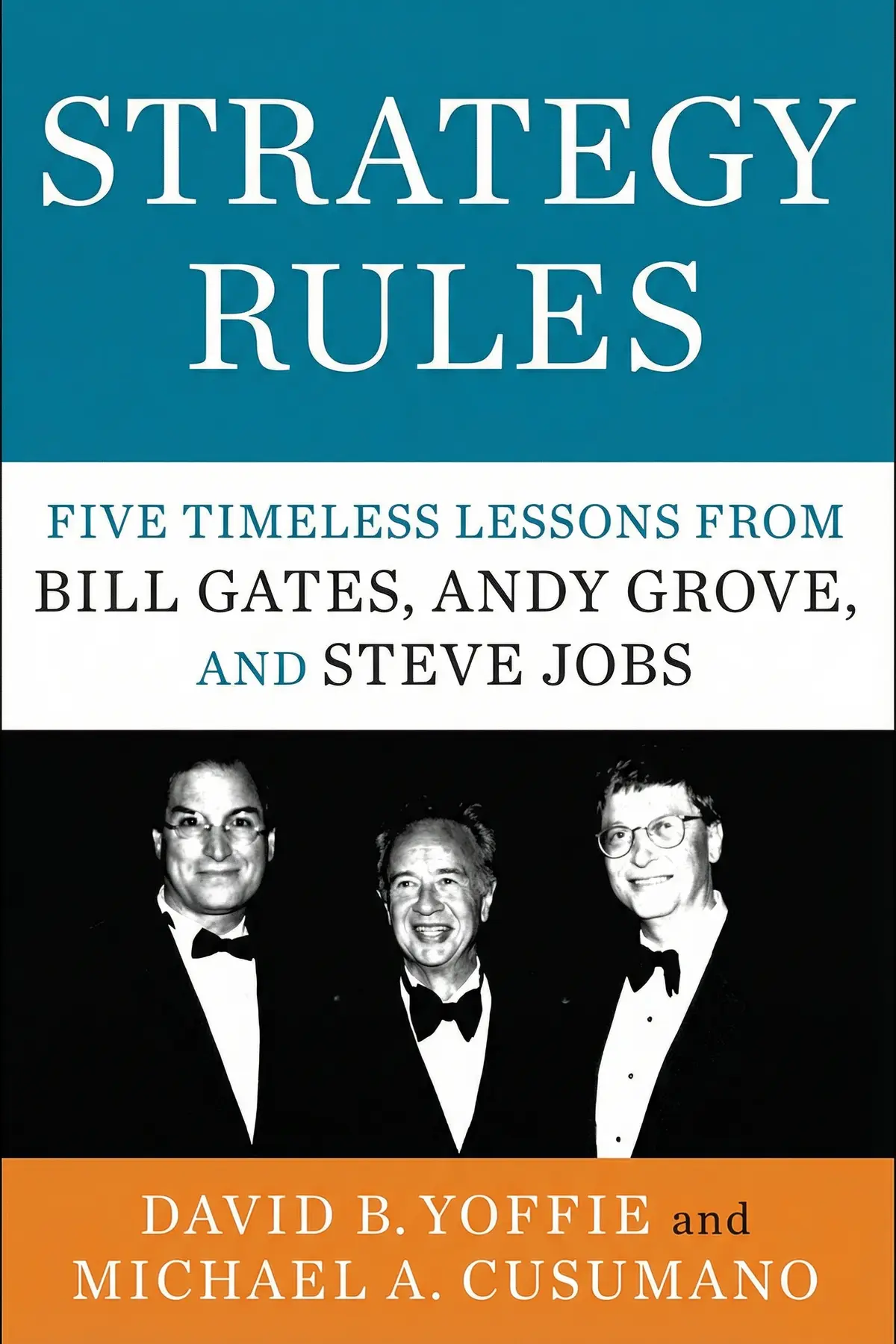
Table of Content
1. Introduction
1 min 10 sec
Most plans start from today and get overtaken by whatever changes next. In Strategy Rules, Harvard Business School professor David B. Yoffie and MIT Sloan professor Michael A. Cusumano show that Bill Gates of Microsoft, Andy Grove of Intel and Steve Jobs of Apple worked the other way round. Each began by imagining the destination in sharp detail, and only then ranked their priorities to reach it.
The three were very different men, but the authors argue they followed the same small set of rules. They set a vision and priorities, chose the right moment to launch, and took big risks only when failure would not sink the company. They built platforms that made their products the standard and switched between stealth and force against rivals. Each one also built his own talents into his company and hired partners for the rest. Those rules, the authors argue, still explain Facebook and Google. The cases run from a failed conference calling system to a $50 million purchase called Android, and each rule works as a test for your own next decision.
2. Start from where your industry is heading
1 min 56 sec
Gates and Grove read the same prediction about computer chips and made opposite bets, and both of them won. What they saw shows why priorities set from where you stand today often point the wrong way.
3. Launch only when the world is ready
1 min 47 sec
Intel and Apple each built a device years ahead of its time. One company spent hundreds of millions of dollars and failed. The other shelved a working product, and that patience paid off.
4. Make bold bets without risking the company
1 min 40 sec
One analyst warned that switching the Mac to Intel chips could finish Apple off. Jobs went ahead anyway. What made the move far safer than it looked had nothing to do with computers.
5. Grow faster with platforms others build on
1 min 59 sec
For years Jobs refused to share Apple’s software, and the Mac stayed a small player. Grove gave valuable research away to the whole industry, and Intel’s sales took off. The difference changes how you think about growth.
6. Know when to look small and when to push
1 min 49 sec
Jobs got better deals from the record labels by making Apple look harmless. Gates kept buyers waiting two years for a product that did not exist yet. Both moves worked, and each one fit its moment.
7. Build your strengths in, hire for the rest
1 min 37 sec
Gates rewrote other people’s code. Jobs ignored finance completely. Neither weakness held their companies back, because each man knew exactly which gifts to spread through the company and which gaps to fill with someone else.
8. The same rules still build giants today
1 min 49 sec
MySpace’s user base in 2007 was four times the size of Facebook’s. Google bought a small company for $50 million and gave its product away for free. Both stories follow rules written a generation earlier.
9. Conclusion
1 min 09 sec
At bottom, Strategy Rules is a story about method. Three men with opposite temperaments, a design lover, a strict organizer and a sarcastic hacker, won with the same playbook. They began with a vision, and the book stresses checking whether the market and technology are ready before launching. They took big risks without staking the whole company and treated the whole industry around their product as something to improve. Jobs’s own path, from a closed Mac with a tiny market share to iTunes on Windows, shows that these rules can be learned, even late.
The authors’ simplest tool is a good place to start. Picture the goal already reached, trace the steps back to today and treat each step as a priority. Before a big move, find the cushion that keeps you alive if it fails. When your product seems stuck, look at what surrounds it: the connector, the network or the developer who could build on top of you.
Grove patented the USB work and then opened it to every manufacturer. Computers got easier to use, and there was an Intel chip inside each one.
About this book
What is this book about?
Microsoft, Intel and Apple were led by men with almost nothing in common. One was a sarcastic hacker, one a deeply disciplined manager and one a design lover who wanted control over every detail. Yet business professors David B. Yoffie and Michael A. Cusumano argue that Bill Gates, Andy Grove and Steve Jobs won by following the same small set of strategic rules. The authors start with vision: each leader pictured where computing was heading and reasoned back to what his company should do now. From there they cover timing a launch, building barriers against rivals, taking large risks without endangering the whole company, and growing through platforms instead of single products. They also describe two styles of competing, quiet judo and heavyweight sumo, and show how each leader built his own strengths into his company while recruiting partners to cover his gaps. The cases include Intel's failed ProShare conference calling system, the iPod money that paid for Apple's switch to Intel chips, and the USB connector Grove opened to the whole industry. The authors then follow the same rules to Facebook and Google. Readers come away with a set of tests for their next strategic decision.
Book Information
Who it's for
Product leaders and founders
Founders and product leaders deciding when to launch, what to bet on and how to compete.
Strategists and managers
Managers and strategists who want tested rules drawn from Microsoft, Intel and Apple.
Curious about tech success
Professionals curious how Gates, Grove and Jobs actually won.
About the Author
David B. Yoffie
David B. Yoffie holds the Max and Doris Starr professorship in International Business Administration at Harvard Business School, where he has taught since 1981 and once chaired the Strategy department. He spent 29 years on Intel's board, serving as Lead Director. Michael A. Cusumano is a distinguished professor at the MIT Sloan School of Management, specializing in strategy, product development and entrepreneurship in software and consumer electronics. He has published 14 books, including Platform Leadership and Microsoft Secrets.
Ratings & Reviews
Ratings at a glance
What people think
Listeners find this an exceptional resource for company leaders and entrepreneurs, with one listener remarking that it is vital reading for those aiming for success. Beyond that, the strategic concepts earn high marks; one listener emphasizes the potent observations concerning today's top strategists. Lastly, listeners admire the caliber of the writing, as one listener observes how the authors skillfully blend their distinct viewpoints.
Top reviews
Big
Finally got around to reading this, and it’s a masterclass for any aspiring entrepreneur. Yoffie and Cusumano don’t just offer dry theory; they provide a blueprint based on the real-world maneuvers of Gates, Grove, and Jobs. To be fair, most of us know the basic history of these tech giants, but seeing their strategies distilled into five core rules makes the complexity of high-stakes business feel much more manageable. The concept of building platforms rather than simple products really hit home for me. It’s a powerful read that feels both historical and extremely relevant for today’s market leaders who need to scale fast. The authors successfully combine their academic backgrounds with practical, board-level experience to create something truly excellent.
Show morePalm
Ever wonder how three completely different personalities managed to dominate the same era of computing? This book is a fascinating look at the shared DNA of their strategic thinking. I found the chapter on "shaping the organization around your personal anchor" to be the most revelatory part of the whole text. It humanizes these "American Gods" by showing their flaws and how they built teams to compensate for them. For any business leader, this is a must-read that clarifies the difference between being a good manager and being a great strategist. The authors have provided powerful insights into how contemporary strategists can apply these lessons to their own companies today.
Show moreSomporn
Wow, what an incredible synthesis of three of the most influential careers in modern history. The authors managed to take decades of tech evolution and boil it down to five essential habits that anyone can study. I especially appreciated the focus on how these leaders had to learn and grow; they weren't born perfect strategists. It shows that execution is a skill honed over time through trial and error. The writing style is professional yet accessible, making it an excellent choice for both students and seasoned executives. If you want to understand the architecture of the digital age and how to build a lasting platform, start here. It's a must-read for business success.
Show moreWitthaya
As someone who works in tech strategy, I appreciated the focus on "looking forward and reasoning back." The authors do a fantastic job of showing how vision isn't just a vague dream but a calculated roadmap for the future. While some of the anecdotes about Microsoft and Apple have been told a thousand times, the synthesis here is what adds value. Personally, I found the section on exploiting leverage particularly insightful, even if the tactics feel a bit ruthless at times. My only gripe is that it occasionally feels a bit like a university textbook, which might slow down casual readers. Regardless, it is a solid framework for anyone trying to understand how the industry standard is actually set by the biggest players.
Show moreAroha
The perspective here is unique because Yoffie actually sat on Intel’s board, giving him a front-row seat to Grove’s decision-making process. That personal connection elevates the narrative above your typical business biography. I particularly liked the emphasis on "cannibalizing your own products" before a competitor does it for you; it’s a terrifying but necessary strategy in modern tech. The prose is sharp and avoids the fluff that plagues most management books. While it does suffer slightly from survivorship bias, the lessons on building ecosystems are timeless. It's an excellent resource for anyone looking to move beyond simple product management and into the realm of true industry leadership and long-term planning.
Show moreSumalee
Picked this up during a flight and ended up finishing it before I landed. It’s a very quick, engaging read that distills complex corporate maneuvers into actionable advice. The way Yoffie and Cusumano contrast Grove’s discipline with Jobs’s intuition is brilliant. Frankly, the lesson about making "big bets" without betting the entire company is something every startup founder needs to hear twice. It’s not a perfect book—some sections on Microsoft’s legal battles felt a bit dated—but the core principles remain remarkably sturdy. It definitely deserves a spot on your professional development shelf if you want to understand the mechanics of the digital world. The authors really know how to communicate their experience effectively.
Show moreVimolwan
This book provides a decent introduction to tech strategy, but if you’ve followed these companies for years, you won't find many new revelations here. It felt like a very polished rehashing of well-documented business cases from HBS and MIT. To be fair, the five rules are a useful rubric, and the writing is clear enough, but it lacks the deep psychological dive I was hoping for. Why did these men make these specific choices under pressure? The authors stay mostly on the surface of execution rather than the "why" behind the personality. It’s good for a beginner who is new to management, but maybe too basic for seasoned pros who have already read the major biographies.
Show moreIsaiah
Look, while the case studies on Gates, Jobs, and Grove are interesting, we have to acknowledge the elephant in the room: timing was everything for them. The authors present these rules as a deterministic formula for success, but in my experience, the same strategies could have led to failure in a different decade. The book is well-written and the comparative study is structured logically, making it easy to digest. However, it feels a bit like looking at history through a very specific lens that ignores the failures of others who followed the same rules. It’s an interesting read for students, just take it with a grain of salt and don't expect a perfect recipe for your own startup.
Show moreTanawan
In my experience, business books like this tend to lionize their subjects a bit too much, and this one is no exception. Gates, Grove, and Jobs are treated as monoliths, and while their successes are undeniable, the writing occasionally brushes over their more controversial traits. To be fair, the authors do mention some shortcomings, but the focus is clearly on the "rules" of their success. The framework is helpful for organizing one's thoughts on market positioning, but don't expect a gritty, tell-all biography. It’s a strategic overview, pure and simple, and it serves that specific purpose reasonably well. I found the comparative approach helpful, even if it lacked some much-needed critical distance.
Show moreYui
Not what I expected given the high pedigree of the authors. I found it incredibly difficult to maintain my concentration throughout the middle chapters, which felt repetitive and overly academic. The truth is, the "five rules" could have been summarized in a long-form article rather than stretched into a full book. It leans heavily on the successes of three men while largely ignoring the role of luck or external market conditions at the time. To be fair, the summary at the end for the "next generation" was okay, but the journey to get there was a bit of a slog for me. It feels like a missed opportunity to provide more contemporary insights beyond just looking at the same three legends again.
Show moreQuestions about this book
What is the main idea of Strategy Rules?
David B. Yoffie and Michael A. Cusumano argue that Bill Gates, Andy Grove and Steve Jobs, despite very different personalities, followed the same strategic rules. They pictured where technology was heading and set priorities from there. They timed launches carefully, took big risks without endangering the whole company, built platforms that became industry standards, used both stealth and force against rivals, and built their personal strengths into their companies.
What does Strategy Rules say about platforms?
The authors argue that a strong platform beats a great product on its own. Jobs struggled while he refused to license Apple’s software, then succeeded once iTunes ran on Windows and the iPod worked with any computer. Grove opened Intel’s research, including the USB connector, to all manufacturers. Computers became easier to use, sold better and carried Intel chips, so improving the industry raised Intel’s sales.
How did Steve Jobs take big risks without betting Apple?
When Apple moved the Mac from IBM PowerPC chips to Intel processors, it had to rewrite its software and risked losing customers and developers. Jobs went ahead because the iPod had sold more than 10 million units in the two quarters before the announcement. That income meant Apple’s survival did not depend on Mac sales during the switch. Over the following five years, the Mac doubled its share of the market.
What are judo and sumo strategies in business?
Judo strategy means looking harmless so rivals underestimate you, as Jobs did when he presented Apple to the record labels as a small computer company with two percent of the market. Sumo strategy uses size: buying competitors, cutting prices or announcing products early to freeze buyers. Gates did this in 1982 when he promoted Microsoft’s graphical operating system long before it was ready.
How can I apply the lessons of Strategy Rules?
Start with the authors’ backward exercise: imagine your vision achieved, then trace the steps back to today and treat each one as a priority. Before launching, check whether the infrastructure your customers need already exists. Before a major bet, make sure something else keeps the business alive if it fails. And look for ways to improve the wider system around your product so that others build on it.
Readers also enjoyed

A Bigger Prize: How We Can Do Better Than the Competition
Margaret Heffernan





A Year with Peter Drucker: 52 Weeks of Coaching for Leadership Effectiveness
Joseph A. Maciariello



Acting with Power: Why We Are More Powerful Than We Believe
Deborah Gruenfeld
AUDIO SUMMARY AVAILABLE
Listen to Strategy Rules in 15 minutes
Get the key ideas from Strategy Rules by David B. Yoffie, plus 5,000+ more nonfiction titles.
- 5,000+ titles
- Listen as much as you want
- 7-day free trial
- Cancel anytime









