

13 min 53 sec
Available in: English
 ไทย
EnglishไทยShow Your Work!: 10 Ways to Share Your Creativity and Get Discovered
By Austin Kleon
Shows creative people how to get discovered without self-promotion: share your process daily, own a website, show what inspires you, tell the story behind your work, teach your methods and keep going.
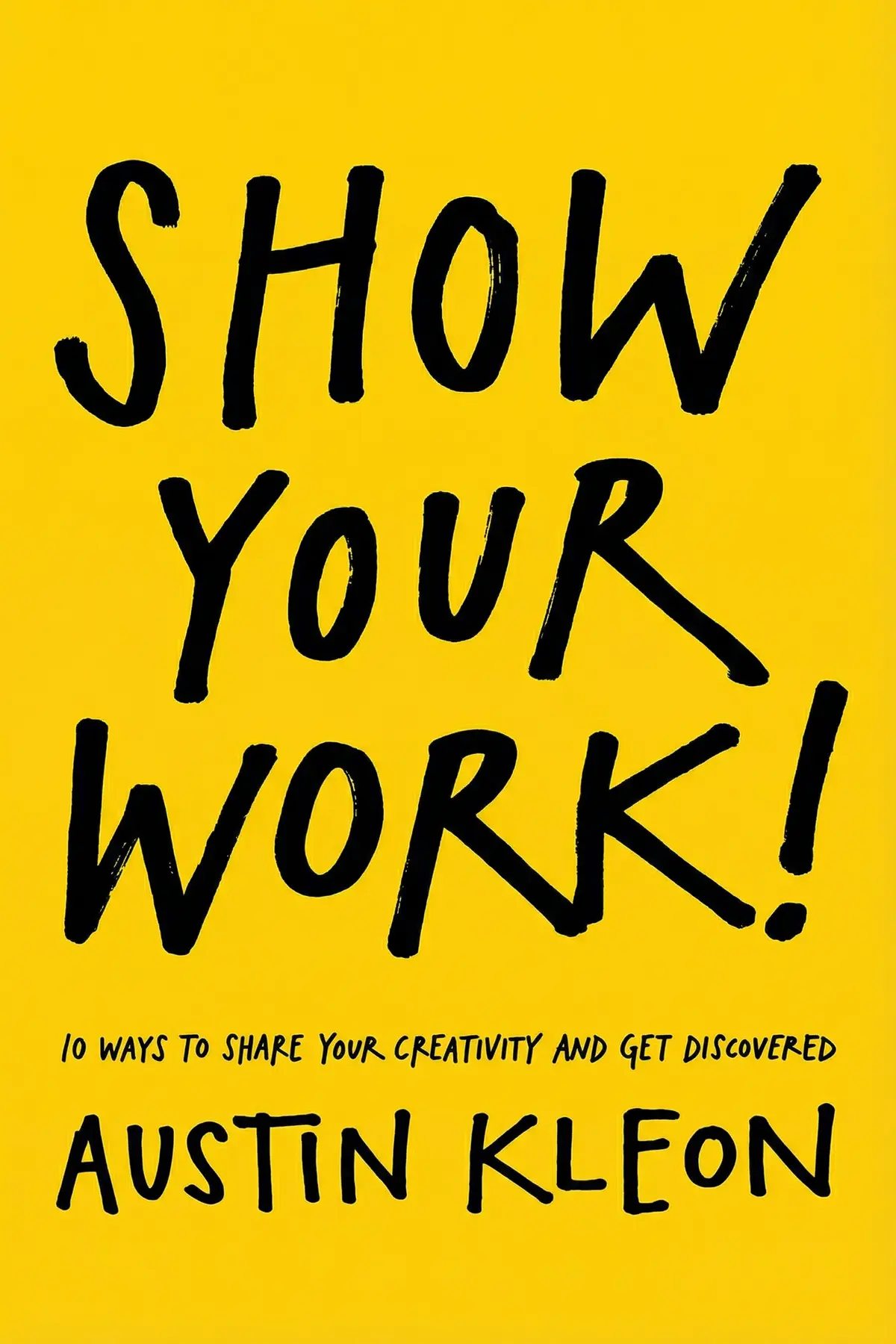
Table of Content
1. Introduction
53 sec
If you make things but cringe at self-promotion, Austin Kleon has a gentler route to being found: show the work while it happens. In Show Your Work!, the writer and artist argues that being good is no longer enough, because work nobody can find might as well not exist. His answer is to share your process, your influences and what you have learned, a little at a time, so the right people discover you on their own.
That idea carries everything that follows. Creativity is a group activity, and showing your work is how you join the group. Kleon makes it practical, from a daily post that takes half an hour to a website you own, a short answer for parties and a reason to give your techniques away. Along the way come an astronaut clipping his nails in orbit, a garbage collector with a museum and a Texas pitmaster teaching his ribs on camera.
2. Trade the lone genius for a creative scene
1 min 48 sec
A towering figure of Western culture may be the biggest obstacle to your creative life. Kleon replaces him with something more crowded, more forgiving and far more open to beginners than you might expect.
3. Post one small piece of your process daily
1 min 42 sec
An astronaut won millions of viewers without showing a single finished achievement. What he shared instead points to a habit anyone can start tonight, and it takes less time than a lunch break.
4. A home online that outlasts every platform
1 min 35 sec
Social networks feel permanent until the day they disappear, taking your work with them. Kleon credits nearly his whole career to one modest choice most creative people put off for years.
5. Show what you love and find your people
1 min 45 sec
Your guilty pleasures and odd obsessions may say more about you than anything you have made. A New York garbage collector shows why taste you might hide is worth putting on display.
6. Tell the story that gives your work value
1 min 41 sec
Two identical paintings stop looking identical the moment you learn one detail about them. That shift explains why quality alone rarely carries a career, and what to say at the next party instead.
7. Teach your methods and learn even more
1 min 42 sec
A pitmaster whose customers line up down the block handed his rib technique to a camera crew. His reasoning turns the fear of being copied upside down, and it changes who you should follow.
8. Earn from your work and keep going
1 min 42 sec
The Sistine Chapel and The Godfather share an origin that purists would rather forget. Kleon uses it to defend getting paid, then explains what keeps a creative life moving through burnout and trolls.
9. Conclusion
1 min 05 sec
Kleon’s book turns a dreaded chore into a habit of generosity. A network can grow without any networking. When you make things you love, show the half-finished versions, share your influences, tell the story behind the work and teach what you know, people who care about the same things find their way to you. They bring friendship and feedback with them, and getting noticed becomes a side effect of being open.
The method works at almost any scale. Tonight, after your work, post one honest snapshot of where it stands, and give yourself no more than thirty minutes. Claim a domain in your own name, even if the site starts as a single page with an email sign-up. Prepare a plain answer to the question of what you do, one your neighbor would understand. And when the next project begins, light it from the last one.
Aaron Franklin explained his ribs on camera while customers lined up down the block six days a week. What they came for could never fit in a recipe: years of practice by the person who mastered it. Showing your work is how people find that person.
About this book
What is this book about?
Many people who write, design, paint or build things would rather do the work than promote it. They hope good work will be noticed on its own. Austin Kleon argues that this hope no longer holds. Skill alone does not suffice, he argues, because people can only find you if you make yourself easy to locate. His answer is not a marketing plan. Kleon rejects the myth of the lone genius and treats creativity as something that happens among people, in what he calls a scenius. From there he lays out a set of habits: share a small snapshot of your process every day, build a website you own, show the influences you love, learn to tell the story of your work, teach what you know, and keep going when money, burnout or criticism arrive. Readers get a low-pressure way to build an audience and real relationships, with concrete steps like a 30-minute daily post, an email sign-up on every page and a plain answer to the question of what you do.
Book Information
Who it's for
Creatives who hate self-promotion
Writers, designers and artists who make good work but hate the idea of promoting it.
Hoping for a following
Professionals and career switchers who want to be known for a skill and build a following around it.
Freelancers and makers
Freelancers and makers who rely on social media alone and want a lasting home for their work.
About the Author
Austin Kleon
Austin Kleon writes about creativity in the digital age. Show Your Work! sits between Steal Like an Artist and Keep Going in a trilogy that has passed a million copies in print and been translated into more than two dozen languages. He also wrote Newspaper Blackout, poems made by blacking out newspaper text with a marker. Before writing books he worked as an advertising copywriter, a web designer and a librarian, and he has spoken at Pixar, Google and TEDx.
Ratings & Reviews
Ratings at a glance
What people think
Listeners find this book an accessible and delightful experience that offers useful tips for creators. They value its unique take on the creative world and believe it is essential for anyone in that industry. The material is direct and fast to implement, with one listener highlighting the inclusion of helpful diagrams. Listeners call it a valuable investment, with one noting it serves as an excellent follow-up to Steal Like an Artist.
Top reviews
Wei
After hearing endless praise for Austin Kleon’s trilogy, I finally dove into this square-shaped gem. Frankly, it’s a breath of fresh air for anyone terrified of the 'self-promotion' label. The book is incredibly easy to digest, peppered with informative diagrams and hand-drawn illustrations that make the advice feel personal rather than preachy. I particularly loved the 'Vampire Test'—a simple but brutal way to audit your circle and protect your creative energy. While some might argue the ideas aren't revolutionary, the presentation is what matters here. It’s a toolkit for the modern age where your process is just as valuable as the finished product. If you’re struggling to find your voice or feel invisible online, this is a must-read. It’s a quick win that leaves you feeling empowered to post that first 'work-in-progress' shot.
Show moreSook
Wow, talk about a shot of adrenaline for my social media anxiety. I used to think that sharing my unfinished work was 'showing off' or being 'extra,' but Kleon reframes it as being helpful. Personally, I found the advice on attribution and linking to be the most practical part. He rightly points out that if you don't include a link, no one is going to bother Googling you. The book itself is a work of art—the typography and sketches make the reading experience feel like flipping through a friend’s sketchbook. It’s a great companion for anyone who feels like they’re shouting into the void. It taught me that being a 'connector' is just as important as being a 'creator.' I’ll be keeping this on my desk for regular inspiration.
Show moreNikolai
Finally got around to reading this, and the truth is, I finished it in about forty-five minutes. But those were forty-five very productive minutes. The book’s core message—that your social media presence is your actual resume—is a wake-up call. I loved the David Carr quote about how 'no one gives a damn about your resume, they want to see what you made with your own fingers.' It’s a very visual book, which helps the concepts stick better than a traditional wall of text. It isn't just for 'artists' either; anyone trying to build a career in 2024 needs to understand these principles. It's spiced up with informative diagrams that make complex networking ideas feel like common sense. Truly a must-read for any creative professional.
Show moreRatthapong
This book is essentially a toolkit for the modern age where your digital footprint is your legacy. It’s a quick, enjoyable read that provides practical advice for creatives who are scared of the spotlight. I’ve read a lot of self-help, but Kleon’s style is much more 'cool older brother' and less 'corporate coach.' The layout is fantastic, using bold graphics to punctuate his points. It’s a great companion to Steal Like an Artist, but I actually think this one is more useful for long-term career growth. It teaches you how to build a 'tribe' by being helpful rather than just being loud. Frankly, every student and freelancer should have a copy of this on their shelf. It’s a short read, but the impact is lasting.
Show moreSin
Picked this up during a massive creative slump and finished it in a single sitting. To be fair, if you’re looking for a 500-page academic treatise on marketing, you’ll be disappointed. This is a punchy, visual guide that focuses on '10 ways' to stay discovered. The chapter on the 'Cabinet of Curiosities' resonated with me deeply; it’s about sharing what you love so that others can find you. Some of the sections felt a little bit light on the 'how-to' specifics, leaving the execution up to the reader, but the motivational boost is undeniable. It’s a fantastic companion to his earlier work, Steal Like an Artist, and serves as a reminder that we don't have to be geniuses to contribute something meaningful to the world. A solid four stars for clarity and style.
Show moreGor
Ever wonder why some mediocre artists gain massive traction while you’re toiling away in secret? This book explains the shift from the 'lonely genius' myth to the 'scenius' reality. The truth is, people want to see the human behind the art. Kleon’s advice on using the 'Block' button to handle trolls was a highlight for me; it’s a necessary survival skill for the internet. I also appreciated his stance that you don’t need to be an expert to share your journey. Sometimes the amateur has more to teach us because they remember what it’s like to struggle. My only gripe is that it relies heavily on quotes from other famous people to drive points home, which can feel a bit repetitive. Still, it’s a refreshing perspective on the creative community.
Show moreElena
The chapter on being a 'connector' really shifted my perspective on how to navigate the internet without feeling like a used-car salesman. To be fair, Austin Kleon isn't reinventing the wheel here, but he is presenting it in a way that is actually fun to read. I loved the section on 'The Vampire Test'—it's such a simple way to figure out who is draining your creativity. The book is short, but that's the point. It’s meant to be a manual you can reference when you're stuck. I do think he could have spent more time on the ethics of 'showing your work' without over-sharing, but overall, it's a great purchase. It’s straightforward, quick to employ, and honestly quite charming. Definitely worth the price for the psychological shift it provides.
Show moreAiden
As someone who hates traditional networking, this book felt like a permission slip to just be myself. It’s refreshing to hear an author admit that the process is often messy and that’s okay to show. Not gonna lie, the book is incredibly thin on actual technical advice—don't expect a tutorial on SEO or algorithm hacks. Instead, you get a philosophy of generosity. The blurb on the back alone shows how much confidence Kleon has in this 'open source' way of living. He practices what he preaches. My favorite part was the advice to 'share a small piece of your process every day.' It makes the daunting task of building an audience feel manageable. It’s a 4-star read for me because while it's light, it's highly effective.
Show morePear
In my experience, Kleon is great at making you feel like you can conquer the world, but this book occasionally feels like a collection of tweets stretched into a manuscript. Don’t get me wrong, the layout is beautiful and it’s a very quick read—you can fly through it in under an hour. However, I found myself wishing for more meat on the bones. He gives you the broad concepts but skips the actual grit of implementation. Not gonna lie, I’ve heard most of this advice before on various productivity blogs. If you’re brand new to social media or the creative arts, you’ll find it revolutionary. If you’ve been in the game for a few years, it might just feel like a friendly, albeit shallow, reminder of things you already know.
Show moreAnucha
Look, if you’re obsessed with 'Deep Work' and looking for profound, life-altering insights, you should probably keep walking. The author himself notes that '90 percent of everything is crap,' and I’m afraid a good chunk of this book falls into that category for me. It’s essentially a very expensive pamphlet. There is zero flow between the chapters; it feels like he just gathered a bunch of blog posts and threw some sharpie drawings over them to increase the page count. The ideas are extremely basic—'tell stories,' 'don't be a vampire,' 'share a snack.' It’s the kind of surface-level motivation that feels good for five minutes until you realize you still don't have a plan. Maybe I’ve just outgrown this genre, but I found it frustratingly shallow and lacking in real substance.
Show moreQuestions about this book
What is the main idea of Show Your Work! by Austin Kleon?
Kleon argues that good work no longer gets noticed on its own; you have to be findable. Rather than self-promotion, he recommends sharing your process, influences, stories and methods openly, a little at a time. He rejects the myth of the lone genius and sees creativity as something that grows in communities he calls sceniuses, where sharing ideas brings audience, friendship and feedback.
How do you show your work every day according to Kleon?
After each day’s work, share one snapshot of where you are: something inspiring you, a work in progress or discarded scraps. Any format works, from a photo or video to a blog post or email, and it does not need to be perfect. Kleon suggests writing the post on a commute or at lunch, or setting a 30-minute timer and returning to work when it rings.
Why does Austin Kleon say you need your own website?
Social networks come and go, as Myspace showed, so work that lives only on them can vanish. Kleon credits his own website, which began as a blog serving as sketchbook and storefront, with his books, art shows, talks and friendships. He advises registering a domain, adding an email sign-up to every page and treating the site as a place to invent yourself.
What does Show Your Work! say about selling out and criticism?
Kleon calls the starving artist a false ideal and points out that Michelangelo painted the Sistine Chapel on commission and Mario Puzo wrote The Godfather to escape debt. He urges grit, starting each new project from the last one, and short daily breaks when you burn out. For criticism, ignore trolls, keep producing a lot of work and remember your work is not who you are.


Readers also enjoyed






AUDIO SUMMARY AVAILABLE
Listen to Show Your Work! in 15 minutes
Get the key ideas from Show Your Work! by Austin Kleon, plus 5,000+ more nonfiction titles.
- 5,000+ titles
- Listen as much as you want
- 7-day free trial
- Cancel anytime









