
14 min 24 sec
Available in: English
Scaling Up: How a Few Companies Make It...and Why the Rest Don’t (Mastering the Rockefeller Habits 2.0)
Shows growing companies how to keep people, strategy, execution and cash moving together, using simple tools for accountability, coaching, a one-page vision, a steady meeting rhythm and a shorter cash cycle.
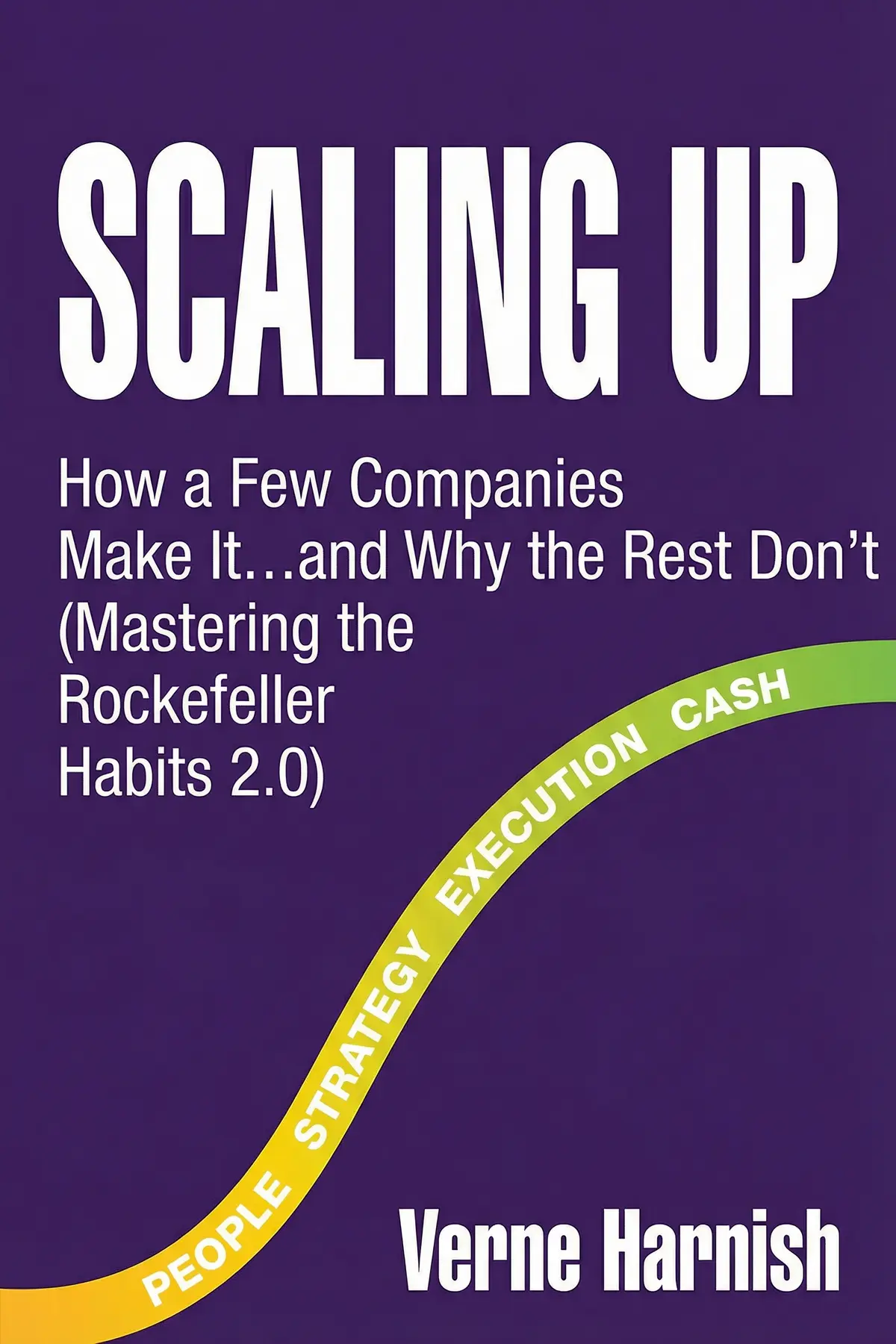
Table of Content
1. Introduction
1 min 01 sec
Getting bigger is supposed to make a business easier to run, with more people, more cash and more momentum. In Scaling Up, Verne Harnish, founder of the Entrepreneurs’ Organization, argues the reverse. Each new hire adds to the work of keeping a company organized, which helps explain why only two to three percent of US companies become high-impact firms lasting more than 25 years.
In his view, growth alone proves nothing. A company scales well only when its people, its strategy, its routines of execution and its cash grow together, because any one of them falling behind will stall the rest. Harnish has spent some four decades coaching growing firms, and he turns that conviction into simple tools, most of which fit on a single page. They include charts that settle who owns what, a vision people can carry in a pocket, a meeting rhythm that keeps hundreds of people aligned, and a single number showing how fast your cash comes home.
2. Grow the team without choking communication
1 min 49 sec
A company that triples its staff should, in theory, find everything easier. Harnish shows why the opposite happens, and why something as ordinary as a missing kitchen can slow a firm down.
3. Give every function and process one owner
1 min 42 sec
An executive team filled in a simple chart and found that half the people in the room were missing from it. The gap it exposed is common in growing firms, and the cost can be serious.
4. Turn managers into coaches people want to follow
1 min 40 sec
Google studied what makes managers great, and The Container Store spends money on staff that most retailers would never spend. Both point to the same change in what a boss is for.
5. A one-page vision that guides every decision
1 min 39 sec
Past a certain size, the boss forgets names and the early sense of mission starts to fade. One company’s answer was small enough for a jacket pocket and showed up at every meeting.
6. Own one word and one edge in customers' minds
1 min 42 sec
A car brand made a single word belong to it, and a restaurant chain made money from a problem every competitor simply put up with. Both found growth hiding in something others overlooked.
7. Run the plan on a steady meeting rhythm
1 min 48 sec
John D. Rockefeller had the same lunch routine every day for a reason. A fast-growing company needs that kind of rhythm too, and the right pace depends on how fast it is growing.
8. Shorten your cash cycle to fund faster growth
1 min 48 sec
In the mid-1990s Dell was heading toward bankruptcy, and later it had enough cash to take itself private. One number made the difference, and most growing firms never measure it.
9. Conclusion
1 min 15 sec
Harnish’s case is that a growing company is really four things growing at once: a team, a strategy, a set of routines and a pool of cash. Trouble starts the moment one of them falls behind the others. The 1,500-person company in the CEO’s announcement will not organize itself. Someone has to size the teams, name the owners and coach the people. Someone has to put the vision on a page, set the meeting rhythm and watch how long cash takes to come home. None of these tools is complicated. On Harnish’s account, the few firms that last are the ones that keep using them steadily while everything else changes.
A practical first move is the one Harnish recommends himself. Hold a daily executive meeting of 15 minutes or less, and have each executive repeat it with their own team, so priorities reach the whole company every day. Alongside it, fill in a function chart and notice how many names repeat. Before the next budget is set, run the Power of One on your cash levers.
A jazz band that has rehearsed its parts can improvise when the music speeds up. Growth is that moment, and the rehearsal has to happen before it arrives.
About this book
What is this book about?
Most new companies fail within a few years, and even successful ones often stall as they grow. Verne Harnish argues that getting bigger makes a business harder to run. Every new hire adds to the work of keeping people informed and organized. Only a small share of firms become lasting, high-impact companies, and in his view the difference usually comes down to people. Scaling Up is a revised edition of his earlier Mastering the Rockefeller Habits. It holds that the team, the strategy and the company's organizational and physical infrastructure must expand together, or success won't last. For each one Harnish offers a practical tool. There are charts that give every function and process a single owner, and a shift from managing to coaching. A vision summary gathers core values, purpose, brand promises and a big long-range goal, and a one-page strategic plan names a top priority and a critical number. A meeting rhythm runs from daily huddles to quarterly offsites, and a method for shortening the time it takes cash to come back. The examples come from Apple, Dell, Outback Steakhouse, The Container Store and VeriFone. Readers come away with a set of routines they can start using with their leadership team right away.
Book Information
Who it's for
Fast-hiring founders and CEOs
Founders and CEOs whose company is adding people faster than its routines can keep up.
Leaders wanting clear ownership
Executives and team leads who need clear ownership, sharper priorities and a meeting rhythm that works.
Operators fearing cash shortfalls
Operators worried about cash running short in the middle of a growth spurt.
About the Author
Verne Harnish
Verne Harnish founded the Entrepreneurs' Organization and also set up the Association of Collegiate Entrepreneurs and the Growth Institute. He has spent about four decades helping companies scale. He is the founder and CEO of Scaling Up, an executive education and coaching company. For fifteen years he chaired the Entrepreneurs' Organization's CEO program at MIT and taught in it. Scaling Up revises his earlier Mastering the Rockefeller Habits and has been translated into 26 languages. He also wrote Scaling Up Compensation and 12 Habits of Valuable Employees.
Ratings & Reviews
Ratings at a glance

What people think
Listeners find this business guide to be an essential read, specifically for individuals launching startups and new company owners. It delivers functional advice and real-world insights that help people develop a unique competitive strategy and explore organizational foundations in detail. They value the book's straightforward nature, with one listener pointing out the ready-to-use templates, and describe it as an invaluable tool for businesses dedicated to growth.
Top reviews
Siriporn
Ever wonder why some companies explode while others just coast? Verne Harnish basically hands you the blueprint here, though you better bring a highlighter and some coffee. It’s not a light beach read, but for an entrepreneur trying to move past the 'mom and pop' stage, it is pure gold. We implemented the daily huddles and the OPSP (One Page Strategic Plan) immediately. The structure provided for our leadership meetings changed the entire rhythm of our office within a month. People complain about the acronyms, but they act as a useful shorthand that eventually sticks. It's the most practical business manual I've ever owned, period.
Show moreEmily
Picked this up on a recommendation from a mentor and it’s easily the most useful resource in my library. Most authors give you 'what' to do, but Verne gives you the 'how' with zero fluff. The 'Power of One' analysis for cash flow was a massive eye-opener for our accounting department. We stopped guessing about our margins and started looking at the specific levers that actually drive growth. Not gonna lie, it’s a firehose of information. You have to take it one chapter at a time or you’ll get overwhelmed. If you are serious about moving from $1M to $10M, this is your bible.
Show moreHemp
Finally got around to reading this and I’m kicking myself for waiting so long. The 'One Page Strategic Plan' is a masterpiece of simplification that forced our executive team to finally align on our core purpose. In my experience, most companies fail because they try to do too much, but Harnish emphasizes saying 'no' to the wrong opportunities. The focus on 'Profit per X' changed how we view our entire product line. This isn't just a book to read; it’s a toolkit to implement over several years. If you're an entrepreneur who feels like they’re drowning in day-to-day operations, this will give you your life back.
Show moreWoramet
The chapter on Strategy alone is worth the price of admission. Moving from SWOT to SWT (Strengths, Weaknesses, and Trends) was a subtle shift that completely changed our long-term forecasting. Truth is, most business books are 200 pages of fluff around one good idea, but this is the exact opposite. Every page has a tool or a metric that you can actually use. We used the '7 Strata of Strategy' to find a differentiator that our competitors can't easily copy. It’s helped us move away from competing on price and toward owning a specific 'word' in our market. Essential for any growth-minded founder.
Show moreEmma
Wow. This book is a beast in the best way possible. It’s the first time I’ve seen a comprehensive system that links high-level strategy directly to daily execution without losing anything in translation. The focus on 'A-players' and the job scorecard changed our entire hiring process for the better. We used to hire based on 'gut feeling,' but now we have a repeatable process that actually works. It’s a rare breed of business book that is both highly tactical and visionary. I keep a copy on my desk and refer to it at least once a week during our quarterly planning sessions. Highly recommended.
Show moreScarlett
As someone who has navigated the messy middle of a startup, I found the section on 'The 4 Decisions' to be incredibly grounding. The book provides a very specific framework for People, Strategy, Execution, and Cash that most business books gloss over with vague anecdotes. Look, it’s dense—almost like a textbook—so don't expect to finish it in one sitting. I did find the Kindle version a bit frustrating because the diagrams are small and hard to read, which is a shame given how vital the worksheets are. Buy the physical copy so you can actually use the templates provided. It’s worth the extra effort for the clarity it brings to your scaling process.
Show moreEleni
After hearing so much buzz in my CEO peer group, I finally dove into the 'Scaling Up' methodology. It’s a significant step up from Harnish's previous work, offering much more depth on the 'Cash' and 'People' pillars. I particularly liked the Function Accountability Chart (FACe) as it cleared up a lot of internal confusion about who actually owns what. My only gripe is that it feels a bit too 'one-size-fits-all.' Some of the meeting rhythms felt a bit excessive for our remote team structure. Still, the actionable insights far outweigh the minor annoyances of the writing style. It's a solid, disciplined roadmap for growth.
Show morePatchara
This book has enough acronyms to make a Pentagon official dizzy. Seriously, Harnish tries to turn every single concept into a three or four-letter shorthand, and it gets exhausting after the first fifty pages. To be fair, the core logic is sound, especially the focus on cash and execution. However, if you already own Mastering the Rockefeller Habits, you might feel a bit of deja vu. It feels like an updated version with extra layers of complexity that aren't always necessary for smaller teams. I appreciate the Jim Collins references, but at times I felt I was reading a derivative work rather than something entirely fresh.
Show moreZanya
Frankly, the content is five-star, but the presentation is a bit of a mess. It’s a very 'busy' book with gray boxes, sidebars, and charts crammed into every corner, which makes for a distracting reading experience. I felt a tiny hint of information overload where I didn't know where to start. It relies heavily on the reader already being familiar with Jim Collins' concepts, which is fine, but it lacks a bit of its own unique voice at times. I’ve implemented the daily huddles with my team and they’ve been effective, but I’m struggling to get through the technical chapters. Good, but proceed with patience.
Show moreTom
Not what I expected based on the rave reviews. This isn't really a book; it’s more like a disorganized binder of checklists and corporate-speak that lacks any real narrative flow. Every other page seems to reference Jim Collins or another business guru, making me wonder why I didn't just read the source material instead. The tone feels incredibly corporate and detached, which didn't resonate with our smaller, organic culture at all. Honestly, it felt like being yelled at by a consultant who loves the sound of his own jargon. There are some okay ideas buried in here, but the acronym soup made it nearly impossible for me to stay engaged.
Show moreQuestions about this book
What is the main idea of Scaling Up by Verne Harnish?
Harnish argues that growth makes a company harder to run, not easier, because every new person adds to the work of staying organized. A firm scales well only when its people, strategy, execution routines and cash grow together. For each area he offers practical tools: accountability charts, a one-page vision and strategic plan, a regular meeting rhythm and methods for shortening the cash conversion cycle.
What is the Cash Conversion Cycle in Scaling Up?
It is the time it takes for a dollar a company spends to come back as revenue, and shorter is better. Dell’s cycle was 63 days in the mid-1990s, when the company was heading toward bankruptcy. Under CFO Tom Meredith it fell to 21 days within ten years, and Dell began producing cash. Harnish recommends dividing the cycle into four stages, namely sales, delivery, billing with payment, and production along with inventory, and then improving each one.
What meeting rhythm does Verne Harnish recommend?
Harnish recommends daily or weekly team meetings, a monthly learning day for executives and a larger offsite strategy meeting each quarter. Companies growing 20 to 100 percent a year should treat each quarter like a full year. His starting point is a daily executive session of no more than 15 minutes. Each executive then repeats it with their own team, so priorities spread through the whole company.
How do the FACe and PACe charts work?
The Function Accountability Chart lists every company function, with one accountable person and the KPIs that measure success for each. The Process Accountability Chart does the same for key processes such as recruiting, and adds how each process should improve and who takes part at each critical step. When Perly Fullerton’s six executives filled in the first chart, only three names appeared on it. That showed the founders needed to delegate more clearly.
Who should read Scaling Up?
It suits founders, CEOs and senior managers of companies that are growing and starting to feel the strain: unclear ownership, priorities that get mixed up between teams, and cash that runs short. The tools are practical enough for a leadership team to use together, from writing a one-page vision summary to calculating which financial lever would improve cash flow most.
Readers also enjoyed



A Bigger Prize: How We Can Do Better Than the Competition
Margaret Heffernan





A Year with Peter Drucker: 52 Weeks of Coaching for Leadership Effectiveness
Joseph A. Maciariello


AUDIO SUMMARY AVAILABLE
Listen to Scaling Up in 15 minutes
Get the key ideas from Scaling Up by Verne Harnish, plus 5,000+ more nonfiction titles.
- 5,000+ titles
- Listen as much as you want
- 7-day free trial
- Cancel anytime









