

13 min 27 sec
Available in: English
Know What Matters: Lessons from a Lifetime of Transformations
By Ron Shaich
Panera founder Ron Shaich shows how to decide today what will matter in five years, then build toward it on purpose, in a company, a career and a life.
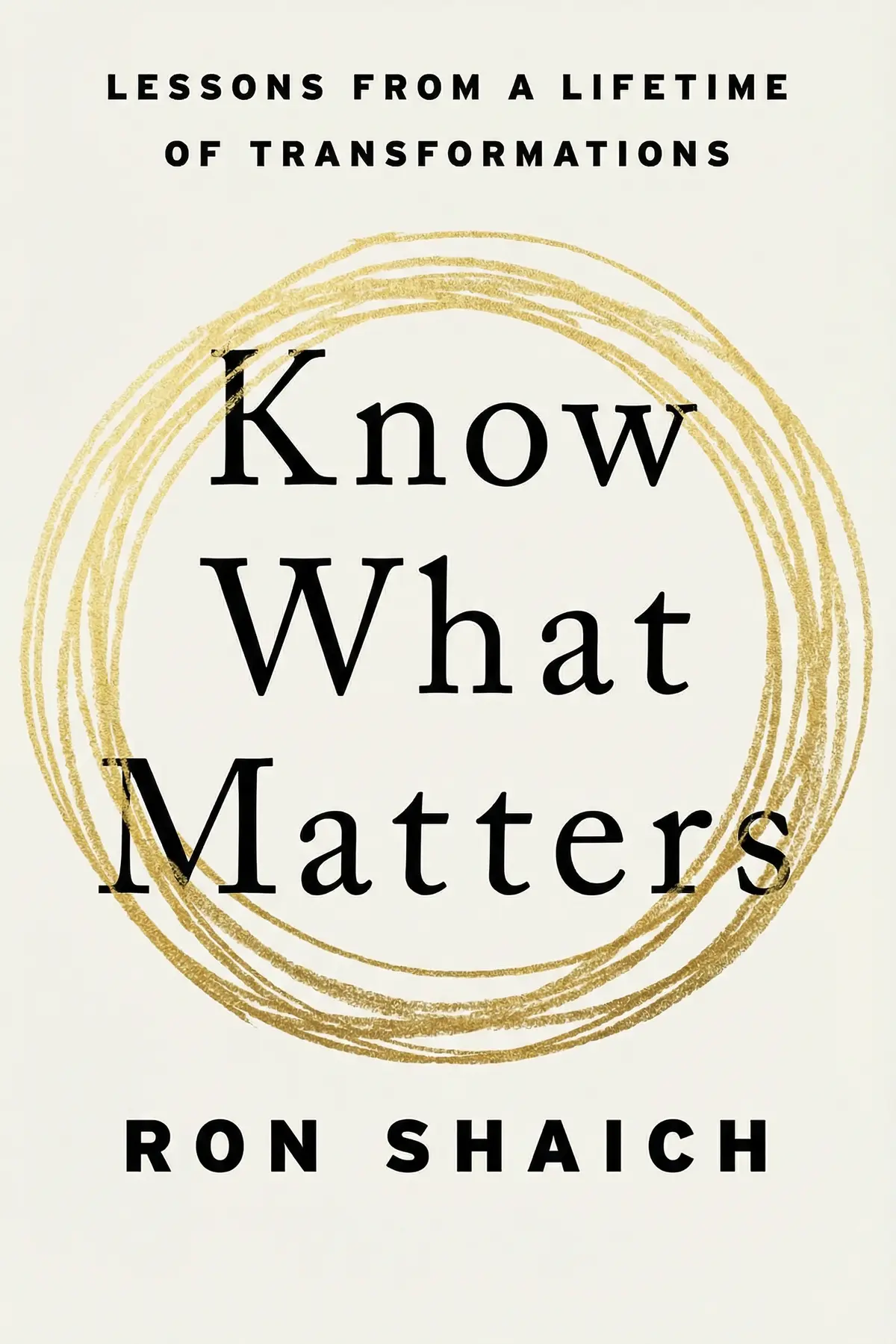
Table of Content
1. Introduction
1 min 02 sec
Most careers and companies drift. They stay busy every day and only discover years later where they have landed. In Know What Matters, Panera Bread founder Ron Shaich argues that the drift stops when you decide today what will matter tomorrow and build toward it on purpose. He boils his record down to three moves: tell the truth about where you stand, know what matters, and get the job done.
Those moves took him from a cookie shop of 400 square feet to 2,400 restaurants with $5 billion in yearly revenue, through a major transformation every six or seven years. They also cost him a marriage, and he says so plainly. One thread connects the stories: success in work and in life is built by intent, working back from the future you want. Along the way come a planning exercise built on an imaginary newspaper article and a test of whether customers would walk past your rivals. There is also a way to judge your life early, while it can still change.
2. Review your life while there is time to change it
1 min 36 sec
Most people judge their lives when the game is almost over. A founder who built a company worth billions explains what he lost by waiting, and the earlier scorecard he now recommends to everyone.
3. Write tomorrow's headline, then work backward
1 min 34 sec
Plans fail less often from bad ideas than from aiming at the wrong thing. A yearly exercise built around an imaginary newspaper story turns a vague ambition into steps a team can take now.
4. Keep your discovery muscle strong as you grow
1 min 37 sec
Big companies often serve their current customers beautifully right up until those customers leave. Shaich traces the problem to two habits of mind that rarely share a room, and to a strange sandwich request.
5. Give customers a reason to walk past your rivals
1 min 44 sec
Being good is rarely enough when a dozen similar options sit on the same street. Shaich explains what real advantage looks like, and how reading the coffee aisle helped him invent a new kind of restaurant.
6. Bet on the business with the brightest future
1 min 28 sec
Selling healthy parts of a company to back a smaller one sounds reckless. A single question from a friend pushed Shaich to do exactly that, and the next eighteen months were the worst of his career.
7. Cut the friction between craving and buying
1 min 38 sec
A great product can still lose customers before they ever taste it. Shaich learned this standing in his own lines, and one sight outside a Panera convinced a technology skeptic to rebuild the whole company.
8. Lead people with stories and patient money
1 min 36 sec
Financial targets that excite a boardroom leave most employees cold. Shaich explains what actually moves people, why he wants therapists near executives and why building a company resembles climbing Everest.
9. Conclusion
1 min 12 sec
The book ends where it began, with family. Its final chapter opens on the memory of his father’s voice, and its last pages give way to an email from his son, reflecting on Shaich leaving Panera after thirty years. For a book full of bakery cafes and record deals, that ending carries the argument. Every transformation he describes, from sliced baguettes to digital ordering, came from looking ahead and asking what would matter. Asked about a life, the same question is harder and more urgent.
Shaich does not claim the dream alone gives life meaning. In a passage from June 2023, echoing Springsteen’s Working on a Dream, he finds it in the daily, disciplined work of building.
So write the article you want published about your work in five years, and trace back what this year must look like to earn it. Find one point of friction between what your customers want and what they get, and remove it. Before the late innings, score the four relationships he names and ask whether this is a life you will respect.
The future you want is already giving instructions. His advice is to read them while you can still act.
About this book
What is this book about?
Most companies and careers drift. They stay busy every day and are surprised years later by where they ended up. Ron Shaich, who grew a tiny cookie shop into a chain of 2,400 restaurants, argues that drift can be stopped. His formula has three parts: tell the truth about where you stand, know what matters, and get the job done. The book follows his habit of transforming his companies roughly every six or seven years. He turned sliced baguettes into the first bakery cafes. He helped create the fast casual category, sold every other division to back Panera, and rebuilt it around digital ordering before its 2017 sale. Behind each move sits one method he calls managing future-back: picture the future, then work backward to the steps that produce it. Shaich is just as frank about the personal cost, including a lost marriage. He offers a way to review your own life early, while it can still change. Readers get practical tools: a yearly pre-mortem, a test of real competitive advantage and the desire-friction ratio. They also get a sober picture of what building something lasting demands.
Book Information
Who it's for
Founders and operators
Founders and operators deciding what to bet on next and what to let go.
Managers under delivery pressure
Managers in growing companies who feel delivery pressure crowding out fresh ideas.
Professionals worried about balance
Ambitious professionals worried that work is consuming the rest of their lives.
About the Author
Ron Shaich
Ron Shaich co-founded Au Bon Pain and later founded Panera Bread, serving as chairman and CEO of both. He is widely credited with helping shape the fast-casual restaurant category. Panera sold in 2017 for $7.5 billion. In 2018 he founded Act III Holdings, where he is CEO and managing partner, and he has been chairman and lead investor in companies such as Cava and Tatte. He was twice named Ernst and Young Entrepreneur of the Year and was Restaurant Leader of the Year in 2018.
Ratings & Reviews
Ratings at a glance

What people think
Listeners find this book highly accessible and regard it as a must-read for entrepreneurs. They value the author's authentic narrative style and blend of individual anecdotes, as one listener points out the valuable insights about goal-setting. The volume acts as a masterclass on constructing a purposeful life, and listeners admire the tempo, with one review mentioning its emphasis on ideas like continuous transformation.
Top reviews
Nim
The concept of the 'desire-friction ratio' alone makes this worth the price of admission. It’s a complete flip of the script on how we usually think about product quality versus the actual user experience. In my experience, most business authors focus on the 'what,' but Ron Shaich is obsessed with the 'how' and the 'why.' He explains how even a great sandwich loses its appeal if the customer has to fight through traffic and long lines to get it. By using tech to bridge that gap at Panera, he basically wrote the playbook for modern retail. It’s an essential read for anyone trying to build something that lasts in a world full of flash-in-the-pan startups. This is a masterclass on continuous transformation that every founder needs.
Show moreWittaya
Finally got around to finishing Ron Shaich’s new book, and it’s essentially a masterclass in long-term strategic thinking. Unlike the typical Silicon Valley 'fail fast' narrative, Shaich emphasizes a 'Concept Essence' that stays relevant for decades. I was fascinated by how his team went through hundreds of drafts just to define what Panera stood for. That kind of rigor is missing in today’s frantic AI-obsessed market where everyone is chasing the next shiny tactic without a North Star. The writing is plainspoken and logical, which is refreshing in an industry full of buzzwords. If you want to know how to move from random motion to actual forward momentum, read this. It’s a genuine story about what it means to lead with a purpose that transcends the stock price.
Show moreEarn
Few business leaders are willing to talk about mortality with the same intensity they use to discuss quarterly earnings. Shaich’s reflection on his father’s 'judgment day' serves as a sobering reminder that our professional successes mean very little if we haven't built a life we actually respect. I found his breakdown of the four key relationships—family, health, work, and spirit—to be incredibly grounding. While he admits to struggling with the balance in the past, his current clarity is a gift to younger entrepreneurs. It’s a rare thing to see a public company CEO show this much empathy. We need more leaders who aren't afraid to suggest that executive teams might need therapists on staff. This book is a beautiful, genuine exploration of what it means to be human in a corporate world.
Show moreLars
This is far more than a handbook for restaurant owners; it’s a blueprint for anyone trying to align their daily actions with their ultimate destiny. Shaich’s writing is authentic and avoids the glossy, self-congratulatory tone of most business books. I loved the focus on reducing friction—not just in business, but in life. He challenges you to look at your own 'runway into the future' and decide if you're actually living a life you’ll respect when the time is up. The way he integrated technology into Panera to save the customer experience was fascinating. It shows that innovation isn't just about gadgets; it's about empathy for the person using the product. Truly an essential read for those looking to build something with lasting value.
Show morePatcharaporn
As someone who has followed the Panera story for years, I found this to be a surprisingly vulnerable look into what it actually takes to build a multi-billion dollar brand. Truth is, the sections on work-life balance are a bit of a gut punch. Shaich doesn't sugarcoat the fact that his career cost him a marriage and time with his kids. While I didn't love his defense of the 'business owns you' mentality, I deeply respected the honesty. Most CEOs pretend they have it all figured out, but Ron admits he was 'bad at retirement' because his identity was so tangled with his work. It’s a heavy read but a necessary one for anyone questioning the true cost of success. The pacing is excellent, keeping you engaged through every pivot.
Show moreSomporn
Pick this up if you want a business book that reads more like a conversation over coffee than a dry lecture from a Harvard MBA. The storytelling is easily the best part of the book, especially the early days of Au Bon Pain. I’ll be honest, the stuff about his father at the beginning really set the tone for the whole 'living a life you respect' theme. It made the business advice feel grounded in something much larger than just profit margins. My only gripe is that it occasionally felt like an extended essay that could have been shorter. Still, the insights on minimizing customer hassle are pure gold. It’s a quick read that packs a punch, particularly for entrepreneurs looking for a mix of tactical advice and existential reflection.
Show moreEleni
Does the world really need another CEO memoir? Usually, I’d say no, but Shaich is a contrarian in the best way. He calls out the absurdity of the public market's pursuit of growth at any cost, arguing that growth should be a by-product of a great product, not the goal itself. That's a heretical view in 2025, but he proves it works. The book is well-paced and avoids the 'Silicon Valley bubble' mentality, focusing instead on real-world innovation in the fast-casual space. I particularly liked his take on the 'desire-friction' balance. Even if you don't own a restaurant, the logic applies to almost any customer-facing role. It’s a solid four-star read that offers a refreshing, plainspoken perspective on modern capitalism.
Show moreChon
After hearing Ron on a podcast, I wanted to dive deeper into his 'Concept Essence' framework. The book delivers on the tactical side of management, showing exactly how he steered Panera through multiple transformations. It’s a powerful premise: don't wait until the end of your life to decide what your story should be. Start writing it now through your daily decisions. To be fair, some of the middle chapters drag a bit when he gets deep into corporate restructuring, but the nuggets of wisdom are worth the wait. He manages to make complex business problems feel like a joy to solve rather than a hassle. It’s a meaningful guide for anyone trying to navigate the tension between ambition and integrity.
Show moreMalee
The stories about Au Bon Pain and the transition to Panera were the highlights for me, offering a gritty look at the 'friction' involved in scaling a physical business. Look, some of the principles might feel familiar if you’ve already been in high-level leadership—I’ve seen similar cultures at places like Chick-fil-A—but his framing is unique. The way he discusses the 'desire-friction ratio' helps you see your own business through a fresh lens. My only criticism is that he defends his work-life imbalance as a necessary evil, which I don't necessarily agree with. However, his honesty about it is better than a lie. It’s a compelling, fast-paced read that definitely makes you smarter about the realities of long-term market dominance.
Show moreLena
Not what I expected after seeing all the hype on the Wall Street Journal lists. I was looking for a guide on how to live a purpose-driven life, but this felt more like a long justification of his career at Panera. I didn't connect with the author's voice at all. Frankly, his remarks about team members and his inability to engage with his family during vacations were really off-putting. It’s hard to take life advice from someone who admits the business owned him to the point of personal sacrifice. If you're a die-hard fan of the Panera brand, you might get something out of it. Otherwise, there are far better business biographies out there that offer more actionable insights without the ego.
Show moreQuestions about this book
What is the main idea of Know What Matters by Ron Shaich?
Shaich argues that lasting success is built by intent. His formula has three steps: be honest about where you stand and what the market looks like, identify what will matter, then get it done. He calls the method managing future-back, deciding now what will be important later and working backward to make it real. He applies it to companies, which he transformed every six or seven years, and to his own life.
What is the desire-friction ratio?
It is Shaich’s name for a simple pattern: customers’ enthusiasm for a product falls as obtaining it gets harder. Traffic, parking and long lines can make a great sandwich feel not worth it. He points to Amazon, where one-click ordering, free Prime delivery and easy returns keep friction near zero. Seeing this at Panera led him to rebuild the company around digital ordering, faster pickup and delivery.
How do you run a pre-mortem the way Ron Shaich does?
Once a year, imagine the Wall Street Journal article that will be written about your business in five or ten years. Decide what you want it to say, then work backward to the means that would produce that outcome. Shaich treats this as the heart of the book. He pairs it with a warning: success cannot be chased directly, it follows from serving customers better than anyone else.
What does Shaich say about work and personal life?
He is candid that the business cost him a marriage and kept him from engaging with his children on vacations. Watching his parents judge their lives at the end taught him to review his own early, in the fifth or third inning rather than the ninth. He names four relationships to check: with God, with work, with family and loved ones, and with your own body.
Who should read Know What Matters?
Shaich wrote it for entrepreneurs, corporate leaders and people developing their careers, drawing on 36 years running organizations and 26 years as a public company CEO. It suits founders weighing big bets, managers in large firms who struggle to keep fresh ideas alive, and professionals who want an honest look at what building something lasting costs and demands.
Readers also enjoyed


A Bigger Prize: How We Can Do Better Than the Competition
Margaret Heffernan





A Year with Peter Drucker: 52 Weeks of Coaching for Leadership Effectiveness
Joseph A. Maciariello


AUDIO SUMMARY AVAILABLE
Listen to Know What Matters in 15 minutes
Get the key ideas from Know What Matters by Ron Shaich, plus 5,000+ more nonfiction titles.
- 5,000+ titles
- Listen as much as you want
- 7-day free trial
- Cancel anytime









